Architectural Record
search
cart
facebook twitter linkedin youtube
  • Sign In
  • Subscribe
  • Sign Out
  • My Account
Architectural Record
  • NEWS
    • Latest News
    • Awards
    • Interviews
    • Obituaries
    • Podcasts
      • Design:Ed Podcast
      • Sponsored Podcasts
  • OPINION
    • Book Reviews / Excerpts
    • Exhibition Reviews
    • Forum
  • EXCLUSIVES
    • Videos
    • Design Vanguard
    • Top 300 Firms
    • Sponsored Content
    • Sponsored eBooks
    • From the Archives
  • CONTINUING ED
    • Editorial Continuing Ed
    • CE Center
    • CE Academies
  • PROJECTS
    • Buildings By Type
    • Reuse & Renovation
    • Museums & Arts Centers
    • Colleges & Universities
    • Multifamily Housing
    • Interiors
    • Lighting
    • Kitchen & Bath
  • HOUSES
    • Record Houses
    • House of the Month
    • Featured Houses
  • PRODUCTS
    • Products by Category
    • Record Products of the Year
    • Latest Products
  • EVENTS
    • Dates & Events
    • Record on the Road
    • Innovation Conference
    • Sustainability in Practice
    • Women In Architecture
    • Webinars
    • Ad Excellence Awards
    • Submit an Event
  • CONNECT
    • Ask RECORD AI
    • Newsletters
    • Contact
    • Advertise
    • Editorial Calendar
    • Store
    • Customer Service
  • SUBMIT
    • Submission Guidelines
    • RECORD Competitions
  • MAGAZINE
    • Subscribe
    • My Account
    • Digital Edition
    • Current Issue
    • Firm Pass
    • Historic Archive
Projects

The Barnes Foundation

After a tempest over its relocation, an acclaimed art collection settles into its spacious new home.
By Christopher Hawthorne
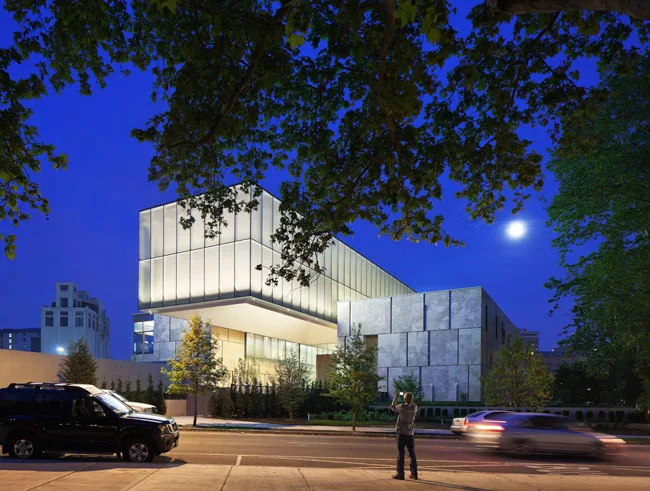
At the west end of the Barnes, the light canopy cantilevers over a terrace. A limestone rainscreen is attached to the steel-framed gallery building (at right) and a poured concrete pavilion wing (at l
At the west end of the Barnes, the light canopy cantilevers over a terrace. A limestone rainscreen is attached to the steel-framed gallery building (at right) and a poured concrete pavilion wing (at left).
Photo © Michael Moran
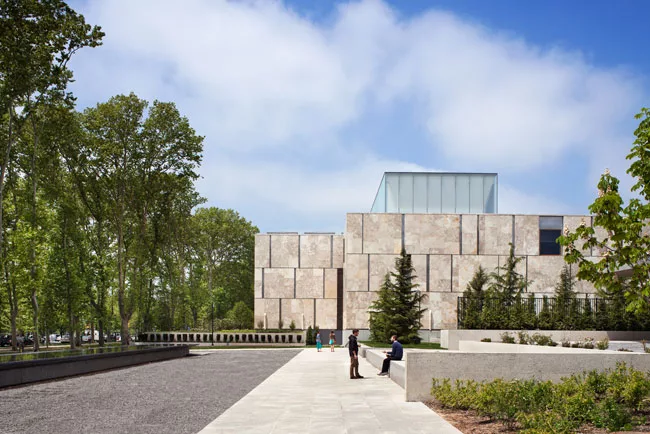
At the southeast end, OLIN's landscaping eases the transition from the Parkway to the main entrance in the back.
Photo © Michael Moran
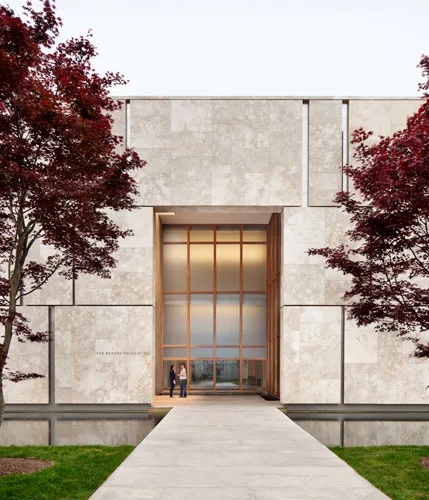
This entrance, on the north facade, leads into the L-shaped Pavilion wing that holds temporary exhibition rooms and ancillary spaces. (Green roofs and photovoltaic panels should help qualify the build
This entrance, on the north facade, leads into the L-shaped Pavilion wing that holds temporary exhibition rooms and ancillary spaces. (Green roofs and photovoltaic panels should help qualify the building for a LEED Platinum rating.)
Photo © Michael Moran
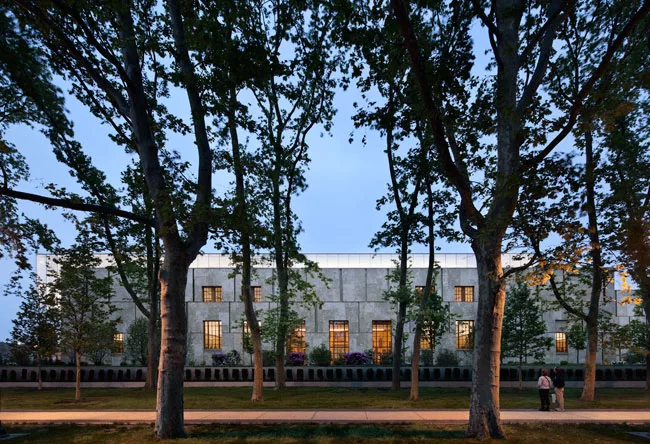
Along the Benjamin Franklin Parkway, the Barnes museum presents an unassuming air, with crisp, elegant stone detailing recalling the Modernist work of Philadelphia architect Louis Kahn. Contained with
Along the Benjamin Franklin Parkway, the Barnes museum presents an unassuming air, with crisp, elegant stone detailing recalling the Modernist work of Philadelphia architect Louis Kahn. Contained within it are the galleries re-created from the museum in Merion.
Photo © Michael Moran
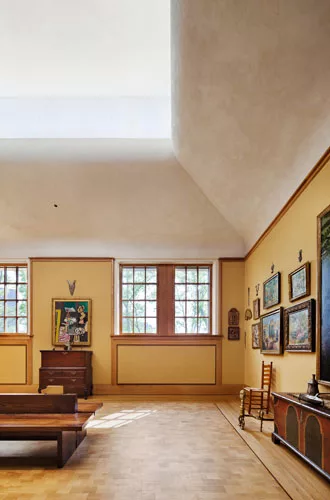
On the second floor, the architects have given gallery ceilings a very different treatment with cyma curve plaster moldings and clerestories of acid-etched glass.
Photo © Michael Moran
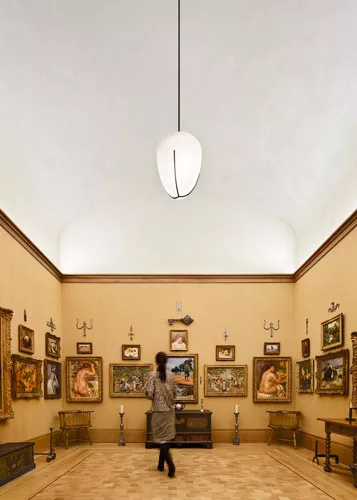
The shaped ceilings in ancillary first floor galleries echo the barrel vaults of the galleries in Merion.
Photo © Michael Moran
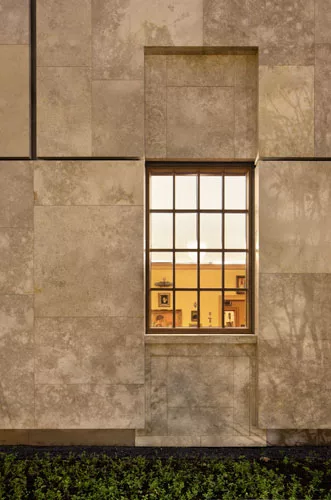
Seen from the Parkway facade, the rooms are framed within the wood-mullioned windows set in Negev limestone.
Photo © Michael Moran
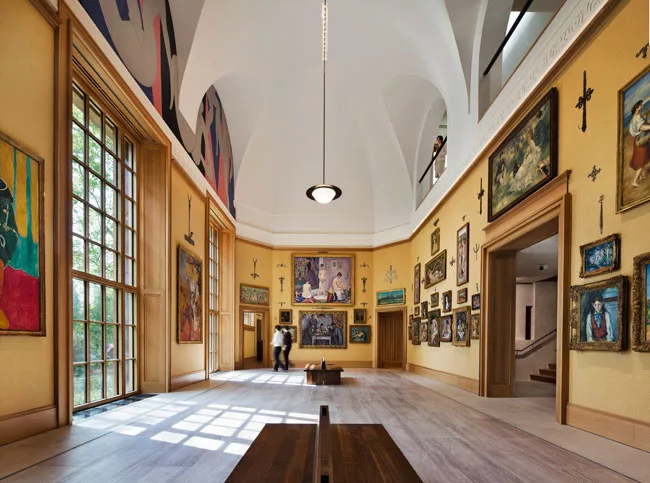
On the first floor of the wing containing the Barnes collection, the main hall's coves feature Henri Matisse's 'The Dance' murals. Williams and Tsien kept the proportions, scale, and placement of the
On the first floor of the wing containing the Barnes collection, the main hall's coves feature Henri Matisse's 'The Dance' murals. Williams and Tsien kept the proportions, scale, and placement of the installation intact, redesigning the cornices and moldings, lighting, and window coverings. The floor is Tennessee marble. This main gallery is oriented to the Parkway; visitors can view the murals from the balcony.
Photo © Michael Moran
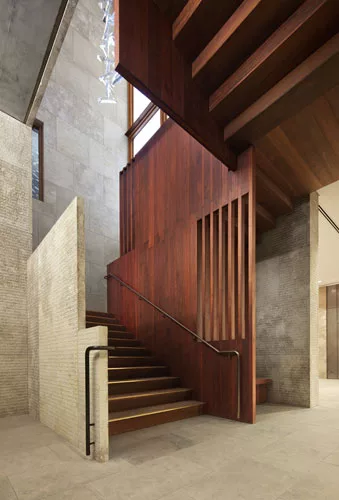
In the Pavilion wing, an ip' stair framed by walnut and chiseled-limestone walls connects the lower level to the lobby.
Photo © Michael Moran
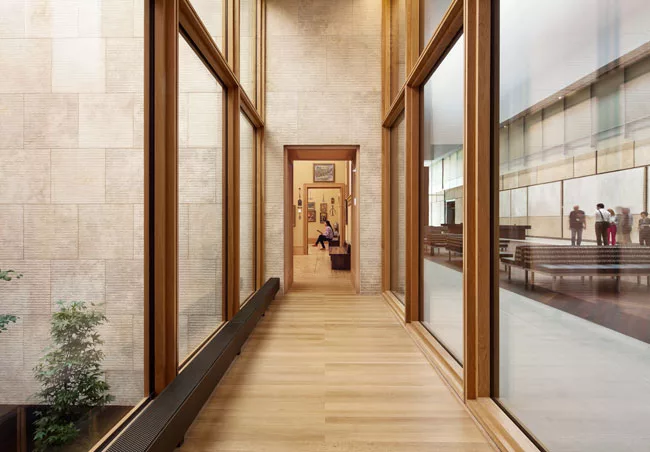
The Gallery wing is entered from the Light Court. A small enclosed garden (at left in photo) divides the block of re-created Barnes galleries.
Photo © Michael Moran
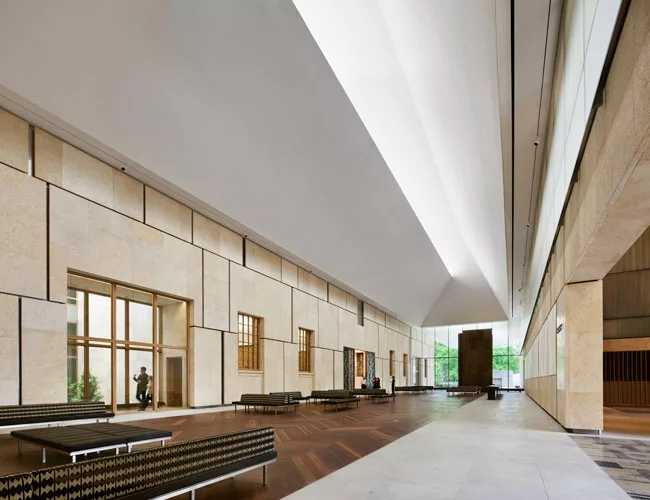
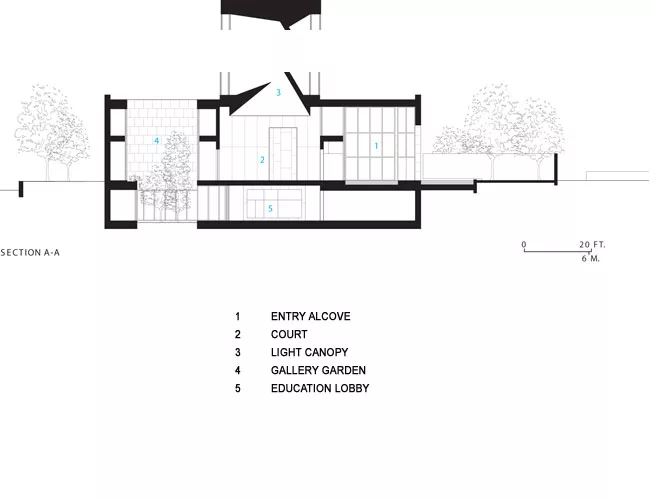
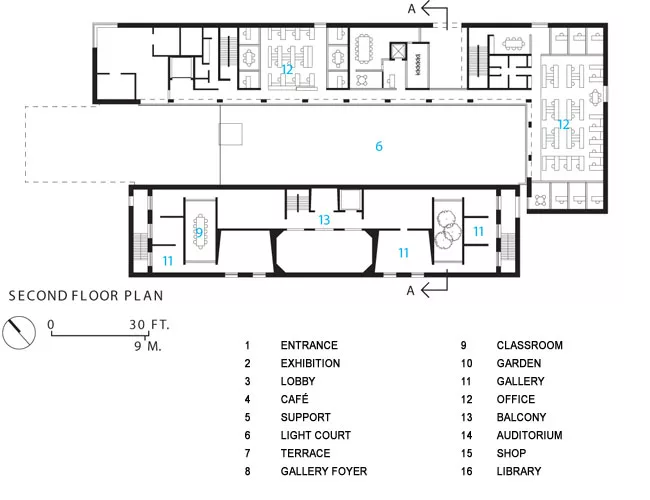
The Light Court separates the Gallery wing for the collection from the L-shaped Pavilion wing for temporary exhibitions and ancillary spaces. The angled light canopy is sheathed in seamless acoustic p
The Light Court separates the Gallery wing for the collection from the L-shaped Pavilion wing for temporary exhibitions and ancillary spaces. The angled light canopy is sheathed in seamless acoustic plaster; the floor is recycled ipé.
Photo © Michael Moran
The Barnes Foundation
Image courtesy Tod Williams Billie Tsien Architects
The Barnes Foundation
Image courtesy Tod Williams Billie Tsien Architects
The Barnes Foundation
Image courtesy Tod Williams Billie Tsien Architects
The Barnes Foundation
Image courtesy Tod Williams Billie Tsien Architects
At the west end of the Barnes, the light canopy cantilevers over a terrace. A limestone rainscreen is attached to the steel-framed gallery building (at right) and a poured concrete pavilion wing (at l
At the southeast end, OLIN's landscaping eases the transition from the Parkway to the main entrance in the back.
This entrance, on the north facade, leads into the L-shaped Pavilion wing that holds temporary exhibition rooms and ancillary spaces. (Green roofs and photovoltaic panels should help qualify the build
Along the Benjamin Franklin Parkway, the Barnes museum presents an unassuming air, with crisp, elegant stone detailing recalling the Modernist work of Philadelphia architect Louis Kahn. Contained with
On the second floor, the architects have given gallery ceilings a very different treatment with cyma curve plaster moldings and clerestories of acid-etched glass.
The shaped ceilings in ancillary first floor galleries echo the barrel vaults of the galleries in Merion.
Seen from the Parkway facade, the rooms are framed within the wood-mullioned windows set in Negev limestone.
On the first floor of the wing containing the Barnes collection, the main hall's coves feature Henri Matisse's 'The Dance' murals. Williams and Tsien kept the proportions, scale, and placement of the
In the Pavilion wing, an ip' stair framed by walnut and chiseled-limestone walls connects the lower level to the lobby.
The Gallery wing is entered from the Light Court. A small enclosed garden (at left in photo) divides the block of re-created Barnes galleries.
The Light Court separates the Gallery wing for the collection from the L-shaped Pavilion wing for temporary exhibitions and ancillary spaces. The angled light canopy is sheathed in seamless acoustic p
The Barnes Foundation
June 16, 2012

Architects & Firms

Tod Williams Billie Tsien Architects

Philadelphia

There is a good deal to admire about the architecture of the new Barnes Foundation, which opened May 19 on Philadelphia’s Benjamin Franklin Parkway, just down the road from the Philadelphia Museum of Art. The sober, handsome, and exquisitely detailed museum, designed by the increasingly busy New York City architects Tod Williams and Billie Tsien, offers a rare combination of material richness and spatial ingenuity.

Taking cues from the designs of Louis Kahn, Carlo Scarpa, and Edward Larrabee Barnes—masters of the late-Modern museum—the new Barnes shows its architects (who are best known for their modestly sized, now closed American Folk Art Museum in New York City) working at a high level. Most impressive of all is the thoughtful sense of procession that carries visitors through the $150 million complex, first from the outside in and then from the museum’s airy common spaces almost inexorably toward the smaller-scaled galleries.

At the same time, thanks to the peculiar restrictions that have governed the design of those galleries, it would hardly be an exaggeration to say that compared with the original Barnes, in the leafy Philadelphia suburb of Merion, Pennsylvania, the new building suffers from a distinct lack of soul.

The contradiction can be traced back to a single source: Montgomery County Judge Stanley Ott. At the end of 2004, Ott took an idea put forth by the trustees of the Barnes and gave it the force of law: In exchange for permission to move the superb collection of the late Dr. Albert C. Barnes from Merion to the Parkway, the Barnes would pledge to “replicate” the galleries in the original building, a fine Italianate design from 1925 by the architect Paul Cret. Ott’s broader decision approving the move, which flew in the face of Dr. Barnes’s own stated desire to keep the paintings in Merion in perpetuity, generated years of controversy.

There are reasonable arguments on both sides of this debate. The old Barnes offered one of the most satisfying combinations of architecture, art, and landscape I’ve ever experienced; anyone who appreciates seeing great paintings in an intimate setting will mourn its loss. At the same time, growing crowds were beginning to overwhelm its suburban site. Given the remarkable quality of the collection—which is staggeringly strong in post-Impressionist and early Modern art but also includes American furniture and African art—keeping the Barnes where it was would likely have guaranteed never-ending battles about visiting hours and public access.

Lost in the hubbub, however, was any real analysis of what the notion of “replication” would ultimately mean for the architects who took on the complex job of producing a new home for the Barnes. That becomes clear as soon as you walk through the building, which sits on a long, narrow 4.5-acre site next to the 1929 Rodin Museum, another Cret design.

Wherever Dr. Barnes’s collection is not on view, Williams and Tsien have been free to create a wholly new piece of architecture, one wrapped in large panels of Israeli limestone and topped by a cantilevered light box. Wherever those artworks are on display, the architects have essentially been obliged to practice an odd and unpersuasive kind of impersonation.

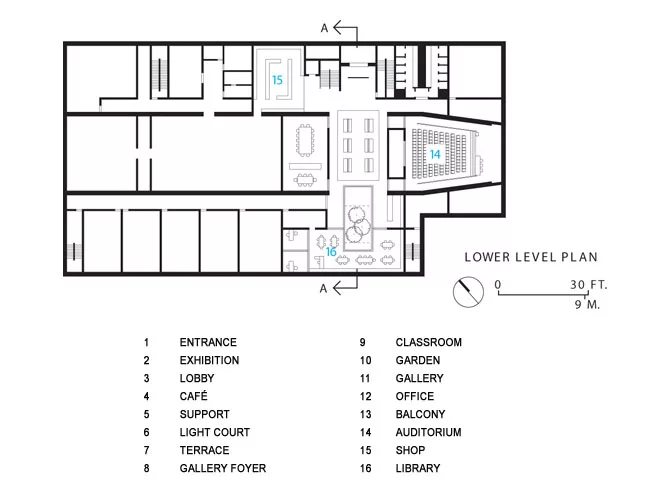
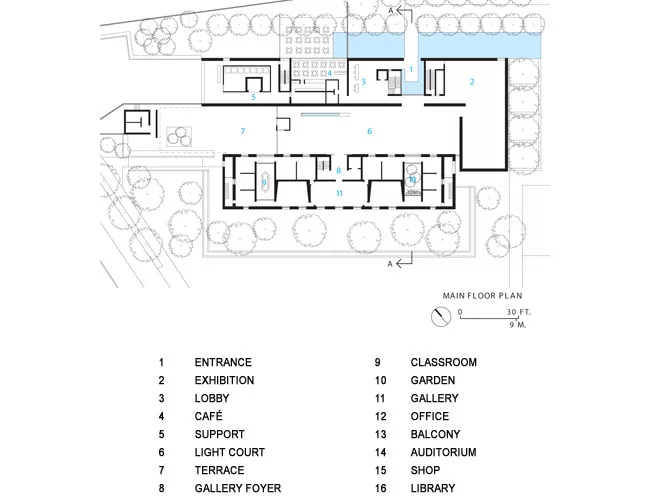
At 93,000 square feet, the relocated Barnes is nearly ten times the size of the old one, the latest example of a creeping gigantism in contemporary museum architecture. After making their way through an elegant, rather formal landscape by Philadelphia’s Laurie Olin, visitors enter the building through an oversize oak entry, facing to the north, away from the Parkway. What’s most impressive in the design of the L-shaped Pavilion wing’s common areas is the combination of tactile richness of materials—such as limestone, bronze, and concrete—and surprising shifts in scale of the various spaces.

A vast central atrium, known as the Light Court, is the one place where Williams and Tsien have really been able to let loose. It is topped by a soaring ceiling made of the same folded planes as the facade of the Folk Art Museum, albeit in white acoustic plaster instead of cast bronze. The hall will certainly be the social heart of the new Barnes. It is also meant to neatly cleave the new from the old, separating the bar-shaped Galleries building, containing the collection from the Pavilion wing and its special exhibitions rooms, café, and auditorium.

Entering the bar building, visitors will find the re-created galleries. In a couple of places, Williams and Tsien have been able to tweak the details of the original design. They’ve simplified the moldings and doorframes, stripping them of some decorative detail. The lighting in the galleries is brighter and clearer than it was in Merion. The architects have added interstitial rooms, including a glass-enclosed interior garden, to give visitors a breather from this incredibly dense arrangement of paintings.

But in nearly every other way, the galleries suggest a high-culture, painstaking version of Disneyfication. The dimensions of the new rooms are exactly the same as the old ones, and the paintings hang in the same precise spots. The wall-covering in both locations is burlap. The orientation of the gallery wing is even the same as it was: If a window faced south in Merion, it faces south in Philadelphia.

The result is a suite of rooms that feel hollow and insubstantial, in great contrast to the rest of this serious, substantial, and occasionally rough-hewn building. Hanging in rooms where the subtly symbiotic relationship between art and architecture has been thrown out of whack—has in fact been rigged—the van Goghs, Klees, and Modiglianis are themselves appreciably diminished. In keeping such close company with fake architecture, they seem in their own right somehow less real. This, of course, raises the question: How much of the blame for the shortcomings of the new Barnes can reasonably be laid at the feet of the architects? Weren’t their hands tied?

Certainly the Barnes Foundation, in stubbornly seeking to create simulacra of the old galleries, gave the architects a singularly difficult brief. Ironically, the subtlety by which Williams and Tsien have managed to update the design of those galleries makes clear how impressive the rooms might have been had the architects truly had the chance to start from scratch. The high quality of the rest of the building makes the same argument in a different way.

But it’s also worth pointing out that the architects knew precisely what they were signing up for. The Request for Qualifications that the Barnes sent out indicated that the galleries would have to be replicated. The design by Williams and Tsien flows directly from their willingness to go along with that misguided strategy—and even from the belief that they might manage, in the end, to redeem it.

Christopher Hawthorne is the architecture critic for the Los Angeles Times.

Completion Date: May 2012

Gross square footage: 93,000 GSF

Total Project cost: $150M

Architect:
Tod Williams Billie Tsien Architects
222 Central Park South
New York, NY 10019

People

Architect:
Tod Williams Billie Tsien Architects
222 Central Park South
New York, NY 10019

Personnel in architect's firm who should receive special credit:
Tod Williams, Partner
Billie Tsien, Partner
Philip Ryan, Project Manager
David Later, Project Architect
Robin Blodgett, Assistant Project Architect

Stephen Freret, Project Architect, Ballinger
Eva Lew, Project Manager, Ballinger
Simon Tickell, Senior Associate, Ballinger

Project Team:
Jenée Anzelone
Miriam Peterson
Whang Suh
Aaron Korntreger
Carlyle Fraser
Adam Hayes
Peter Dustin
Ed Strockbine
Maryellen Wickoff
Helen Joo
Soo Choi

Architect of record:
Tod Williams Billie Tsien Architects

Associate architect(s): 
Ballinger Architects and Engineers

Engineer(s):
Structural: Severud Associates

Civil: Hunt Engineering

MEP: Altieri Sebor and Wieber LLC Consulting Engineers

Consultant(s):
Landscape: Laurie Olin, The OLIN Studio

Lighting: Fisher Marantz Stone Partners

Acoustical and Audio Visual: Acoustic Dimensions

Code: Hughes Associates

Elevator: Van Dusen Associates

Exterior Wall: Axis Group Limited

Conservation Consultant Architect: Samuel Anderson Architects

Retail Designer: Charles Sparks and Company

Fountain Consultant: Dan Euser Waterarchitecture Inc.

Concrete Consultant: Reginald Hough, FAIA

Irrigation Consultant: Irrigation Consulting Inc.

Security Consultant: Ducibella Venter & Santore

Food Service: Post & Grossbard

Graphics and Wayfinding: Pentagram

Geotechinical: Earth Engineering Inc.

Project Management:  Aegis Property Group

Construction Manager: L.F. Driscoll

Photographer(s):
Michael Moran
C: 917-721-3016
E: michael@moranstudio.com
Studio Manager: Jessika Creedon
T: 718-237-8830
E: jessika@moranstudio.com

Renderer(s):
Brooklyn Digital Foundry

CAD system, project management, or other software used: Autocad 2011/14, Prolog, Google Sketchup, Adobe Creative Suite


Products

Structural system:
Cast-in-place concrete frame and structural steel frame

Exterior cladding
Masonry:
Ramon Gray and Gold Limestone provided by ABC Stone and installed by D.M. Sabia & Co. 

Metal Panels:
1/8” custom fabricated Non-Directional Stainless Steel paneling

Metal/glass curtain wall: 
Light box: Custom extruded aluminum curtain wall with monolithic 5/8” low iron, acid etched glass installation and engineering by National Glass & Metal

Light Court: Insulated structurally glazed insulated glass window wall. Glass by JE Berkowitz, installation and engineering by National Glass & Metal.

Wood Windows: Custom white oak wood windows by Duratherm Windows. Glass by JE Berkowitz.

Rainscreen:
See masonry and stainless steel above.

EIFS, ACM, or other:
Dryvit, installation by Hagen Construction

Moisture barrier:   
Perm-a-barrier by W.R. Grace

Curtain wall: 
See above.

Roofing
Elastomeric: 
PVC Roofing by Sika Sarnafil

Metal: 
Zinc coated copper by Revere. Installation by EDA.

Other:
Green Roof utilizing 3” sedum

Photovoltaic panels:
Sharp 235W NU-235F3 photovoltaic panels installed by Ray Angelini, Inc.

Shade louvers:
Construction Specialties, Inc.

Exterior shades:
Resstende “Guided System” Solar veil (Exterior façade) and Mechoshade Exterior black out (Clerestory)

Windows
Wood frame:
Duratherm Windows, installed by Colory Metal, Inc.

Metal frame: 
Custom Aluminum extruded windows by National Glass & Metal

Glazing
Glass: 
J.E. Berkowitz

Doors
Entrances: 
Duratherm, Trade Images

Metal doors:  
Curries/Assay Abloy, Total Door, installed by Tru-Fit.

Wood doors: 
Harring Doors

Sliding doors: 
Stainless Doors, Inc. , installed by Tru-Fit.

Hardware
Locksets:
Accurate Lock, Sargent

Closers: 
Rixson, LCN

Exit devices:  
Von Duprin, Sargent

Pulls: 
Rajack

Security devices:
Various, work installed by The Protection Bureau Inc.

Other special hardware:  
Custom bronze pulls by Krando Metal Products

Interior finishes
Acoustical ceilings: 
Tectum (back of house spaces) and Baswaphon Acoustic Plaster (Light Court and Auditorium)

Suspension grid: 
Armstrong

Cabinetwork and custom woodwork: 
White oak, corian, and walnut custom millwork by Trade Images

Paints and stains:  
Finishing of Ipe reclaimed floor in light court: Ipe Oil. Finishing of White oak strip and edge grain block floors: Bona Seal.

Wall coverings: 
Belgian linen wall coverings and acoustic panels by Libeco-Lagae and installed by Trade images. Jute (or burlap) wall covering by Melfabco, installed by Shafer DeSoussa Brown.

Paneling:
All custom corian and white oak veneer paneling by Trade Images.

Plastic laminate:
All plastic laminate by Trade Images.

Solid surfacing:  
LG Hi-Macs

Floor and wall tile:
The Court Flooring - The “herring bone” patterned wood floor in the Court is made from a Brazilian hardwood called Ipe. These boards had a former life as the support beams for Coney Island boardwalks in New York City. The wood was sourced by a local Philadelphia firm called Provenance Old Soul Architectural Salvage. www.phillyprovenance.com. The floor is finished with Ipe Oil.

Carpet:
Entry Lobby: Custom Printed Entry Rug and Library Rug by Miliken Carpet
Offices and back-of house spaces: Bloomsburg Carpet/TUVA Looms

Special interior finishes unique to this project:
Stone Mosaic Entry Floor by Artsaics, Long Island, NY, stone mosaic provided by ABC Stone
Wool and silk Tapestries in light court and cafe by Claudy Jongstra

Furnishings
Office furniture:
Workstations are Knoll Auto Strada and Dividends

Reception furniture:
Custom Couches by Knoll and Wieland Design with Senegalese hand woven fabric by Aissa Dionne

Fixed seating:
 Poltrona Frau Pitagora auditorium seating with “Cognac” leather

Chairs:
Custom Walnut seating by Nakashima
Custom walnut benches, tables by Stephen Iino, New Jersey
Custom oak and teak café tables by Dan McClellan Craftsman, Inc.
Loose furniture by Herman Miller, Arper, Knoll, The Source

Upholstery:
African Fabric for Knoll couches by Aissa Dionne

Other furniture:
Walnut Gallery Benches and tables by Stephen Iino

Lighting
Interior ambient lighting:

Downlights: 
Edison Price, Zumtobel, Lightolier, Birchwood Lighting

Task lighting:
Artemide

Exterior:
Bega, Cooper Lighting

Dimming System or other lighting controls:
Electronic Theater Controls Inc.

Other:
Custom Designed Chandeliers by Aurora Lampworks
Non-electrified prismatic Chandelier by Kbonk / Axis Sourcing
Custom Exterior Lantern by Elena Colomba

Conveyance
Elevators/Escalators:
Kone / Quality Elevator (Pennsauken, NJ)

Plumbing
Kohler, Caroma, Elkay, Hansgrohe, Filtrine

Energy
Energy management or building automation system:
Siemens Building Automation System

Photovoltaic system:  
Sharp, Shoals Technologies Group

Other unique products that contribute to sustainability:

  1. Water from the green roof and foundation drain pumps supply water to a 40,000 gallon, buried, fiberglass cistern that is used to irrigate all of the landscape.
  2. Baswaphon wool fiber acoustic ceiling panel
  3. Advanced lighting control system to maximize daylighting usage in galleries
  4. Waterless urinals
  5. Energy efficient, electric vehicle/hybrid parking spaces (with charging station)
Site stone from Quebec Canada (San Sebastian Granite provided by Polycor and installed by LePore and Sons.
 
KEYWORDS: Philadelphia

Share This Story

Looking for a reprint of this article?
From high-res PDFs to custom plaques, order your copy today!

Christopher Hawthorne was the architecture critic of the Los Angeles Times from 2004 to 2018 and served as Los Angeles's first Chief Design Officer.

Post a comment to this article

Report Abusive Comment

Subscription Center
  • Create an Account
  • Start a Subscription
  • Manage My Account
  • Sign Up for Newsletters
  • Visit Customer Service
  • Update Preferences

More Videos

Sponsored Content

Sponsored Content is a special paid section where industry companies provide high quality, objective, non-commercial content around topics of interest to the Architectural Record audience. All Sponsored Content is supplied by the advertising company and any opinions expressed in this article are those of the author and not necessarily reflect the views of Architectural Record or its parent company, BNP Media. Interested in participating in our Sponsored Content section? Contact your local rep!

close
  • TAMLYN XtremeTrim Exterior Trim
    Sponsored byTamlyn

    Designing Cleaner Panel Facades: Why Exterior Trim Details Matter

  • Building with Vapor Barriers
    Sponsored byReef Industries, Inc.

    Vapor Barriers Help Control Moisture in Tighter Building Designs

  • Duct Interior with Prodeq System
    Sponsored byHenry, a Carlisle Company

    Designing Resilient Water Containment Systems

DESIGN:ED Podcast
Listen to Architectural Record’s DESIGN:ED Podcast

Events

June 10, 2026

Rethinking Stormwater – The Power of Porous Paving

Credits: 1 AIA LU/HSW; 1 AIBD P-CE; 0.1 ICC CEU

Learn how porous paving systems support stormwater management, reduce heat island effects, and enhance sustainable site design performance.

June 11, 2026

Very Early Warning Fire Detection for Mission-Critical Facilities

Credits: 1 AIA LU/HSW; 1 AIBD P-CE; 0.1 ICC CEU

Examine advanced fire detection strategies that support uptime and enhance safety in data centers and other mission-critical facilities.

View All Submit An Event

Products

2026 Architect's Square Foot Costbook

2026 Architect's Square Foot Costbook

See More Products

Popular Stories

Practice Matters illustration

What’s in a (Firm’s) Name? Thinking About Succession and Legacy

Coronado Bridge

The Architect’s Guide to San Diego

Practice Matters illustration

By the Numbers: Counting America's Architects

Riverdale House by Studio Lau

Riverdale House by Studio Lau

KRESA by DLR

In Kalamazoo, DLR Group Completes a Mass-Timber Hub for Career and Technical Education Programs

Broader Sustainability of CMU - Free Webinar - May 21, 2026

Related Articles

  • Barnes Collection Readies for Move to New Home by Williams/Tsien

    See More
  • Barnes Collection Readies for Move to New Home by Williams/Tsien

    See More
  • Williams Tsien to Design Barnes' New Space

    See More
×

The latest news and information

#1 Source for Architectural Design, News and Products

SUBSCRIBE
  • RESOURCES
    • Advertise
    • Contact Us
    • Submit
    • Store
  • ACCOUNT CENTER
    • Create an Account
    • Start a Subscription
    • Manage My Account
    • Sign Up for Newsletters
    • Visit Customer Service
    • Update Preferences
  • PRIVACY
    • PRIVACY POLICY
    • TERMS & CONDITIONS
    • DO NOT SELL MY PERSONAL INFORMATION
    • PRIVACY REQUEST
    • ACCESSIBILITY
  • SERVICES
    • Marketing Services
    • Reprints
    • Market Research
    • List Rental
    • Survey/Respondent Access
  • STAY CONNECTED
    • Linkedin
    • Facebook
    • Instagram
    • YouTube
    • X (Twitter)

Copyright ©2026. All Rights Reserved BNP Media, Inc. and BNP Media II, LLC.

Design, CMS, Hosting & Web Development :: ePublishing