Architectural Record
search
cart
facebook twitter linkedin youtube
  • Sign In
  • Subscribe
  • Sign Out
  • My Account
Architectural Record
  • NEWS
    • Latest News
    • Awards
    • Interviews
    • Obituaries
    • Podcasts
      • Design:Ed Podcast
      • Sponsored Podcasts
  • OPINION
    • Book Reviews / Excerpts
    • Exhibition Reviews
    • Forum
  • EXCLUSIVES
    • Videos
    • Design Vanguard
    • Top 300 Firms
    • Sponsored Content
    • Sponsored eBooks
    • From the Archives
  • CONTINUING ED
    • Editorial Continuing Ed
    • CE Center
    • CE Academies
  • PROJECTS
    • Buildings By Type
    • Reuse & Renovation
    • Museums & Arts Centers
    • Colleges & Universities
    • Multifamily Housing
    • Interiors
    • Lighting
    • Kitchen & Bath
  • HOUSES
    • Record Houses
    • House of the Month
    • Featured Houses
  • PRODUCTS
    • Products by Category
    • Record Products of the Year
    • Latest Products
  • EVENTS
    • Dates & Events
    • Record on the Road
    • Innovation Conference
    • Sustainability in Practice
    • Women In Architecture
    • Webinars
    • Ad Excellence Awards
    • Submit an Event
  • CONNECT
    • Ask RECORD AI
    • Newsletters
    • Contact
    • Advertise
    • Editorial Calendar
    • Store
    • Customer Service
  • SUBMIT
    • Submission Guidelines
    • RECORD Competitions
  • MAGAZINE
    • Subscribe
    • My Account
    • Digital Edition
    • Current Issue
    • Firm Pass
    • Historic Archive
Projects

Owe'neh Bupingeh Preservation Project

Native American Homecoming.
By Joann Gonchar, FAIA
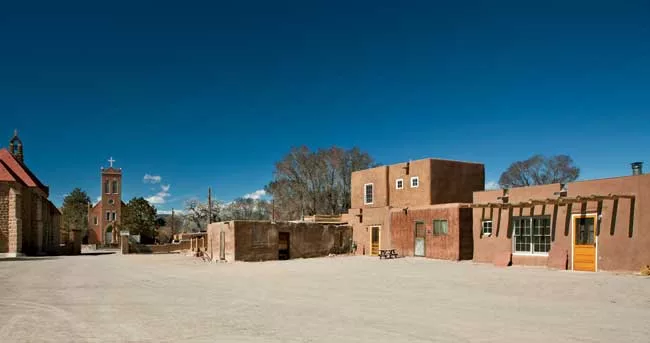
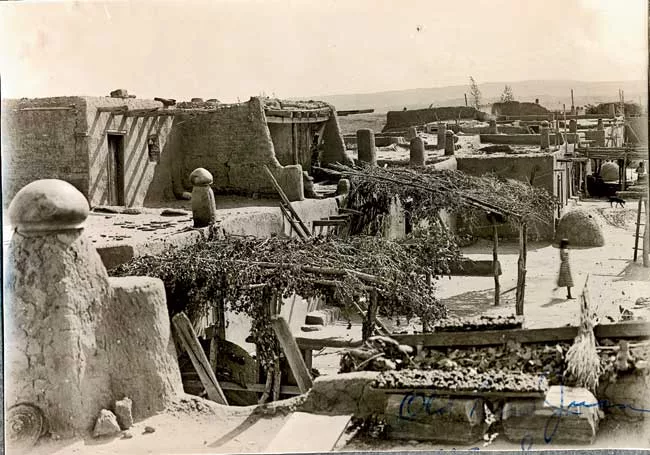
Two-story houses were common in Owe'neh Bupingeh through at least the early 20th century.
Owe'neh Bupingeh Preservation Project
Atkin Olshin Schade Architects
Ohkay Owingeh, NM
Two-story houses were common in Owe'neh Bupingeh through at least the early 20th century.
Photo ©Kate Russell
By the 1970s all of the dwellings in the historic center were one story. As part of the preservation project, the contractor is building upper stories, but not necessarily in locations where they exis
Owe'neh Bupingeh Preservation Project
Atkin Olshin Schade Architects
Ohkay Owingeh, NM
By the 1970s all of the dwellings in the historic center were one story. As part of the preservation project, the contractor is building upper stories, but not necessarily in locations where they existed previously. Instead, the upward extensions are being added to meet the space needs of families without encroaching on the public plazas. The new upper stories also enable the project to comply with HUD bedroom requirements and size standards.
Photo ©Kate Russell
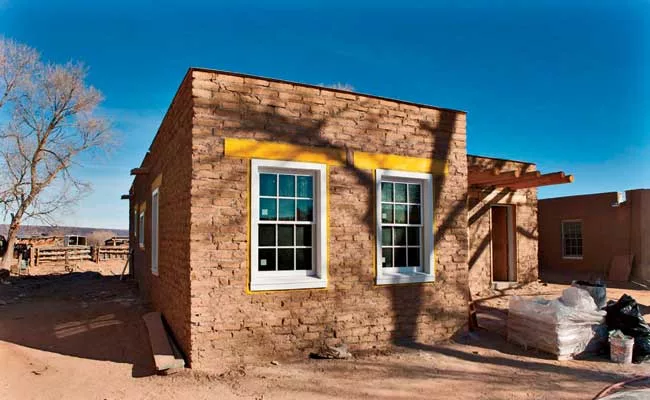
The restored and rebuilt walls are made of traditional adobe: sun-dried brick-and-mud mortar that is then covered with mud plaster.
Owe'neh Bupingeh Preservation Project
Atkin Olshin Schade Architects
Ohkay Owingeh, NM
The restored and rebuilt walls are made of traditional adobe: sun-dried brick-and-mud mortar that is then covered with mud plaster.
Photo ©Kate Russell
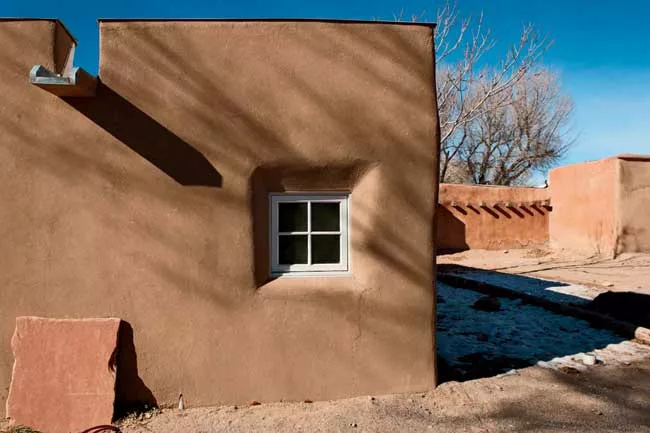
 To improve the walls&#39; durability, the client elected to incorporate elements such as metal caps on the roof parapets and flagstone splash blocks at the base of the walls under the <em>canales</em
Owe'neh Bupingeh Preservation Project
Atkin Olshin Schade Architects
Ohkay Owingeh, NM
To improve the walls' durability, the client elected to incorporate elements such as metal caps on the roof parapets and flagstone splash blocks at the base of the walls under the canales, or roof drainage spouts. With the goal of further enhancing the longevity of the adobe, the client has instituted a series of mud-plaster workshops to train residents to maintain the finish of their homes' walls.
Photo ©Kate Russell
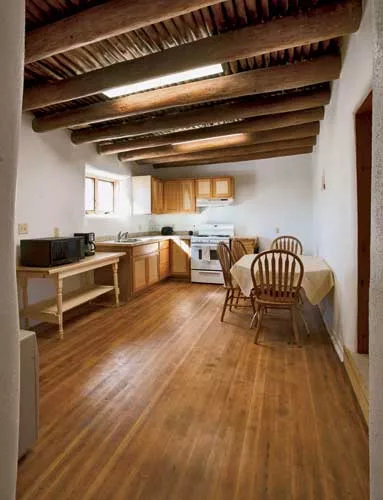
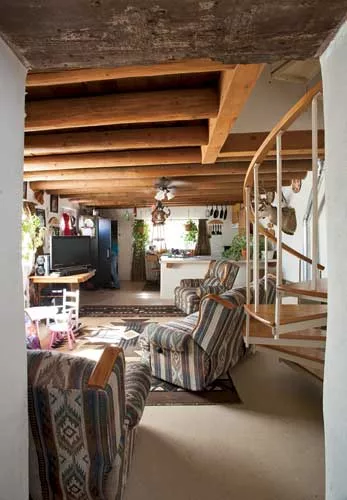
Inside the houses, the project team restored the ceiling <em>vigas</em> (roughly dressed logs) and <em>latias</em> (small-diameter wood poles) wherever it could.
Owe'neh Bupingeh Preservation Project
Atkin Olshin Schade Architects
Ohkay Owingeh, NM
Inside the houses, the project team restored the ceiling vigas (roughly dressed logs) and latias (small-diameter wood poles) wherever it could.
Photo ©Kate Russell
Although the existing floors were sometimes wood, typically they were dirt. In such cases, the client elected for finishes such as carpet or linoleum over plywood and sleepers. Concrete slabs have bee
Owe'neh Bupingeh Preservation Project
Atkin Olshin Schade Architects
Ohkay Owingeh, NM
Although the existing floors were sometimes wood, typically they were dirt. In such cases, the client elected for finishes such as carpet or linoleum over plywood and sleepers. Concrete slabs have been omitted so that future residents can opt to remove the flooring system and restore the direct connection with the earth.
Photo ©Kate Russell
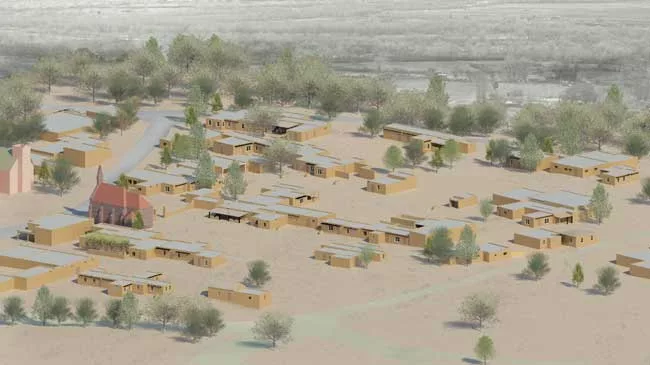
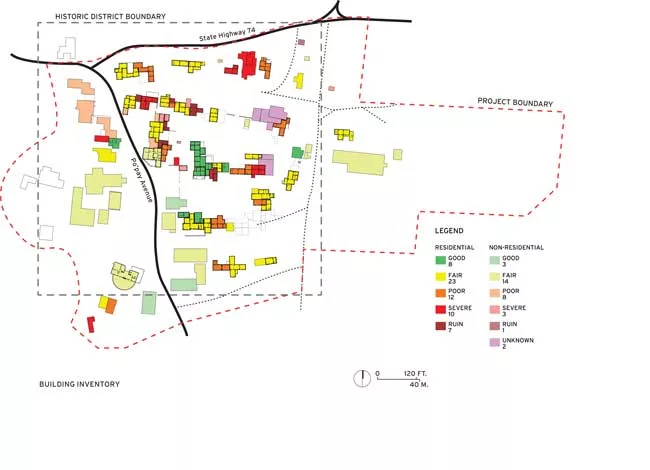
Before the start of the first phases of the preservation project, attached adobe houses loosely delineated a series of plazas.
Owe'neh Bupingeh Preservation Project
Atkin Olshin Schade Architects
Ohkay Owingeh, NM
Before the start of the first phases of the preservation project, attached adobe houses loosely delineated a series of plazas.
Image courtesy Atkin Olshin Schade Architects
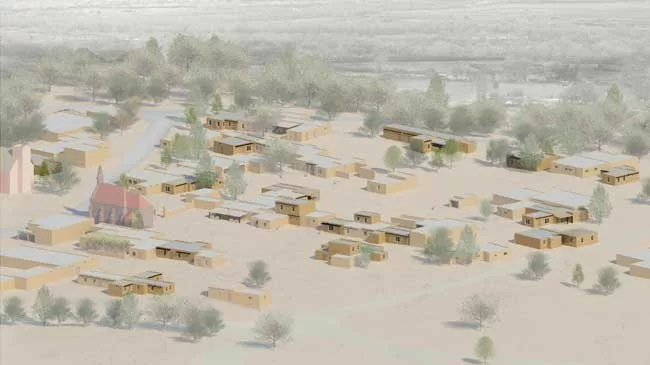
The first two phases of the project encompassed rehabilitation of 20 houses. Two of these houses have new second stories.
Owe'neh Bupingeh Preservation Project
Atkin Olshin Schade Architects
Ohkay Owingeh, NM
The first two phases of the project encompassed rehabilitation of 20 houses. Two of these houses have new second stories.
Image courtesy Atkin Olshin Schade Architects
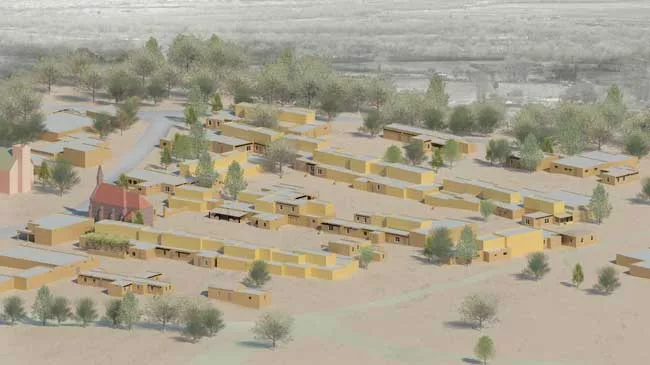
Future phases of the project will continue the rehabilitation and vertical extension of houses. To better define the plazas and provide more housing, the tribe plans to build new infill homes on once
Owe'neh Bupingeh Preservation Project
Atkin Olshin Schade Architects
Ohkay Owingeh, NM
Future phases of the project will continue the rehabilitation and vertical extension of houses. To better define the plazas and provide more housing, the tribe plans to build new infill homes on once occupied, but now vacant, lots.
Image courtesy Atkin Olshin Schade Architects
Owe&#39;neh Bupingeh Preservation Project
Owe'neh Bupingeh Preservation Project
Atkin Olshin Schade Architects
Ohkay Owingeh, NM
Image courtesy Atkin Olshin Schade Architects
Two&#45;story houses were common in Owe&#39;neh Bupingeh through at least the early 20th century.
By the 1970s all of the dwellings in the historic center were one story. As part of the preservation project, the contractor is building upper stories, but not necessarily in locations where they exis
The restored and rebuilt walls are made of traditional adobe: sun-dried brick-and-mud mortar that is then covered with mud plaster.
 To improve the walls&#39; durability, the client elected to incorporate elements such as metal caps on the roof parapets and flagstone splash blocks at the base of the walls under the <em>canales</em
Inside the houses, the project team restored the ceiling <em>vigas</em> (roughly dressed logs) and <em>latias</em> (small-diameter wood poles) wherever it could.
Although the existing floors were sometimes wood, typically they were dirt. In such cases, the client elected for finishes such as carpet or linoleum over plywood and sleepers. Concrete slabs have bee
Before the start of the first phases of the preservation project, attached adobe houses loosely delineated a series of plazas.
The first two phases of the project encompassed rehabilitation of 20 houses. Two of these houses have new second stories.
Future phases of the project will continue the rehabilitation and vertical extension of houses. To better define the plazas and provide more housing, the tribe plans to build new infill homes on once
Owe&#39;neh Bupingeh Preservation Project
March 16, 2013

Architects & Firms

Atkin Olshin Schade Architects

Ohkay Owingeh, New Mexico

Not far from where the Chama River meets the Rio Grande, about 30 miles north of Santa Fe, the Ohkay Owingeh—one of 19 federally recognized Native American Pueblo tribes in New Mexico—live on land they have inhabited for at least 600 years. For almost all of this history, daily life revolved around a series of plazas loosely delineated by attached adobe houses. This village center, known as Owe'neh Bupingeh, also served as the backdrop for the community's feast-day celebrations and ritual dances.

The 2,700-member tribe still considers Owe'neh Bupingeh the spiritual and cultural heart of the pueblo. However, in recent decades it had slowly depopulated and its condition deteriorated, as many residents left their traditional homes in favor of new, but nondescript, manufactured housing subsidized by the Department of Housing and Urban Development (HUD) on subdivision-like lots elsewhere on the 16,000-acre reservation.

Now an unusual project is helping tribal members, who otherwise could not afford it, return to their ancestral homes. It is also allowing Ohkay Owingeh to restore its center, which is listed on the state and national registers of historic places, without creating a museum piece frozen in time. The core is “part of the life of the pueblo, and is in an ongoing state of transformation, as it has been for many centuries,” says Tony Atkin, a principal of Atkin Olshin Schade Architects (AOS), the Santa Fe– and Philadelphia-based firm working on the multiphase rejuvenation.

The project got its start in 2005 with a $7,500 grant from the New Mexico Historic Preservation Division to train six high school students from the tribe in preservation documentation. By then, only about 25 of the historic core's 60 houses were occupied, and about half the structures were in poor condition or worse. Many had missing doors or windows, while others had vegetation growing on their roofs. In some, the character-defining and structurally essential vigas (beams roughly hewn from logs) were rotting, and in a few cases houses had completely collapsed.

Since 2010, general contractor Avanyu has completed the restoration of 20 houses, with the rehabilitation of nine more under way. In order to guide the construction process, AOS created a preservation plan, working closely with the client–the Ohkay Owingeh Housing Authority–as well as a group of tribal elders who served as cultural advisers. The document defines an approach that balances the sometimes conflicting requirements for funding, restoration standards, and the tribe's cultural values. And it provides a strategy for creating cost-effective and comfortable living environments.

The plan helps the project team make myriad decisions, including determining when modern materials and construction methods are appropriate. For example, the restored adobe houses include membrane roofs and metal parapet caps. The coping, painted to match the color of the mud plaster, alters the typically soft profile of adobe against the sky. However, it should greatly improve durability.

The work to date, including five years of planning plus replacement of the 25-acre core's utility infrastructure, has been financed with more than $8 million from foundations, the 2009 federal stimulus, and HUD grants, among others.

Homeowners with income below 50 to 60 percent of the county median qualified for the project's first three phases. Future phases will likely include families with income above this threshold. They will be eligible for low-interest loans to fund the renovations through the housing authority's community-development financial institution, or CDFI.

Ultimately, Ohkay Owingeh hopes to build 20 new homes on now-vacant but previously occupied lots. “The tribal council's vision for Owe'neh Bupingeh,” says Tomasita Duran, the housing authority's executive director, “is 100 percent occupancy.”

Completion Date:
Phase 1/II – May 2012
Phase III - ongoing

Gross square footage:
Phase I/II – 27,202 square feet
Phase III – 10,998 square feet

Total construction cost:
Phase I/II - $3,128,927.12
Phase III - $1,958,600.45 (original contract value)

People

Owner: Various Homeowners
Owner’s Agency:  Ohkay Owingeh Housing Authority

Architect:
Atkin Olshin Schade Architects
1802 Second Street, Suite 34
Santa Fe, NM 87505
505.982.2133 ph
505.992.3454 fx
www.aosarchitects.com

Personnel in architect's firm who should receive special credit:
Tony Atkin, FAIA, Principal-in-Charge (registered architect)
Jamie Blosser, AIA, Housing & Sustainability Project Manager (registered architect)
Shawn Evans, AIA, Preservation Project Manager (registered architect)
Daniel Barboa, Preservation Specialist
Tom Pederson, PhD, GIS Manager

Engineer(s):
ABQ Engineers, Albuquerque, NM
M&E Engineers, Santa Fe, NM
Chavez Grieves Consulting Engineers, Inc., Albuquerque, NM

Consultant(s):
Other:
Development Consultant:  Concept Consulting Group LLC.
Albuquerque, NM

General contractor:
Avanyu General Contracting, Inc.
San Ildefonso Pueblo, NM

Photographer(s):
Kate Russell Photography
505.820.0927

Tania Hammidi
714.928.6930 (pictures of the mud plastering workshop)

CAD system, project management, or other software used:
AutoCAD


Products

Structural system
Load-bearing adobe masonry or conventional wood frame walls
Vigas (stripped round logs used for roof framing) or conventional wood framing

Exterior cladding
Other cladding unique to this project: 

  • new Adobe bricks by “The Adobe Man” Santa Fe, NM
  • earthen plaster made onsite from soil from tribal lands

Roofing
Elastomeric: Mule-Hide TPO

Windows
Wood frame: Semco Windows & Doors

Hardware
Locksets: Schlage

 
KEYWORDS: New Mexico

Share This Story

Looking for a reprint of this article?
From high-res PDFs to custom plaques, order your copy today!

Joann gonchar

Joann Gonchar, FAIA, LEED AP, is deputy editor at Architectural Record. She joined RECORD in 2006, after working for eight years at its sister publication, Engineering News-Record. Before starting her career as a journalist, Joann worked for several architecture firms and spent three years in Kobe, Japan, with the firm Team Zoo, Atelier Iruka. She earned a Master of Architecture degree from the University of Pennsylvania and a Bachelor of Arts from Brown University. She is licensed to practice architecture in New York State.

Post a comment to this article

Report Abusive Comment

Subscription Center
  • Create an Account
  • Start a Subscription
  • Manage My Account
  • Sign Up for Newsletters
  • Visit Customer Service
  • Update Preferences

More Videos

Sponsored Content

Sponsored Content is a special paid section where industry companies provide high quality, objective, non-commercial content around topics of interest to the Architectural Record audience. All Sponsored Content is supplied by the advertising company and any opinions expressed in this article are those of the author and not necessarily reflect the views of Architectural Record or its parent company, BNP Media. Interested in participating in our Sponsored Content section? Contact your local rep!

close
  • TAMLYN XtremeTrim Exterior Trim
    Sponsored byTamlyn

    Designing Cleaner Panel Facades: Why Exterior Trim Details Matter

  • Building with Vapor Barriers
    Sponsored byReef Industries, Inc.

    Vapor Barriers Help Control Moisture in Tighter Building Designs

  • Duct Interior with Prodeq System
    Sponsored byHenry, a Carlisle Company

    Designing Resilient Water Containment Systems

DESIGN:ED Podcast
Listen to Architectural Record’s DESIGN:ED Podcast

Events

June 11, 2026

Very Early Warning Fire Detection for Mission-Critical Facilities

Credits: 1 AIA LU/HSW; 1 AIBD P-CE; 0.1 ICC CEU

Examine advanced fire detection strategies that support uptime and enhance safety in data centers and other mission-critical facilities.

June 16, 2026

Focus on the Façade: Exploring Steel, Timber & Fire-Rated Curtain Walls and Channel Glass Systems

Credits: 1 AIA LU/HSW; 1 AIBD P-CE; 0.1 ICC CEU

Explore modern façade and glazing systems that enhance daylighting, fire safety, and thermal performance while expanding architectural design possibilities.

View All Submit An Event

Products

2026 Architect's Square Foot Costbook

2026 Architect's Square Foot Costbook

See More Products

Popular Stories

Coronado Bridge

The Architect’s Guide to San Diego

Practice Matters illustration

By the Numbers: Counting America's Architects

SanDiegoAirport

Top 300 Architecture Firms of 2026

House on a Hill

Design Vanguard 2026: Forma

Crane Cove, ONO

Design Vanguard 2026 Winners

Broader Sustainability of CMU - Free Webinar - May 21, 2026

Related Articles

  • Tower at PNC Plaza

    See More
  • Continuing Education: Dee and Charles Wyly Theatre

    See More
×

The latest news and information

#1 Source for Architectural Design, News and Products

SUBSCRIBE
  • RESOURCES
    • Advertise
    • Contact Us
    • Submit
    • Store
  • ACCOUNT CENTER
    • Create an Account
    • Start a Subscription
    • Manage My Account
    • Sign Up for Newsletters
    • Visit Customer Service
    • Update Preferences
  • PRIVACY
    • PRIVACY POLICY
    • TERMS & CONDITIONS
    • DO NOT SELL MY PERSONAL INFORMATION
    • PRIVACY REQUEST
    • ACCESSIBILITY
  • SERVICES
    • Marketing Services
    • Reprints
    • Market Research
    • List Rental
    • Survey/Respondent Access
  • STAY CONNECTED
    • Linkedin
    • Facebook
    • Instagram
    • YouTube
    • X (Twitter)

Copyright ©2026. All Rights Reserved BNP Media, Inc. and BNP Media II, LLC.

Design, CMS, Hosting & Web Development :: ePublishing