Architectural Record
search
cart
facebook twitter linkedin youtube
  • Sign In
  • Subscribe
  • Sign Out
  • My Account
Architectural Record
  • NEWS
    • Latest News
    • Awards
    • Interviews
    • Obituaries
    • Podcasts
      • Design:Ed Podcast
      • Sponsored Podcasts
  • OPINION
    • Book Reviews / Excerpts
    • Exhibition Reviews
    • Forum
  • EXCLUSIVES
    • Videos
    • Design Vanguard
    • Top 300 Firms
    • Sponsored Content
    • Sponsored eBooks
    • From the Archives
  • CONTINUING ED
    • Editorial Continuing Ed
    • CE Center
    • CE Academies
  • PROJECTS
    • Buildings By Type
    • Reuse & Renovation
    • Museums & Arts Centers
    • Colleges & Universities
    • Multifamily Housing
    • Interiors
    • Lighting
    • Kitchen & Bath
  • HOUSES
    • Record Houses
    • House of the Month
    • Featured Houses
  • PRODUCTS
    • Products by Category
    • Record Products of the Year
    • Latest Products
  • EVENTS
    • Dates & Events
    • Record on the Road
    • Innovation Conference
    • Sustainability in Practice
    • Women In Architecture
    • Webinars
    • Ad Excellence Awards
    • Submit an Event
  • CONNECT
    • Ask RECORD AI
    • Newsletters
    • Contact
    • Advertise
    • Editorial Calendar
    • Store
    • Customer Service
  • SUBMIT
    • Submission Guidelines
    • RECORD Competitions
  • MAGAZINE
    • Subscribe
    • My Account
    • Digital Edition
    • Current Issue
    • Firm Pass
    • Historic Archive
Projects

Tyrolean Festival Hall

Peak Performance: A concert hall carves its own niche in the Austrian Alps while bowing to the neighboring midcentury playhouse and the breathtaking landscape beyond.
By Tracy Metz
Anchored in a grassy slope, the new building holds an unlikely dialogue with the adjacent Passionsspielhaus, which has hosted Passion plays (acted out by the townspeople) once every six years since th
Tyrolean Festival Hall
Delugan Meissl Associated Architects
Erl, Austria
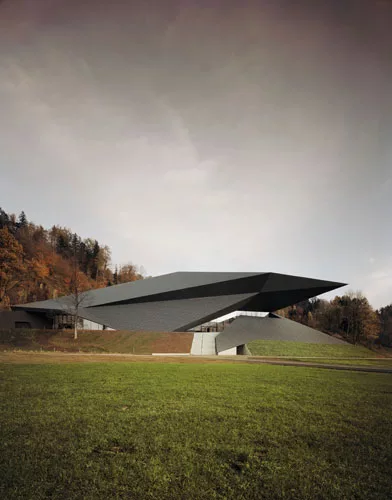
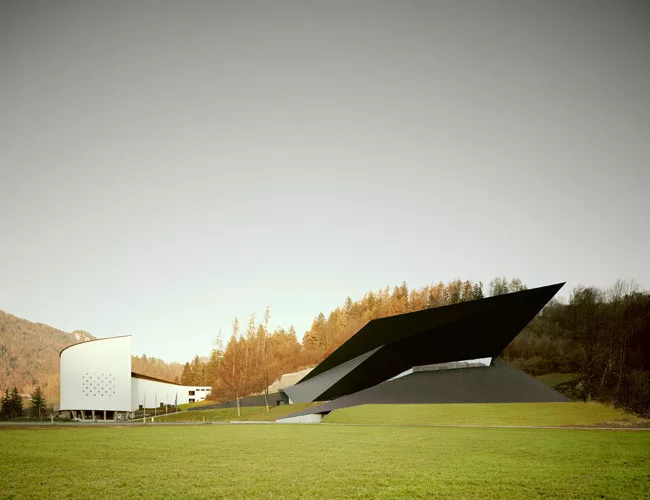
Anchored in a grassy slope, the new building holds an unlikely dialogue with the adjacent Passionsspielhaus, which has hosted Passion plays (acted out by the townspeople) once every six years since the late 1950s.
Photo © Brigida Gonzalez
Charcoal-gray fiber cement panels clad the exterior and create a unique texture for the building’s sleek form.
Tyrolean Festival Hall
Delugan Meissl Associated Architects
Erl, Austria
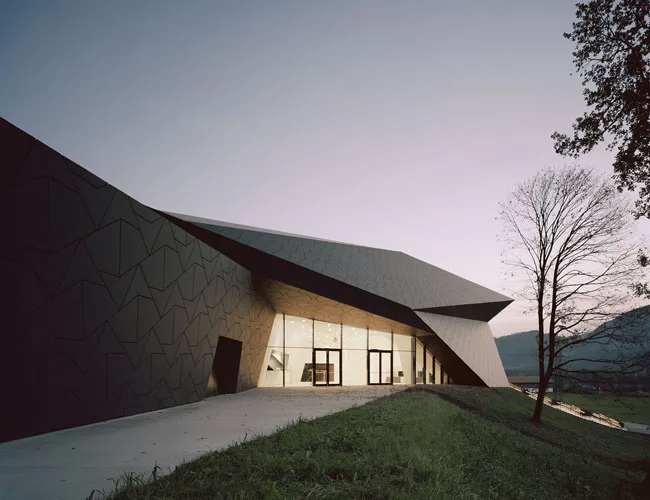
Charcoal-gray fiber cement panels clad the exterior and create a unique texture for the building’s sleek form.
Photo © Brigida Gonzalez
Oiled acacia wood panels lend a visual and acoustic richness to the concert hall. A cavity above the space accommodates lighting technicians as well as serving to draw smoke up and out of the space in
Tyrolean Festival Hall
Delugan Meissl Associated Architects
Erl, Austria
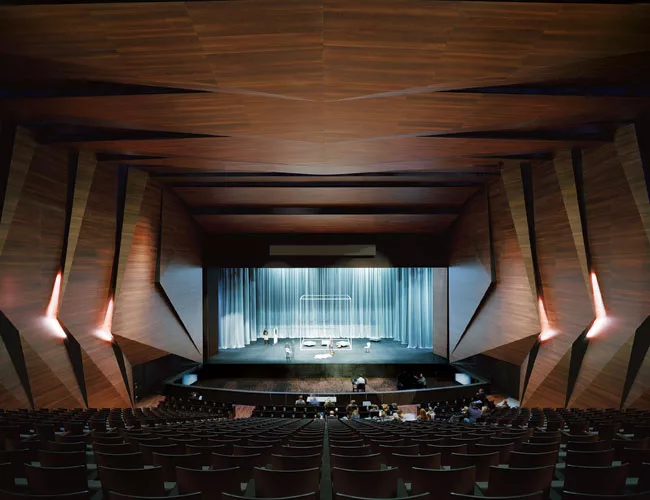
Oiled acacia wood panels lend a visual and acoustic richness to the concert hall. A cavity above the space accommodates lighting technicians as well as serving to draw smoke up and out of the space in the event of a fire.
Photo © Brigida Gonzalez
Oiled acacia wood panels lend a visual and acoustic richness to the concert hall. A cavity above the space accommodates lighting technicians as well as serving to draw smoke up and out of the space in
Tyrolean Festival Hall
Delugan Meissl Associated Architects
Erl, Austria
Oiled acacia wood panels lend a visual and acoustic richness to the concert hall. A cavity above the space accommodates lighting technicians as well as serving to draw smoke up and out of the space in the event of a fire.
Photo © Brigida Gonzalez
While referring to the surrounding mountain landscape as well as the building’s exterior, the foyer also serves as a counterpoint, with its bright white, crisply folded-plane walls and pristine,
Tyrolean Festival Hall
Delugan Meissl Associated Architects
Erl, Austria
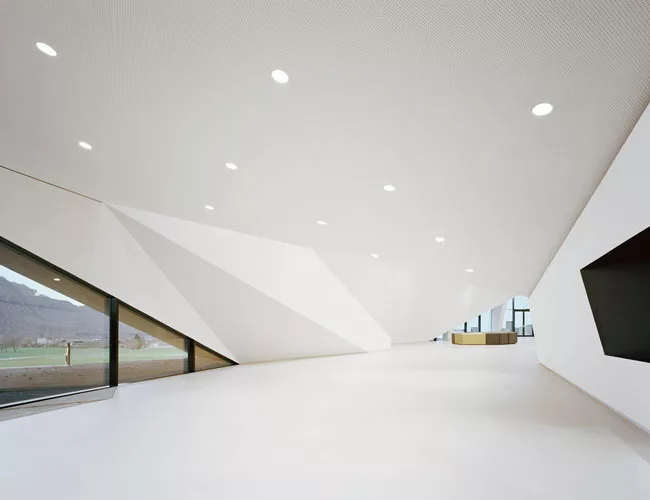
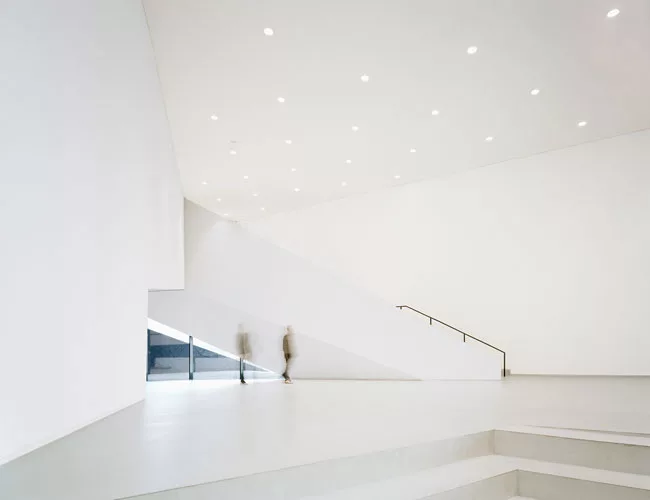
While referring to the surrounding mountain landscape as well as the building’s exterior, the foyer also serves as a counterpoint, with its bright white, crisply folded-plane walls and pristine, poured-concrete floors. The space moves visitors from the wide-open spaces of the valley into the performance hall at the building’s center.
Photo © Brigida Gonzalez
Tyrolean Festival Hall
Delugan Meissl Associated Architects
Erl, Austria
Photo © Brigida Gonzalez
Tyrolean Festival Hall
Delugan Meissl Associated Architects
Erl, Austria
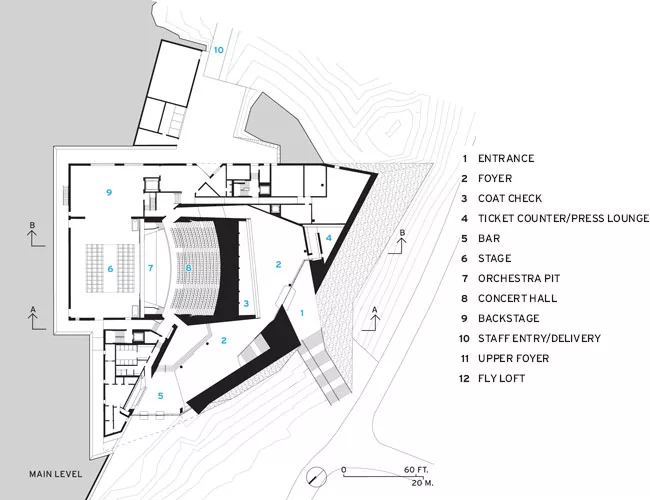
Image courtesy Delugan Meissl Associated Architects
Tyrolean Festival Hall
Delugan Meissl Associated Architects
Erl, Austria
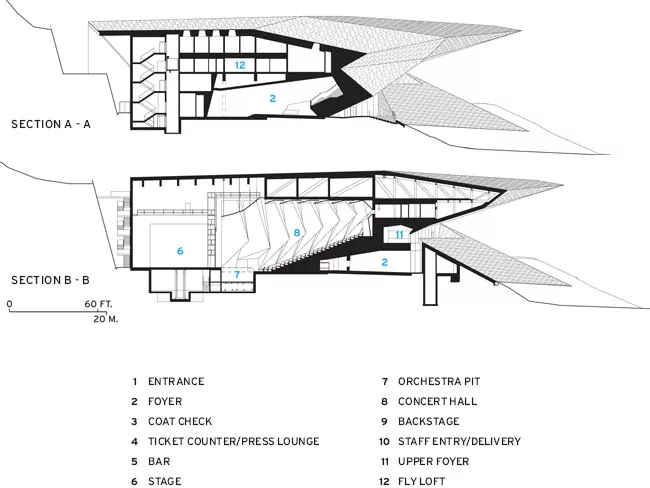
Image courtesy Delugan Meissl Associated Architects
Anchored in a grassy slope, the new building holds an unlikely dialogue with the adjacent Passionsspielhaus, which has hosted Passion plays (acted out by the townspeople) once every six years since th
Charcoal-gray fiber cement panels clad the exterior and create a unique texture for the building’s sleek form.
Oiled acacia wood panels lend a visual and acoustic richness to the concert hall. A cavity above the space accommodates lighting technicians as well as serving to draw smoke up and out of the space in
While referring to the surrounding mountain landscape as well as the building’s exterior, the foyer also serves as a counterpoint, with its bright white, crisply folded-plane walls and pristine,
Tyrolean Festival Hall
October 16, 2013

Architects & Firms

Delugan Meissl Associated Architects

Erl, Austria

People/Products

In the picturesque Austrian village of Erl, just east of the German border, where the rugged Alps seem to descend from the heavens to meet the undulating valley below, a striking, angular structure, the Tyrolean Festspielhaus, or Festival Hall, pierces the landscape that inspired it. “We conceived of the building as tectonic plates shifting over one another,” says Sebastian Brunke, one of the project architects (along with Jörg Rasmussen), of the Viennese firm Delugan Meissl Associated Architects (DMAA). “The opening between the two plates forms the foyer, which glows at night and through which the Alpine landscape flows like a carpet.” Reflecting the mountains above, the upper volume's sharply pointed cantilever juts out almost 100 feet. Its radical design juts out, too, in Erl–a typical Tyrolean town of traditional wood chalets with flowerboxes full of geraniums.

The new concert hall, with its horizontal orientation and stern, thrusting forms, is also a counterpoint to its predecessor, the adjacent Passionsspielhaus, or Passion Playhouse, a swooping white performance space by Tyrolean architect Robert Schuller. Built in the late 1950s to host a Passion play once every six years (a local tradition that dates back to the early 17th century), the uninsulated, nautiluslike building is only able to operate during the warmer months. Thanks to the new venue, the Tyrolean Festival organization, with its own orchestra and choir academy, is now able to extend its program of opera and classical music into the winter.

“In order to wrap a volume like this, with its two intersecting planes,” explains the 33-year-old Brunke, “we broke the envelope down into elements whose pattern does not have a discernable direction.” Lending a reptilian texture to the sleek, origami-like form, a skin of charcoal-colored fiber cement panels shrouds the building and takes on various shades of black and gray depending on the angle of the sun. The surface is composed of modules, each consisting of four panels—two chevron-shaped pieces and two irregular quadrilaterals—mounted on metal frames secured to the building's steel structure as if part of an elaborate jigsaw puzzle.

The influence of the Alpine topography continues past the concert hall's sculptural exterior. Inside, the double-height foyer narrows and widens, reflecting the nature of the site in its 3 percent slope up from west to east. Traversing the building means feeling the sensation of moving up or down that gradient. This is emblematic of the architects' larger design approach, where expanding and contracting spaces guide visitors through their buildings, causing them to experience the dimensions of the architecture in a more conscious way. The lobby's acutely angled walls mirror the dark facades beyond, as well as to the surrounding mountainous landscape, which seeps in through strategic slashes in the walls. Inserted into this public space are a bar, cloakroom, and ticket counter whose darkly hued interiors contrast with the bright white of the lobby.

Beyond the foyer, visitors enter the 732-seat concert hall, the heart of the building. The space is relatively square; the architects altered the original competition-winning design, which was longer and narrower, to cut costs by minimizing excavation into the hillside behind. Even so, a massive quantity of stone and soil had to be removed to anchor the building in the slope. Adjusting the concert hall's proportions also brings the audience closer to the stage, creating a more intimate experience. This “folded cave,” as Brunke describes the hall, is lined in oiled acacia panels installed with impeccable workmanship. Flexibility was key to the design. The orchestra pit can be raised mechanically to the same level as the front of the hall, making it possible to add 130 chairs. And it can be raised farther, to the level of the stage, to hold a full orchestra. Movable wood panels in the wings can alter the width of the stage from 59 to 69 feet, to accommodate anything from chamber music to opera. Offices, rehearsal areas, and dressing rooms are tucked into the irregular “leftover” spaces between the rectangular hall and the assertive facade.

From the point when DMAA won the competition for the project in 2007, progress was swift. It helped that the firm had the trust of the Festival president, Hans Peter Haselsteiner, who is an art collector as well as executive of the project's construction company and its main financier. Construction started in the fall of 2010, and the 95,000-square-foot building was complete in less than 20 months.

The greatest challenge of the project, says Brunke, was to accommodate the specific programmatic demands for the building while maintaining the fluid geometry of its form. The architects also had their work cut out for them with regard to the site and its bold existing features, both built and natural. And here DMAA's instinct was dead on: rather than insert itself quietly onto the scene, the Festival Hall Erl translates the language of its surroundings into a powerful architectural gesture, marking a new era for the tradition of performance in this quaint Tyrolean enclave.


People

Owner:
Winterfestspielhaus ERL Errichtungss- und Betriebsgesellschaft GmbH
A-9800 Spittal/Drau, Ortenburgerstraße 27

Architect:
Delugan Meissl Associated Architects
Mittersteig 13/4, 1040 Vienna, Austria
T: +43 (0)1 585 36 90  
F: +43 (0)1 585 36 90 – 11

Personnel in architect's firm who should receive special credit:
Associate architect(s): MHM Architects

Interior designer: Delugan Meissl Associated Architects

Engineer(s): FCP Fritsch, Chiari & Partner ZT GmbH, Vienna

Consultant(s):
Lighting: Hailight, Innsbruck

Acoustical: Quiring Consultants, Aldrans

Other:
Building Services Engineering: Zentraplan GmbH, Wiener Neustadt
Stage Planning: e.f.f.e.c.t.s, technisches Büro GmbH, Klosterneuburg
Stage Machinery: PKE Electronics AG, Innsbruck
Building Physics: Dr.Pfeiler GmbH, Graz
Geotechnics: PGI, GmbH, Kufstein
Measurement: Jankowitsch Harald, Kufstein
Fire Prevention: Norbert Rabl ZT GmbH
BSB Ing. Christoph Wegscheider, Mils
Planning & Construction KG: Ing.Werner Hann, Innsbruck

General contractor:
STRABAG AG
Walchsee, Austria

Photographer(s):
Brigida González,
+49 (711) 60 24 91

Renderer(s): Delugan Meissl Associated Architects

Size:

95,000 square feet

Cost:

$47 million

Completion date:

August 2012


Products

Structural system
Structural steel:
Arge Baustahl Eisen Blasy GmbH
6020 Innsbruck, Austria
T: 0043 512 586077

Exterior cladding
Metal/glass curtain wall:
Metalworking Trinkel
6290 Mayrhofen, Austria
T: 0043 5285-62527

Other cladding unique to this project:
Fibre Cement Pannels:
Wanit Fulgurit,
Heidelberg, Germany
T: 0049 6131 3277 877

Roofing
Other:
Fibre Cement Pannels:
Wanit Fulgurit
Heidelberg, Germany
 T: 0049 6131 3277 877

Windows
Metal frame:
Metalworking Trinkel
6290 Mayrhofen, Austria
T: 0043 5285-62527

Doors
Metal doors:
Metalworking Trinkel
6290 Mayrhofen, Austria
T: 0043 5285-62527

Interior finishes
Acoustical ceilings:
Barth Innenausbau KG
Bressanone, Italy
T: +39 (0472) 27 19 00

Cabinetwork and custom woodwork:
Parquet floor:
Fischer Parkett
5151 Nußdorf a.H., Austria
T: +43 (0)6274 / 8125-0

Wall coverings:
Concert hall:
Barth Innenausbau KG
Bressanone, Italy
T: +39 (0472) 27 19 00

Foyer and offices: Cladding: 
Lino Putz GmbH
6166 Fulpme, Austria
T: +43 0676 6144 54 6

Paneling: (Concert hall):
Barth Innenausbau KG
Bressanone, Italy
T: +39 (0472) 27 19 00

Resilient flooring:
Auer Estrichverlegung GmbH
 6364 Brixen im Thale, Austria
T: 0043 664 / 415 96 17

Furnishings
Fixed seating:
Braun Lockenhaus GmbH
7442 Lockenhaus, Austria
T: +43 26 16 22 04 0

Lighting
Interior ambient lighting:
Hailight Lichtplanung
Innsbruck, Austria
T: +43 (0) 512 / 34 22 70

Downlights:
Hailight Lichtplanung
 Innsbruck, Austria
T: +43 (0) 512 / 34 22 70

Task lighting:
Hailight Lichtplanung
Innsbruck, Austria
T: +43 (0) 512 / 34 22 70

Exterior:
Hailight Lichtplanung
Innsbruck, Austria
T: +43 (0) 512 / 34 22 70

Dimming System or other lighting controls:
Hailight Lichtplanung
Innsbruck, Austria
T: +43 (0) 512 / 34 22 70

Conveyance
Elevators/Escalators:
Kone GmbH, Innsbruck
Austria / T: 0043 (0)512 – 286590-0

Energy
Energy management or building automation system:
Johnson Controls Inc.
6020 Innsbruck, Austria
T: +43 512 263140-0

Add any additional building components or special equipment that made a significant contribution to this project:
Stage Machinery:
PKE Electronics AG
6020 Innsbruck, Austria
T: 0043 50 150-5001

Gunned concrete:
Felbermayr Bau GmbH&CoKG
6422 Stams, Austria
T: +43 5262 66811-0

 
KEYWORDS: Austria

Share This Story

Looking for a reprint of this article?
From high-res PDFs to custom plaques, order your copy today!
Post a comment to this article

Report Abusive Comment

Subscription Center
  • Create an Account
  • Start a Subscription
  • Manage My Account
  • Sign Up for Newsletters
  • Visit Customer Service
  • Update Preferences

More Videos

Sponsored Content

Sponsored Content is a special paid section where industry companies provide high quality, objective, non-commercial content around topics of interest to the Architectural Record audience. All Sponsored Content is supplied by the advertising company and any opinions expressed in this article are those of the author and not necessarily reflect the views of Architectural Record or its parent company, BNP Media. Interested in participating in our Sponsored Content section? Contact your local rep!

close
  • cold storage facility
    Sponsored byCarlisle SynTec Systems

    How Architects Can Design More Continuous Cold Storage Envelopes

  • TAMLYN XtremeTrim Exterior Trim
    Sponsored byTamlyn

    Designing Cleaner Panel Facades: Why Exterior Trim Details Matter

  • Building with Vapor Barriers
    Sponsored byReef Industries, Inc.

    Vapor Barriers Help Control Moisture in Tighter Building Designs

DESIGN:ED Podcast
Listen to Architectural Record’s DESIGN:ED Podcast

Events

June 23, 2026

Enhancing Fire Resistance with Advanced PVC Solutions

Credits: 1 AIA LU/HSW; 1 AIBD P-CE; 0.1 ICC CEU; 1 IIBEC CEH

Evaluate advanced PVC solutions that improve fire resistance, support WUI compliance, and enhance resilience in residential and commercial building design.

June 25, 2026

Designing Glass Railing Systems that Enhance Aesthetics and Meet Code

Credits: 1 AIA LU/HSW; 1 AIBD P-CE; 0.1 ICC CEU

Upon course completion, participants will possess a deeper understanding of glass railings to help ensure that safety, aesthetic, and performance objectives are achieved.

View All Submit An Event

Products

2026 Architect's Square Foot Costbook

2026 Architect's Square Foot Costbook

See More Products

Popular Stories

Lorcan O' Herilhy

California Architect Lorcan O’Herlihy Has Died, Age 66

Obama Presidential Center, Chicago

The Obama Presidential Center Opens on Chicago’s South Side

Spoonbill Ranch

Johnsen Schmaling Architects Integrates Spoonbill Ranch into a Pristine Landscape

West Village Penthouse

Design Vanguard 2026: Brent Buck Architects

Image of Bruce Springsteen Center for American Music

The CookFox-designed Bruce Springsteen Center for American Music Opens in New Jersey

Enhancing Fire Resistance with Advanced PVC Solutions - Free Webinar - June 23, 2026

Related Articles

  • Marlon Blackwell Church Wins World Architecture Festival Award

    See More
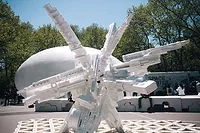
  • At the Ideas City street fair: An installation made from discarded styrofoam by Terreform ONE rises in front of Raumlabor's <em>Spacebuster</em>, a mobile inflatable pavilion comissioned by the Storef

    Recap: The New Museum's 2013 Ideas City Festival

    See More
  • World's Best Buildings Honored at Festival

    See More
×

The latest news and information

#1 Source for Architectural Design, News and Products

SUBSCRIBE
  • RESOURCES
    • Advertise
    • Contact Us
    • Submit
    • Store
  • ACCOUNT CENTER
    • Create an Account
    • Start a Subscription
    • Manage My Account
    • Sign Up for Newsletters
    • Visit Customer Service
    • Update Preferences
  • PRIVACY
    • PRIVACY POLICY
    • TERMS & CONDITIONS
    • DO NOT SELL MY PERSONAL INFORMATION
    • PRIVACY REQUEST
    • ACCESSIBILITY
  • SERVICES
    • Marketing Services
    • Reprints
    • Market Research
    • List Rental
    • Survey/Respondent Access
  • STAY CONNECTED
    • Linkedin
    • Facebook
    • Instagram
    • YouTube
    • X (Twitter)

Copyright ©2026. All Rights Reserved BNP Media, Inc. and BNP Media II, LLC.

Design, CMS, Hosting & Web Development :: ePublishing