Architectural Record
search
cart
facebook twitter linkedin youtube
  • Sign In
  • Subscribe
  • Sign Out
  • My Account
Architectural Record
  • NEWS
    • Latest News
    • Awards
    • Interviews
    • Obituaries
    • Podcasts
      • Design:Ed Podcast
      • Sponsored Podcasts
  • OPINION
    • Book Reviews / Excerpts
    • Exhibition Reviews
    • Forum
  • EXCLUSIVES
    • Videos
    • Design Vanguard
    • Top 300 Firms
    • Sponsored Content
    • Sponsored eBooks
    • From the Archives
  • CONTINUING ED
    • Editorial Continuing Ed
    • CE Center
    • CE Academies
  • PROJECTS
    • Buildings By Type
    • Reuse & Renovation
    • Museums & Arts Centers
    • Colleges & Universities
    • Multifamily Housing
    • Interiors
    • Lighting
    • Kitchen & Bath
  • HOUSES
    • Record Houses
    • House of the Month
    • Featured Houses
  • PRODUCTS
    • Products by Category
    • Record Products of the Year
    • Latest Products
  • EVENTS
    • Dates & Events
    • Record on the Road
    • Innovation Conference
    • Sustainability in Practice
    • Women In Architecture
    • Webinars
    • Ad Excellence Awards
    • Submit an Event
  • CONNECT
    • Ask RECORD AI
    • Newsletters
    • Contact
    • Advertise
    • Editorial Calendar
    • Store
    • Customer Service
  • SUBMIT
    • Submission Guidelines
    • RECORD Competitions
  • MAGAZINE
    • Subscribe
    • My Account
    • Digital Edition
    • Current Issue
    • Firm Pass
    • Historic Archive
Projects

Suntory Museum of Art

Kengo Kuma's signature screens, deployed inside and out, create a serene oasis for viewing works in modest yet assertive museum

By Naomi Pollock, FAIA
November 19, 2007

Architects & Firms

Kengo Kuma and Associates
Nikken Sekkei

Tokyo, Japan

Though embedded in a mammoth, mixed-use development, the comparatively modest 50,590-square-foot Suntory Museum of Art confidently stands its ground. The product of architect Kengo Kuma, the Suntory does not need signage or street access to assert itself. Instead, its articulated, exterior massing, clad with elegant, ceramic fins, deftly distinguishes the museum from Tokyo Midtown’s looming, terra-cotta-covered towers.
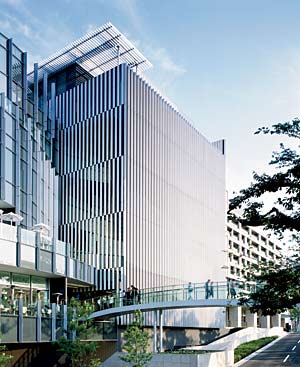
Suntory Museum of Art
Photography © Mitsumasa Fujitsuka

From the outside, the museum’s protruding form practically reads as an independent entity. But its interiors are fully integrated with Midtown’s multistoried shopping concourse: Visitors enter the museum on the mall’s third floor, at the northwest corner, where they find the gift shop, café, and elevators. However, the prescribed route for viewing the private collection actually begins on the fourth floor, where museumgoers arrive at a dimly lit gallery to view the works amassed by Suntory Limited, one of Japan’s largest liquor producers. The museum’s 3,000 historic objects include paintings, textiles, ceramics, and lacquer, with some designated “Important Cultural Property,” and a couple “National Treasure.”

From the main gallery, visitors descend a gracious, glass-encased stair to the third-floor atrium, a 31-foot-high space overlooking Midtown’s semicircular greenbelt park. The atrium, which is earmarked for large artworks, connects to a second gallery. Museum offices and storage fill the fifth floor, while the sixth floor holds a conference hall opening onto an outdoor deck, a members’ club, and an informal tea-ceremony room (Ryuurei) open to the public. The tearoom incorporates new and existing elements, such as the wood frame, woven cedar ceiling, and sliding paper partitions moved from the tearoom at the Suntory’s previous location.

Until the company relocated to the city’s Odaiba area in 2005, the galleries occupied the top floors of its central Tokyo headquarters. Although Suntory’s art collection and corporate offices are now separated, Kuma is responsible for designing the new homes for both. He intended this new facility to evoke traditional, residential architecture. “I didn’t want a white box,” Kuma explains. “I wanted to design a space like a private house—in terms of light, materials, and scale.”

Without quoting directly from traditional architecture, Kuma has incorporated into his design delicate, well-crafted elements such as washi paper (a paper made from fibers of tree bark), which is affixed to glass partitions; wood floors made from recycled Suntory whiskey barrels; and slatted screens of paulonia wood, the material of choice for kimono storage chests. The client was initially reluctant to build with this notoriously soft material.“But the wood’s  fragility,” argues Kuma, “conveys the intimate feeling of the home.”

KEYWORDS: Tokyo

Share This Story

Looking for a reprint of this article?
From high-res PDFs to custom plaques, order your copy today!
Contributing Editor Naomi Pollock, FAIA, is the author of Japanese Design Since 1945: A Complete Sourcebook and the forthcoming Vanishing Japan: Modern Architecture Gone But Not Forgotten,

Post a comment to this article

Report Abusive Comment

Subscription Center
  • Create an Account
  • Start a Subscription
  • Manage My Account
  • Sign Up for Newsletters
  • Visit Customer Service
  • Update Preferences

More Videos

Sponsored Content

Sponsored Content is a special paid section where industry companies provide high quality, objective, non-commercial content around topics of interest to the Architectural Record audience. All Sponsored Content is supplied by the advertising company and any opinions expressed in this article are those of the author and not necessarily reflect the views of Architectural Record or its parent company, BNP Media. Interested in participating in our Sponsored Content section? Contact your local rep!

close
  • TAMLYN XtremeTrim Exterior Trim
    Sponsored byTamlyn

    Designing Cleaner Panel Facades: Why Exterior Trim Details Matter

  • Building with Vapor Barriers
    Sponsored byReef Industries, Inc.

    Vapor Barriers Help Control Moisture in Tighter Building Designs

  • Duct Interior with Prodeq System
    Sponsored byHenry, a Carlisle Company

    Designing Resilient Water Containment Systems

DESIGN:ED Podcast
Listen to Architectural Record’s DESIGN:ED Podcast

Events

June 10, 2026

Rethinking Stormwater – The Power of Porous Paving

Credits: 1 AIA LU/HSW; 1 AIBD P-CE; 0.1 ICC CEU

Learn how porous paving systems support stormwater management, reduce heat island effects, and enhance sustainable site design performance.

June 11, 2026

Very Early Warning Fire Detection for Mission-Critical Facilities

Credits: 1 AIA LU/HSW; 1 AIBD P-CE; 0.1 ICC CEU

Examine advanced fire detection strategies that support uptime and enhance safety in data centers and other mission-critical facilities.

View All Submit An Event

Products

2026 Architect's Square Foot Costbook

2026 Architect's Square Foot Costbook

See More Products

Popular Stories

Practice Matters illustration

What’s in a (Firm’s) Name? Thinking About Succession and Legacy

Practice Matters illustration

By the Numbers: Counting America's Architects

House on a Hill

Design Vanguard 2026: Forma

Crane Cove, ONO

Design Vanguard 2026 Winners

KRESA by DLR

In Kalamazoo, DLR Group Completes a Mass-Timber Hub for Career and Technical Education Programs

Broader Sustainability of CMU - Free Webinar - May 21, 2026

Related Articles

  • Thomas Phifer and Partners North Carolina Museum of Art Project Portfolio

    See More

Related Products

See More Products
  • superlux.jpg

    SuperLux: Smart Light Art, Design & Architecture for Cities

See More Products
×

The latest news and information

#1 Source for Architectural Design, News and Products

SUBSCRIBE
  • RESOURCES
    • Advertise
    • Contact Us
    • Submit
    • Store
  • ACCOUNT CENTER
    • Create an Account
    • Start a Subscription
    • Manage My Account
    • Sign Up for Newsletters
    • Visit Customer Service
    • Update Preferences
  • PRIVACY
    • PRIVACY POLICY
    • TERMS & CONDITIONS
    • DO NOT SELL MY PERSONAL INFORMATION
    • PRIVACY REQUEST
    • ACCESSIBILITY
  • SERVICES
    • Marketing Services
    • Reprints
    • Market Research
    • List Rental
    • Survey/Respondent Access
  • STAY CONNECTED
    • Linkedin
    • Facebook
    • Instagram
    • YouTube
    • X (Twitter)

Copyright ©2026. All Rights Reserved BNP Media, Inc. and BNP Media II, LLC.

Design, CMS, Hosting & Web Development :: ePublishing