Centre Pompidou-Metz by Shigeru Ban
Metz, France
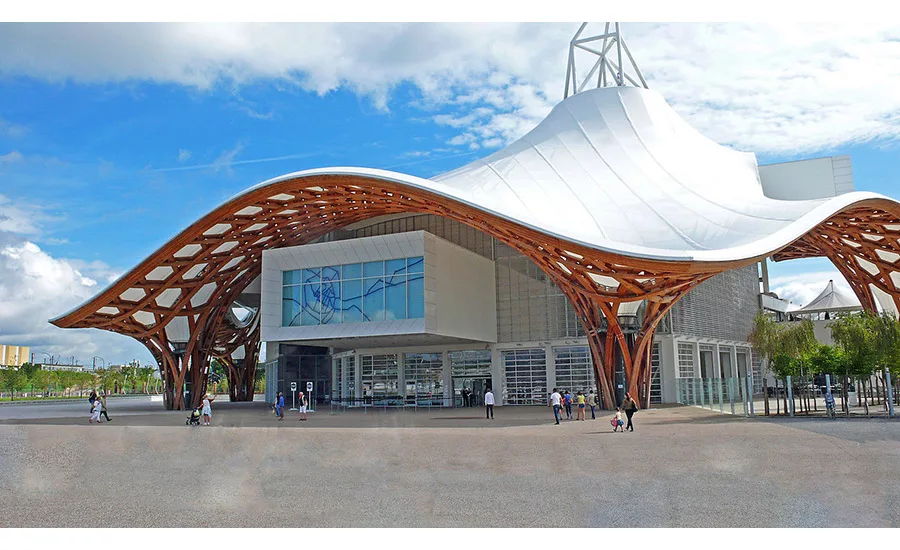
Photo © Guido Radig
Architects & Firms
Shigeru Ban is an appealing architect. His emergency shelters of cardboard and paper, devised in response to disasters such as the 1995 earthquake in Kobe, Japan, present him as someone turning his skills to public benefit rather than personal gratification. He also designed a series of houses in which walls disappear or take the form of giant curtains. His choice of renewable materials gives him a warm, ecological glow. He seems to stand for the adaptive and responsive, with work that provides an antidote to the grandiose and the formal.
The Centre Pompidou in Paris has an astounding collection of Modern art and a history of imaginative exhibitions, installations, events, and structures. Its 1977 building, designed by Renzo Piano and Richard Rogers, is a landmark of 20th-century architecture.
Ban and the museum have come together to create an $62 million outpost of the Pompidou in Metz, in eastern France. In theory, it could have been a wonderfully productive union. In practice, it is conspicuously, tragically less than the sum of its parts.
The main mission of Pompidou-Metz is to display works from the parent institution, in an admirable attempt to share its collection more widely. The obvious precedent is the expanding franchise of New York City’s Solomon R. Guggenheim Museum, most famously with Frank Gehry’s building in Bilbao, Spain. As in Bilbao,
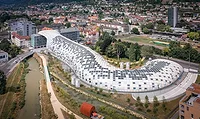
the aim is to raise the profile of a neglected city. Metz, whose contested ownership with Germany contributed to two world wars, now has a forgotten air, despite its fine stone streets and medieval cathedral. The new, 122,000-square-foot building is on the periphery, on the site of a former freight-railway depot, near the remnants of a Roman amphitheater, and separated by train tracks from the rest of the city. Close by is the town’s passenger-rail station, to which the TGV travels the 200 or so miles from Paris in a brisk hour and 23 minutes.
Tokyo-based Ban, together with French architect Jean de Gastines and Londoner Philip Gumuchdjian, won the design competition for the Pompidou-Metz in 2003. Gumuchdjian’s close involvement with the project subsequently ended, with Ban and de Gastines taking it to completion. Their concept was for an enveloping, undulating roof, compared by Ban to a bamboo hat, supported by a lattice of laminated and curved timber members. The seemingly woven structure, with spans of up to 170 feet, changes into funnel-like elements where the roof meets the ground.
The whole is covered in an 80,000-square-foot membrane of translucent fiberglass and polytetrafluoroethylene (PTFE). The idea is that “the roof is on top of the landscape,” says Ban. “We wanted the landscape to flow into the museum,” he explains.
Looking for quick answers on architecture and design topics?
Try Ask RECORD, our new smart AI search tool.
Ask RECORD →
Beneath the roof is a loose assemblage of volumes. At ground level is the Grande Nef. Although intended primarily for large-scale work, the 60-foot-tall space has been divided into 17 relatively conventional rooms for the duration of the opening exhibition. Above is a stack of three galleries in shoe-box-shaped reinforced-concrete tubes, oriented to frame views of the surroundings through glazed ends. The tubes pivot around a steel elevator tower that pierces the roof and transforms into a 250-foot-high spire. Other volumes sheltered under the tentlike covering contain an auditorium, a restaurant, a café, a studio, and offices.
Rising the height of the interior is a big atrium, called the Forum, providing an open-ended area for events. It is semi-external, with transparent walls of polycarbonate and retractable glass doors that allow the space to open almost completely to a landscaped plaza.
As a concept, the project is convincing and seductive: a big, beautiful roof with free-form volumes underneath. It also reprises, in a very different location, the original Pompidou’s goal of urban revitalization. Yet the simplicity and lightness of the idea get lost in execution. You can’t really read the stack of tubes on the inside, which instead feels inchoate. Internal circulation is disjointed. The roof, conflated with the cuboid volumes beneath, becomes ponderous.
In addition, materials and systems—wood, plastic, metal, glass, competing grids and modules—collide in ways that seem underconsidered. De Gastines once worked for Gehry, but these are not the joyous collisions you find in Gehry’s work. If you ascend the tower, you find yourself on a balcony looking down on the atrium, which is potentially the culmination of the internal sequence. But the view is of mechanical equipment and the dust-gathering tops of the tubes enclosing galleries below.
The gallery interiors feel careless. In the inaugural exhibition, A-list works by Picasso, Brancusi, Miró, Duchamp, Dalí, Pollock, et al were washed with a dirty light, a drab metallic grid overhead. The spaces don’t show the attention that architects such as Piano or David Chipperfield would bring to materials, proportion, or detail. The idea was more for a studied casualness, but it doesn’t come off.
The theme of the building is the play of the monumental and the spontaneous, the permanent and the transient. However, instead of dancing together, these qualities entangle and trip. If it’s a tent, it’s a lugubrious one; if it’s a museum, it’s a shoddy one. The best things about the project are the works on display and the fact that they have come to Metz. There are some satisfying spatial moments, including the panoramic views from the galleries and the translucent roof lit up at night. Also successful was the studio that Ban created to deliver the project, a lightweight tube slung high up on the Piano and Rogers building in Paris. This temporary office perfectly responds to the original Pompidou’s spirit of appropriation and change. Disappointingly, this spirit seems to have been lost on the train ride east.
Looking for a reprint of this article?
From high-res PDFs to custom plaques, order your copy today!