Architectural Record
search
cart
facebook twitter linkedin youtube
  • Sign In
  • Subscribe
  • Sign Out
  • My Account
Architectural Record
  • NEWS
    • Latest News
    • Awards
    • Interviews
    • Obituaries
    • Podcasts
      • Design:Ed Podcast
      • Sponsored Podcasts
  • OPINION
    • Book Reviews / Excerpts
    • Exhibition Reviews
    • Forum
  • EXCLUSIVES
    • Videos
    • Design Vanguard
    • Top 300 Firms
    • Sponsored Content
    • Sponsored eBooks
    • From the Archives
  • CONTINUING ED
    • Editorial Continuing Ed
    • CE Center
    • CE Academies
  • PROJECTS
    • Buildings By Type
    • Reuse & Renovation
    • Museums & Arts Centers
    • Colleges & Universities
    • Multifamily Housing
    • Interiors
    • Lighting
    • Kitchen & Bath
  • HOUSES
    • Record Houses
    • House of the Month
    • Featured Houses
  • PRODUCTS
    • Products by Category
    • Record Products of the Year
    • Latest Products
  • EVENTS
    • Dates & Events
    • Record on the Road
    • Innovation Conference
    • Sustainability in Practice
    • Women In Architecture
    • Webinars
    • Ad Excellence Awards
    • Submit an Event
  • CONNECT
    • Ask RECORD AI
    • Newsletters
    • Contact
    • Advertise
    • Editorial Calendar
    • Store
    • Customer Service
  • SUBMIT
    • Submission Guidelines
    • RECORD Competitions
  • MAGAZINE
    • Subscribe
    • My Account
    • Digital Edition
    • Current Issue
    • Firm Pass
    • Historic Archive
Residential ArchitectureRecord Houses

House NA

Open House: A clear breach of form within a discreet city, this simple glass house raises the bar on transparent living for a working couple—and their neighbors.

By Naomi Pollock, FAIA
A clear glass partition hardly separates the bathroom from the sleeping area.
House NA
Sou Fujimoto Architects
Tokyo
A clear glass partition hardly separates the bathroom from the sleeping area.
Photo © Iwan Baan
Terraces on the south-facing facade provide a modicum of screening from the street and double as sun-shading devices.
House NA
Sou Fujimoto Architects
Tokyo
Terraces on the south-facing facade provide a modicum of screening from the street and double as sun-shading devices.
Photo © Iwan Baan
Outside, House NA reads as an assemblage of cubic forms.
House NA
Sou Fujimoto Architects
Tokyo
Outside, House NA reads as an assemblage of cubic forms.
Photo © Iwan Baan
Following in the footsteps of Japanese tradition, shoes are removed at the entry, enabling the platforms to function as much more than floors. For example, the living area floor becomes a seat when th
House NA
Sou Fujimoto Architects
Tokyo
Following in the footsteps of Japanese tradition, shoes are removed at the entry, enabling the platforms to function as much more than floors. For example, the living area floor becomes a seat when the adjacent loft floor becomes a work area.
Photo © Iwan Baan
House NA
House NA
Sou Fujimoto Architects
Tokyo
Image courtesy Sou Fujimoto Architects
House NA
House NA
Sou Fujimoto Architects
Tokyo
Image courtesy Sou Fujimoto Architects
House NA
House NA
Sou Fujimoto Architects
Tokyo
Image courtesy Sou Fujimoto Architects
House NA
House NA
Sou Fujimoto Architects
Tokyo
Image courtesy Sou Fujimoto Architects
House NA
House NA
Sou Fujimoto Architects
Tokyo
Image courtesy Sou Fujimoto Architects
A clear glass partition hardly separates the bathroom from the sleeping area.
Terraces on the south-facing facade provide a modicum of screening from the street and double as sun-shading devices.
Outside, House NA reads as an assemblage of cubic forms.
Following in the footsteps of Japanese tradition, shoes are removed at the entry, enabling the platforms to function as much more than floors. For example, the living area floor becomes a seat when th
House NA
House NA
House NA
House NA
House NA
April 16, 2012

Architects & Firms

Sou Fujimoto Architects

Tokyo

There's no running around naked in Sosuke Fujimoto's House NA. The 3-D matrix of tiny rooms and exterior terraces—all located on different floor levels—is encased almost entirely with see-through glass. Supported by a bare, white structural frame, the transparent walls reveal the interior contents to all who pass by. Even in Japan, where proximate neighbors and thin walls often compromise privacy, an unclothed house is a daring solution.

Yet House NA is not simply a bold, exhibitionist gesture. It is Fujimoto's carefully considered response to the building's surrounding conditions. Designed for a working couple in their forties, the home is located in a quiet Tokyo neighborhood on a 592-square-foot plot that opens onto a narrow street and is hemmed in by adjacent houses just about everywhere else. It does not turn its back on the city with solid walls, a typical strategy for Japan's cramped urban areas. Instead, the house engages the environment with transparency. Just inches away, a neighbor's concrete-block wall doubles as House NA's wallpaper, while a borrowed view toward the roof garden next door enhances the interior.

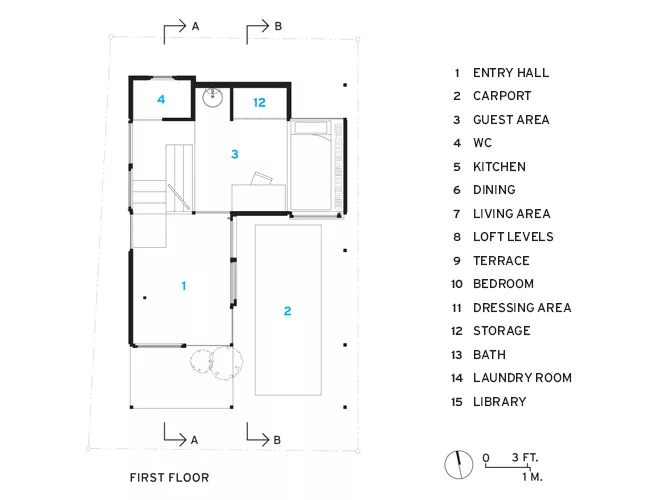
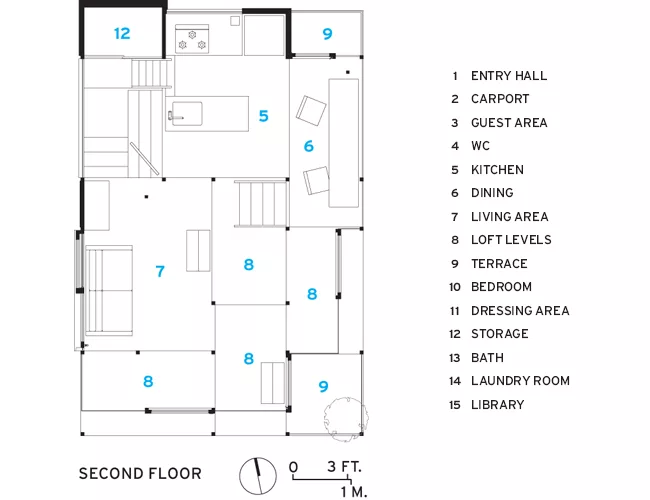
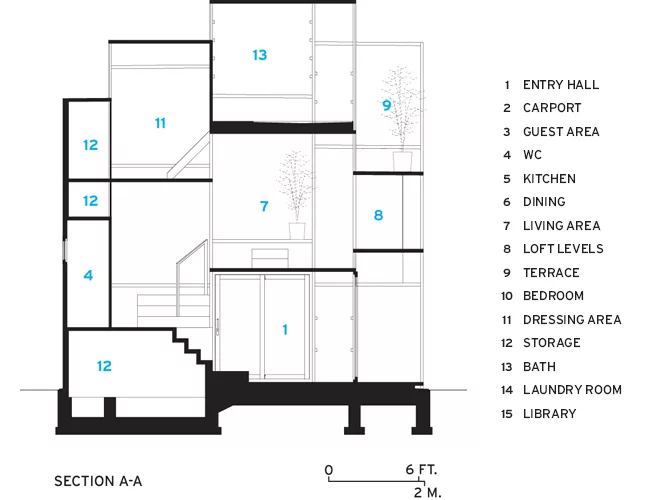
Inside, there aren't many walls, either. “In a sense, it is like a one-room house,” explains Fujimoto. This vertical “room” is actually 21 individual floor plates that delineate functional areas. Ranging in size from 21 to 81 square feet, the various levels are linked by an assortment of stairs and ladders in addition to short runs of fixed and movable wooden steps.

At grade, the house begins with a covered carport and entrance. The foyer leads down to the guest quarters and up to the kitchen. Abutting a slotlike dining space, the kitchen segues into the living area, a large platform that expands into a series of small, raised lofts that double as seating or work surfaces. Overhead, the sleeping area adjoins the library, followed by a sunroom and multiple tiny terraces. Higher still, a dressing area leads up to the bathroom, which crowns the house.

While the absence of walls, both inside and out, posed a number of practical challenges, the unimpeded flow from one level to another does make the interior feel spacious. Fujimoto installed in-floor heating within some of the horizontal platforms and subtly embedded electrical outlets in the main areas. He concentrated the HVAC and plumbing equipment, storage, and lateral bracing in the thick, north-facing wall at the rear of the house. Then he tucked additional lateral bracing in a full-height bookshelf and lightweight concrete panels inserted into the side elevations.

According to consulting engineer Jun Sato, “In our first meeting the shape of the building was almost fixed, but there was no clear structural direction.” Sato proposed a slender, steel frame system to complement the house's cellular composition and floating floor plates.

Elegant in its simplicity, the structure consists of 1-inch-thick, corrugated-steel deck plates plus solid 1.4-by-2.4-inch rectangular beams and 2-inch-square columns—all assembled on-site with welded joints exclusively. The solid sections of these components required careful temperature control during welding to avoid steel shrinkage. Below grade, the columns are embedded in the concrete foundations anchored to steel piles.

Because of the delicacy of Fujimoto's architecture, Sato went to great lengths to minimize the dimensions of the structural components. While the placement of the individual floors determined the columns' gridlike configuration, the slabs' short spans enabled the design team to reduce the column size and deck thickness. Cross bracing—0.63-inch-diameter round pipes where exposed and flat bars where concealed—not only counter earthquake and lateral forces, they also enabled Sato to reduce the dimensions of the square pillars.

Integral to the architecture, white-tinted birch flooring and stairs blend with the structure and serve as a visual transition to the chunky wood sashes and frames that outline the operable windows. The fenestration, strategically positioned to maximize the flow of fresh air, is the house's only source of ventilation and cooling.

Living in a home as exposed as House NA is not for everyone, not even the architect. “The composition of space—a group of small floors at different levels—is fine for me, but this house would honestly be too open for my personal residence,” admits Fujimoto. His clients even added some curtains and blinds. It seems, for them, privacy is more than a state of mind.

Naomi Pollock is RECORD's Tokyo-based correspondent.

Completion Date: October 2010

Size: 914 square feet

Total construction cost: Withheld per client’s request

Architect:
Sou Fujimoto Architects
Ichikawa Seihon building 6F
10-3, Higashienoki-cho,
Shinjuku-ku,Tokyo 162-0807, Japan
Tel: +81(0)3-3513-5401
Fax:+81(0)3-3513-5402

People

Owner: Individual

Architect
Sou Fujimoto Architects
Ichikawa Seihon building 6F
10-3, Higashienoki-cho,
Shinjuku-ku,Tokyo 162-0807, Japan
Tel: +81(0)3-3513-5401
Fax:+81(0)3-3513-5402

Personnel in architect's firm who should receive special credit:
Sou Fujimoto, principal
Takahiro Hata, Keisuke Kiri, Masaki Iwata, design team

Engineer(s): Jun Sato Structural Engineering

General contractor: HEISEI construction

Photographer(s):
Iwan Baan

CAD system, project management, or other software used:
Vectorworks


Products

Exterior cladding
Metal/glass curtain wall: Float glass t=10mm

Wood: Birch veneer t=3mm/OSUC Paint/Thin white

Curtain wall: Nippon Sheet Glass (10mm float glass with a photocatalytic coating and insulation film)

Roofing
Built-up roofing: Fiber-reinforced plastic t=3m/Top coat/N-95

Windows
Wood frame: (interior) Basswood plywood t=24mm/OSUC paint/Thin white

Metal frame: (exterior) Aluminum

Glazing
Glass: Tempered glass t=8mm

Insulated-panel or plastic glazing: Polystyrene foam/Insulation paint

Doors
Entrances: Porcelain tile

Wood doors: Basswood Plywood

Sliding doors: Aluminum

Interior finishes
Acoustical ceilings: Calcium silicate

Cabinetwork and custom woodwork: Basswood plywood/ Beech plywood/ Pine glulam

Wall coverings: Birch veneer t=3mm/ OSUC paint/ Thin white

Special surfacing: Float glass/ Insulation film/ Photocatalyst coating

KEYWORDS: Tokyo

Share This Story

Looking for a reprint of this article?
From high-res PDFs to custom plaques, order your copy today!


Contributing Editor Naomi Pollock, FAIA, is the author of Japanese Design Since 1945: A Complete Sourcebook and the forthcoming Vanishing Japan: Modern Architecture Gone But Not Forgotten,

Post a comment to this article

Report Abusive Comment

Subscription Center
  • Create an Account
  • Start a Subscription
  • Manage My Account
  • Sign Up for Newsletters
  • Visit Customer Service
  • Update Preferences

More Videos

Sponsored Content

Sponsored Content is a special paid section where industry companies provide high quality, objective, non-commercial content around topics of interest to the Architectural Record audience. All Sponsored Content is supplied by the advertising company and any opinions expressed in this article are those of the author and not necessarily reflect the views of Architectural Record or its parent company, BNP Media. Interested in participating in our Sponsored Content section? Contact your local rep!

close
  • TAMLYN XtremeTrim Exterior Trim
    Sponsored byTamlyn

    Designing Cleaner Panel Facades: Why Exterior Trim Details Matter

  • Building with Vapor Barriers
    Sponsored byReef Industries, Inc.

    Vapor Barriers Help Control Moisture in Tighter Building Designs

  • Duct Interior with Prodeq System
    Sponsored byHenry, a Carlisle Company

    Designing Resilient Water Containment Systems

DESIGN:ED Podcast
Listen to Architectural Record’s DESIGN:ED Podcast

Events

June 18, 2026

Rebooting the Aging Office Building

Credits: 1 AIA LU/HSW; 1 AIBD P-CE; 0.1 ICC CEU; 1 PDH

Explore façade retrofit strategies and award-winning design concepts that can transform aging office buildings into healthier, higher-performing workplaces for today’s hybrid workforce.

June 23, 2026

Enhancing Fire Resistance with Advanced PVC Solutions

Credits: 1 AIA LU/HSW; 1 AIBD P-CE; 0.1 ICC CEU; 1 IIBEC CEH

Evaluate advanced PVC solutions that improve fire resistance, support WUI compliance, and enhance resilience in residential and commercial building design.

View All Submit An Event

Products

2026 Architect's Square Foot Costbook

2026 Architect's Square Foot Costbook

See More Products

Popular Stories

SanDiegoAirport

Top 300 Architecture Firms of 2026

Coronado Bridge

The Architect’s Guide to San Diego

Lorcan O' Herilhy

California Architect Lorcan O’Herlihy Has Died, Age 66

CCA, Studio Gang

The Winners of the AIA’s 2026 Architecture Award Range from Collegiate Rowing Hubs to Housing for the Homeless

Dusk House

Design Vanguard 2026: ONO

Rebooting the Aging Office Building - Free Webinar - June 18, 2026

Related Articles

  • Ando Museum

    See More
  • Kyoto Hyoto

    An Elaborate Array of Wood and Aluminum-Mesh Panels Fills a Soaring Eatery in Osaka

    See More
  • Casa na Gateira

    Casa na Gateira

    See More

Related Products

See More Products
  • biogenic.jpg

    Manual of Biogenic House Sections

  • iconic house.jpg

    The Iconic House

See More Products
×

The latest news and information

#1 Source for Architectural Design, News and Products

SUBSCRIBE
  • RESOURCES
    • Advertise
    • Contact Us
    • Submit
    • Store
  • ACCOUNT CENTER
    • Create an Account
    • Start a Subscription
    • Manage My Account
    • Sign Up for Newsletters
    • Visit Customer Service
    • Update Preferences
  • PRIVACY
    • PRIVACY POLICY
    • TERMS & CONDITIONS
    • DO NOT SELL MY PERSONAL INFORMATION
    • PRIVACY REQUEST
    • ACCESSIBILITY
  • SERVICES
    • Marketing Services
    • Reprints
    • Market Research
    • List Rental
    • Survey/Respondent Access
  • STAY CONNECTED
    • Linkedin
    • Facebook
    • Instagram
    • YouTube
    • X (Twitter)

Copyright ©2026. All Rights Reserved BNP Media, Inc. and BNP Media II, LLC.

Design, CMS, Hosting & Web Development :: ePublishing