Architectural Record
search
cart
facebook twitter linkedin youtube
  • Sign In
  • Subscribe
  • Sign Out
  • My Account
Architectural Record
  • NEWS
    • Latest News
    • Awards
    • Interviews
    • Obituaries
    • Podcasts
      • Design:Ed Podcast
      • Sponsored Podcasts
  • OPINION
    • Book Reviews / Excerpts
    • Exhibition Reviews
    • Forum
  • EXCLUSIVES
    • Videos
    • Design Vanguard
    • Top 300 Firms
    • Sponsored Content
    • Sponsored eBooks
    • From the Archives
  • CONTINUING ED
    • Editorial Continuing Ed
    • CE Center
    • CE Academies
  • PROJECTS
    • Buildings By Type
    • Reuse & Renovation
    • Museums & Arts Centers
    • Colleges & Universities
    • Multifamily Housing
    • Interiors
    • Lighting
    • Kitchen & Bath
  • HOUSES
    • Record Houses
    • House of the Month
    • Featured Houses
  • PRODUCTS
    • Products by Category
    • Record Products of the Year
    • Latest Products
  • EVENTS
    • Dates & Events
    • Record on the Road
    • Innovation Conference
    • Sustainability in Practice
    • Women In Architecture
    • Webinars
    • Ad Excellence Awards
    • Submit an Event
  • CONNECT
    • Ask RECORD AI
    • Newsletters
    • Contact
    • Advertise
    • Editorial Calendar
    • Store
    • Customer Service
  • SUBMIT
    • Submission Guidelines
    • RECORD Competitions
  • MAGAZINE
    • Subscribe
    • My Account
    • Digital Edition
    • Current Issue
    • Firm Pass
    • Historic Archive
ProjectsLighting Design

Frick Chemistry Laboratory

By Joann Gonchar, FAIA
Architects Hopkins and Payette devised fixed aluminum shading devices for the laboratory wing's east-facing curtain wall to mitigate heat gain and glare.
Frick Chemistry Laboratory
Hopkins Architects with Payette Associates
Princeton, New Jersey
Architects Hopkins and Payette devised fixed aluminum shading devices for the laboratory wing's east-facing curtain wall to mitigate heat gain and glare.
Photo © Warren Jagger
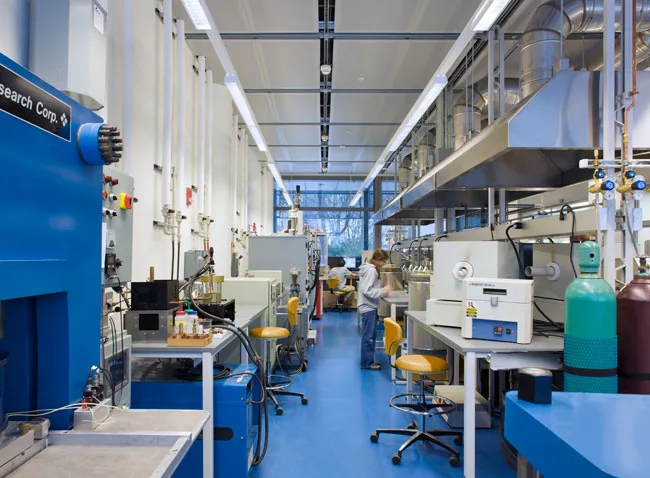
Direct lighting fixtures attached to a suspended raceway provide illumination for the central zone of each lab.
Frick Chemistry Laboratory
Hopkins Architects with Payette Associates
Princeton, New Jersey
Direct lighting fixtures attached to a suspended raceway provide illumination for the central zone of each lab.
Photo © Warren Jagger
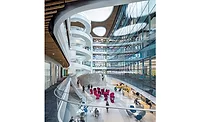
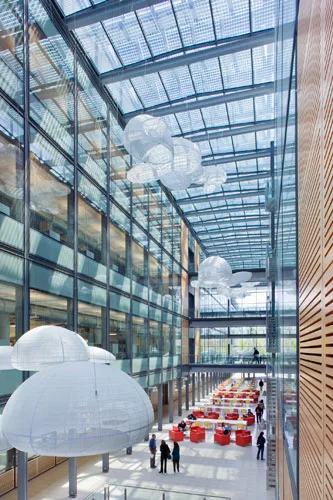
Photovoltaic panels top a glazed central atrium, serving as shading devices while generating electricity.
Frick Chemistry Laboratory
Hopkins Architects with Payette Associates
Princeton, New Jersey
Photovoltaic panels top a glazed central atrium, serving as shading devices while generating electricity.
Photo © Warren Jagger
Frick Chemistry Laboratory
Hopkins Architects with Payette Associates
Princeton, New Jersey
Photo © Warren Jagger
Architects Hopkins and Payette devised fixed aluminum shading devices for the laboratory wing's east-facing curtain wall to mitigate heat gain and glare.
Direct lighting fixtures attached to a suspended raceway provide illumination for the central zone of each lab.
Photovoltaic panels top a glazed central atrium, serving as shading devices while generating electricity.
Frick Chemistry Laboratory
February 15, 2012

Architects & Firms

Hopkins Architects
Payette

Princeton, New Jersey

At Princeton University's new Frick Chemistry Laboratory, dedicated in April, a highly efficient lighting scheme is one of several tightly integrated strategies that contribute to the building's ambitious energy-saving goals: Frick is designed to use 24 percent less site energy than allowed by the 2007 version of ASHRAE 90.1 standard.

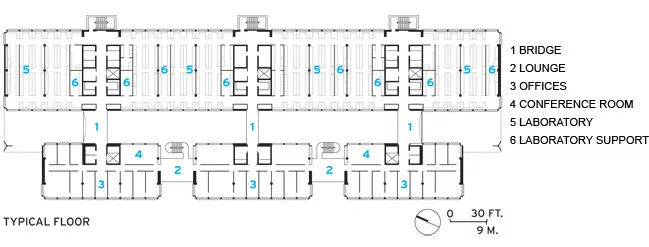
This building's configuration is a product of both environmental and programmatic goals, according to its architects, London-based Hopkins and Payette Associates of Boston. The 265,000-square-foot structure has two four-story, largely glass-enclosed wings'one on the east for research and another on the west for offices. The pieces are joined by a 75-foot-tall, skylit atrium topped with photovoltaic panels that provide shading in addition to generating electricity. Along with its transparency, the scheme promotes connectivity between individual elements and interaction among occupants, says Robert Schaeffner, Payette principal.

The research wing, organized as repeating modules with lab benches at the center and an open zone for circulation and study carrels at the perimeter, has an average connected lighting load of 1.25 W/square foot'a level that is about 11 percent below the code allowance, says Christopher Rush, senior lighting consultant in the New York office of Arup. Designers provided the required illumination over lab benches while keeping lighting power densities low, with direct lighting fixtures housing T5 lamps. The luminaires, positioned so that researchers will not cast shadows over their own work surfaces, are attached to a raceway suspended below exposed ductwork and other mechanical equipment'a strategy that allowed the project team to place fixtures wherever they were needed and omit them where not. This trunk system should also make it easier for facility managers to move the fixtures if lab equipment is rearranged at a later date.

The lighting in this central zone is controlled by occupancy sensors, but is not connected to daylight dimmers. This differs from the scheme at the perimeter, where indirect pendant fixtures, activated by both daylight dimming and occupancy sensors, bounce light off an uncluttered suspended ceiling. Occupants can control task lights in the study carrels lined up along the glazed wall between the laboratory and the atrium and along the east-facing exterior curtain wall. Here, fixed aluminum shading devices mitigate heat gain and glare. Manually operated interior roller blinds provide additional protection.

People


Products

KEYWORDS: New Jersey

Share This Story

Looking for a reprint of this article?
From high-res PDFs to custom plaques, order your copy today!

Joann gonchar

Joann Gonchar, FAIA, LEED AP, is deputy editor at Architectural Record. She joined RECORD in 2006, after working for eight years at its sister publication, Engineering News-Record. Before starting her career as a journalist, Joann worked for several architecture firms and spent three years in Kobe, Japan, with the firm Team Zoo, Atelier Iruka. She earned a Master of Architecture degree from the University of Pennsylvania and a Bachelor of Arts from Brown University. She is licensed to practice architecture in New York State.

Post a comment to this article

Report Abusive Comment

Subscription Center
  • Create an Account
  • Start a Subscription
  • Manage My Account
  • Sign Up for Newsletters
  • Visit Customer Service
  • Update Preferences

More Videos

Sponsored Content

Sponsored Content is a special paid section where industry companies provide high quality, objective, non-commercial content around topics of interest to the Architectural Record audience. All Sponsored Content is supplied by the advertising company and any opinions expressed in this article are those of the author and not necessarily reflect the views of Architectural Record or its parent company, BNP Media. Interested in participating in our Sponsored Content section? Contact your local rep!

close
  • cold storage facility
    Sponsored byCarlisle SynTec Systems

    How Architects Can Design More Continuous Cold Storage Envelopes

  • TAMLYN XtremeTrim Exterior Trim
    Sponsored byTamlyn

    Designing Cleaner Panel Facades: Why Exterior Trim Details Matter

  • Building with Vapor Barriers
    Sponsored byReef Industries, Inc.

    Vapor Barriers Help Control Moisture in Tighter Building Designs

DESIGN:ED Podcast
Listen to Architectural Record’s DESIGN:ED Podcast

Events

June 23, 2026

Enhancing Fire Resistance with Advanced PVC Solutions

Credits: 1 AIA LU/HSW; 1 AIBD P-CE; 0.1 ICC CEU; 1 IIBEC CEH

Evaluate advanced PVC solutions that improve fire resistance, support WUI compliance, and enhance resilience in residential and commercial building design.

June 25, 2026

Designing Glass Railing Systems that Enhance Aesthetics and Meet Code

Credits: 1 AIA LU/HSW; 1 AIBD P-CE; 0.1 ICC CEU

Upon course completion, participants will possess a deeper understanding of glass railings to help ensure that safety, aesthetic, and performance objectives are achieved.

View All Submit An Event

Products

2026 Architect's Square Foot Costbook

2026 Architect's Square Foot Costbook

See More Products

Popular Stories

SanDiegoAirport

Top 300 Architecture Firms of 2026

Lorcan O' Herilhy

California Architect Lorcan O’Herlihy Has Died, Age 66

Obama Presidential Center, Chicago

The Obama Presidential Center Opens on Chicago’s South Side

Spoonbill Ranch

Johnsen Schmaling Architects Integrates Spoonbill Ranch into a Pristine Landscape

CCA, Studio Gang

The Winners of the AIA’s 2026 Architecture Award Range from Collegiate Rowing Hubs to Housing for the Homeless

Enhancing Fire Resistance with Advanced PVC Solutions - Free Webinar - June 23, 2026

Related Articles

  • Frick Chemistry Laboratory

    See More
  • 806 House

    Dark-Sky Design: 806 House by Richard Orne Architect

    See More
  • Continuing Education: Lighting Controls

    Continuing Education: Lighting Controls

    See More

Related Products

See More Products
  • 0470130628.gif

    Sustainable Design: The Science of Sustainability and Green Engineering

  • superlux.jpg

    SuperLux: Smart Light Art, Design & Architecture for Cities

See More Products
×

The latest news and information

#1 Source for Architectural Design, News and Products

SUBSCRIBE
  • RESOURCES
    • Advertise
    • Contact Us
    • Submit
    • Store
  • ACCOUNT CENTER
    • Create an Account
    • Start a Subscription
    • Manage My Account
    • Sign Up for Newsletters
    • Visit Customer Service
    • Update Preferences
  • PRIVACY
    • PRIVACY POLICY
    • TERMS & CONDITIONS
    • DO NOT SELL MY PERSONAL INFORMATION
    • PRIVACY REQUEST
    • ACCESSIBILITY
  • SERVICES
    • Marketing Services
    • Reprints
    • Market Research
    • List Rental
    • Survey/Respondent Access
  • STAY CONNECTED
    • Linkedin
    • Facebook
    • Instagram
    • YouTube
    • X (Twitter)

Copyright ©2026. All Rights Reserved BNP Media, Inc. and BNP Media II, LLC.

Design, CMS, Hosting & Web Development :: ePublishing