European Designers Seek Long-Term Solutions to House Refugees
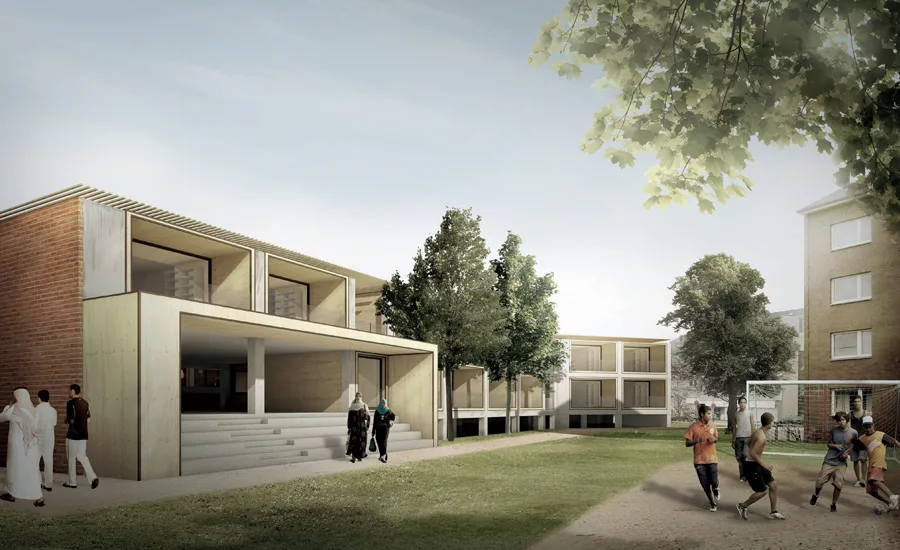
Another project of Welcome Architecture proposes using existing structures as refugee housing to increase urban density throughout.
Image courtesy Leibniz University, Hanover
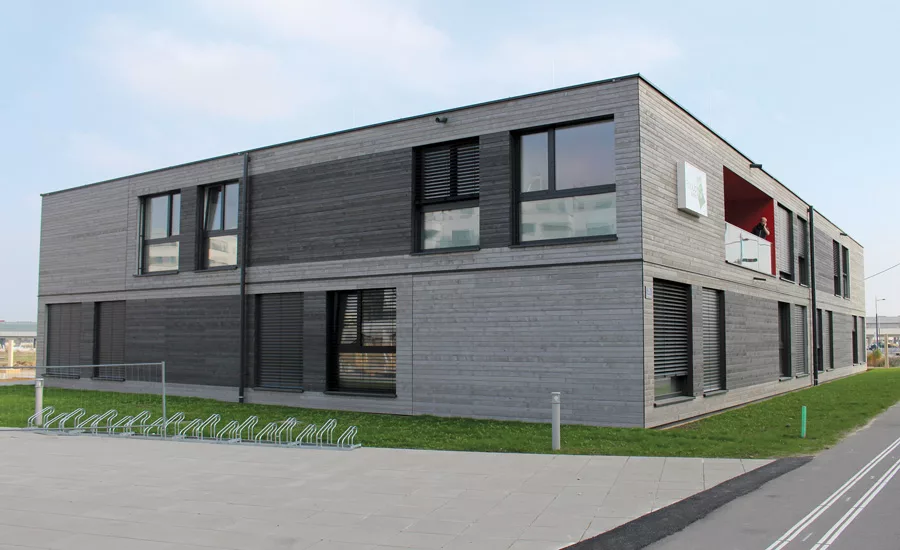
Meanwhile, an Austrian-based design group is proposing an inexpensive passive-house model, originally intended for low-cost student housing.
Photo © LANG Consulting
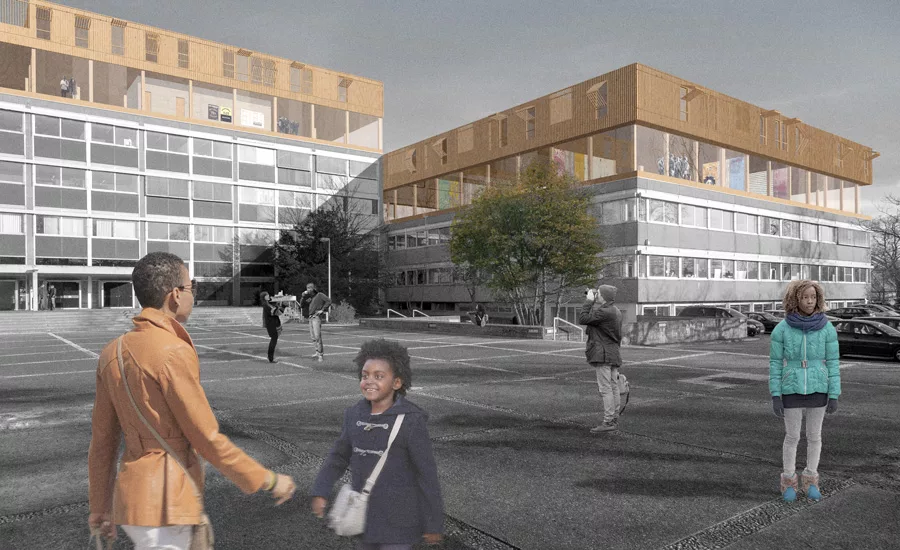
A group at Leibniz University in Hanover, Germany, proposes adding light-frame structures on the roofs of existing buildings to house asylum-seekers flooding into the country.
Image courtesy Leibniz University, Hanover
One evening in September, an American couple traversing Europe camped after dark in a national park near Sundholmen, Sweden, along the Finnish border. At dawn they were awoken by a Swedish official and Europe’s new reality: they had inadvertently pitched their tent next to a refugee encampment. What had been a resort is now packed with refugees from the Middle East, sleeping in bunk beds stacked to the ceiling in its guest rooms.
Similar arrangements can be seen throughout Europe in school gymnasiums and in antiquated airports—anywhere basic services can be provided. This humanitarian crisis is escalating: 744,000 refugees, most from the war-torn Middle East, have flooded into Europe this year. Sweden is expecting to take in an estimated 350,000 asylum-seekers by the end of 2015; Germany, under Chancellor Angela Merkel, nearly 1 million.
As the immigrants crowd into makeshift shelters and camps, similar to those the vacationers encountered in Sundholmen, architects and government officials are beginning to grapple with the task of creating more permanent—and humane—housing.
At the School of Architecture at Leibniz University in Hanover, Germany, the Welcome Architecture project is engaging government officials with innovative solutions. A year and a half ago, when the group of architects, academics, and students began the initiative, the city was expecting a total of about 2,500 refugees, according to Assistant Professor Simon Takasaki. “We’re now seeing about 800 refugees arriving each day,” he says.
The project looked for opportunities in the dense urban fabric of Hanover that would be suitable for new housing. Rather than reproduce the problematic model of isolating refugees on the periphery (as in the banlieues of Paris), Welcome Architecture is focusing on three promising strategies that will intersperse groups of newcomers throughout the city.
Since multistory parking decks in the city often operate at 40 percent capacity, the team proposed inserting housing into underutilized structures: the decks would provide a ready armature for infill housing. Second, numerous open lots, some left over from the destruction of WWII, haven’t managed to attract commercial development but are suitable for housing. The third option is to add light-frame housing units on top of existing flat-roofed buildings. Takasaki says that, rather than creating sprawl, these solutions increase the density of cites, an important issue in Europe. Although local officials have expressed interest, no timetable has been set for implementation.
For more immediate housing, several cities are repurposing shipping containers. A government program in Berlin, for example, is building six multi-story container villages throughout the city that will house 2,500 refugees. The developments are spartan, with narrow living areas in containers bracketing double-loaded corridors and common washing facilities. But because they lack adequate ventilation and soundproofing, they are only suitable for short-term housing, not the permanent housing believed to be needed.
Looking for quick answers on architecture and design topics?
Try Ask RECORD, our new smart AI search tool.
Ask RECORD →
Another challenge for new low-cost housing is meeting the stringent energy efficiency standards in many EU countries. In Austria, a passive-house concept, which was first developed by a consortium of nonprofits for affordable student housing, is drawing interest from several European cities, including Munich and Hanover, for housing refugees. The Green Flex Studio, designed by Lang Passive House Consulting and the Austrian firm F2 Architects, is a prefabricated 800-square-foot, self-contained dwelling that requires only a simple six-pier foundation with water, waste, and electrical hook-ups.
Despite its modest $160-per-square-foot price tag, the units meet the rigorous passive house energy efficiency standard by incorporating 18-inch insulated walls, ceilings, and floors; triple-glazed windows; and a high-efficiency ventilating heat exchanger. The units come essentially complete, including interior finishes, says Günter Lang of Lang Consulting. For a 10-unit pilot project in Aspern, Austria, this summer, the manufacturing process took two months and only a few weeks to install and finish the project.
As with all of these long-term solutions, the Flex Studio is still in the proposal stage. There are other, similar models, such as modular wood housing produced by Bauer Products in Neukirk, Germany, which has begun manufacturing housing for refugees on a small scale. These strategies are a step forward, but each will take time to develop into solutions that address the magnitude of the crisis.
In the long term, many economists foresee the influx of migrants as a boon for Europe’s economy, adding jobs in areas such as construction and bolstering shrinking populations. But the immediate concern is a humanitarian one. Chancellor Merkel—known as “Mama Merkel” to many refugees—is steadfast in her support for keeping the EU’s doors open: “If Europe fails on the question of refugees—if this close link with universal civil rights is broken—then it won’t be the Europe we wished for.”
Looking for a reprint of this article?
From high-res PDFs to custom plaques, order your copy today!