East Harlem Center For Living and Learning
A charter school with an ambitious urban mission stands out with stately simplicity.
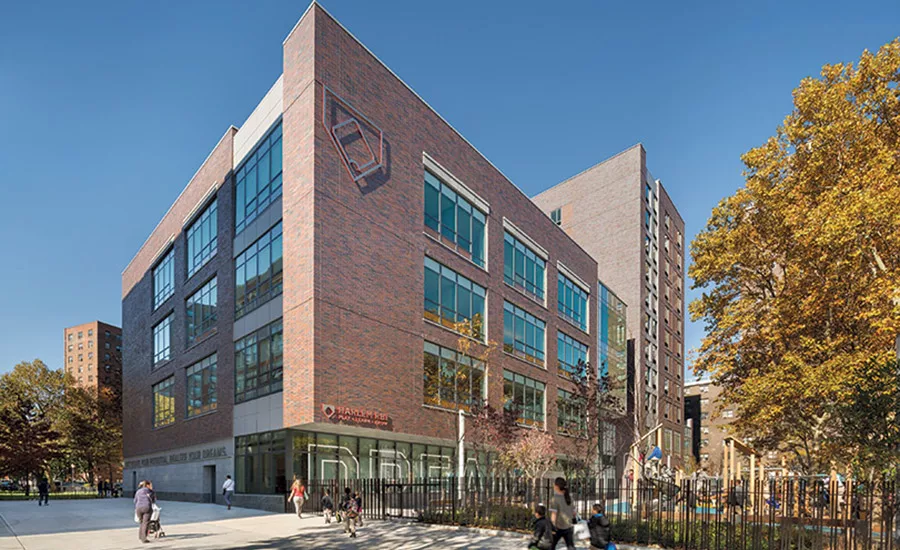
The Dream Charter School occupies a four-story block, pulled back behind a small park on Second Avenue in East Harlem.
Photography By Sarah Mechling-Perkins Eastman
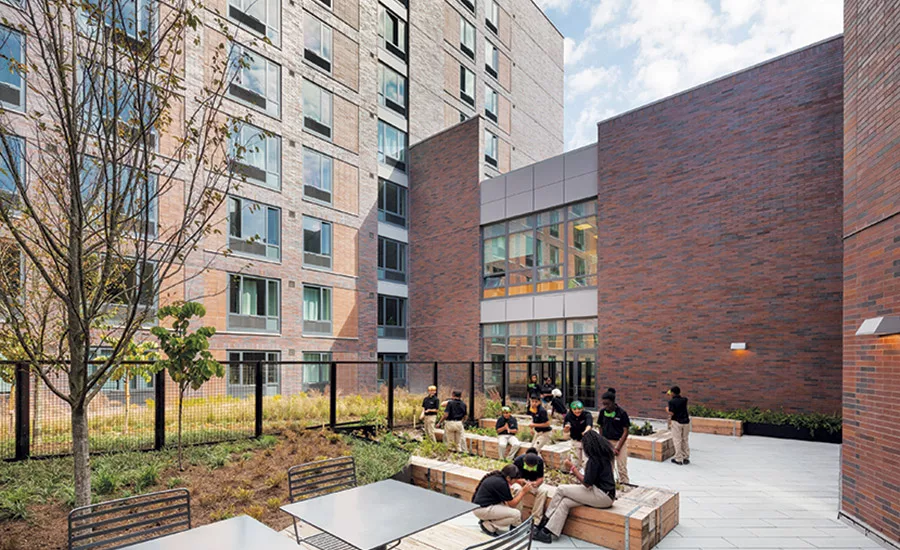
It abuts an 11-story tower for affordable housing clad in ironspot brick, as seen from the third-level outdoor terrace of the school.
Photography By Paúl Rivera
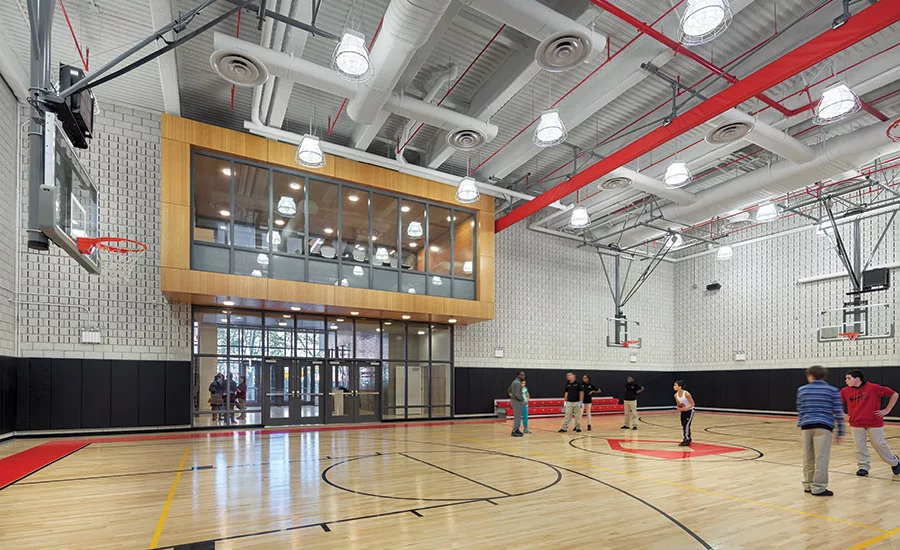
The wood-paneled “skybox”, overlooking the gym, provides an additional area for meetings.
Photography By Paúl Rivera
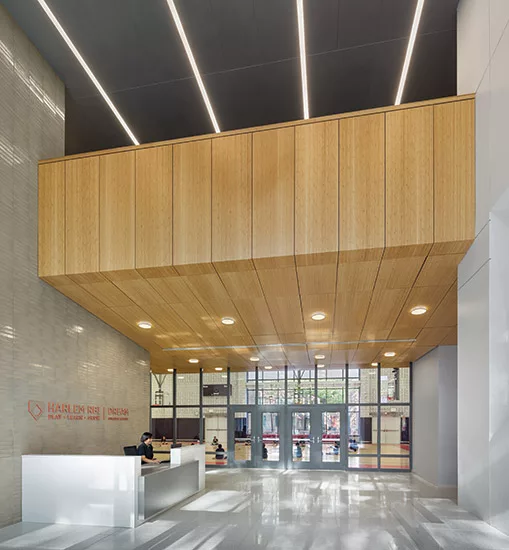
The entrance lobby looks straight into the gym, which receives daylight from a rear glass wall. To mitigate noise, walls are acoustical concrete block.
Photography By Paúl Rivera
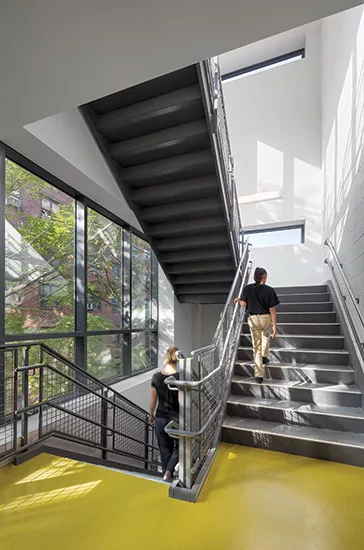
The trimly detailed stairwells, such as one at the back of the building are enlivened by views of trees.
Photography By Paúl Rivera
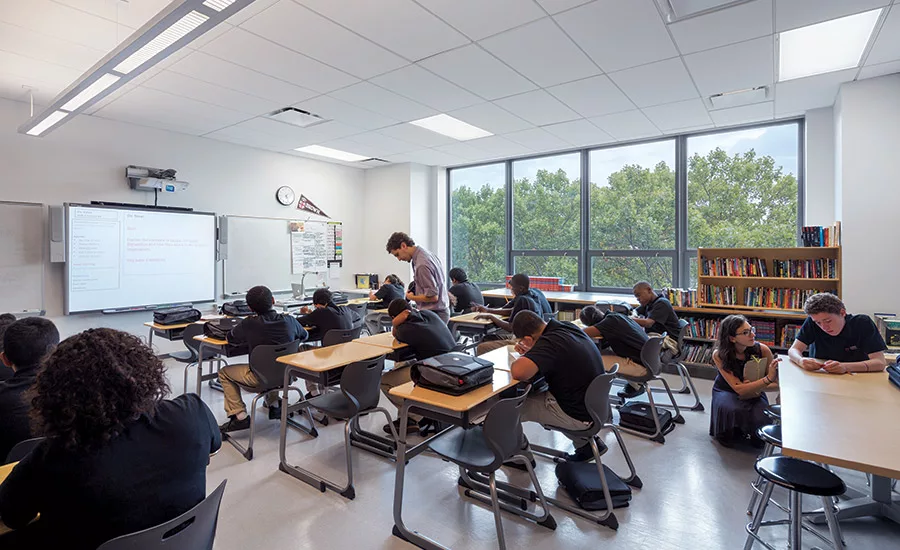
The classrooms rely on familiar materials such as acoustical ceilings and resilient flooring, with the key visual element reliably the glimpse of treetops through generous windows.
Photography By Paúl Rivera
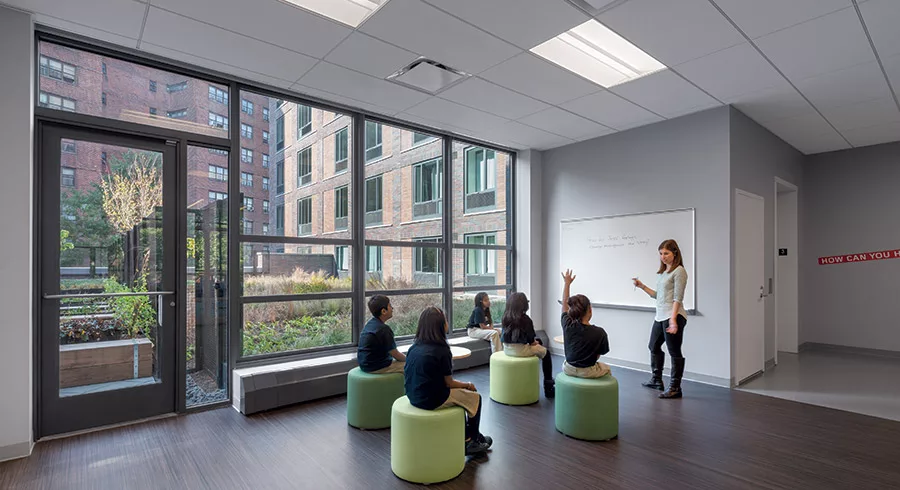
An open collaboration space on the third floor has an entry to a planted terrace on top of the gym.
Photography By Paúl Rivera
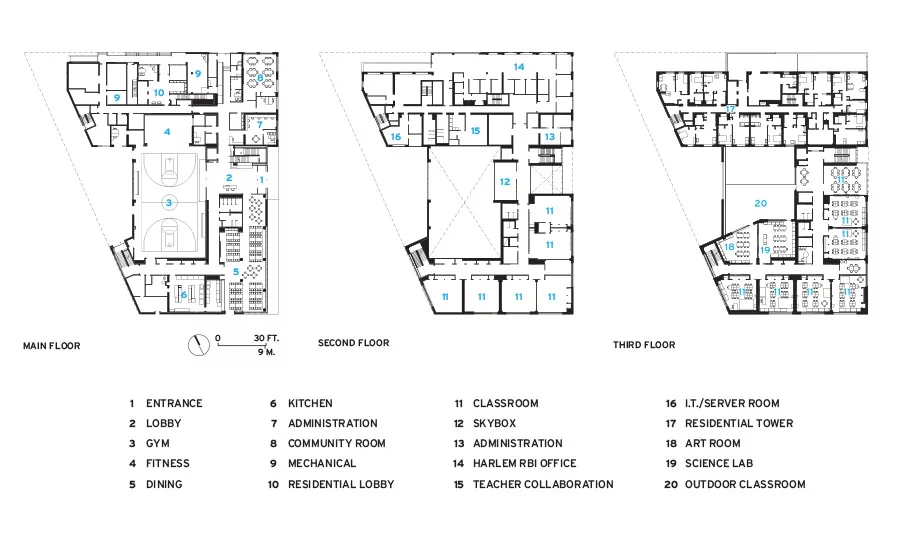
Image courtesy Perkins Eastman
Architects & Firms
New York
You might say that East Harlem in Manhattan is well-known for the wrong reasons, such as high rates of crime and joblessness. Over a quarter of the low- and moderate-income residents in the area north of 96th Street between Fifth Avenue and the East and Harlem rivers occupy New York City Housing Authority projects. But the neighborhood, traditionally called El Barrio for its largely Latino population, has shown significant signs of change—and not just gentrification as landlords renovate apartments to lure young professionals able to pay higher rents.
Certain substantive initiatives are bolstering the future of the existing community too. One prime example is the DREAM Charter School, which moved into a crisply tailored, light-filled building last August. The K–8, four-story facility for 450 students is part of a new mixed-use complex—the East Harlem Center for Living and Learning, which includes 89 units of affordable housing, along with offices for nonprofit groups.
Its architects, Perkins Eastman, designed a U-shaped block to extend from 103rd to 104th streets on the west side of Second Avenue, most of which is devoted to the 63,000-square-foot school, with the 11-story, 151,000-square-foot residential wing filling out the north edge. While the cladding of the $24 million steel-framed educational structure is a Roman-style brick, richly hued ironspot masonry sheathes the adjoining concrete-framed residential component (developed by the Jonathan Rose Companies).
Both maintain their own identity but “do not depart radically from the physical context,” says Christine Schlendorf, principal in charge of the school for Perkins Eastman. “Putting the two programs together was a challenge,” notes Mark McCarthy, design principal for the firm. To make everything fit on the tight 30,000-square-foot site, the architects located school functions and nonprofit offices on the first two floors of the housing arm.
Expansive glass on the exterior walls brings daylight into the core of the building. As you come into the main lobby from a small park running along Second Avenue, you see straight ahead into the 30-foot-high gym and event hall, backed by a rear glass wall. Similarly, ample glazing runs along the dining area to the south of the entrance as well as the community room on the northeast corner, allowing passersby to view the center’s activities within.
Upstairs, large window walls provide classrooms with views of trees, and abundant daylight, while additional glazing inside fosters the visibility of various activities. Another surprise comes when you discover an outdoor classroom on the third floor, on top of the gym. Here wood benches, decking, and a variety of plantings encourage small groups to come outside from the classrooms when weather permits.
Some 40 or 50 years ago, education experts sought to seal classrooms by claiming that windows caused students to be distracted, encouraged vandalism, and raised energy costs. Clearly, those days are long gone. “I like being able to see outside,” says second grader Louis Gomez, who also admires the school’s straightforward, L-shaped floor plans: “You know where to go.”
The new home for the DREAM Charter School is the result of an ambitious plan by the Harlem RBI (“Runs Batted In” in baseball parlance), a nonprofit development program for the young. Founded in 1991, the organization seeks to keep neighborhood kids from joining gangs and taking drugs through its sports and education programs. The group’s baseball diamond (called the Field of Dreams) at 101st Street and First Avenue has proved to be hugely popular.
The charter school, founded in 2007, at first had to be located in spaces borrowed from public schools. While a part of New York City’s school system, DREAM Charter offers smaller classes and more intensive educational programs than most public schools. Special-needs students form about 25 percent of its population. By law, the lottery system determines admission, with preference given to siblings, children of staff members, those living in the neighboring public housing, as well as the East Harlem community.
A visit on a late-fall afternoon corroborated the claims that larger classes of 25 and more would have two instructors and that discrete areas would be devoted to one-on-one tutoring. The energy and passion of the school head, Eve Colavito, and the staff and students were palpable, even among the assemblage of second graders about to tackle Pachelbel’s Canon in D on the xylophone. One sixth grader, Aniya King, says she has been in the DREAM school since kindergarten. Says this old-timer of the new facility, “The settings are amazing. I get even more help and teacher support.” Rich Berlin, the executive director of Harlem RBI, which has its offices here, adds that the architecture reinforces the culture of the school and the opportunities offered inside. From the point of view of its students and its clients, the design has hit the ball out of the park. The Field of Dreams now has a proper educational symbol to complement its courageous agenda.
PeopleArchitect: Perkins Eastman — Michael Lew, principal in charge; Christine Schlendorf, project manager; Mark McCarthy, principal designer (school); Joe DesRosier, principal designer (residential); Jonathan Thomas, project designer; Shaon Arrindell, project architect (residential); Melissa Babb, project architect (school); Michael Cheng, construction administration (residential); Alex Soto, construction administration (school); Jenny Aleman, interior design (school) Engineers: GACE Consulting Engineers (structural); MG Engineering (m/e/p); AKRF (civil) Consultants: SCAPE (landscape); Steven Winter Associates (sustainability) contractor: Citnalta Construction Corp (school) clients: Harlem RBI, Jonathan Rose Companies, Civic Builders owner: Harlem RBI Size: 63,000 square feet (58,000 square feet, school; 5,000 square feet, offices) Cost: $24 million (construction, school)
Completion date: September 2015 |
ProductsMASONRY: Belden/Tri State metal panels: METL SPAN METAL-FRAME WINDOWS: A.D.S. Design glass, insulated panels: PPG interior glazing: Oldcastle BuildingEnvelope metal and fire-control doors: L.I.F. Industries acoustical ceilings, suspension grid, and wood paneling: Armstrong Interior Brick: Trikeenan paints and stains: Sherwin Williams
resilient flooring: Mannington, Azrock, Johnsonite, Forbo
|
Looking for a reprint of this article?
From high-res PDFs to custom plaques, order your copy today!