Architectural Record
search
cart
facebook twitter linkedin youtube
  • Sign In
  • Subscribe
  • Sign Out
  • My Account
Architectural Record
  • NEWS
    • Latest News
    • Awards
    • Interviews
    • Obituaries
    • Podcasts
      • Design:Ed Podcast
      • Sponsored Podcasts
  • OPINION
    • Book Reviews / Excerpts
    • Exhibition Reviews
    • Forum
  • EXCLUSIVES
    • Videos
    • Design Vanguard
    • Top 300 Firms
    • Sponsored Content
    • Sponsored eBooks
    • From the Archives
  • CONTINUING ED
    • Editorial Continuing Ed
    • CE Center
    • CE Academies
  • PROJECTS
    • Buildings By Type
    • Reuse & Renovation
    • Museums & Arts Centers
    • Colleges & Universities
    • Multifamily Housing
    • Interiors
    • Lighting
    • Kitchen & Bath
  • HOUSES
    • Record Houses
    • House of the Month
    • Featured Houses
  • PRODUCTS
    • Products by Category
    • Record Products of the Year
    • Latest Products
  • EVENTS
    • Dates & Events
    • Record on the Road
    • Innovation Conference
    • Sustainability in Practice
    • Women In Architecture
    • Webinars
    • Ad Excellence Awards
    • Submit an Event
  • CONNECT
    • Ask RECORD AI
    • Newsletters
    • Contact
    • Advertise
    • Editorial Calendar
    • Store
    • Customer Service
  • SUBMIT
    • Submission Guidelines
    • RECORD Competitions
  • MAGAZINE
    • Subscribe
    • My Account
    • Digital Edition
    • Current Issue
    • Firm Pass
    • Historic Archive

Death, Life, and Libeskind

By Brian Hanson, Nikos Salingaros
World Trade Center Museum Proposal
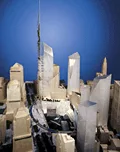
In Libeskind's December 18, 2002 proposal, a museum at the epicenter of Ground Zero leads out into a memorial space, where the huge retaining walls of the World Trade Center's basement would be kept as relics. The footprints of the towers would be kept free of human intrusion. Half of the memorial space around the footprints would only be open to family members of those killed on September 11. A great circular walkway would lead around the site and down into the memorial area. One of the surrounding buildings would tower to 1776 feet, making it the world's tallest. Gardens would adorn the top of that spire. Street-level shops and cafes and an underground mall and rail station complete the scheme.
Libeskind Proposal
The shape of Libeskind's proposed 1776-foot tower echoes the profile of the Statue of Liberty.
Plans for the WTC site
World Trade Center Museum Proposal
Libeskind Proposal
Plans for the WTC site
January 18, 2016

Daniel Libeskind's inclusion on the short list of architects who have been asked to propose designs for rebuilding the World Trade Center site and the region around it represents for him a great leap forward. His skewed, dismembered WTC design has been vehemently criticized for its intentional shock effect, but it is this very quality that endears it to the avant-garde. We wish to find a reasonable basis for analysis that bypasses the usual terms of debate on architectural deconstruction. That so far only generates polemics without hope of sensible resolution. Towards this end, it is necessary to dig deeper than superficial style.

Libeskind's participation in the WTC project symbolizes a jump from buildings that crystallize a particularly horrific experience, but do not seek to move on from it--such as his Jewish Museum in Berlin--into buildings that are meant to symbolize, even contribute to, "regeneration." Nevertheless, there is essentially no difference between what he believes commemorates death, and what commemorates life, for the simple reason that he gives them exactly the same geometrical properties. Whatever life he thinks he is injecting into his "regenerative" work is no more than the artificial appearance of life, as in a Golem, or Frankenstein monster--terms that will recur later in this essay.

There is indeed an enormous difference between structures that embody "life," and those that embody "death"--it is just that the currently fashionable architects don't seem to be aware of that difference, or at least of how to reflect it in their buildings. It suffices to look at Libeskind's World Trade Center proposal to see what we mean. A tall, unbalanced form with protruding, menacing components is supposed to be his answer to building on the memorial space while satisfying both the spirit of remembrance for the victims of the tragedy, and rekindling the life of the region through a regenerated urban fabric. We agree entirely with Libeskind when he says that "Architecture is an act of optimism; the site can't turn into a funerary area." Nevertheless, we are convinced that his intervention would endow the site with neither life, nor optimism.

AN ARCHITECTURE OF DEATH


Daniel Libeskind is one of a very few contemporary architects whose work constitutes a recognizable "brand." The brand consists of sharp, angular, metallic shards, with gravity-defying walls, and conveys the unmistakable thrill of transgression. The building most often used to illustrate these qualities is his Jewish Museum in Berlin. Physically impenetrable except via an underground route through a baroque courthouse, this building embodies completely in its architecture the various fates suffered in the 1930s and '40s by German Citizens who were Jewish, or who had some Jewish ancestry. The introduction into it of mundane exhibits, some time after its opening, was undertaken with fear and trembling. While the objects collected by the Museum strive to paint a portrait of Jewish LIFE--stretching over a period of one and a half millennia no less--the building that houses them is preoccupied by the DEATHS visited upon the Jewish people of Europe during the first half of the last century.

It is a testament to Libeskind's achievement that he reproduces the visceral revulsion of the Extermination Camps--not by copying their insipid, industrial Bauhaus style, but by using high-tech materials to define a specific geometry. This geometry succeeds in making us anxious and physically ill, and recreates the terrible purpose behind the camps--a rekindling of unspeakable evil, the human spirit's darkest and most horrible forces--by triggering our memory and senses strictly through form, space, and surface. A visitor to the Berlin Museum may well feel sick and depressed after going through the Jewish Department Extension, and this, we believe, is an appropriate experience.

In those of Libeskind's buildings which speak above all of despair, exile, and annihilation, there is a deliberate "geometry of death" at work--one so powerfully present that it threatens to suffocate any tokens of life that dare occupy its spaces. At the same time, we would expect to see, in those buildings which speak of regeneration, a corresponding "geometry of life." For a building to participate in regeneration there surely must be something generative about it, something life-giving in its very forms. However, search his work as you will, the "geometry of life" is nowhere to be found. Despite Libeskind's words, it is the "geometry of death" which predominates in his forms, and which ultimately compromises those of his works through which he hopes to effect reconnection or reconciliation.

These phrases, "the geometry of death" and "the geometry of life" are not used loosely here, or by way of analogy, but with the very specific meaning they have acquired over the last two decades, in scientific studies of life processes and living complexity--a body of work to which Libeskind will occasionally pay lip-service. Human beings demonstrate more affinity with buildings and environments which are shaped by processes like those that give rise to life, than those which are not, or which choose for some special reason to deploy a geometry deliberately counter to living processes. This emphasis on process is crucial, because so much of what has been deemed to be "organic" in twentieth century architecture--whether it be Frank Lloyd Wright's Guggenheim spiral in New York or the double-helix megastructures of Kisho Kurokawa's New Tokyo--has been merely a formal analogy of life, rather than life itself.
 

Looking for quick answers on architecture and design topics?
Try Ask RECORD, our new smart AI search tool.
Ask RECORD →

KEYWORDS: World Trade Center

Share This Story

Looking for a reprint of this article?
From high-res PDFs to custom plaques, order your copy today!
Brian Hanson is an Architectural historian, and former Secretary in Architecture to HRH The Prince of Wales.
Nikos Salingaros is a Professor of Mathematics, and an Architectural Theorist, Department of Applied Mathematics, University of Texas at San Antonio.
Previous 1 2 3 4 Next

Post a comment to this article

Report Abusive Comment

Subscription Center
  • Create an Account
  • Start a Subscription
  • Manage My Account
  • Sign Up for Newsletters
  • Visit Customer Service
  • Update Preferences

More Videos

Sponsored Content

Sponsored Content is a special paid section where industry companies provide high quality, objective, non-commercial content around topics of interest to the Architectural Record audience. All Sponsored Content is supplied by the advertising company and any opinions expressed in this article are those of the author and not necessarily reflect the views of Architectural Record or its parent company, BNP Media. Interested in participating in our Sponsored Content section? Contact your local rep!

close
  • TAMLYN XtremeTrim Exterior Trim
    Sponsored byTamlyn

    Designing Cleaner Panel Facades: Why Exterior Trim Details Matter

  • Building with Vapor Barriers
    Sponsored byReef Industries, Inc.

    Vapor Barriers Help Control Moisture in Tighter Building Designs

  • Duct Interior with Prodeq System
    Sponsored byHenry, a Carlisle Company

    Designing Resilient Water Containment Systems

DESIGN:ED Podcast
Listen to Architectural Record’s DESIGN:ED Podcast

Events

June 16, 2026

Focus on the Façade: Exploring Steel, Timber & Fire-Rated Curtain Walls and Channel Glass Systems

Credits: 1 AIA LU/HSW; 1 AIBD P-CE; 0.1 ICC CEU

Explore modern façade and glazing systems that enhance daylighting, fire safety, and thermal performance while expanding architectural design possibilities.

June 18, 2026

Rebooting the Aging Office Building

Credits: 1 AIA LU/HSW; 1 AIBD P-CE; 0.1 ICC CEU; 1 PDH

Explore façade retrofit strategies and award-winning design concepts that can transform aging office buildings into healthier, higher-performing workplaces for today’s hybrid workforce.

View All Submit An Event

Products

2026 Architect's Square Foot Costbook

2026 Architect's Square Foot Costbook

See More Products

Popular Stories

Coronado Bridge

The Architect’s Guide to San Diego

SanDiegoAirport

Top 300 Architecture Firms of 2026

Crane Cove, ONO

Design Vanguard 2026 Winners

House on a Hill

Design Vanguard 2026: Forma

House A on a Hill

Design Vanguard 2026: Santiago Valdivieso

Focus on the Facade - Free Webinar - June 16, 2026

Related Articles

  • Sigurd Lewerentz: Architect of Death and Life.

    Review of 'Sigurd Lewerentz: Architect of Death and Life'

    See More
  • The Death and Life of Old Beijing

    See More

Related Products

See More Products
  • 1118522532.gif

    Future Details of Architecture

  • postmodern design.jpg

    Postmodern Design Complete

See More Products
×

The latest news and information

#1 Source for Architectural Design, News and Products

SUBSCRIBE
  • RESOURCES
    • Advertise
    • Contact Us
    • Submit
    • Store
  • ACCOUNT CENTER
    • Create an Account
    • Start a Subscription
    • Manage My Account
    • Sign Up for Newsletters
    • Visit Customer Service
    • Update Preferences
  • PRIVACY
    • PRIVACY POLICY
    • TERMS & CONDITIONS
    • DO NOT SELL MY PERSONAL INFORMATION
    • PRIVACY REQUEST
    • ACCESSIBILITY
  • SERVICES
    • Marketing Services
    • Reprints
    • Market Research
    • List Rental
    • Survey/Respondent Access
  • STAY CONNECTED
    • Linkedin
    • Facebook
    • Instagram
    • YouTube
    • X (Twitter)

Copyright ©2026. All Rights Reserved BNP Media, Inc. and BNP Media II, LLC.

Design, CMS, Hosting & Web Development :: ePublishing