Death, Life, and Libeskind

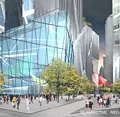
EXPRESSING DEATH USING GEOMETRY
A "geometry of death" reverses the properties of living structure, while at the same time suppressing the mechanisms by which human beings connect to the world. The first component recognizes death outside of us--its rules are summarized as: an absence of the organized complexity found in organisms, and the presence of structural disorganization that marks their death and decomposition. This definition encompasses not only formerly living structures in the process of decomposing, but also structures that could never have been alive in the first place--what are commonly recognized as "alien" forms. An alien structure threatens us, making us anxious. Such structures do exert an undeniable fascination--this is the fascination children and adolescents have for things that scare them.
The second component of the "geometry of death" recognizes death within us. It indicates (or mimics) a failure of our cognitive mechanisms that is characteristic of the onset of our own death. Its purpose is: to reduce our physical experience of the world by providing insufficient information to understand our environment. The method of achieving this is to create spaces and surfaces that frustrate our sensory embedding within our surroundings. For human beings to be fully alive means more than just to metabolize and reproduce--it presupposes our sensing and understanding the world. If we are confronted with obvious physical structures around us, which we see but to which we cannot connect, such an environment threatens our conscious existence as embodied beings. The anxiety we feel reflects this loss of connectivity.
These two components suggest specific techniques for simulating the geometrical presence of "death" in buildings: (i) Dehumanizing structures and spaces--either too small or too large for a human being to relate to, built deliberately without a connective scaling hierarchy. (ii) Shapes that stand out from nature by lacking connective symmetries and attachment to the gravitational axis. (iii) Random, geometrically disconnected units that have no obvious means of support. (iv) Corners and sharp edges projecting toward us. (v) Sheer, empty surfaces without internal differentiations, which shift our perceptual attention to their edge--surfaces unresponsive or intentionally repulsive to our visual and tactile senses, and which can be drab and colorless, smooth or rough, or made of sleek materials such a shiny metal and glass.
A third component of the "geometry of death" is: to mimic the disorientation that comes about when we lose our ability for spatial navigation. Part psychological, part physiological, we possess a complex of senses that position us in the physical world and permit our locomotion. To deny this sense means to cut us off from our circulation realms. This is achieved via the techniques we have already mentioned, such as stairs that lead to nowhere; corridors that are arbitrarily cut; entrances or exits that are impossible to find; and, most of all, a deliberate circulation constrained by built structures that force us to walk in a direction different to what seems natural to us.
Although not the only architect working with the above rules to define a strikingly noticeable "style", Libeskind is certainly one of its most brilliant exponents. Of course, these rules are a well-kept trade secret, and have never, to our knowledge, been written down. They are applied with such confidence and deliberate intention that we find it hard to suppose that this is accidental, or that they could in any way be confused with their antithetical, "life-giving" rules.
"LIFE" IN ARTIFACTS
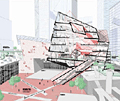
In the case of the Victoria and Albert Museum, those who fail to see the presence of the "geometry of death" in Libeskind's proposed extension also clearly fail to appreciate what it is that this Museum houses. We have in this unparalleled collection a group of objects that embodies "life" to the greatest extent possible--the products of artistic, religious, and technical traditions that aim to capture mathematical life (as defined by contemporary complexity theorists) using only human intuition and humble materials. Those artisans and craftsmen did not have our latest scientific insights to help them, but relied instead on lessons learned over millennia of human ingenuity.
If we were to search the world over for man-made objects that best reflect the properties of what we now understand to be a "geometry of life", and which most closely capture the spirit (though not necessarily the form) of natural and biological structures, then we would come up with something like the catalogue of the V&A's collection--Chinese Shang bronzes; Byzantine miniatures; European Mediaeval sculptures; Seljuk Minai bowls; Iznik tiles; oriental carpets; Japanese sword guards; etc. This is discussed at length in Christopher Alexander's The Nature of Order (2003).
Looking for quick answers on architecture and design topics?
Try Ask RECORD, our new smart AI search tool.
Ask RECORD →
It is only appropriate that such objects--the prime representatives of a "geometry of life" applied to create artifacts that connect to the living beings that see and use them--be housed in a building with those very same qualities. If not, the structure will become locked in combat with these products of traditional crafts, representing a variety of sacred traditions, in the same way that the museums in Osnabrück and Berlin are in tension with their contents. Since Libeskind's design is, unlike almost all the objects in the museum, nihilistic, its effect would be to drain objects of their essential spiritual value.
Significantly, the V&A "Spiral" which Libeskind proposes is not a true spiral--i.e. a mathematical helix like Frank Lloyd Wright's Guggenheim. He is in fact coining a new term, the "contemporary spiral" lacking an axis, and thus continuing the task the Bauhaus began--to see "Gods … toppled, orders broken, walls smashed, the center removed." The V&A project is actually composed of lopsided, intersecting cubes, and bears an uncanny resemblance to the 1919 "Würfel [Dice] Komposition" by the Bauhaus's Johannes Itten.
CONCLUSION
If one looks beyond mere formal analogies of life to the mathematical patterns and processes which scientists are now pointing to as the source of life itself, then Libeskind's buildings are invariably dead. All his attempts to transfer a geometry appropriate to Holocaust Memorials (which, in that context, is restrictive of freedom) to buildings which are intended to celebrate, if not engender life, have failed, as they must inevitably continue to do so.
What about the relationship of Libeskind's buildings to their surroundings? The life of traditional environments is not just seen in the forms themselves, but contains the seeds of its own dissemination. As is well known, the structure of DNA is such that the information it contains can be replicated and passed on. Lacking life in their forms, Libeskind's buildings lack also (some would say, thankfully) the ability to reproduce. They stand as sterile objects within the city, the most they can hope for being to be "cloned", by some one or another camp-follower of deconstruction. While traditional architecture both lived and reproduced, by dint of its origins in relatively simple human activities, the architecture Libeskind provides would serve to propagate only an avant-garde elite which, for all its talk of openness, thrives on a new form of mystification.
Looking for a reprint of this article?
From high-res PDFs to custom plaques, order your copy today!