Color in Architecture: Part 5 and 6
Principles of Architectural Polychromy
From ARCHITECTURAL RECORD, May 1922
PART V: The Color Treatment of the Capital, Cornice and Other Architectural Items
The coloring of the various types of Greek capital is a subject worthy of greater elaboration than our space permits. Typical examples of the three orders have been selected to demonstrate the general principles of color location. In the Doric capital color figures to the minimum extent, despite the fact that it constitutes so prominent a feature in authenticated restorations of edifices designed after that manner.
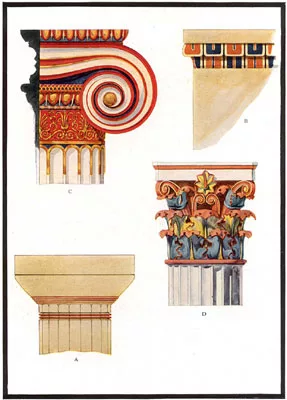
Theoretically, this is to be expected, and is consistent with the observation that the presence of color depreciates the appearance of structural strength; the stalwart character realized in the columns of this order would necessarily have been diminished had polychrome enrichment of a more elaborate character been developed. Archaeological research records red to have been the only color used on the echinas; where there is repetition of the channeling in certain examples, at the top of the shaft, a similar color treatment was adopted, as is shown in Diag. A (PlateV.); this constitutes the maximum extent of color decoration in the majority of instances. As the piers (B) have a lesser structural significance, greater color elaboration was permissible; our illustration is a typical example taken from the Temple of Zeus, Olympia: the piers of the Parthenon were treated in much the same manner. (See Collignon.)
Our illustration of the Erectheum capital is rendered after the restoration of Dr. Josef Durm, which shows the Ionic capital in all its magnificence. The colored volutes were treated after two fashions; in certain examples (e. g. Temple of Apollo Epicurus) a full torus forms the outer edge; this developed a wide range of tones in the red decorating it; its sharp shadow projection accentuated the brilliancy of the color. In the Erectheum capital a sharp angled channel replaces the torus, which, from the point of view of color development, is vastly superior.
As the volute turns, the color upon the planes which form the inner and outer faces of this incision, changes in strength, from the deepest tones possible under the circumstances of illumination, to the lightest. The color on the plane inclined from the light at the top of the cap starts in shadow; by the subtlest tone gradation, the deep tone gradually progresses to its maximum purity, as this plane becomes inclined to the light. The two planes forming the channel produce tone contrasts throughout the greater part of the volute, by reason of the difference in their angles to the sun's rays. The eye of the volute is supposed to have been gilt in the majority of cases.
The Corinthian cap in our illustration was exhumed at Olympia in comparatively good preservation. It is difficult to find data upon this subject, and this example is of particular interest, inasmuch as it demonstrates the application of the decorative principles of color alternation, and color separation. The foliated husk of the angle volutes and the lower tier of leaves are painted blue; the centre tier is painted yellow;* the yellow is also carried into the centre of the rosette, and on the stems of the lower leaf tier, realizing, as nearly as the motif permits, the appearance of alternating color. Unity in color effect is achieved by the method of separating bright colors with a fillet of another color, red serving this purpose in its outlining of the detail. This well-balanced distribution of red contributes much to the stabilizing of effect.
THE COLORING OF THE ROOF
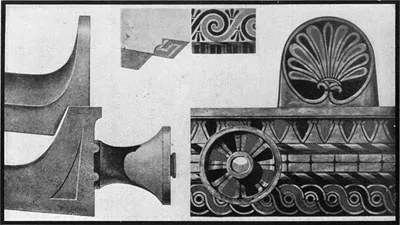
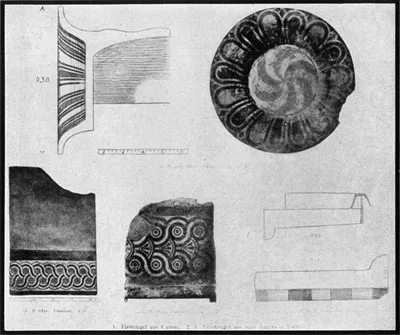
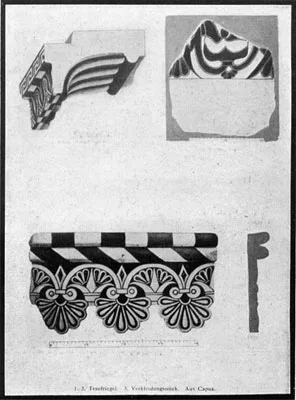
Owing to the great variety in roof designs it would be as difficult to generalize in treatment of this feature as it is upon the coloring of the capitals, were it not for the rigid adherence of the Greeks to fundamental aesthetic principles. Color elaboration and ornamental ingenuity were lavished upon the essentially decorative features. Polychrome and single color designs were developed upon the ridge tiles frequently adorned with antifixae; the cornice antifixae; the akroteria, and the vertical edge of the lowest row of roof tiles; when the latter projected beyond the face of the structure, the under side also was ornamented. The tiles of semicircular or rectangular section which bridged over the joints of the pantiles were occasionally treated with simple ornamentation. A great variety of decorative roof-tile is reproduced in Dachterrakotten aus Campanien, by H. Koch.
Looking for quick answers on architecture and design topics?
Try Ask RECORD, our new smart AI search tool.
Ask RECORD →
THE COLORING OF THE CORNICE
The treatment of the cornice in polychrome is one of the most difficult problems encountered in the planning of color for architectural effect. The designs developed upon each item must naturally be individually effective. By reason of the contiguity of the architectural members to be similarly treated, the design upon each must possess the quality of contrast, but must be devoid of competitive interest. The architectural integrity of each member must be preserved in decoration; that is to say, decorative values, or color values which have a mutual affinity, must not occur upon adjacent members. Finally, when viewed in mass, these varied design elements must constitute an entity of effect.
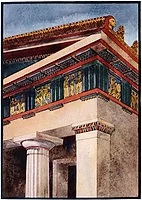
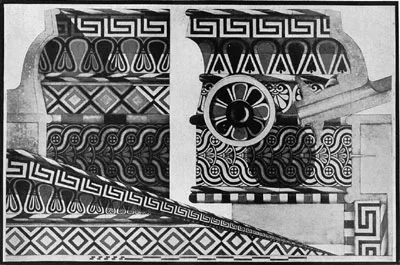
No better example could probably be found, embodying these complex design requirements, than the terra-cotta cornice of the Treasury of Gela. Great brilliancy in effect, combined with subtle color quality, is achieved by a very skillful use of two colors only--red and black, upon a buff terra-cotta ground. Despite the virile strength of each of these superimposed bands of ornamentation, no confusion is sensed architecturally.
This is due to the skill with which distinct design and color values are established upon each architectural unit. With the aim of keeping each molding distinct from its neighbor, our first impulse in design would probably be to vary the scale of proportion of detail upon each. This simple solution was deliberately avoided by the designer of this cornice. We find the broad lines which figure so prominently in each of the superimposed details to be of uniform width, and realize how important a factor this becomes in the ultimate unification of the grouped designs.
The proportionate use of the red and black is manipulated most skillfully, with the purpose of preserving the identity of each architectural unit. This is achieved in the simplest manner. The detail of the guilloche decorating the frieze is almost entirely in black, the minimum amount of red being introduced only upon the three small petals which occur at the interlacing of the bands. In the rectangular pattern above the guilloche, red prevails, black being used as a strongly contrasting note.
Above this decoration, we find a design so contrived that red and black are employed in alternation in equal proportions. Surmounting this group of patterns, the black fret is used, unrelieved by red, the obvious purpose being to create a border of sufficient strength to withstand the strong light against which it is placed. The manner in which the tori, which separate these varied designs, are decorated, is well worthy of study; no more effective or simple treatment could have been devised than these bands, chevrons, and spirals.
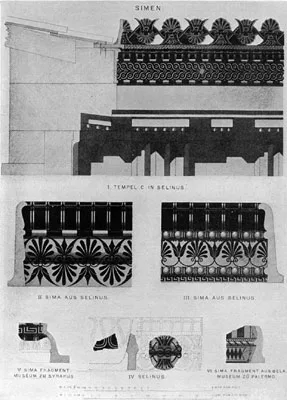
In Temple C. of Selinous a corresponding quality is realized; this, unfortunately, does not show in our illustration, which was taken from a color plate, the black and red having photographed the same tone. In this example the leaves decorating the cyma are treated in color alternation after the manner of Diag. E, Plate III. Refer to Parts I and II for illustrations showing cornice treatments of other types.
COLORED ORNAMENTATION UPON MOLDINGS
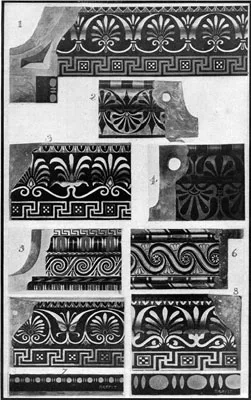
The following is a description of the color treatment of the ten examples illustrated:
No. 1. Cyma. Pointed black leaves upon a red ground decorate the upper member; these colors are separated by a white line. The principal motif is silhouetted in white upon a black ground; the husks of the anthemia and the bands connecting the scrolls are enlivened with red. The fret is red upon a black ground: the square motif is black and white.
No. 2. Cyma. Upper member; black leaves upon a red ground; outline and bud in white. Principal motif white on black; red outlines the husk of the central palmette in our illustration, and also outlines the centre of the other palmette. Fret, red on black; a red outline frames the square motif, which is in black and white.
No. 3. Cyma. Black ornamentation upon a red ground.
No. 4. Cyma. A black fret decorates the topmost fascia. The leaves below the fret are treated with red and black in alternation; the lines separating the leaves are black and the ground buff. Torus; Chevrons in red and black alternately, upon a buff ground. Scrolls and flower petals; red and black in alternation. Fascia; black chevrons on buff. Leaf decoration on lowest member, red and black alternately.
No. 5. Cyma. Red and black are arranged in alternation upon the leaves and palmettes; ground, buff or ochre.
No. 6. Frieze. The ground color of this molding is a terra-cotta buff. Tori; bands of red and deep mulberry in alternation in the horizontal direction, but not in the vertical. Scrolls, mulberry, with floral motif outlined in red. Red and mulberry on the two lower Tori in complete alternation.
No. 7. Cyma. Practically a replica of the color planning in No. 1.
No. 8. Cyma. As No. 1.
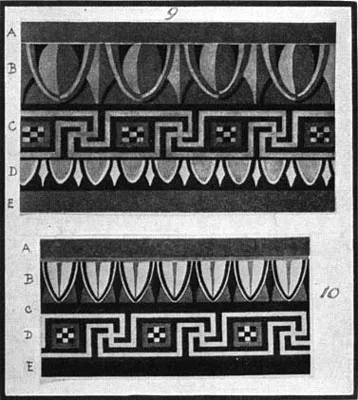
No. 9. Triglyph molding. (a) Dark blue. (b) "Eggs" light blue and yellow, black used to indicate the upper fullness of the eggs. (c) Fret, red and blue; frame of square motif yellow, chequers in centre of square light blue and black. (d) Light blue and white upon a red ground. (e) Dark blue.
No. 10. Triglyph molding. (a) Light blue. (b) White leaves, blue centre line; inner outline of leaf red; dart, red; ground blue. (c) Dark mulberry. (d) Fret, red and white; frame of square motif yellow, chequers black and white. (e) Dark mulberry.
ANTIFIXAE
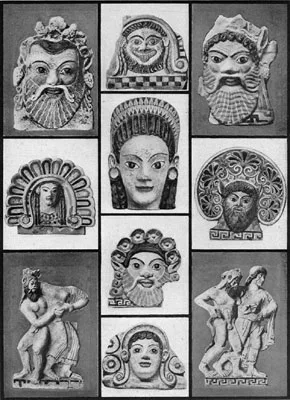
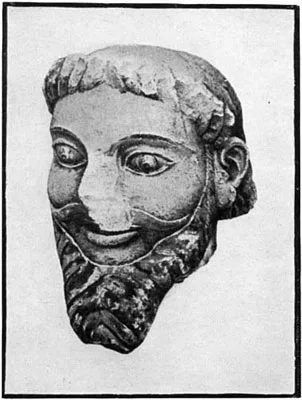
There is an enormous variety of interpretations of this detail. In Part III a few examples are reproduced of the simpler type, in which two colors are used in alternation upon the palmettes. The full-page illustration showing a variety of subjects, represents onIy a fractional part of the data which is available, and barely gives an impression of the latitude that the Greeks allowed themselves in design. Many of these have been taken from Van Buren's Figurative Terra-Cottas: a great variety can be seen in the H. Koch's Dachterrakotten Aus Campanien. Where the human head forms the motif, the following general formula for color treatment is followed: Hair and brows, black. Eyes; white eyeballs, red iris, black pupil. Eyelids; outlined in black. Lips, and often the cheeks, red. Yellow is used for certain accessory detail in some examples, e.g., berries or flowers. The earrings and jewelry on female heads are touched with color. When a shell crowns the head, the fluting or ornamentation decorating it is painted in alternating colors upon repeating detail. Though many examples can be seen which deviate from the above in minor details, this description of color location and treatment will be found to apply to the majority. The practice of outlining lips and eyes is general; the beard treatment shown in the top right and left illustrations is frequently practiced. The white lines drawn across the modelling are a simple means for rendering the waviness of the hair. Relative tone values have been reestablished in these cuts.
THE AKROTERION
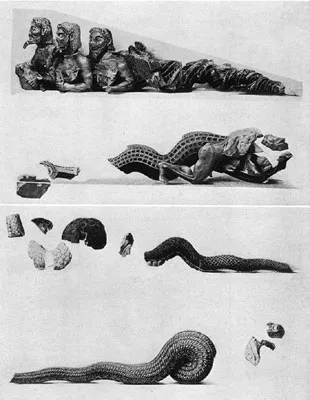
Comparatively recent discoveries by archaeologists reveal to some extent the degree to which the Greeks regarded the designing of this item as an opportunity for imaginative effort. The symmetrical designs, such as those found at Aegina and Olympia, represent only one phase of treatment. The beautiful akroterion of Eos and Kephalos comes, in all probability, from a large temple, as it measures m. o. 98 in height. Van Buren describes its coloring as follows: EOS; hair, brownish black; chiton, cream with a dark border; earrings and diadem, dark red with designs in cream and black. KEPHALOS; flesh, red; hair, brows and eyes, black. The ground is blue. The spirals on the reverse side are red and black upon a cream ground.
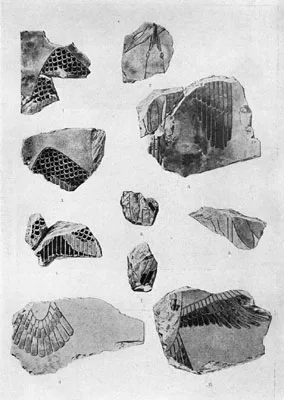
HORSE. This is a fragment from the lower part of an akroterion group. Head and neck, cream; mane, red; small feathers upon the shoulder of the wings, red outlined in cream; long wing feathers, inner row black and cream alternately; outer rows cream and red alternately; torus, black imbrications with a double outline in cream.
WARRIORS. The detail is intricately colored is black, red and cream.
With subjects of this character it is obviously impossible to generalize, but from the above description a fair impression of color effect may be gathered.
Looking for a reprint of this article?
From high-res PDFs to custom plaques, order your copy today!