Our Four Big Bridges
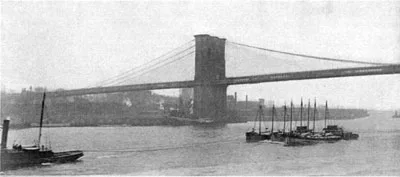
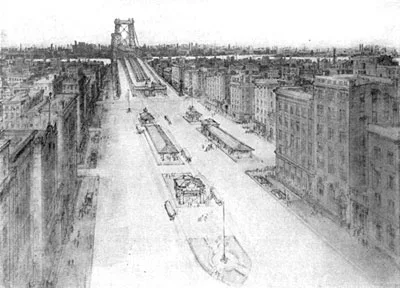
As monuments, the two latest bridges show as distinct an advance upon the earliest as the second shows a retrogression. And the credit for this advance cannot be withheld from Mr. Lindenthal, under whose administration of the Bridge Department the Queensborough Bridge was redesigned and virtually begun, though some progress had already been made in building the supporting piers, and Manhattan Bridge re-designed also, though the engineering changes of the revised design have again been discarded in the actual structure.
Mr. Lindenthal had the conviction that the common method of bridge-building, whereby the structure is designed by an engineer, and afterward, if at all, an architect invoked to give it such form and comeliness as may still be practicable, was a radically wrong method; that the "beautification" of a great structure originally designed without reference to beauty or expression was an impossible operation, too often a hopeless attempt to retrieve the irretrievable.
He held that in order to secure an artistic result in these great works, of which the general form must remain the chief element of their impressiveness, and of which the general form proceeding from new applications and in new materials of mechanical principles, they must from the first be the subject of aesthetic as well as of scientific investigation. In a word, the artistic constructor must be associated with the scientific constructor at every step from the very outset of the design. Messrs. Palmer and Hornbostel were accordingly associated with the design of the Queensborough while Messrs. Carrère and Hastings stood in the same relation to the design of the Manhattan, with the results for which we have so much reason to be grateful.
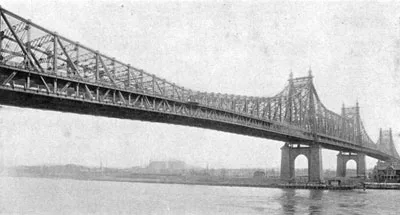
The intervention of Blackwell's Island at the point indicated as the most suitable for the Queensborough Bridge made the construction much more economically feasible than it would have been had the whole width of the river, here some 3,700 feet from shore to shore, been unbroken by land. From the architectural point of view, the facility involved an awkwardness, since the western water span is some 200 feet longer than the eastern. But the cantilever construction has here been so applied that even this marked failure of symmetry does not afflict the observer, and most observers, one imagines, would not be conscious of it, from any point of view they would be likely to take, unless it were pointed out to them.
The curve of the river spans approximates that of the Mirabeau Bridge at Neuilly on the Seine, only here reversed from a "deck span" supported by the cantilevers to a "through span," depending from them; and the Pont Mirabeau has imposed itself as the most artistic of metallic bridges, both in its general form and in the rational and exquisite treatment of constructional detail in metal. In this latter respect it is far superior to the later, more conspicuous and more familiar Pont Alexandre III. by the same authors.
For, while the Alexander Bridge is very impressive by its stately and decorated roadway as one passes over it, and by the boldness and grace of its arch, of a length of radius and slightness of curvature almost or quite unprecedented, one's admiration is much diminished when he walks under it and notes such solecisms of detail as the application, at intervals which must have been determined simply by the accepted proportions of a classic column, of capitals and bases in carved marble to posts of flanged and riveted metal, which are evidently continuous below the bases and above the capitals, and with the function of which the applied ornamentation in stone has evidently and even ostentatiously nothing whatever to do.
Though the lines of the Queensborough are, in fact, broken instead of curved, the effect of the bridge is that of four towers with three suspended spans, and is doubtless the best example of a cantilever of anything like equal extent, for the Mirabeau is, as a piece of construction, child's play compared with this gigantic work, of which the shortest of the three spans is probably equal to the whole extent of the French example. (Fig. 10.) Surely there is no great example of the cantilever construction on this side of the ocean which equals this in effectiveness, while the most famous example on the other, Sir Benjamin Baker's Forth Bridge, is commonly adduced as an awful example of ugliness.
Looking for quick answers on architecture and design topics?
Try Ask RECORD, our new smart AI search tool.
Ask RECORD →
Considering the Queensborough, one wonders if it would not have been better, in view of the conspicuousness and the artistic success of the towers, if the arches of the masonic substructure had been omitted altogether and only their stark and massive abutting piers retained to carry downward the lines of the so-called towers and prolong and emphasize the impression made by these, so that they should in effect be continuous from base to finial, instead of being interrupted, as here in effect they are, by the turning of the arches between the masonry supports.
Be that as it may, one cannot help seeing and feeling that "every joint and member" of the superstructure has been considered with reference to the expression as well as to the performance of its mechanical function, while those "features" of the construction which by their dimensions are entitled to an effect of grandeur without question convey that effect. Consider, for example, that westernmost of the four metallic towers, even from the point of view of the photograph, which is by no means the most favorable point of view.
What an expression of power it conveys, of power and grace, and grace, you will remember, is analyzed by Herbert Spencer into simply the expression of ease. Certainly that is an apt enough definition when, as here, it pertains to the doing of mechanical work, such as is imposed upon these erections, of which the height from base to summit nearly equals that of the towers of the suspension bridges, and would of itself make them very notable in any but the city of skyscrapers.
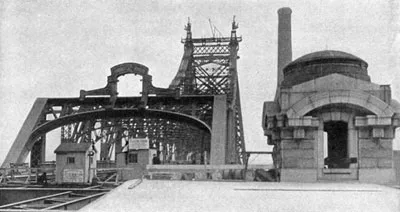
And consider also the simplicity and effectiveness, even in its actual and uncompleted condition, of the entrance (Fig. 11) at the extremity of the Manhattan "shore arm" of the cantilever, how much the effectiveness depends upon the simplicity, and how the simplicity enables and indeed demands a massiveness in the treatment of metal akin to the massiveness of the adjoining masonry. It were to "beat the bones of the buried," to point out how this simplicity is the summary and result of a process of simplification, and what a complicated and ineffectual network of Lars it was which the associated engineer and architect of the restudy have reduced to this simple expression.
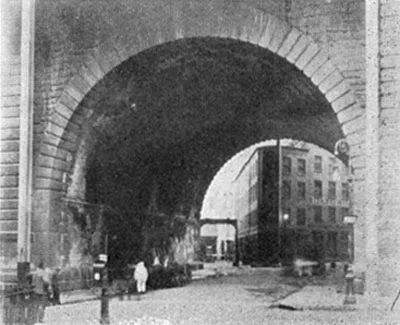
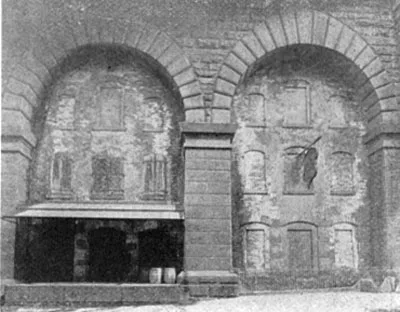
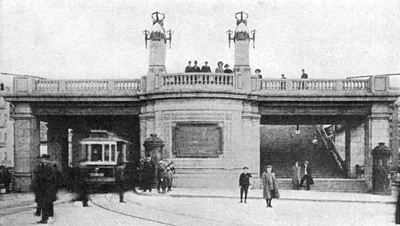
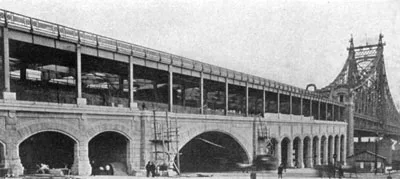
Observe also that the "grade" of some three and a half per cent. is here carried in a gradual and unbroken slope, from the level of the land on either side to the central span. For architecture in the academic and conventional sense, from which the idiomatic treatment of metal is excluded, we must resort to the approaches. Even there we fail to find the academic and the conventional prevailing in the most conspicuous of the features, the arcade in masonry, interrupted only by the wider arches of the street crossing. (Fig 12.)
Instead of the conventional "Florentine arches" of the earliest East River Bridge, deepest at the crown and shallowest at the impost, the form "the reverse of that dictated by mechanical considerations alone," we find that reversed form, dictated by mechanical considerations, in which the arches are deepest at the impost and shallowest at the crown. So far as I know, this is a novelty on this scale, and "in this connection."
But it is by no means on that account a caprice. It would in any case give, even to the spectator who did not stop to analyze it, that grateful sense of reality which a work of architecture must at least not contradict. In the present case it has the obvious practical advantage of giving the greatest amount of "head room" to a segment-headed arcade in a situation in which the maximum of height is a practical and an aesthetic desideratum.
The filling of the spandrils of the stone arches with an incrustation of particolored tiling in relief is an effective novelty, and even more effective is the ceiling of the interiors of the bays made by the piers and arches with tile-vaulting of low pitch and shallow curves, a mode of interior finish which, if not quite a novelty with us, is by no means as trite as it deserves to become, and which is here carried out in a particularly interesting way.
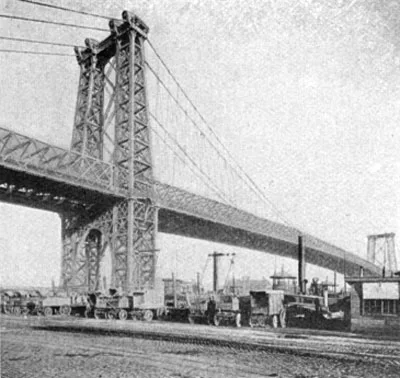
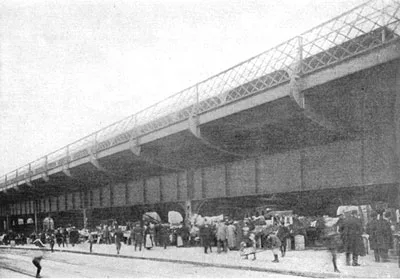
One can foresee an even more useful future function for these sheltered spaces than the warehouses of the East River Bridge fulfil, or than is fulfilled in the public market, only partially sheltered from the weather, which has accrued under the projecting roadways of the approaches to the Williamsburg. In the meantime a visit to these spaces, as yet unoccupied and hardly as yet "swept and garnished" must be of the greatest interest to any mind which is open to scientific convictions or to artistic impressions.
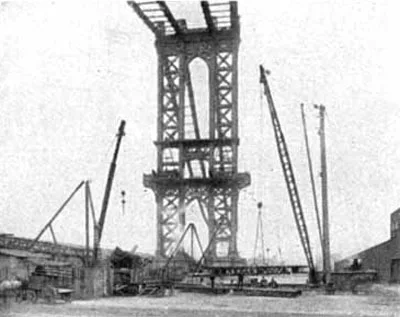
Least of all the four bridges in a condition to be judged is, of course, the fourth: (Fig. 13.)
Pendent opera interrupta minaeque
Murorum ingentes, aequataque machina coelo.
The Manhattan is absurdly and meaninglessly miscalled; it has no more to do with this island than any one of the other three. "The Wallabout" is a designation that would have local and historical significance. Most Manhattanese, one may assume, who have no occasion to cross the Fast River, recall the design of the Manhattan mainly in connection with the contention among the engineers to which the redesigning of it under Commissioner Lindenthal gave rise. Far be it from an incompetent layman to revive that old controversy.
But it is germane to the present purpose to point out that, whether scientifically preferable or not to the discarded and now readopted design, that of Mr. Lindenthal embodied a most impressive architectural conception. That was the conception of abolishing the "stiffening truss," which, as we have seen, is apt to become an unsightly appendage to a chain bridge, by incorporating its functions with that of the suspensory structure and leaving the roadway as a great street floor unencumbered at either side from end to end.
And it is only just to acknowledge the magnanimity of the subsequent administrations of the department in recognizing the enormous architectural improvements which had been evolved, together with what they regarded as an ineligible engineering design, and in retaining these improvements, so far as the changed design admitted. This magnanimity extends to the succeeding architects who have re-studied and refined the first design for the towers instead of discarding it. It is an article of architectural faith that any construction mechanically sound is susceptible of artistic expression.
It is true that even the general form and outline of the Manhattan are not yet developed. As one sees it now from the river, it does not appear, even of the great catenary curve, what it shall be, much less what the effect of it will be when its line is supplemented by that of the unbegun roadway beneath, and of the filaments which are to connect these two essential members of a suspension bridge. It is the metal work of the towers alone and the masonry of the anchorages alone that are sufficiently advanced to be judged. In these there is already abundant evidence of a more skilful and expressive and successful treatment than is to be found in any other suspension bridge anywhere.
Mr. Hornbostel's design for the towers, as exhibited some years ago in a model, was universally admired. But it is clear that this has been vastly - improved in the executed work. Instead of a trellis of metal panels in each of the three compartments into which the tower is divided above the roadway, this trellis is now confined to the lateral compartments, the central being opened to the top, where it is closed by an arch, with a great gain in expression, the uprights which support each its respective cable being unmistakably specialized for that function.
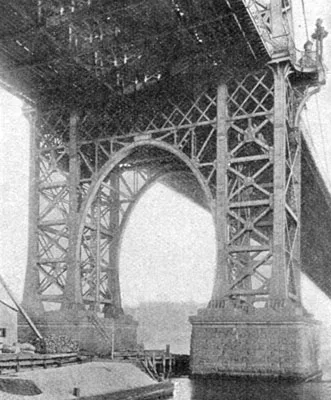
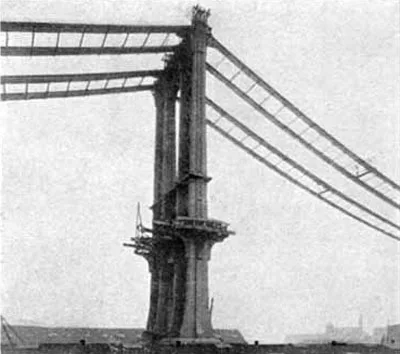
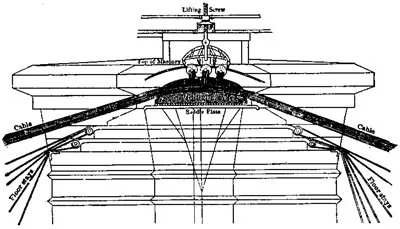
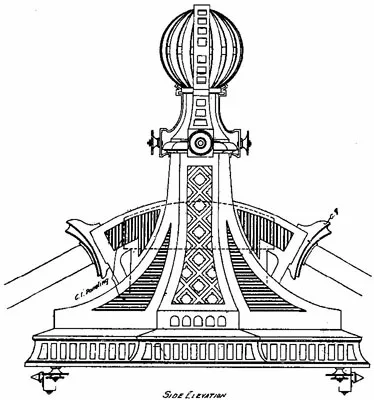
And there is an equal increase both in power and in refinement over the original design in the spreading substructure of the tower (Fig. 14), in which the function of every part speaks with forcible and eloquent expression, and the unity in variety of the whole is so impressive that it is impossible to regret that in these masonry was discarded for metal. It is instructive to compare the section of the summit of the towers of the East River Bridge, in which such blundering and mistaken pains were taken to ignore the actual purpose of their erection, to conceal what they were, in fact, all about, with the successful pains which have been taken in the -exposition and the emphasis of the offices of the cable holders and the cable saddles shown in the outline of the tops of the towers of the Manhattan (Fig. 15).
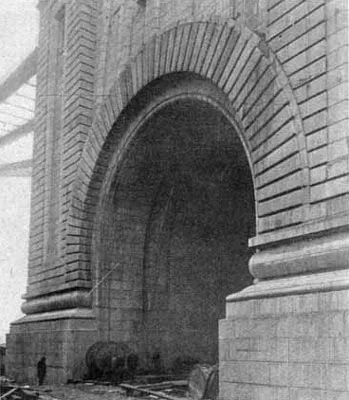
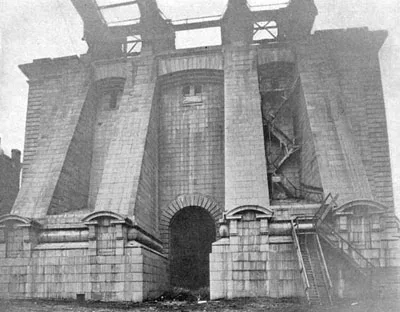
But the masonry of the anchorages is at least equally admirable with the metal of the towers, and equally expressive (Figs. 16 and 17). The effect of massiveness in these anchorages is almost more than Roman. They wear, indeed, an aspect of Egyptian immobility, and immobility is the very purport of their erection. Where in the world can one see a more impressive effect of sheer power than in the ordered masses of this Manhattan anchorage, which so few of us have thus far taken the trouble to see at all?
It is hard to say which is the more impressive view, that of the front, with its four great backward-raking buttresses, each corresponding to the great cable to restrain which is its office, or of the flank, in which the aperture destined for the passage of Cherry Street serves but to emphasize the solidity of its abutting masses. The four-foot torus which is the impost-moulding of the arch–and one wishes that it had been of a single instead of a double course of masonry–will give the scale of the monumental work which is given also by the human figure alongside. And what a scale!
Why man it doth bestride the narrow street,
Like a Colossus, and we, petty men,
Walk under its huge legs and peep about–
Egyptian mass! Egyptian immobility! "Pylons" is the only name for these huge erections, that so recall how the Egyptians "planting lasting bases, defied the crumbling touches of time and the misty vaporousness of oblivion." These anchorages give visible promise of a duration equal to that of the great temple of Ramses, or the great pyramid of Cheops. And it is as gratifying as it is exemplary to note that all this is so impressive because it is so expressive, because it is in detail, as well as in mass, a faithful and skillful following of the facts of the case.
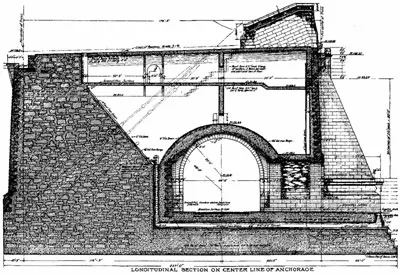
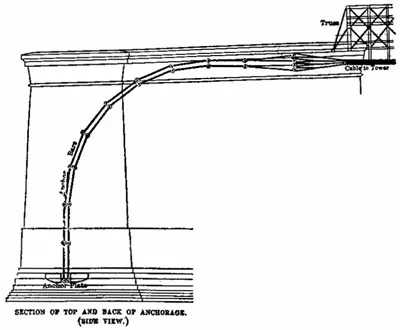
Each of the buttresses is modeled to express its special function of seizing and holding its allotted cable, which, as the section shows, it is reaching up to grasp. Even our old friend, the curved pediment, finds a meaning as the offset and dripstone of a buttress. The contrast is as vivid and as overwhelmingly in favor of the modern instance between the section of this anchorage (Fig. 18) and that of the crude and amorphous lump of the anchorage of the old East River Bridge (Fig. ig), as between the summits of their respective towers, though the process has been in one case that of attenuation and in the other that of accumulation.
There seem to have been generations of earnest and artistic workers between the crudity of the earlier and the refinement of the later of two works which, in fact, less than a single generation divides. It is a great advance. The Queensborough and the Manhattan Bridges give promise of a final and triumphant refutation of the official European criticism that "public works in America are executed without reference to art."
Looking for a reprint of this article?
From high-res PDFs to custom plaques, order your copy today!