In the Cause of Architecture, VII: The Meaning of Materials—Concrete
An essay from August, 1928, by Frank Lloyd Wright.
What then should be the Aesthetic of Concrete?
Is it Stone? Yes and No.
Is it Plaster? Yes and No.
Is it Brick or Tile? Yes and No.
Is it Cast Iron? Yes and No.
Poor Concrete! Still looking for its own at the hands of Man.
Perhaps the term “concrete” popularly meaning conglomerate, in this connection, denotes it the mongrel, servile as such, destined to no more than the place of obedient servant in the rank of materials.
Looking for quick answers on architecture and design topics?
Try Ask RECORD, our new smart AI search tool.
Ask RECORD →
Terra cotta, the fanciful, however, though less artificial, is not much more fortunate in character and make-up. The two materials have much in common. Tera cotta having the great advantage of standing up to be modelled and becoming indestructible, colorful and glazed when fired, a comparatively expensive process.
The chief difference between stone and concrete lies in the binding medium which, in the case of stone, is of the stone itself – a chemical affinity.
In the case of concrete it is a foreign substance that binds the aggregate. There is little or none other than a mechanical affinity in concrete.
But for this difference concrete would be, in fact, a true natural stone. And taking this difference for granted it is more truly and artificial stone than it is anything else; the nature of the artifice enabling the artificer to enter at the time the mixture is in a state of flux, to give it whatever shape he may desire.
Yes, artificial stone it is that concrete usually becomes.
But the essential difference between stone and concrete is still unconsidered. And that essential difference is the plasticity of the material itself as distinguished from natural stone which has none at all.
I should say that in this plasticity of concrete lies its aesthetic value. As an artificial stone, concrete has no great, certainly no independent, aesthetic value whatever. As a plastic material – eventually becoming a stone-like in character – there lives in it a great aesthetic property, as yet inadequately expressed.
To design a concrete pattern for a casting that would feature this flow of the material might be possible and so allow its plastic nature to come through the process into artistic expression, thus distinguishing concrete from stone. I have seldom seen it done unless by accident. Of course, where the material is tamped relatively dry or beating into molds there is no such problem.
There is another plastic possibility in treatment. The material en masse may be printed, “goffered,” while fresh and wet, as the printer’s die embosses his paper – and such effects had as may be seen in stone where fossil remains of foliage or other organic forms, either cameo or intaglio, are found in it. And this treatment would be nearer to its nature, aesthetically, than is any casting whatsoever.
The pre-cast slab, rolled to small thickness but large in size, is a means common to all materials that set hard from a flux and absorb reinforcement. But there is little or nothing in that treatment to distinguish concrete from sheet steel or glass or plaster.
The slab may be smaller, be printed with design appropriate to the material and be knit together with steel laid in wide grooved joints and the whole poured and locked together into a thin slab, and express the nature of the material itself no more than it would express terra cotta or glass or metal, except as the feeling of the design and mass, as a whole, reflected it.
Most usefully then, probably, in this mechanical era, concrete is another passive or negative material depending for aesthetic life almost wholly upon the impress of human imagination. This element of pattern, however it may mechanically be made to occur, is therefore the salvation of concrete in the mechanical processes of this mechanical age, whenever it rises as material above the mere mass into which it may naturally be thrown on the ground and where it serves as such better than any other material.
Of course, always there is the interior content or aggregate of the concrete to work up in various ways, giving texture and color to the block, slab or mass. These treatments are too familiar to require much comment, and are all useful to quality the material, but of no great significance in the broad question of finding the aesthetic interpretation that will best express the nature of concrete considered as a material.
These expedients all partake of the nature of stone and bring concrete still nearer as artificial stone, the sole advantage of the concrete being that it may be formed in place in great size, by small means, by way of accretion – whereas stone must be got out, expensively cut, transported and lifted to place in bulk.
Thus concrete becomes the ideal makeshift of this, the vainglorious Makeshift Era.
There never was a more “inferior” building material than was the old concrete block unless it was ungalvanized sheet-iron. The block was cheap imitation and abominable as material when not downright vicious. Every form it undertook it soon relegated to the back-yard of aesthetic oblivion.
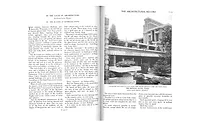
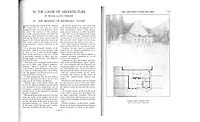
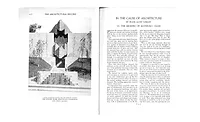
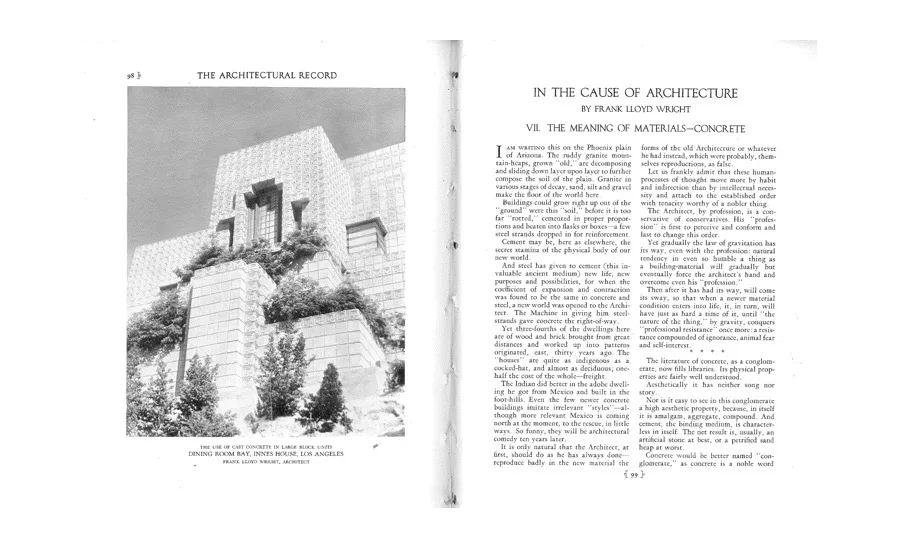
Several of the illustrations show what that self-same degraded block may become with a little sympathy and interpretation, if scientifically treated.
Herein the despised thing becomes at least a thoroughbred and a sound mechanical means to a rare and beautiful use as an architect’s medium, as the “block” becomes a mere mechanical unit in a quiet, plastic whole. And this mechanical use of concrete as a mechanical material has only just begun. In it, along, is a medium for an “Architecture” – humble as it is before Imagination enters.
And there remain to be developed those higher uses – non-mechanical, plastic in method, treatment and mass – to which I have referred, working naturally with color into truly plastic beauty.
Looking for a reprint of this article?
From high-res PDFs to custom plaques, order your copy today!