In the Cause of Architecture, VI: The Meaning of Materials—Glass
An essay from July, 1928, by Frank Lloyd Wright.
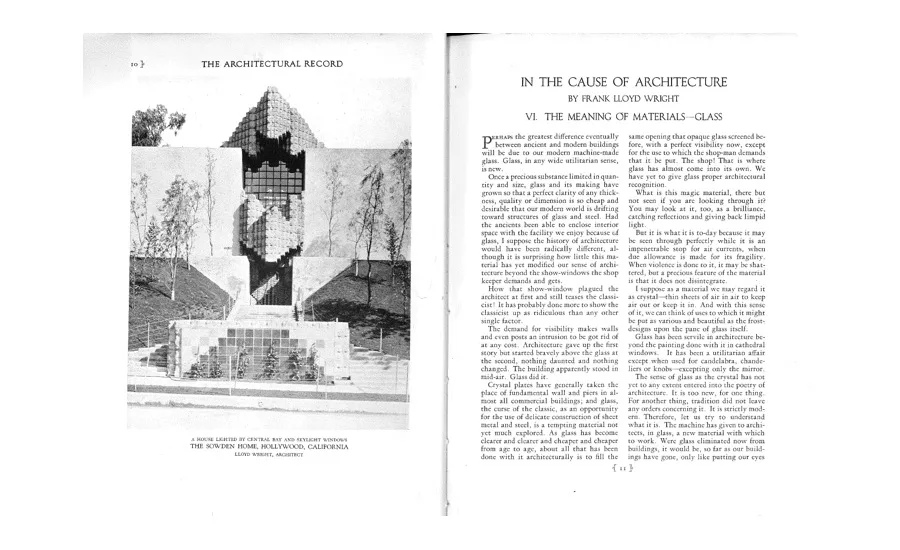
From Architectural Record, July, 1928. Read a PDF of the original article here.
Perhaps the greatest difference eventually between ancient and modern buildings will be due to our modern machine-made glass. Glass, in any wide utilitarian sense, is new.
Once a precious substance limited in quantity and size, glass and its making have grown so that a perfect clarity of any thickness, quality or dimension is so chap and desirable that our modern world is drifting toward structures of glass and steel. Had the ancients been able to enclose the interior space with the facility we enjoy because of glass, I suppose the history of architecture would have been radically different, although it is surprising how little this material has yet modified our sense of architecture beyond the show-windows the shop keeper demands and gets.
How that show-window plagued the architect at first and still teases the classicalist! It has probably done more to show the classicist up as ridiculous than any other single factor.
The demand for visibility makes walls and even post an intrusion to be got rid of at any cost. Architecture gave up the first story but started bravely above the glass at the second, nothing daunted and nothing changed. The building apparently stood in mid-air. Glass did it.
Crystal plates have generally taken the place of fundamental wall and piers in almost all commercial buildings; and glass, the curse of the classic, as an opportunity for the use of delicate construction of sheet metal and steel, it a tempting material not yet much explored. As glass has become clearer and clearer and cheaper and cheaper from age to age, about all that has been done with it architecturally is to fill the same opening that opaque glass screened before, with a perfect visibility now, except for the use to which the shop-man demands that it be put. The shop! That is where glass has almost come into its own. We have yet to give glass proper architectural recognition.
What is this magic material, there but not seen if you are looking through it? You may look at it, too, as a brilliance, catching reflections and giving back limpid light.
Looking for quick answers on architecture and design topics?
Try Ask RECORD, our new smart AI search tool.
Ask RECORD →
But it is what it is to-day because it may be seen through perfectly while it is an impenetrable stop for air currents, when due allowance is made for its fragility. When violence is done to it, it may be shattered, but a precious feature of the material is that it does not disintegrate.
I suppose as a material we may regard it as crystal – thin sheets of air in air to keep air out or keep it in. and with this sense of it, we can think of uses to which it might be put as various and beautiful as the frost-designs upon the pane of glass itself.
Glass has been servile in architecture beyond the painting done with it in cathedral windows. It has been a utilitarian affair except when used for candelabra, chandeliers or knobs – excepting only the mirror.
The sense of glass as the crystal has not yet to any extent entered into the poetry of architecture. It is too new, for one thing. For another thing, tradition did not leave any orders concerning it. It is strictly modern. Therefore, let us try to understand what it is. The machine has given to architects, in glass, a new material with which to work. Were glass eliminated now from buildings, it would be, only like putting our eyes out. We could not see out or see into the building. We have gone so far with it as to make it the eyes of the building. Why not now combine it with steel, the spider’s web, spin the building frame as an integument for crystal clearness – the crystal held by the steel as the diamond in held in its setting of gold – and make it the building itself?
All the diversity of color and texture available in any material is not only available but imperishable, in glass. So far as deterioration or decay is concerned, it is possible now to preserve the metal setting for an indefinite period. And it is the life of this setting along that would determine the life of the building. It is time to give attention to that setting.
Shadows have been the brush-work of the architect when he modeled his architectural forms. Let him work, now, with light diffused, light refracted, light reflected – use light for its own sake – shadows aside. The prism has always delighted and fascinated man. The Machine gives him his opportunity in glass. The machine can do any kind of glass – thick, thin, colored, textured to order – and cheap. A new experience is awaiting him.
Then why are modern cities still sodden imitation of mediaeval strongholds? Black or white slabs of thick glass have already gone far as substitutes for marble slabs. They could easily go farther for their own sake, in walls of buildings. Glass tiles, too, are not uncommon. Nor are glass mosaics an unusual sight.
All these uses together would form an incomparable palette for an architect. The difficulty is, architects are bound by traditional ideas of what a building must look like or be like. And when they undertake to use new materials, it is only to make them conform to those preconceived ideas.
Every new material means a new form, a new use if used according to its nature. The free mind of the natural architect would use them so, were the unnatural inhibition of that freedom not imposed upon all by a false propriety due to the timidity of ignorance.
The Persian, the Egyptian and the Moor had most insight concerning the mathematics of the principle at work in the crystal. The Persian and the Moor were most abstract; the Egyptian was most human. All knew more of the secrets of glass than we do – we who may revel in it unrestrained by economic considerations of any kind, and who understand it not at all, except as a mirror.
As a mirror, the vanity and elegance of the French brought glass into architectural use. Their brilliant salons, glittering with cut-glass pendants and floral form blown in clear and colored glass, were something in themselves new in architecture. The very limitation of the size of the sheet available gave a feature in the joint that adds rather than detracts from the charm of the whole effect of their work.
But now the walls might disappear, the ceiling, too, and – yes – the floors as well. A mirror floor? Why not? In certain cases. Nicely calculated effects of this sort might amplify and transform a cabinet into a realm, a room into a bewildering vistas and avenues: a single unit into unlimited areas of color, pattern and form.
Looking for a reprint of this article?
From high-res PDFs to custom plaques, order your copy today!