In the Cause of Architecture, III: Steel
An essay from August, 1927, by Frank Lloyd Wright.
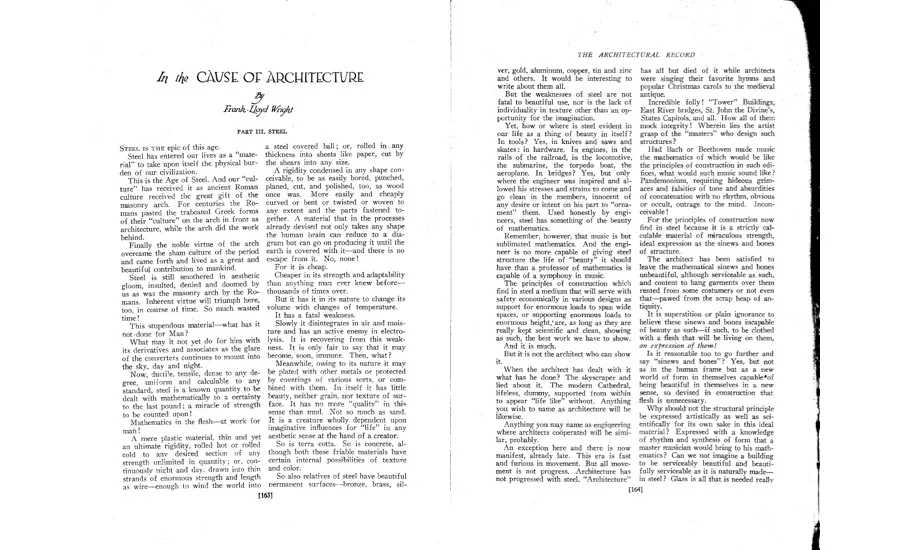
From Architectural Record, August, 1927. Read a PDF of the original article here.
Steel is THE epic of this age.
Steel has entered our lives as a “material” to take upon itself the physical burden of our civilization.
This is the Age of Steel. And our “culture” has received it as ancient Roman culture received the great gift of the masonry arch. For centuries the Romans pasted the trabeated Greek forms of their “culture” on the arch in front as architecture, while the arch did the work behind.
Finally the noble virtue of the arch overcame the sham culture of the period and came forth and lived as a great and beautiful contribution to mankind.
Steel is still smothered in aesthetic gloom, insulted, denied and doomed by us as was the masonry arch by the Romans. Inherent virtue will triumph here, too, in course of time. So much wasted time!
This stupendous material – what has it not done for Man?
Looking for quick answers on architecture and design topics?
Try Ask RECORD, our new smart AI search tool.
Ask RECORD →
What may it not yet do for him with its derivatives and associates as the glare of the converters continues to mount into the sky, day and night.
Now, ductile, tensile, dense to any degree, uniform and calculable to any standard, steel is a known quantity to be dealt with mathematically to a certainty to the last pound; a miracle of strength to be counted upon!
Mathematics in the flesh – at work for man!
A mere plastic material, thin and yet an ultimately rigidity, rolled hot or rolled cold to any desired section of any strength unlimited in quantity; or, continuously night and day. Drawn into thin strands of enormous strength and length as wire – enough to wind the world into a steel covered ball; or, rolled in any thickness into sheets like paper, cut by the shears into any size.
A rigidity condensed in any shape conceivable, to be as easily bored, punched, planed, cut, and polished, too, as wood once was. More easily and cheaply curved or bent or twisted or woven to any extent and the parts fastened together. A material that in the processes already devised not only takes any shape the human brain can reduce to a diagram but can go on producing it until the earth is covered with it – and there is no escape from it. No, none!
For it is cheap.
Cheaper in its strength and adaptability than anything man ever knew before – thousands of times over.
But is has in its nature to change its volume with changes of temperature.
It has a fatal weakness.
Slowly it disintegrates in air and moisture and has an active enemy in electrolysis. It is recovering from this weakness. It is only fair to say that it may become, soon, immune. Then, what?
Meanwhile, owing to its nature it may be plated with other metals or protected by coverings of various sorts, or combined with them. In itself it has little beauty, neither grain, nor texture of surface. It has no more “quality” in this sense than mud. Not so much as sand. It is a creature wholly dependent upon imaginative influences for “life” in any aesthetic sense at the hand of a creator.
So is terra cotta. So is concrete, although both these friable materials have certain internal possibilities of texture and color.
So also relatives of steel have beautiful permanent surfaces – bronze, brass, silver, gold, aluminum, copper, tin and zinc and others. It would be interesting to write about them all.
But the weaknesses of steel are not fatal to beautiful use, nor is the lack of individuality in texture other than an opportunity for the imagination.
Yet, how or where is steel evident in our life as a thing of beauty in itself? In tools? Yes, in knives and saws and skates: in hardware. In engines, in the rails of the railroad, in the locomotive, the submarine, the torpedo boat, the aeroplane. In bridges? Yes, but only where the engineer was inspired and allowed his stresses and strains to come and go clean in the members, innocent of any desire or intent on his part to “ornament” them. Used honestly by engineers, steel has something of the beauty of mathematics.
Remember, however, that music is but sublimate mathematics. And the engineer is no more capable of giving steel structure the life of “beauty” it should have than a professor of mathematics is capable of a symphony in music.
The principles of construction which find in steel a medium that will serve with safety economically in various designs as support for enormous loads to enormous height, are, as long as they are really kept scientific and clean, showing as such, the best work we have to show.
And it is much. But it is not the architect who can show it.
When the architect has dealt with it what has he done? The skyscraper and lied about it. The modern Cathedral, lifeless, dummy, supported from within to appear “life like” without. Anything you wish to name as architecture will be likewise.
Anything you may name as engineering where architects cooperated will be similar, probably.
An exception here and there is now manifest, already late. This era is fast and furious in movement. But all movement is not progress. Architecture has not progressed with steel. “Architecture” has all but dies of it while architects were singing their favorite hymns and popular Christmas carols to the medieval antique.
Incredible folly! “Tower” Buildings, East River bridges, St. John and the Divine’s, States Capitols, and all. How all of them mock integrity! Wherein lies the artist grasp of the “masters” Who design such structures?
Had Bach or Beethoven made music the mathematics of which would be like the principles of construction in such edifices, what would such music sound like? Pandemonium, requiring hideous grimaces and falsities of tone and absurdities of concatenation with no rhythm, obvious or occult, outrage to the mind. Inconceivable!
For the principles of construction now find in steel because it is a strictly calculable material of miraculous strength, ideal expression as the sinews and bones of structure.
The architect has been satisfied to leave the mathematical sinews and bones unbeautiful, although serviceable as such, and content to hang garments over them rented from some costumers or not even that – pawed from the scrap heap of antiquity.
It is superstition or plain ignorance to believe these sinews and bones incapable of beauty as such – if such, to be clothed with a flesh that will be living on them, an expression of them!
Looking for a reprint of this article?
From high-res PDFs to custom plaques, order your copy today!