Complexity and Contradiction in Architecture Turns 50
Complexity and Contradiction in Architecture Turns 50
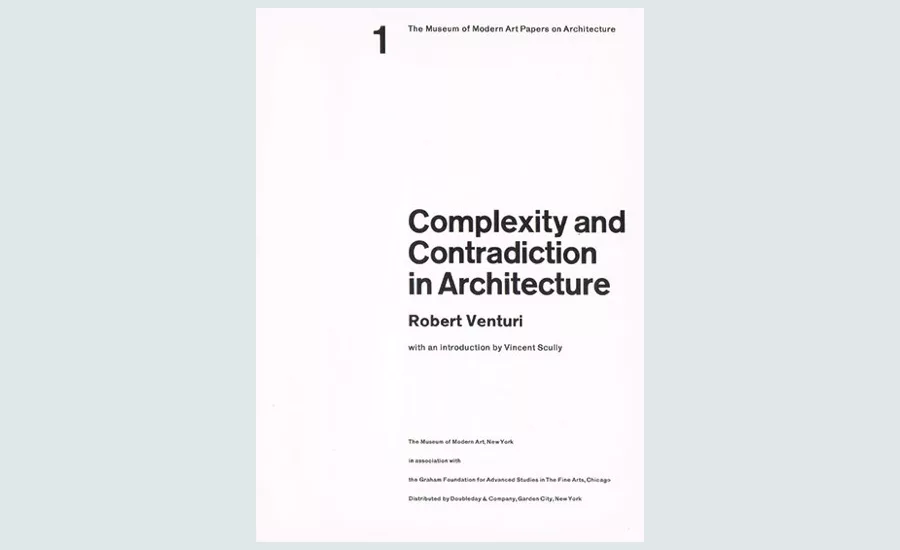
Robert Venturi’s landmark book was published in 1966.
Complexity and Contradiction in Architecture Turns 50
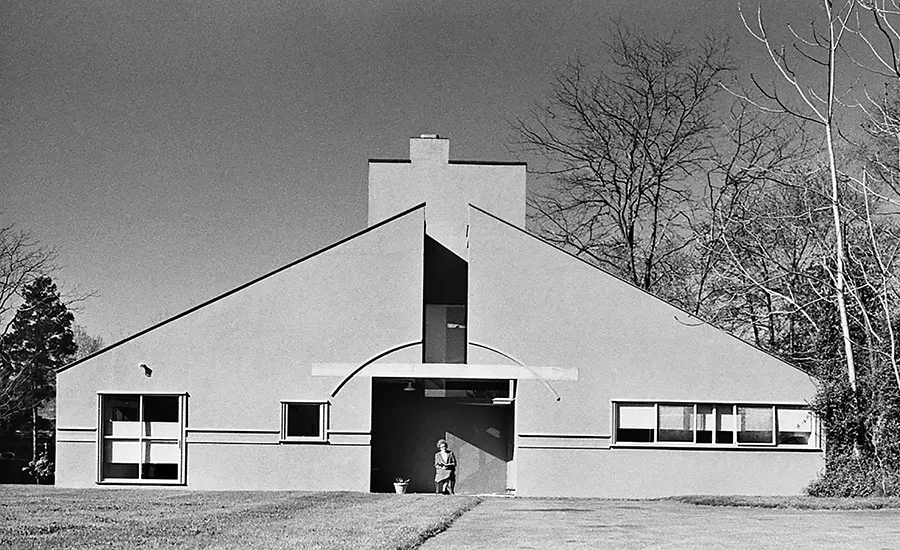
He used historic examples of architecture to argue that multilayered and even paradoxical principles could circumvent the banality in orthodox modern design. In the final chapter, Venturi presented projects his firm had designed combining asymmetrical and off-center elements within a unified, centered whole, seen in the Vanna Venturi House in Chestnut Hill, Pennsylvania (1964).
Photo © Rollin La France
Complexity and Contradiction in Architecture Turns 50
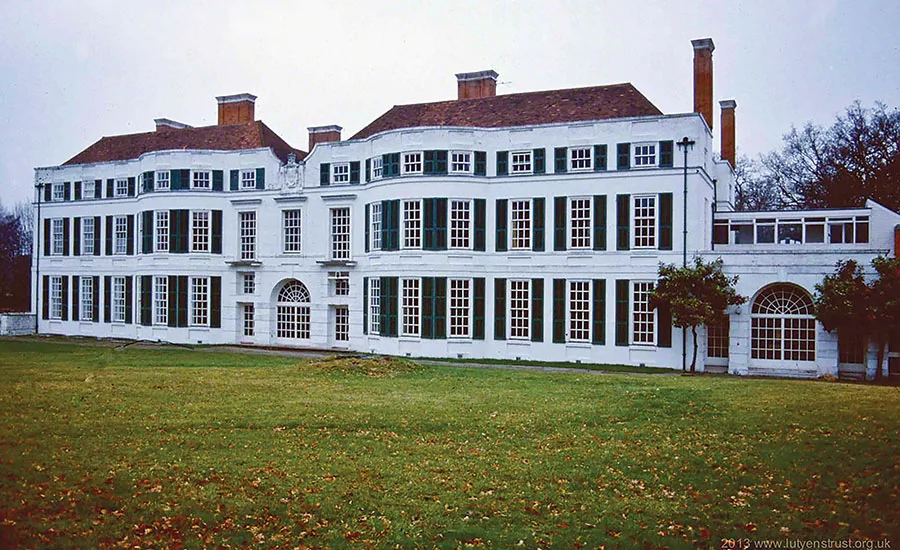
Venturi’s call for ambiguity in architecture is shown in the bifurcated (resolved or not?) facade of Nashdom by Sir Edwin Lutyens in Burnam, England.
Photo © John Trotter
Complexity and Contradiction in Architecture Turns 50
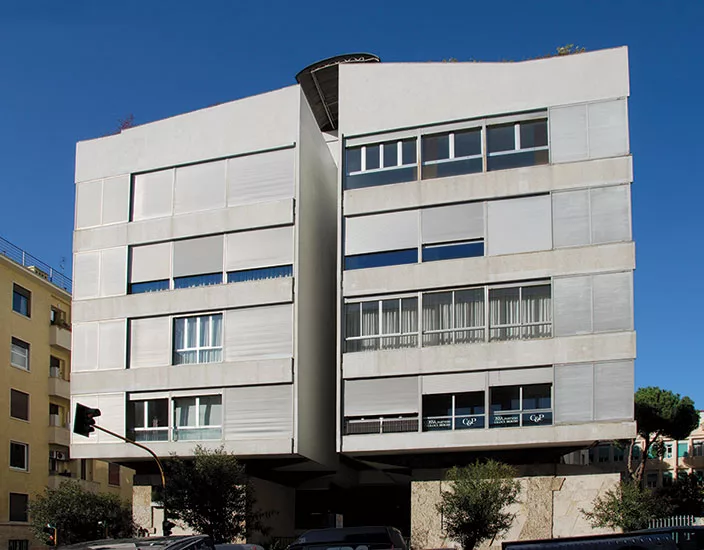
Venturi’s call for ambiguity in architecture is shown in the split volumes of Il Girasole apartments by Luigi Moretti in Rome (one building or two?).
Photo © Michael J. Waters
Complexity and Contradiction in Architecture Turns 50
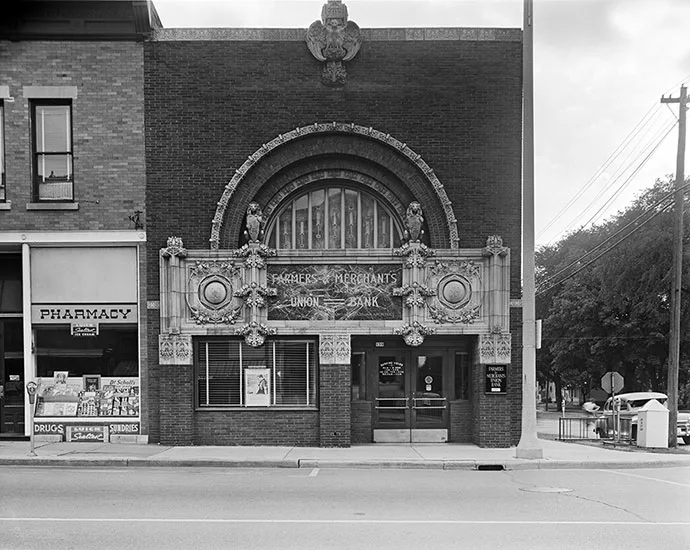
The obligation to effect a difficult whole is seen in Louis Sullivan’s Farmers’ and Merchants Union Bank in Columbus, Wisconsin, where the entrance is off-center within an otherwise symmetrical composition.
Photo © Wayne Andrews/Esto
When Robert Venturi’s Complexity and Contradiction in Architecture was published 50 years ago, Vincent Scully announced in the introduction that it was “probably the most important writing on the making of architecture since Le Corbusier’s Vers une Architecture” of 1923. With this endorsement and its prestigious publisher—the Museum of Modern Art—probably no other tract in American architecture had ever had such a powerful send-off. Spin like that made one bristle, even if it turned out to be true. Venturi’s slender white book, with its postage-stamp illustrations, was a well-aimed manifesto that fell on the barren ground of orthodox Modern architecture as very welcome fertilizer. Like Jane Jacobs’s polemic of 1961, The Death and Life of Great American Cities, it challenged the hegemony of Modernism by planting the seeds for a future Postmodern argument. Jacobs had attacked the simplified planning proposals of Robert Moses’s highway expansions and Le Corbusier’s tower-in-the-park urbanism in her last chapter and argued persuasively that, like a biological organism, a city is fundamentally based on “organized complexity.” Later, Venturi pushed for complexity in architecture instead of Modernism’s generic and simple solutions. While Postmodernism as a movement manifested itself in different forms in dance, literature, and art as well as architecture, the underlying concept—first noted in the environmental-science writings of Rachel Carson and Herbert Simon—proved to be complexity.
Supporting Venturi’s argument of a need for an architecture based on “the richness and ambiguity of modern experience” were all sorts of historical insights. Eight precepts called for such approaches as “Both-And in Architecture” (architecture that is inclusive, with various levels of meaning) and “The Double-Functioning Element” (such as the chimneys of Lutyens’s Grey Walls that act as sculptural entrance markers). His gentle manifesto overturned Modern architecture’s emphasis on simplicity and its Miesian belief that “less is more.” For me, the most important concept was “The Obligation Toward the Difficult Whole.” As Venturi pointed out, unity is found in multiplicity, where all the diverse elements or fragments of architecture establish a sense of relationship—and this is difficult. It takes effort and skill.
Complexity and Contradiction did a good job of identifying the need for an inclusive view but fell into a new trap of exclusionary taste. It emphasized the visual and formal aspects of architecture, but, unlike Le Corbusier’s Vers Une Architecture, it did not deal with the productive, technical, and communicative aspects. It looked closely at individual aspects of architecture (such as window sills, doorways, pilasters) yet failed to apply the same close reading to a whole building—that is, “the difficult whole.” The book’s last section was devoted to such brilliant early Venturi schemes as the Vanna Venturi House (1964) and the Guild House (1963) to illustrate the ideas, but did so with crabbed photos and prose that showed a certain lack of confidence (on the Vanna Venturi House, he remarked, “Some of its elements are good on one level and bad on another”).
Venturi became the father figure to the Postmodern architects who arrived in the 1970s and railed against the generic modernism of simple methods and universal solutions that had taken over so much design. Yet, much later, in 2001, he made an absurd disclaimer: “I am not now and never have been a Postmodernist.” It tells us he may have been disappointed with some of Postmodernism’s most avid disciples, such as Robert Stern and Michael Graves. Like many visionaries whose flock deviates from the prophet’s tastes, his comment hints at wounded pride—especially when other architects, like Philip Johnson, adopted his insights and got the plum commissions.
Venturi’s preface to his book showed a commitment to Modernist literature, citing T.S. Eliot and Eliot’s notion that invention builds on tradition, and the New Critics, above all William Empson, who formed a view of close reading as sometimes too close—what Eliot termed “the lemon-squeezer school of criticism.” Still, if analysis of details took precedence over the difficult whole, there was so much insight along the way that one forgave the squeezing. Empson’s Seven Types of Ambiguity became a template Venturi, in his book, took directly from the New Criticism, deftly applying it to the analyses of buildings to justify his own premise of the necessity of complexity—that there are psychological and cultural reasons for preferring depth and multiple readings to cliché and simple order. But Venturi’s book is a formal analysis that doesn’t deal with sociological truths or, for that matter, the scientific ideas that bolstered complexity theory in other disciplines.
A new paradigm of complexity (which I embrace, writing on multivalence, or layered, pluralistic meanings) has emerged from the Sante Fe Institute, established in 1984. This scientific research organization delves into biology, physics, and the use of computers. The founders believed that this would be “the approach of the 21st century,” and the holistic, digitally based developments in architecture and design have proved them right. Complexity II, as I call the second wave of Postmodern architecture, exemplified by Frank Gehry’s Guggenheim Bilbao (1997) and the late Zaha Hadid’s Phaeno Science Center (2005) in Wolfsburg, Germany, follows directly from Venturi’s and Jacobs’s ideas but seeks a more continuous micro-complexity made buildable by computer software. All of which is to say, Venturi and his epochal book remain relevant to Postmodern architecture in its second phase, even if Venturi denies his paternity. The styles and methods of Complexity II may have changed, but the desire for a holistic architecture of depth and pluralism remains today.
Looking for quick answers on architecture and design topics?
Try Ask RECORD, our new smart AI search tool.
Ask RECORD →
Looking for a reprint of this article?
From high-res PDFs to custom plaques, order your copy today!