Frampton on Baird/Baird on Frampton
A Genealogy of Modern Architecture: Comparative Critical Analysis of Built Form
George Baird reviews Kenneth Frampton's new book.
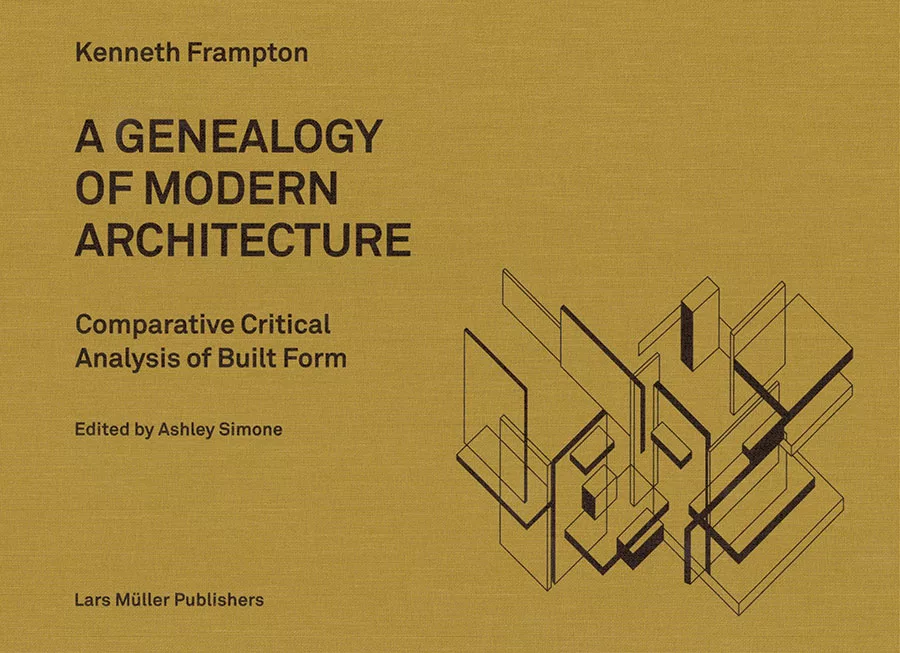
A Genealogy of Modern Architecture: Comparative Critical Analysis of Built Form, by Kenneth Frampton; edited by Ashley Simone. Lars Müller Publishers, October 2015, 304 pages, $40.
A Genealogy of Modern Architecture: Comparative Critical Analysis of Built Form, by Kenneth Frampton; edited by Ashley Simone. Lars Müller Publishers, October 2015, 304 pages, $40.
In A Genealogy of Modern Architecture, the prolific historian, critic, and theorist Kenneth Frampton presents a documentation of a course he used to teach, which involved comparative critical analyses of 14 pairs of more or less canonical modern buildings completed between 1924 and 2007. Frampton systematically analyzes the pairs, which have similar programs and were built about the same times, according to the same categories: type versus context; public, private, semipublic, and service spaces; route/goal; structure/membrane; and, finally, what the author calls a “connotational summation”—an explanatory overview that places each individual building in a historical context. Included are houses, office buildings, civic structures, concert halls, and museums. Even though the ideologies that underpin the designs of many of the pairs differ substantially, Frampton’s measured, detailed, and consistently analytical method minimizes attention to design conception in favor of close consideration of the varied buildings’ sheer physical, constructed reality. This is why only executed designs for buildings make up the entire set of comparisons, extensively illustrated with photographs and diagrams.
The process of analysis is illuminating in unexpected ways. For example, it contemplates the internal dynamics of the social program of the Willis Faber-Dumas Headquarters in Ipswich, England (1975) by Norman Foster—a measure of his work usually ignored by an emphasis on the “high-tech” aspects of the structure and building envelope. By comparing the open plan of Willis Faber-Dumas with the open plan of Herman Hertzberger’s Centraal Beheer office building in Apeldoorn, The Netherlands (1972)—a project where the social program has always been its most discussed feature—Frampton points out how Hertzberger’s subdivided workspace breaks down the scale to be “personalized in a spontaneous manner” in contrast with the “decidedly panoptic character” of Foster’s office layout.
Then too, Frampton’s analysis of the structural system of the Villa Mairea of Alvar Aalto points to a dimension of its specific tectonic reality—the hybrid structure, of masonry, concrete floor slabs, tubular steel columns and framing, along with timber cladding and wood poles—that has not received much critical consideration. Even if the paired selected buildings (e.g., Villa Mairea with Mies van der Rohe’s Tugendhat House) are just taken individually, you frequently learn things about works of architecture you thought you knew so well. And the overview provided by the so-called connotational summations effectively situate the approaches of the various designers in an informative, historical context.
Preceding the comparative analysis is an extended introduction that is very intriguing, especially its brief history of the relevance of phenomenological philosophy to architecture. It is the best short account of this issue that I have read. For many years now, Frampton has been developing a theoretical position about architecture that owes a great intellectual debt to phenomenology—a philosophical movement that gives primacy to the impact on an individual of his or her intellectual and bodily experience of the world around that person.
Frampton’s phenomenological perspective on architecture is somewhat controversial among those who argue it takes insufficient account of architectural form per se. But Frampton has constructed his short precis based on what I would call the mainstream of phenomenological philosophy, stretching from Edmund Husserl and Hans-Georg Gadamer all the way to Meurice Merleau- Ponty, with careful acknowledgement of Martin Heidegger and especially Hannah Arendt along the way. I largely share Frampton’s phenomenological perspective on architecture, and his devising of this concise and very judicious overview is an impressive feat. He manages to demonstrate how important it is that his mode of comparative analysis stresses the organization of space, and avoids reducing architecture to mere matters of function and aesthetics. He uses both Merleau-Ponty and Arendt to explain how the human body and its senses are the prime agencies with which to experience a world where the optical, haptic, and kinesthetic aspects of perception are all involved.
Last year, I participated in a public conversation with Frampton about this book, where the topic of the “autonomy” of architecture arose. In the 1970s, certain theorists argued that architecture embodied an almost transcendent status that could only be understood and discussed on its own terms—not as socially, economically, or politically determined. As one would expect, Frampton views the concept warily, given its strong affinity to formalist approaches. Yet Frampton is not entirely averse to consideration of some degree of autonomy for architecture. He might see such autonomy as residing not primarily in its form at all, but rather in its tectonics (a subject of a previous book). It is in this sense that the introduction to his Genealogy prompts us to address the tectonics of the buildings analyzed there, in phenomenological terms.
Looking for quick answers on architecture and design topics?
Try Ask RECORD, our new smart AI search tool.
Ask RECORD →
It is an extraordinarily useful book and deserves a place beside the computer of every reflective practitioner, teacher, and student in our field.
George Baird is the author of Writings on Architecture and the City. Read Kenneth Frampton's review of that book here.
Looking for a reprint of this article?
From high-res PDFs to custom plaques, order your copy today!