Valletta City Gate
Gateway to the Past: The entrance to a capital city responds to topographical and historical layers.
Valletta City Gate
Photo © Renzo Building Workshop
Valletta City Gate
Photo © Renzo Piano Building Workshop
Valletta City Gate
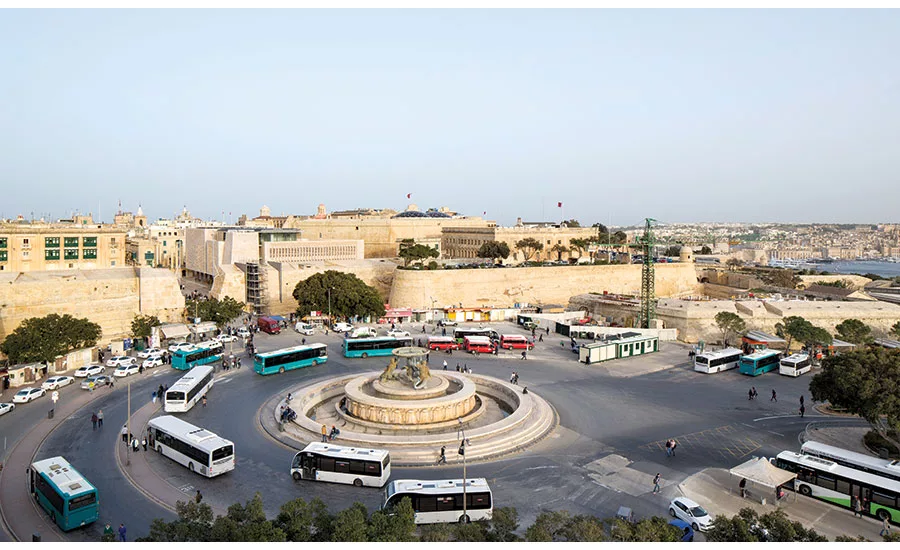
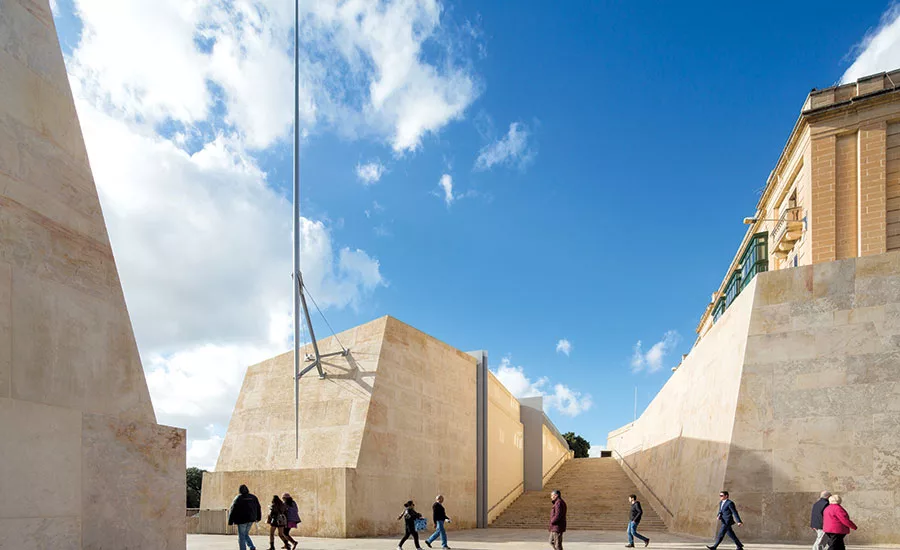
The narrowed gateway aligns with the Triton fountain in the middle of Valletta’s main bus terminal and initiates an axial route through the walled city.
Photo © Renzo Piano Building Workshop
Valletta City Gate
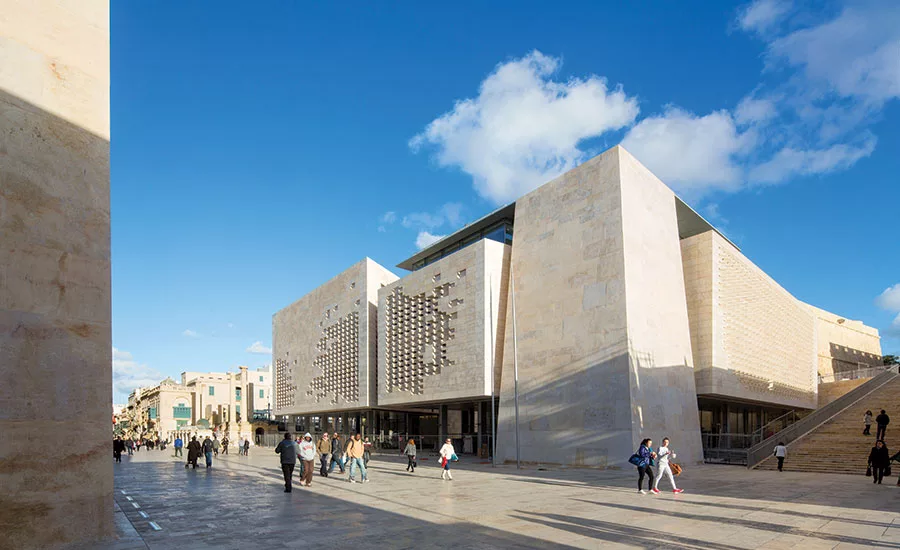
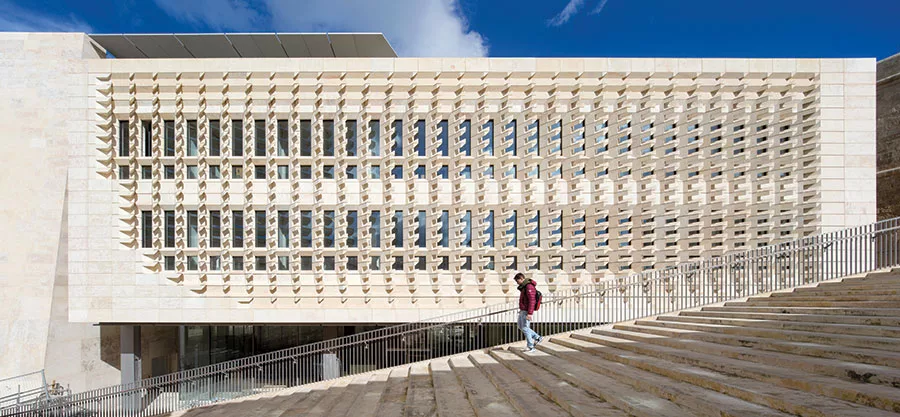
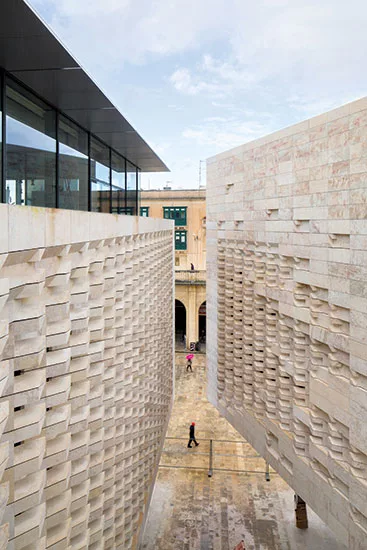
The depth and angles of the parliament building’s stone louvers vary in response to the position of the sun, so the west-facing elevation overlooking the city wall differs from those facing the central courtyard, or north onto Freedom Square. Carving solar shading from the stone cladding required deep facades, and the walls are 33 inches thick.
Photo © Renzo Piano Building Workshop
Valletta City Gate
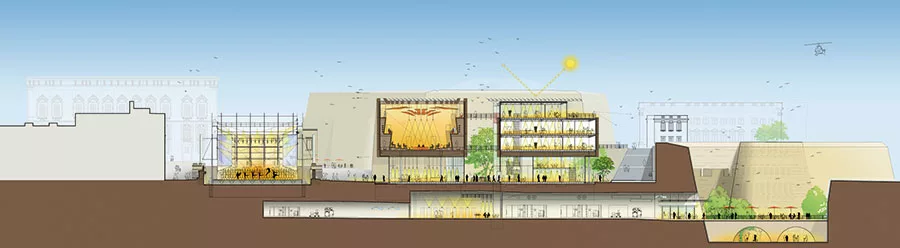
An earlier rendering shows that RPBW intended one of the parliament’s two glazed foyers to have a public use, but both have been adopted as secure entrances.
Photo © Renzo Piano Building Workshop
Valletta City Gate
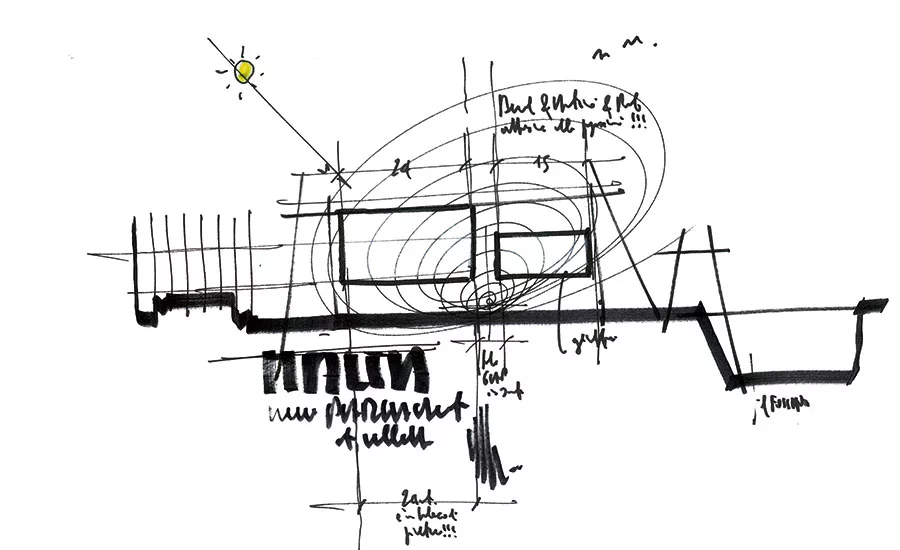
While visiting Valletta Gate’s site, Renzo Piano sketched its topography, using his own stride as a measurement tool.
Image courtesy Renzo Piano Building Workshop
Valletta City Gate
Photo © Renzo Piano Building Workshop
Valletta City Gate
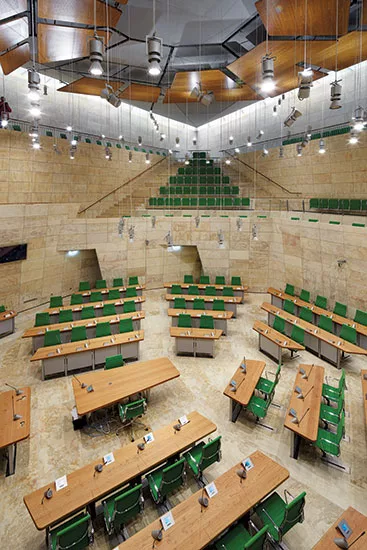
Cherry wood reflectors adjust the acoustics of the quarrylike parliamentary chamber.
Photo © Mario Carrieri
Valletta City Gate
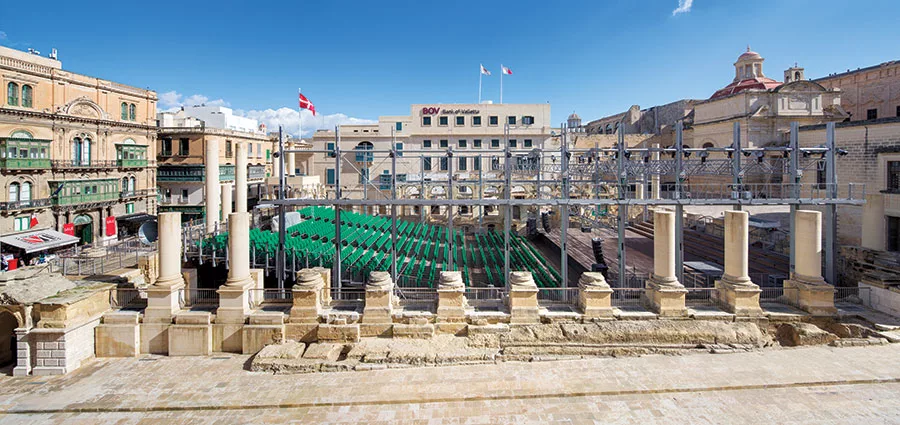
A steel structure carries tiered seating and access walkways over the exposed foundations of the opera’s ruins.
Photo © Renzo Piano Building Workshop
Valletta City Gate
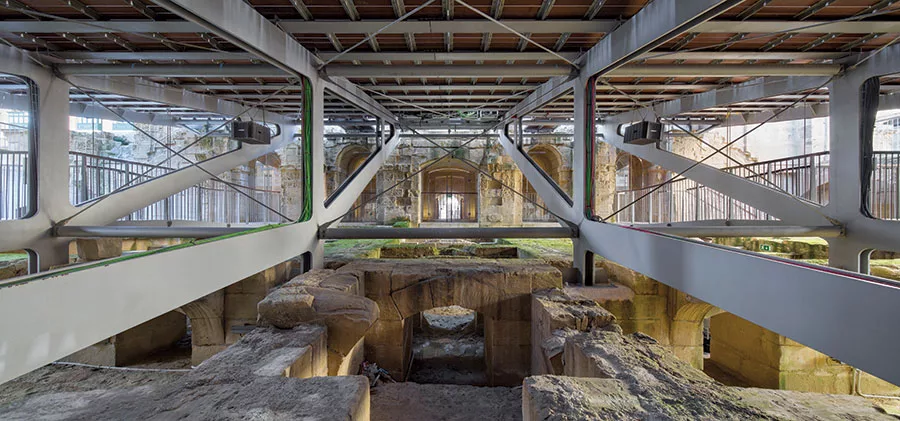
A steel structure carries tiered seating and access walkways over the exposed foundations of the opera’s ruins.
Photo © Renzo Piano Building Workshop
Valletta City Gate
Image courtesy Renzo Piano Building Workshop
Architects & Firms
The completion of Renzo Piano Building Workshop’s (RPBW) Valletta City Gate comes 30 years after the architect was first invited to remodel the main entrance to Malta’s walled capital. Controversial at the time, the project was abandoned but resurrected in 2008, to Piano’s surprise, with a governmental invitation to look again at the gateway, along with the commission to build the island’s first purpose-built parliament nearby. The work has benefited from its long gestation and the enlarged remit, and RPBW has produced an assured but sensitive response to a situation of rare topographic and cultural complexity.
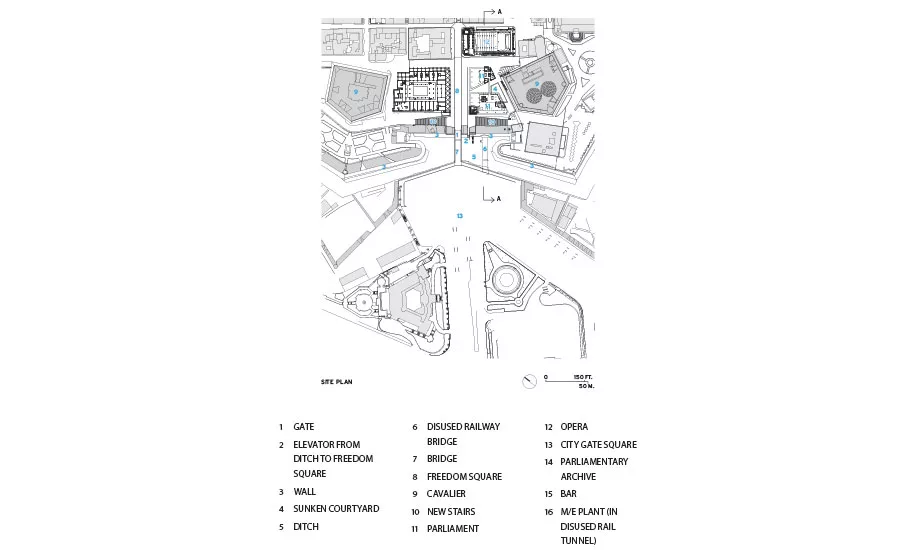
Set on a promontory between two Mediterranean harbors, Valletta’s unique character derives from the conjunction of its hilly terrain, orthogonal Renaissance street grid, and historic fortifications and structures. Its main gate, at the southern end of a central axis, sits at a point of particular intensity in plan and section. Twentieth century alterations had diluted and distended the spatial sequence leading into the city, but RPBW has restored focus through surgical subtraction and judicious addition.
The 17th-century bridge leading to the walls across a surrounding dry moat (known as the “ditch”) had been widened for cars, but is now returned to its original proportions and pedestrian use. Having removed an existing 1960s neo-rationalist gate, the architects reduced a 100-foot-wide breach in the walls by three-quarters with the insertion of two giant, faceted shoulders of stone. Passing through the deep cleft in the rock is a powerful moment of compression followed by release into Freedom Square.
This public space was “a void, out of scale, surrounded by funny 1960s arcades and occupied by cars,” recalls RPBW partner Antonio Belvedere. The architects excised the arcades and a high-level roadway over the gate, revealing the old ramparts and the flanks of two “cavaliers”—tall fortifications within the city walls—that abut the square. Broad flights of stone steps now ascend through limestone canyons from either side of the gate to the ramparts 30 feet above. An inclined elevator, accessed though a steellined slot in the wall, descends to the moat, where gardens will replace yet more parking.
This network of pedestrian routes, tying the square to higher and lower ground and embracing the cavaliers, form the “system” into which the stone-clad, freestanding parliament building was inserted, says Belvedere. Occupying the southern side, it perceptually narrows the square, reinforcing the axial route from the gate, but it has been lifted on steel columns and split into two blocks to preserve public space below and views of one of the cavaliers behind. The blocks, each trapezoidal in plan, are linked by steel bridges across a shady courtyard. One contains ministers’ offices, and the other the debating chamber. Recessed, glazed entrance lobbies imbue a sense of lightness that is a counterpoint to the stair towers at two corners—articulated as tapering stone buttresses reminiscent of the adjacent fortifications.
Deference to the urban context trumped programmatic concerns. “The functional split is not ideal,” says Belvedere of the plans for the building, and there are fewer offices than the brief demanded, “but if the parliament was to be on Freedom Square, it had to be shaped and scaled by the site.” Architectural ingenuity kept the triple-height octagonal debating chamber compact without losing functionality or appropriate grandeur. Stone walls slope inward to maximize floor space while creating public and press galleries above. Administrative offices are neatly hidden in a basement, around a sunken courtyard. And two stories below grade, a disused train tunnel has been colonized by mechanical equipment, an archive, and a bar.
Having composed the building’s massing with due respect to its historic neighbors, RPBW underscored its connection to place by insisting on Maltese limestone for the facades. The design required a hard coralline variety that was not readily available. Undeterred, RPBW opened a new quarry and imported cutting technology and expertise from Italy.
Seismic risk ruled out load-bearing-stone construction, so blocks are hung from a steel frame as both cladding and interior lining. Inspired by the weathering of softer limestone, the architects “wanted to work by erosion” in the treatment of the material, says Belvedere. Solar shading is not added to the facade but carved from it. Angular louvers create a dynamic play of reflection and shadow, and the densely textural surface recalls the Baroque richness of local churches and palaces.
The gate and parliament are contemporary interpretations of the forms and material of the historic city, but the project’s third major component—a 1,000-seat open-air auditorium at the north end of the square—takes a more archaeological approach to the past. On the site of a 19th-century opera house, bombed out in 1942, a skeletal steel “theater machine” was installed behind the stabilized ruins of stone walls and columns, perched above the exposed remains of rooms.
The theater gives an important cultural dimension to the project, but was a late addition. RPBW’s brief stipulated that parliament should occupy the opera site, thereby “erasing two pages of Maltese history, construction, and destruction,” says Belvedere. “We refused.” This resolve was encouraged by the client, who recognized that every aspect of the project would be locally contentious and, so, put its trust in an outsider’s perspective. “Courageously they said, ‘Do what you think is best for the country.’ ” But, if considerable self-confidence was required to operate amid noisy opposition, the City Gate shows no evidence of architectural ego. Instead, it is an essay in careful judgment, weighing the claims of program against those of place, and the claims of the past on those of the future.
The Creative Process
Renzo Piano
“Architecture is about time,” says Renzo Piano, and, because the Valletta project unfolded over many years, he repeatedly walked the site. “Everything starts with wandering around, getting the sense of history or the way the sun touches the surface of stone,” he says. “Every place has a story, and in Malta the story was stone.” Finding the right quarry on the island became the quest: the stone had to be massive enough to frame the gate, but delicate enough for the richly textured walls of the parliament building. “We wanted to carve the stone to play with the light,” says Piano. When he walks, he keeps three tools handy: paper folded to fit his shirt pocket; a pen (often a green felt-tip); and a tape measure. “The sketch is something I do quickly, a little like a writer’s notes—it is a memorandum, a reminder of emotion.” He doesn’t like beautiful drawings—or perfect renderings: “You fall into a trap,” he says. “The computer never tells the truth.” Besides his tape measure, he uses his stride. “I walk with wide steps, like a soldier, and it is exactly 1 meter. The time you spend walking around and measuring and projecting is like taking a mental picture. You try to record the space. And when you go back to the office, you will have the capacity to project in that space, using all the proportions. It’s almost like making a hologram.”
PeopleArchitect: Renzo Piano Building Workshop - A. Belvedere, B. Plattner, partners in charge; D. Franceschin, P. Colonna, P. Pires da Fonte, S. Giorgio-Marrano, N. Baniahmad, A. Boucsein, J. Da Nova, T. Gantner, N. Delevaux, N. Byrelid, R. Tse, B. Alves de Campos, J. LaBoskey, A. Panchasara, A. Thompson, S. Moreau, O. Aubert, C. Colson, Y. Kyrkis, team
Associate Architects: Architecture Project
Consultants: Arup (acoustics, civil, structual, m/e/p); Kevin Ramsey (stone); Daniele Abbado (theater); Franck Franjou (lighting); Studio Giorgetta (landscape); Silvano Cova (theater equipment)
Client: Grand Harbour Regeneration Corporation
Size: 431,000 square feet (site area); 75,000 square feet (parliament); 30,000 square feet (opera)
Cost: $91 million
Completion Date: August 2015 |
ProductsTile Refin
Lighting iGuzzini
Furniture UniFor, Vitra
Elevators Schindler
Plumbing Fixtures Antonio Lupi
|
Looking for a reprint of this article?
From high-res PDFs to custom plaques, order your copy today!