JW Marriott Venice Resort & Spa by Matteo Thun & Partners
Venice

Hotel guests and visitors for the day arrive on the island via a complimentary shuttle from St. Mark’s Square.
Photo courtesy JW Marriott Venice Resort

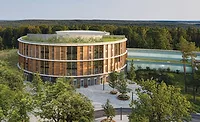
The hotel’s main building originally opened in the early 1930's as a state-of-the-art hospital.
Photo courtesy JW Marriott Venice Resort

Its rooftop bar, restaurant, and pool offer views of Venice.
Photo courtesy JW Marriott Venice Resort

A former warehouse, La Residenza features an internal courtyard onto which bedrooms face.
Photo © Paolo Utmpergher

The architects employed a “box in a box” approach, inserting a steel structure several feet away from the masonry shell.
Photo courtesy JW Marriott Venice Resort

A church building has been converted into an event space.
Photo courtesy JW Marriott Venice Resort

From inside the two-story La Maisonette, the building’s original brick wall is visible just past the new glass facade.
Photo courtesy JW Marriott Venice Resort

The spa and its adjacent treatment rooms are located in restored brick warehouse buildings.
Photo courtesy JW Marriott Venice Resort
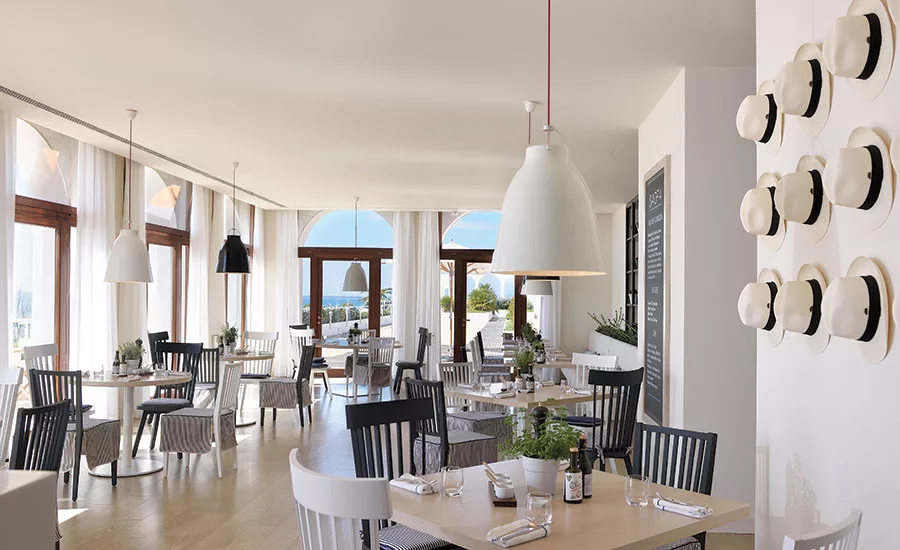
The main building’s rooftop restaurant fuses Mediterranean and Nordic influences.
Photo courtesy JW Marriott Venice Resort

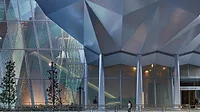
Metal grids were used in parts of the spa building’s facade.
Photo courtesy JW Marriott Venice Resort

The pink and white stucco facade of Dopolavoro was completely restored.
Photo courtesy JW Marriott Venice Resort

A gabled steel canopy replaces crumbled brick walls at the rear of that building, to create an outdoor dining area.
Photo courtesy JW Marriott Venice Resort

A plan of the site.
Photo courtesy Matteo Thun & Partners
Architects & Firms
Since the Middle Ages in Venice, several of the islands in the Venetian lagoon between the Grand Canal and the Lido leading to the Adriatic Sea were used as refuges for monks seeking solitude or for victims of the plague and other contagious diseases. Now that isolationist approach is being tested—on a luxurious scale—on one such abandoned island of the lagoon, home to the new JW Marriott Venice Resort & Spa, the luxury brand of Marriott International. The hotel chain took a chance on the remote location, a 20-minute boat ride from St. Mark’s Square.
The artificial island was built in the 1860s to store fuel and other combustibles but soon became, like the much older neighboring islands, a sanctuary for convalescents. In the 1890s, owing to the island’s proximity to the sea, its agreeable climate, and distance from the cramped quarters and pollution of the city, many of the buildings on its 40 acres were converted to hospitals to treat pulmonary ailments. By the 1930s, a large modern medical facility had opened, to much national fanfare.
That sanitarium would continue to treat patients for five decades, but eventually the entire island was vacated, and it sat in ruin, until the start of a restoration in 2000. That project, taken over by the Milan-based firm Matteo Thun & Partners following an invited competition in 2011, transformed the five-story main hospital building and 17 other smaller ones into 266 hotel rooms and suites, three restaurants, several bars, and a spa. “When you arrive on the island from Venice, you come from a totally urban situation, with no green spaces and overrun with tourists,” explains Matteo Thun. “We wanted to create a 360-degree alternative with a resort experience.”
The architecture of the main building expresses the abstract geometry of prewar Italian Rationalism, where function prevails over aesthetics. “The top of the building looks like a de Chirico painting,” Thun says. “We wanted to follow that Rationalism.” Thun and his partner Luca Colombo left the floor plans largely intact, keeping the wide corridors and their large glass doors onto the terraces of the original hospital. The interiors are mainly white, like the exterior stucco, giving the entire building a light, airy feel. Public spaces are outfitted with lighting that Thun—also well known as a product designer—created for a couple of Italian brands. The biggest architectural intervention was on the roof, where an infinity pool was added beside the rooftop bar and restaurant. Bounded by a glass parapet, the heated water of the pool seems to merge with the lagoon, while views of the cupolas of St. Mark’s Basilica and its neighboring campanile are visible beyond.
Slightly more upscale suites with a colorful décor were designed for the smaller, older buildings, which, while not historically significant, were handled with, so to speak, preservationists’ gloves. “The broken brick walls are very similar to what you see throughout Venice, consumed with the patina of salt and wind,” says Thun. “We did not want to touch them from the outside or from the inside.” For several of these former warehouses, now sporting such names as La Maisonette and La Residenza, the architects employed a “box in a box” approach, inserting a steel structure several feet away from the masonry shell. In the spa building, they added a metal grid—an architectural feature commonly used in Medieval Venice and made popular again by Carlo Scarpa—over parts of the facade to act as both a privacy and sun screen.
The gardens and landscaping on the island, today commonly referred to as Isola delle Rose (Island of the Roses), are as prominent a feature as the architecture. Stately olive trees that border the many allées are harvested to provide the olive oil used in the informal cooking school and restaurants, including the Michelin-starred Dopolavoro. Meaning “after work,” Dopolavoro takes its name from the building in which it is housed, a 1936 structure with hints of a classical vocabulary built for doctors and nurses as a place to eat, drink, and watch movies following their shifts. Newly planted herb and vegetable gardens also contribute to the restaurants’ menus.
The architects were frankly skeptical that travelers to Venice would want to stay so far from the action of the city itself, but since opening in the spring of 2015, the seasonal hotel has frequently been at capacity. A more affordable alternative to Cipriani—also removed from the throngs of tourists on an island closer in—it is especially popular with families, as children can safely run about. For adults of today, including this one, the seclusion of the small island, with its cheerful spaces, does not feel imposed but, rather, welcome.
PeopleArchitect: Matteo Thun & Partners Personnel in architect's firm who should receive special credit: Arch. Luca Colombo (Project Manager and Partner of Matteo Thun) Architect of record: Matteo Thun & Partners Interior designer: Matteo Thun & Partners Engineers: Burro Happold Consultants Landscape: CZ studio, Arch. Laura Zampieri Photographer: JW Marriott Venice Resort, Paolo Utimpergher, Daniele Domenicali Client: Aareal Bank; Marriott International (operator) Size: 145,000 square feet Cost: withheld Completion date: June 2015
|
ProductsStructural System - “La Residenza” (Building 8): internal box structures in X-LAM (by KA KONSTRUCT Srl) Manufacturer of any structural components unique to this project: Exterior Cladding Masonry: - “La Residenza” (Building 8) + “La Maisonette” (Building 17) + Church (Building 18) + “Treatment” (Building 11): restoration of existing brick walls. Facing bricks. (External façade) Metal panels: - “La Maisonette” (Building 17): nord + south front in TECU® Oxid by KME installed by Copermont Srl Curtain wall: - “Spa” (Building 10) + “Dopolavoro Dining Room” (Building 19): steel façade “Termica Up” by Secco Sistemi installed by IALC Serramenti Srl Roofing Metal: - “La Maisonette” (Building 17) + “Dopolavoro Dining Room” (Building 19): roof in metal sheet in in TECU® Oxid by KME installed by Copermont Srl Tile/shingles: - “La Residenza” (Building 8) + “Spa” (Building 10) + “Treatment” (Building 11) + Gym (Building 14): existing tiles have been reused for roofing Windows Wood frame: - Main Hotel (Building 1) + “La Depandance” Building 15 + Church (Building 18): existing profiles in wood have been refurbished by IALC Metal frame: - “La Residenza” (Building 8) + “Spa” (Building 10) + “Treatment” (Building 11) + Gym (Building 14) + “La Maisonette” (Building 17) + “Dopolavoro Dining Room” (Building 19): windows from Secco Sistemi, steel profile installed by IALC (used profiles: OS2 and EBE) Glazing Glass: - Villa (Building 3) + La Residenza (Building 8) +“Spa” (Building 10) + “Treatment” (Building 11) + “Dopolavoro Dining Room” (Building 19) + Gym (Building 14): Saint Gobain Glass Doors Sliding doors: Supplier: Tiziano Rubini Fire-control doors, security grilles: Hardware Locksets: Lockset system by Onity Interior Finishes Suspension grid: Supplier: Knauf Paints and stains: Paint technique: “Velatura metallica” by Colorificio Veneziano Srl Solid surfacing: Wood + parquet by Parador Floor and wall tile: - Bathrooms + Public spaces: Kalingastone di Margraf Carpet: - Rooms: Brinton Carpets Limited Raised flooring: - “Dopolavoro Dining Room” (Building 19): Custom made mirror glass ceiling with AGC glass (installed by Hagenauer) Special interior finishes unique to this project: - “Dopolavoro Dining Room” (Building 19): Custom made mirror glass ceiling with AGC glass (installed by Hagenauer) Furnishings Chairs: - Cucina Daily Restaurant + Sagra Restaurant: stools by Andreu World Tables: Mostly custom made tables Upholstery: - "Dopolavoro Dining Room" (Building 19) +“La Maisonette” (Building 17) + “La Residenza” (Building 8) suites upholstered chairs by Busnelli Lighting Interior ambient lighting: - Public spaces and rooms: Artemide Laguna Lamp design by Matteo Thun + Antonio Rodriguez Downlights: - Villa (Building 3) + Church (Building 18) chandeliers by Barovier + Toso Tasklighting: - Rooms: Artemide Laguna table lamps design by Matteo Thun + Antonio Rodriguez Exterior lighting around Villa (Building 3) – floor lanterns by Unopiù |
Looking for a reprint of this article?
From high-res PDFs to custom plaques, order your copy today!