Soap Opera: The Larkin Building
Frank Lloyd Wright’s Larkin Building in Buffalo was a singular achievement in architectural history, if underappreciated.
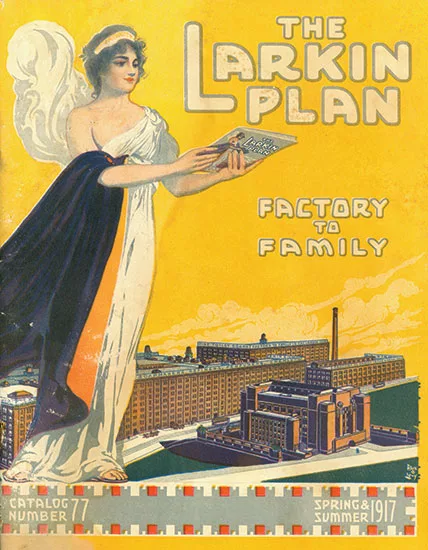
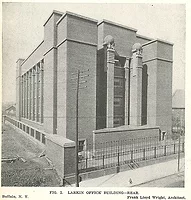
The Larkin Building, completed in 1906 in Buffalo, New York, represented a major commercial commission for Frank Lloyd Wright. The soap company publication shows the building in the foreground of the factory.
Image courtesy Collection of the Buffalo History Museum
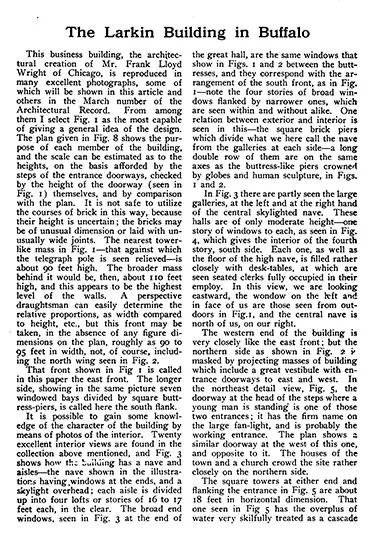
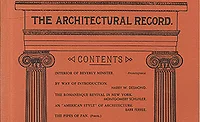
RECORD published a critique of the Larkin Building in April 1908. Read it here.
Image © Architectural Record
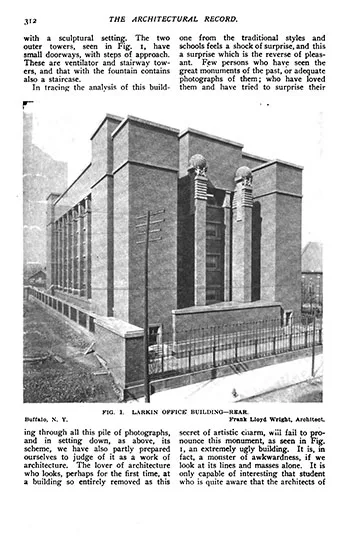
RECORD published a critique of the Larkin Building in April 1908. Read it here.
Image © Architectural Record
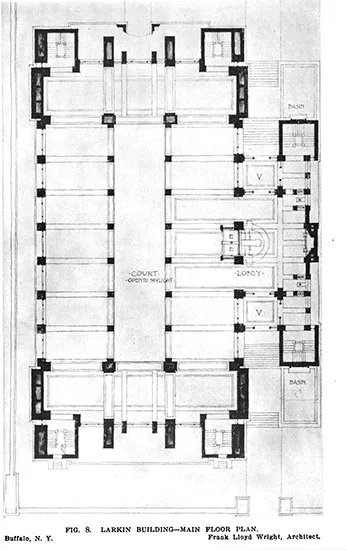
RECORD published a critique of the Larkin Building in April 1908. Read it here.
Image © Architectural Record
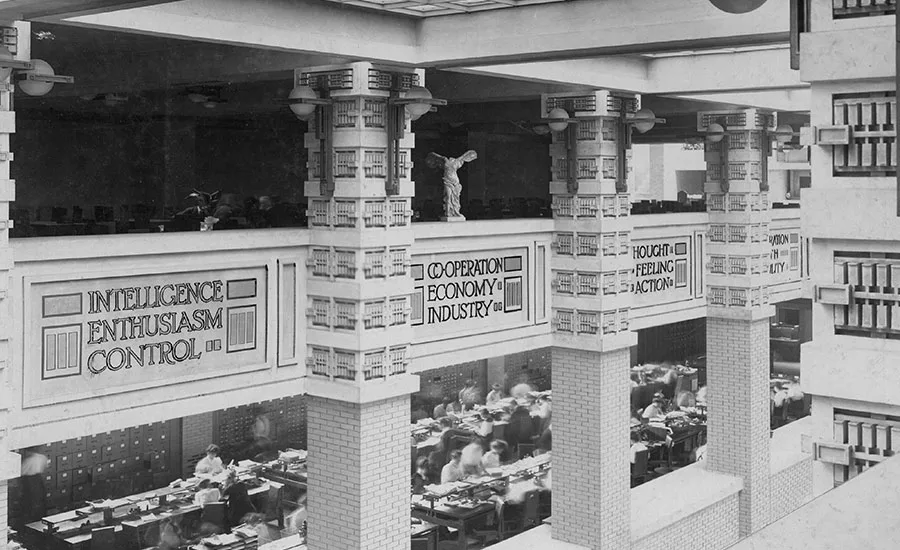
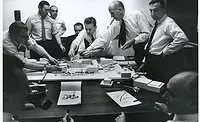
The inward-turning interior of the Larkin Building made history.
Image courtesy Collection of the Buffalo History Museum
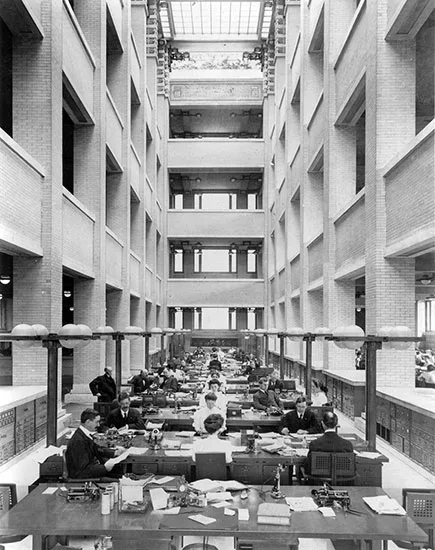
The inward-turning interior of the Larkin Building made history.
Image courtesy Collection of the Buffalo History Museum
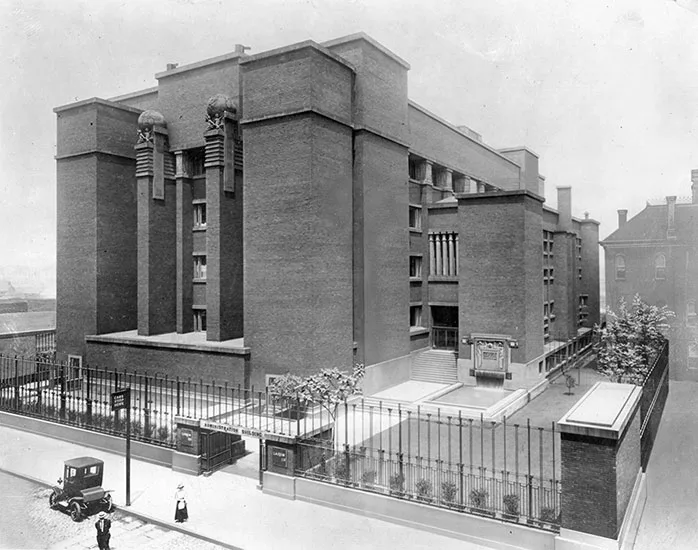
Wright designed a bi-nuclear plan, where the main building has offices arranged around a five-story light court, and the entrance and various services are in the adjoining annex.
Image courtesy Collection of the Buffalo History Museum
Architecture was an all-encompassing endeavor for Frank Lloyd Wright, and the creation of his persona an ongoing project synonymous with his work. His penchant for self-promotion was clear in his long relationship with certain publications: Wright’s first recognition by RECORD occurred in April 1904, which singled out architects in the West, including Louis Sullivan and the “very able” Wright for their “departure from traditional European forms.” No wonder the subsequent publication in RECORD of Russell Sturgis’s negative review of the architect’s Larkin Building (his first commercial structure) in April 1908 was a shattering moment in his developing career—but more about that later.
Following his departure from Adler & Sullivan in 1893, Wright had turned to domestic architecture with considerable success. Commissions, mostly in the greater Chicago area, inundated his office. When Ladies Home Journal published his scheme for “A Home in a Prairie Town” in 1901, he won more national attention. Soon word of Wright reached the Larkin Company in Buffalo through William Heath, who had joined the company in 1899. The businessman had learned of the modern pioneer through his brother-in-law, a contractor, then building Wright’s J. J. Walser house in Chicago in 1903. Because of Heath and Darwin Martin, prospective clients and Larkin executives, Wright was able to convince the mail-order soap company to let him design its new headquarters. The Larkin office commission offered powerful incentives to the architect: large in scale and lucrative, it promised exposure to untapped eastern U.S. markets.
Completed in November 1906, the Larkin radically departed from the conventions of office buildings at that time. Wright’s essay for The Larkin Idea, a publication for its customers (circulation 600,000), explained the innovations in the steel-framed structure, which was clad in red brick with red sandstone trim. Wright arranged the office areas in and around a five-story light court surrounded by balconies, where secretaries and typists answered mail, and placed the executives on the main floor of the atrium in full view of the 1,500 workers. Wright met the company’s principal concerns about fire safety and worker satisfaction by designing custom metal office furniture and trimming interior surfaces with magnesite (for sound reduction) throughout, as well as installing one of the first air-conditioning systems in a business building in the country, to seal out the pollution from its industrial surroundings. He also provided dining facilities atop the light court. In a bi-nuclear plan, the architect separated business functions in the main block from the various social spaces in the annex, where a branch library, a classroom, locker and restrooms, and a lounge were located.
But what really distinguished the building was the architect’s articulation of its major functional elements—the main building and the annex, the six corner stair towers, the intake and ventilation stacks, and the piers containing air-circulation ducts—meticulously proportioned, unadorned masses that expressed the power of a major American company. For Wright, the Larkin Building was an opportunity to contradict the horizontal open quality that characterized his prairie houses and to demonstrate that he was capable of just about any architectural challenge.
Critical response was meager, however. Charles Illsley gave the building a lukewarm reception in the Inland Architect in 1907, and the Architectural Review (Boston) cited portions of Illsley’s article, though adding, “This sort of thing is absolutely in the line of creative architecture.” Perhaps this is why the review by Sturgis was so devastating. Wright’s expectations had been high: after RECORD’s early mention of him in 1904, the magazine came out with an appraisal in “Work of Frank Lloyd Wright—Its Influence” in July 1905, which pointed to the “more truthful relationship between structure and design, and the frank expression of the quality of material.” This piece set the stage for the magazine’s unprecedented 66-page presentation titled “In the Cause of Architecture,” in March 1908, where Wright himself presented the principles guiding his architecture (“more truly simple; more expressive,” as well as “more plastic; more fluent, although more coherent; more organic”). His essay was accompanied by 87 illustrations of his work, including the Larkin Building.
Wright had little time to enjoy that crowning moment before Sturgis’s critical blast, “The Larkin Building in Buffalo,” appeared in the magazine the following month. Sturgis, who worked only from photographs due to declining health, began with a lengthy, error-filled description that concluded with, “Few persons . . . will fail to pronounce this monument . . . an extremely ugly building. It is, in fact, a monster of awkwardness.” Sturgis then equivocated with an acknowledgement that “the fine arts have nothing to do with the hustle and bustle of daily bread-winning operations.” In conclusion, he suggested how the building might be improved with greater attention to light, shade, moldings, a Ruskinian color palette, and picturesque massing—all formalist-historicist principles antithetical to Wright’s vision.
In a letter to RECORD’s editors, Wright took apart Sturgis’s essay point by point and castigated him for working from photographs, some of which he deemed “murderous, wide-angled slanders.” Wright’s defense of the building’s formal abstraction was combined with an underlying anger that led to an ad hominem attack: “To see an eminent architectural critic picking over, bit by bit, his architectural rag-bag for architectural finery wherewith to clothe the nakedness of the young giant whose very muscularity offends as it confronts him is pathetic.” He further ridiculed Sturgis as “the man who, startled, clutches his lifeless traditions closer to his would-be-conservative breast and shrieks, ‘It is ugly!’ ”
RECORD declined to publish Wright’s reply out of deference to Sturgis, who died in February 1909, but the Larkin Company did come out with its own thin volume in 1909 that included Wright’s essay, “In the Cause of Architecture,” along with the Sturgis review and obituary. Sturgis’s critique was an unfortunate setback for Wright, but the Larkin Building was again depicted in the 1910 Wasmuth Portfolio in Berlin with five lithographic Larkin plates: they excited the enthusiasm of H.P. Berlage, Mies van der Rohe, Erich Mendelsohn, and many other European architects. Indeed Wright never abandoned his belief in the Larkin Building: he rightly said upon hearing of its demolition in 1950—by the city of Buffalo, which then owned the building, in what had become an increasingly run-down part of town—that “it had taken its place in the thought of the world.”
Looking for quick answers on architecture and design topics?
Try Ask RECORD, our new smart AI search tool.
Ask RECORD →
Looking for a reprint of this article?
From high-res PDFs to custom plaques, order your copy today!