Celebrating 125 Years: Looking Forward
The Road Ahead: Driverless Vehicles, Cities, and Architecture
Autonomous vehicles are on their way—but what will their arrival mean for density and sprawl?
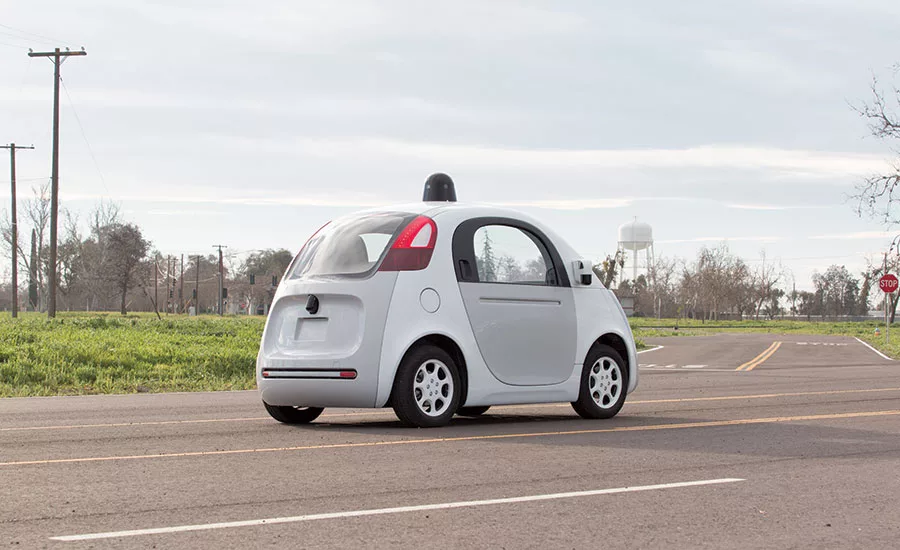
Google X (now known as X) runs a driverless test fleet that currently consists of 24 modified Lexus SUVs, as well as 34 prototypes without steering wheels or brake and gas pedals.
Photo © Google
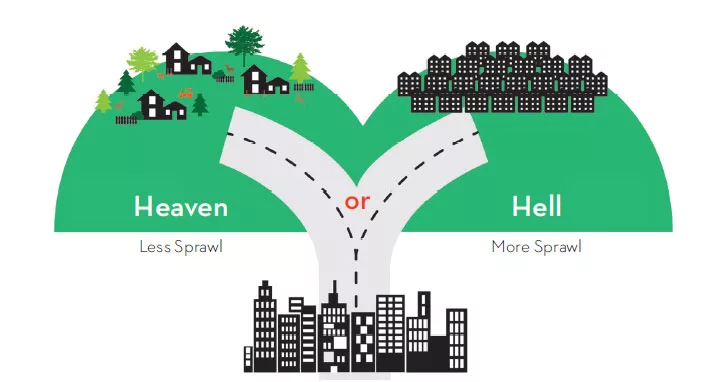
A driverless revolution could increase urban density or, conversely, suburban sprawl—or both.
Image courtesy Arup
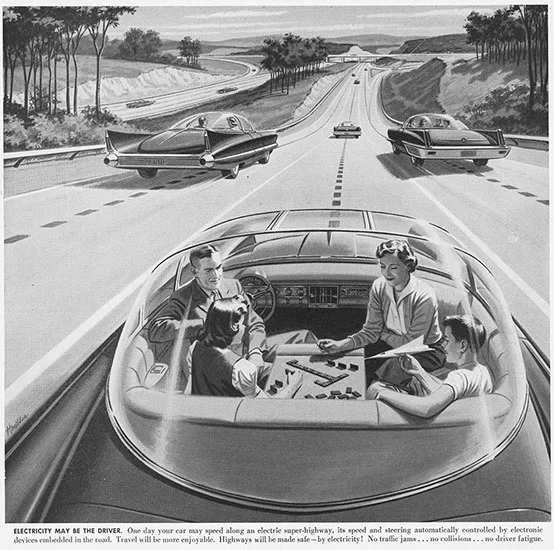
Self-driving was once a pie-in-the-sky pursuit, as suggested by this late ‘50s image, created for an electric company advertorial.
Photo © Advertising Archive / courtesy Everett Collection
The race to develop driverless vehicles is zooming full-speed ahead, engaging all the major car companies—as well as Google X, Apple, and various start-ups. Though schemes for self-driving date back to the 1920s, with resurgences in the ’50s and ’80s, this once-farfetched pursuit is attaining real-world feasibility. Google X, a leading player now known as X, has logged over 1.7 million miles in its autonomous test cars on public roads. States including California, Florida, and Michigan have enacted legislation to permit such trials. Although a recent fatal accident with a Tesla test car drew widespread attention, it was statistically an extremely rare self-driving event. In fact, the day when a phantom chauffeur will charge an electric vehicle on its own, analyze the route, exchange up-to-the-moment information with other cars on the road, and pick you up for work—or your kids for school—is no longer sci-fi fantasy. Many of the manufacturers expect fully autonomous vehicles (AVs), requiring no human supervision or backup drivers, to hit the market around 2020—letting you sleep, read, work, or entertain guests as an unmanned sedan ferries you door to door.
Meanwhile, questions are emerging about how AVs could change the form and structure of cities, towns, and roadways. Much of the research—at venues including MIT, IIT, and Carnegie Mellon University—has examined this autonomy in tandem with other evolving trends and technologies. Exploiting the joint potential, self-driving seems a natural fit with electric powering; hyperconnectivity; sharing models (as in Zipcars, urban bike fleets, and cyber-facilitated car pools); and operative algorithms, akin to the dispatch programs that optimize elevator service based on passenger destinations.
“Autonomous vehicles promise to have dramatic impact in blurring the distinction between private and public modes of transportation,” says professor Carlo Ratti, director of MIT’s SENSEable City Lab. “After taking you to work, ‘your’ car could give a lift to someone else in your family—or to anyone in your neighborhood, social-media community, or city—rather than sitting idle.” While the average automobile in the U.S. is unused an estimated 95-percent of the time, a robo-vehicle has the potential to reposition itself continually, with network-optimized efficiency, from one passenger to the next. Theoretically, self-driving could lend everyone—including the blind, elderly, and very young—unprecedented mobility, providing a shared system of individually customized, on-demand travel with a fraction of the cars currently on the road.
A major consequence could be a radical reduction in parking space. And slots could be packed tight, given robotically nimble maneuvers, not to mention the area saved when no one needs to exit or enter a parked vehicle—ever. (After dropping you off, the car would “valet” itself.) Even curbside spots could become unnecessary, allowing for narrower streets—an efficiency boosted by sensing-and-reaction mechanisms that permit AVs close driving distances, increasing road capacity. The gains could be huge. As Ratti puts it, “Parking infrastructure in the United States covers around 5,000 square miles—an area [43-percent] larger than Puerto Rico.” The freed-up land could be converted to creative and socially enriching uses, providing for art or recreation—as demonstrated temporarily on international Parking Day, or more permanently through initiatives in cities that include Seoul. Such reclamation opportunities, however, only apply where parking occupies open lots or dedicated structures.
Self-driving could also fundamentally change intersections and traffic signals. A recent MIT study proposed an air traffic–inspired slot system that dispenses with traffic lights and stop signs. Instead, vehicles communicate electronically, enabling them to cross intersections safely without stopping or idling, thereby improving traffic flow and energy expenditure.
But predictions vary. John Eddy, an Arup principal who advises municipal transit agencies and other clients on the planning implications of self-driving, cautions, “There’s an expectation that a huge amount of land will come available thanks to driverless cars—but not so fast! We can’t wipe the maps entirely clean of parking, and one great unknown is the space needed for all the pickups and drop-offs. Besides, public policy will play a significant role in how the land actually gets reallocated.” As for the communal aspirations for AVs, he points out that extensive ride pooling is possible today, even without automation, “yet many people prefer—or can afford—not to do it,” he observes. “Yes, enthusiasm for it may be growing, but a complete transformation would require a profound societal change, as well as policies that incentivize sharing versus not sharing.”
Perhaps the most compelling aspect of driverless roads is the promise of vastly increased safety. “Statistically, the least reliable part of a car is the driver,” says Chris Urmson, who until last month headed Google’s Self-Driving Project. “And 1.2 million people are killed in car accidents every year.” By many estimates, 90 percent of them involve human error. Though autonomous driving has seen relatively few incidents, its greatest safety hurdles come in the transition window, when manned and unmanned vehicles still share the road (as with the Tesla accident in May). And AVs need further advancement to address such complications as potholes, snow, reflections, construction obstacles, bicyclists, and pedestrians—not to mention technology failures, if systems go down or get hacked.
Looking for quick answers on architecture and design topics?
Try Ask RECORD, our new smart AI search tool.
Ask RECORD →
Assuming the ongoing progress addresses such shortcomings, and policy keeps pace, it’s unclear if the new autonomy will promote urban density—or suburban sprawl. “Arguments can be built for both options,” says Ratti. As he points out, density is by nature more efficient, allowing for better resource sharing, but swifter, easier, more relaxing and productive commutes could make suburbia more accessible and desirable.
Speculative optimism pervades visions of a brave new driverless world, yet we could realize many of the forecasted benefits now, without AVs. And if parking were minimized, generating a bounty of land, there’s always a risk of development that doesn’t turn parking into parks or otherwise serve the collective good. As for increased density versus sprawl, we could conceivably end up with both. Clearly, the time has come to lay the groundwork for an AV revolution. The impact of self-driving, as Ratti concludes, “will come down to societal decisions about how we really want to live.”
Looking for a reprint of this article?
From high-res PDFs to custom plaques, order your copy today!