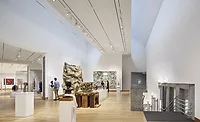
Andlinger Center at Princeton University by Tod Williams Billie Tsien Architects | Partners
Princeton, New Jersey

From the north side of the center, visitors have a direct view beyond the gardens to the entrance lobby and the meeting room above. A stair tower, with venting apparatuses on top, looms behind this volume.
Photo © Michael Moran

A path to the entrance lobby on the west skims past the end of the historic brick wall designed by McKim, Mead & White in 1911, and a sculpture, Uroda (2015), by Ursula von Rydingsvard.
Photo © Michael Moran

A path links the Andlinger to an existing engineering building and runs past gardens and sunken courtyards. The long horizontal bricks of the new building emphasize the dynamic interplay of volumes.
Photo © Michael Moran

Inside, poured-in-place concrete stairs with profiled soffits dramatize a lounge area of the lower level, where ample daylight is admitted through glazed walls.
Photo © Michael Moran

Thanks to sunken courtyards, spaces such as a corridor in the lower level receive ample light and glimpses of the landscaping outside. Synthetic-felt murals printed with scribblings by famous scientists add visual interest.
Photo © Michael Moran

Murals of ceramic tiles enliven public areas such as the lower-level lounge.
Photo © Michael Moran

A framed view from the second level overlooks a garden and the north wing of the center.
Photo © Michael Moran

The auditorium is marked by a skylight-pierced, faceted ceiling.
Photo © Michael Moran

The clean rooms employ glazing with a deep gold tint, used for its light-filtering properties.
Photo © Michael Moran

Throughout the building, ceramic tiles of different hues arranged in geometric patterns help orient users.
Photo © Michael Moran


Lower-level plan

Ground-level plan

Second-level plan
Architects & Firms
In presenting its design solution for a research and teaching facility devoted to sustainable energy and conservation at Princeton University, Tod Williams Billie Tsien Architects | Partners (TWBTA) surprised the selection committee. As Ronald McCoy, the university architect, recalls, the team showed a sketch of its proposed buildings poking above a photo of an old brick wall, and called their scheme “Enter into the Garden.” The rendering referred to the site on the northeastern edge of the leafy campus. Formerly devoted to playing fields and an athletics facility (now demolished), it was bounded on two sides by the masonry wall that McKim, Mead & White designed in 1911. This fragment of history intrigued the architects: “The wall seemed to hold a secret,” says Billie Tsien. “We wanted to make it feel as if you were coming into a hidden garden.”
Additional Information:Jump to credits & specifications
While Williams and Tsien had already designed two major science facilities—the Neurosciences Institute in La Jolla, California (1995) and Skirkanich Hall at the University of Pennsylvania in Philadelphia (2007)—“the garden idea was a compelling premise for the selection committee,” McCoy says.
Williams and Tsien’s back-to-nature approach for the Andlinger Center for Energy and the Environment, which opened in May, evidently gave them an edge over short-listed firms Rafael Viñoly Architects and Foster + Partners. They won the commission. TWBTA had jettisoned the idea of an “object” building for one that was ultra-discreet and deferred to Princeton’s lush, verdant lawns, trees, and gardens. “We wanted to create a three-dimensional complex of courtyards and landscaping integrated with labs and offices,” says Williams, principal of the New York firm, which was recently named the architect for the Obama Presidential Center in Chicago. The university campus’s ample gardens, many designed by early 20th-century landscape designer Beatrix Farrand, along with its distinctive courtyard typology, had been ignored by modernist architects, observes McCoy. “Here Williams and Tsien reinvented a tradition.”
In pursuing this idea of entering a planted domain and not creating a showy stand-alone building, the architects arrived at an intricate, puzzlelike solution that manages to look effortless and simple: they created an orthogonal weave of low-rise concrete-framed bars and two mid-rise towers, all clad in a pale gray-beige brick. Since the mission of the center is to solve problems of sustainable-energy production, pollution, and climate change, TWBTA wanted trees and plants to subtly signify the center’s nature-oriented research. Many of the spaces in the 129,000-square-foot structure have recurrent views of surrounding vegetation. Working with Michael Van Valkenburgh, the designated campus landscape architect, Williams and Tsien filled the outdoor areas with weeping beech trees, English boxwood, witch hazel, and rhododendron.
The architects placed the volumetric low-rise facility, which is part of the School of Engineering and Applied Science, so that it would nestle in and around the Engineering Quad on one side and Bowen Hall for Material Sciences on another. The center pulls in faculty from other departments, such as Physics and Architecture, along with scholars, researchers, and graduate students, as part of its interdisciplinary mission. Indeed, the university’s acclaim in the sciences (this year’s Nobel Prize for Physics was shared by a Princeton professor and two colleagues at other institutions) is symptomatic of the long history of the school’s investment in them, now shifting to such areas as renewable energy, clean fuel combustion, and carbon capture.
The design needed to signal the importance of the new center’s academic vision and emphasize the connection to other disciplines through the interlocking blocks of classrooms, labs, and lecture halls, organized around three sunken courtyards. These exterior spaces, 16 to 22 feet deep, bring daylight into belowground areas: one adjoins the imaging labs and clean rooms, a second is next to the graduate student offices and teaching labs, while the third courtyard abuts the 208-seat auditorium. Because the imaging labs rely on such equipment as electron microscopes, which are sensitive to seismic vibrations, they needed to be placed on bedrock. The clean rooms, 27,000 square feet in all, also start down in the ground and are stacked on two floors, with mechanical spaces between them that filter out dust. Throughout the upper levels of Andlinger, lobbies and lounges are interspersed with more laboratories, classrooms, offices, and conference rooms.
To counter the roughness of the courtyards’ sandblasted concrete retaining walls, Williams and Tsien clad the building in a pale elongated brick made in Denmark, known as Kolumba. It had been developed for the Kolumba art museum in Cologne, Germany, designed by Peter Zumthor in 2007, and its scale, hue, and texture emphasizes the center’s long, horizontal masses.
Inside Andlinger, poured-in-place concrete stairs with profiled soffits bring a strong sculptural effect to compressed spaces, heightened by ample daylight admitted through glazed walls. There are frequent, surprising glimpses of greenery from offices, conference rooms, and lounges in this complex, given that 60 percent of the building is actually below grade. To keep the interiors, particularly the long corridors, from looking institutional, the design team created synthetic-felt wall coverings. They are boldly printed with scribbles taken from notebooks of such scientists as Galileo, Marie Curie, and Einstein, who lectured at Princeton while at the nearby Institute for Advanced Study from 1933 to 1955. Panels of vibrantly polychromed tiles in geometric patterns, by Heath Ceramics, punch up the concrete walls and add palpably to the sense of craft. Because of these unexpected elements, Andlinger never feels like an ordinary science building: this is architecture in the manner of Louis Kahn.
To counteract the energy waste endemic to clean rooms and other labs, the team has come up with a number of sustainable features. Natural ventilation and a radiant-panel system that cools the non-lab areas are significant inclusions, as are low-flow plumbing fixtures, green roofs, and stormwater retention. Forrest Meggers, a professor who teaches at both the center and the architecture school, also points out that the thermal mass of the bricks is particularly efficient.
Considering the complexity and ambitions of the program, it is easy to see why Princeton’s president, Christopher Eisgruber, and so many others are proud. “The Center combines muscular laboratories with a gentle and graceful aesthetic,” says Eisgruber, “and its towers, gardens, and humane scale remind us of the societal context for the trailblazing scientific and engineering work performed within its walls.” This is a world and a century apart from the Princeton campus architecture that the critic Montgomery Schuyler excoriated in Architectural Record (February 1910) as too “individualistic” and “architecturesque.” Yet Schuyler today would have to admire a new, almost dematerialized building that fits in superbly with the campus, the history, and the humanistic heritage of this centuries-old institution. Williams and Tsien have elegantly resolved an incredibly complex brief with artful intelligence.
PeopleArchitect: Tod Williams Billie Tsien Architects | Partners — Tod Williams and Billie Tsien, design principals; Jonathan Reo, project manager; Evan Ripley, project architect; Aaron Fox, Whang Suh, team
Ballinger
Engineers: Severud Engineering (structural); ARUP (m/e/life safety/lighting); Transsolar (sustainability); Jacobs Engineering Group (clean room and laboratory planning); Frank Hubach Associates (acoustical/vibration); Van Note-Harvey Associates (civil); Nitsch Engineering (stormwater)
Consultants: Michael Van Valkenburgh Associates (landscape); Liora Manne (artisan, synthetic felt murals); Propp and Guerin (graphics); Fisher Marantz Stone (lighting); Shen Milsom & Wilke (audiovisual design)
Construction Manager: Sciame Construction |
ProductsBrick Petersen (Kolumba) Curtain wall National Glass & Metal Metal frame windows Wausau Glass Viracon Tile Heath Ceramics (murals) Floors Polycor |
Looking for a reprint of this article?
From high-res PDFs to custom plaques, order your copy today!