Bridge for Laboratory Sciences at Vassar College by Ennead Architects
Poughkeepsie, New York

The curving southeast facade features the first major application of a proprietary glass patterned with a UV-reflective coating that can be seen by birds but is virtually invisible to humans.
Photo © Richard Barnes

The curving building spans a steep slope and a stream in a neglected corner of the bucolic campus.
Photo © LRC Group

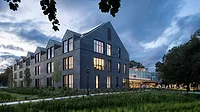
The southwest entrance is clad with a local stone and fiber-cement panels.
Photo © Richard Barnes

The fiber cement continues on the northwest facade, where it alternates with glass patterned in a custom frit designed by Ennead.
Photo © Richard Barnes

Opportunities to meet and gather abound, as with the café seating located in the main spine of the building and in other well-trafficked circulation areas.
Photo © Richard Barnes

Opportunities to meet and gather abound, as with the café seating located in the main spine of the building and in other well-trafficked circulation areas.
Photo © Richard Barnes

The building houses classrooms and labs dedicated to a variety of scientific fields of study.
Photo © Richard Barnes

Image courtesy Ennead Architects

Entry-level plan
Image courtesy Ennead Architects

Upper-level plan
Image courtesy Ennead Architects
Architects & Firms
Bridging disciplines—literally and figuratively—has become a concern du jour for colleges and universities as multidisciplinary collaborations continue to proliferate. But finding a solution depends on the area of research. For those in the humanities, exploring the treasures of another field of study usually takes little more than a stroll from the English Department over to History or Geography. For scientists, who need labs and collaborate with a wider range of disciplines, it’s more complicated. Computer jocks may use robotics labs; psychologists and earth scientists draw on research by chemists and biologists; physicists and astronomers need computer jocks . . . and on and on.
Additional Information:Jump to credits & specifications
With this new norm in academic scientific practice come new demands on campus facilities, most of which were constructed when each scientific discipline operated in its own silo. The increase in multidisciplinary study—as well as rapid advances in research—have fueled an academic building boom in the sciences in larger universities and, increasingly, in liberal arts colleges as well.
An impressive exemplar of this new trend is Vassar College’s Bridge for Laboratory Sciences, part of the new Integrated Science Commons master plan, which contains renovated and new facilities for biology, psychology and cognitive sciences, and physics. Designed by Richard Olcott of Ennead Architects, the Bridge and Commons projects are the result of a decade-long planning and architectural initiative to upgrade and consolidate the school’s science facilities, which had been dispersed around its 1,000-acre campus in Poughkeepsie, New York.
Vassar boasts one of this country’s most beautiful campuses. One hundred of its acres constitute a designated arboretum, and 400 acres comprise an ecological preserve. The campus is also an architectural petting zoo of sorts, offering two National Historic Trust buildings, including the 1865 Main Building by James Renwick Jr., the beautiful little Ferry House by Marcel Breuer, Noyes House by Eero Saarinen, as well as other distinguished historical buildings.
The exception to the campus’s manicured serenity and architectural quality lay in its south-central sector, which was functionally underutilized and, aesthetically and experientially, its least resolved. A well-trafficked shortcut to the campus, the area contained an unsightly parking lot next to a steep, unkempt slope that tumbled down to a trickle of a polluted stream called Fonteyn Kill.
How to activate a bedraggled corner of this extraordinary place and improve circulation to the nearby buildings was one question. Another: Should the college’s outdated science buildings be renovated, and should any be demolished? Could the school’s dispersed science facilities be knit into a cohesive commons? Could Fonteyn Kill be salvaged and its wetlands restored?
Yes, but it took skill and determination. Razing an unfortunately sited and obsolete chemistry laboratory allowed Ennead to consolidate the science facilities around three existing, adjacent buildings–the large but architecturally uninspired Olmsted Hall, the elegant New England Building, and the Sanders Physics Building. What remained necessary was to rehouse the Chemistry Department, add facilities for new science disciplines and laboratories and classrooms, and confer upon the whole complex a central gathering space to nurture interdisciplinary collaborations through informal social encounters.
With one swooping gesture—a building that is a bridge—Olcott developed the critical element to resolve these challenges. Gathered under a curved steel-truss roof and straddling a steeply sloped portion of the now-restored Fonteyn Kill, the new 82,000-square-foot Bridge for Laboratory Sciences building holds the Chemistry Department offices, classrooms, and laboratories, the Earth and Environment Lab, and the robotics research laboratory. The Bridge connects directly to Olmsted Hall and is just a short stroll from New England and Sanders.
Two V-shaped concrete piers support a nearly 400-foot span, and the building’s two principal stories hang from a truss above. Under the “bridge,” a pathway leads into the ravine, where restored wetlands and an arboretum surround the outdoor Edith Roberts Ecological Laboratory. Barberry, holly, Japanese knotweed, honeysuckle, and spicebush grace a landscape designed by Michael Van Valkenburgh and Associates.
The main entrance to the Bridge is located on its short facade. Partially clad in a local blue-gray stone that complements the masonry of the nearby College Chapel, this elevation presents a materially rich, compositionally modest identity for the building. The long elevations, inspired by the light, linear look of a birch grove, blend into the wooded site; white vertical fiber-cement panels alternate with fritted glass insets (the frit mitigates glare and heat gain and minimizes bird collisions, since Fonteyn Kill is on a flyway). “It really is a building in the trees,” Olcott says. On the south elevation, projecting vertical fins add texture and also protect against the sun.
Inside, the intelligence of the design becomes most evident. The facade’s highly textured stone wall continues to form the backdrop for a delicate staircase. Beyond it flows the light-filled, double-height interior, a curved central spine that unfolds as you move through it. A café and informal seating areas with views over the ravine make this an inviting social core of the entire Integrated Science Commons scheme, as well as the first accessible at-grade path into Vassar’s central campus at that point. Lining the spine of the Bridge are commodious instructional spaces that eradicate the conventional separation of lab and classroom by linking them with internal circulation. Students can freely move among these spaces during the same class period.
Demolishing one edifice just to build another—one that spans a ravine, at that!—certainly is not an obvious solution to the numerous challenges that Vassar faced in upgrading its science facilities. But, in many ways, a bridge—structurally as well as symbolically—between disciplines, between teaching and research, between different parts of Vassar’s campus, between nature and architecture, makes perfect sense.
PeopleArchitect Ennead Architects
Personnel in architect's firm who should receive special credit Design Partner: Richard Olcott FAIA Management Partner: Timothy Hartung FAIA and Guy Maxwell AIA Project Designer: Kate Mann AIA Project Architect: Todd Walbourn AIA (New Construction, Renovation and Site work), Theresa O’Leary (Renovation) Interiors: Charmian Place Technical Director: Kathleen Kulpa AIA Project Team: Christina Ciardullo, Edgar Jimenez AIA, Hiroko Nakatani, Tom Offord, Yong Roh, Suzanne Troiano, Constance Vale, Hans Walter, Desiree Wong
Consultants Structural: Severud Associates MEP: Vanderweil Engineers Civil/Survey: LRC Group Geotechnical Engineer: Langan Engineering and Environmental Services, Inc. Laboratory: Jacobs Consultancy/GPR Planners Collaborative Landscape: Michael Van Valkenburgh Associates, Inc. Curtainwall: Heintges & Associates Cost Estimating: M.T. Peters & Associates Inc.; Daniel O’Connell’s Sons; Wolf & Company, P.C. (SD and DD) Sustainable Design: Buro Happold Engineering (DD to Completion) AV/Telecomm/Acoustics/Security: Shen Milson & Wilke LLC Lighting: Cline Bettridge Bernstein Lighting Design, Inc. Graphics/Exhibit Design: Poulin + Morris, Inc. Hardware: Glezen Fisher Group Life Safety: Hughes Associates, Inc. Energy Model: ADS Engineers Specifications: Robert Schwartz & Associates Elevator: Iros Elevator Design Services, Inc. Foodservice: Romano Gatland
Construction manager Daniel O’Connell’s Sons
Photographer: Richard Barnes, 415-577-6662
|
ProductsStructural System steel frame and concrete Manufacturer of any structural components unique to this project: TriPyramid Exterior Cladding Metal panels: Zahner Rainscreen: Eternit Curtain wall: Wausau/Cherry Hill Glass Other cladding unique to this project: Solar Screen: Cherry Hill Glass, Exterior Stone Wall – Hobart Stone Glazing Glass: Viracon, Ornilux Doors Entrances: Ellison Interior Finishes Acoustical ceilings: Decoustics, Armstrong Cabinetwork and custom woodwork: Polybois (in café, classrooms, conference rooms) Wall coverings: interior Stone Wall – Hobart Stone Wood paneling: 9Wood Concrete floors: Get Real Surfaces Special interior finishes unique to this project: concrete floors: Get Real Surfaces Office furniture: Herman Miller Green chairs indoor café and outdoor terrace seating: Vitra Upholstery: Maharam Lighting Interior ambient lighting: large chandelier in Bridge for Laboratory Sciences lobby by Viabia Lighting controls: nLight Conveyance Interior ornamental stair (lobby): Ralph's Blacksmith |
Looking for a reprint of this article?
From high-res PDFs to custom plaques, order your copy today!