Architectural Record
search
cart
facebook twitter linkedin youtube
  • Sign In
  • Subscribe
  • Sign Out
  • My Account
Architectural Record
  • NEWS
    • Latest News
    • Awards
    • Interviews
    • Obituaries
    • Podcasts
      • Design:Ed Podcast
      • Sponsored Podcasts
  • OPINION
    • Book Reviews / Excerpts
    • Exhibition Reviews
    • Forum
  • EXCLUSIVES
    • Videos
    • Design Vanguard
    • Top 300 Firms
    • Sponsored Content
    • Sponsored eBooks
    • From the Archives
  • CONTINUING ED
    • Editorial Continuing Ed
    • CE Center
    • CE Academies
  • PROJECTS
    • Buildings By Type
    • Reuse & Renovation
    • Museums & Arts Centers
    • Colleges & Universities
    • Multifamily Housing
    • Interiors
    • Lighting
    • Kitchen & Bath
  • HOUSES
    • Record Houses
    • House of the Month
    • Featured Houses
  • PRODUCTS
    • Products by Category
    • Record Products of the Year
    • Latest Products
  • EVENTS
    • Dates & Events
    • Record on the Road
    • Innovation Conference
    • Sustainability in Practice
    • Women In Architecture
    • Webinars
    • Ad Excellence Awards
    • Submit an Event
  • CONNECT
    • Ask RECORD AI
    • Newsletters
    • Contact
    • Advertise
    • Editorial Calendar
    • Store
    • Customer Service
  • SUBMIT
    • Submission Guidelines
    • RECORD Competitions
  • MAGAZINE
    • Subscribe
    • My Account
    • Digital Edition
    • Current Issue
    • Firm Pass
    • Historic Archive
Lighting Design

Illuminating Structure

Sayne Foundry

LEDs sensitively illuminate an old industrial building, allowing for contemporary use and lending an enchanting nocturnal appeal.
By Mary Pepchinski
Sayne Foundry

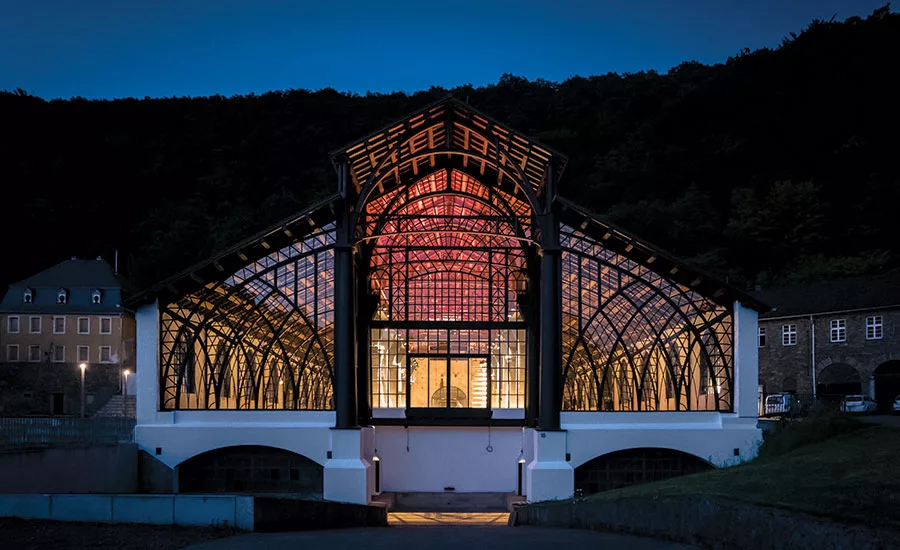
After it was renovated in 2014, the Sayn Foundry was lit entirely from within, so that it radiates a warm glow in the evening that showcases the building’s intricate architectural details.

Photo © Johannes Roloff
Sayne Foundry

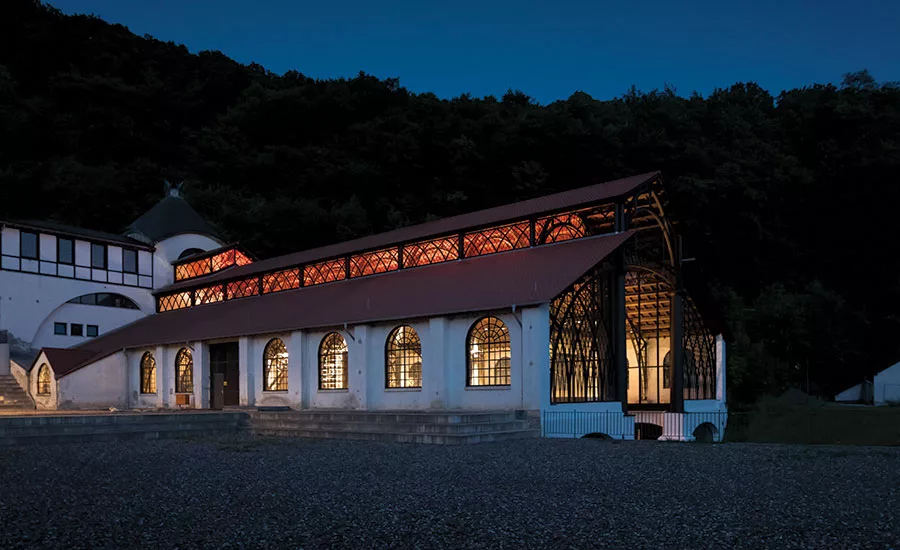
After it was renovated in 2014, the Sayn Foundry was lit entirely from within, so that it radiates a warm glow in the evening that showcases the building’s intricate architectural details.

Photo © Johannes Roloff
Sayne Foundry

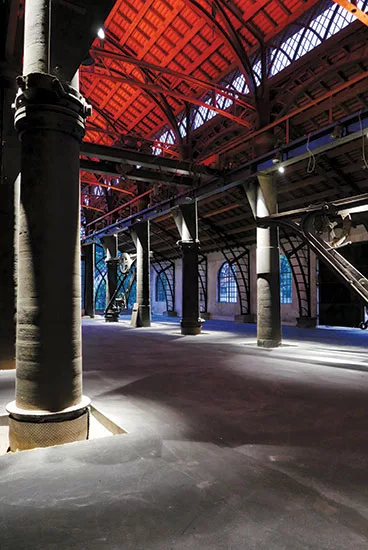
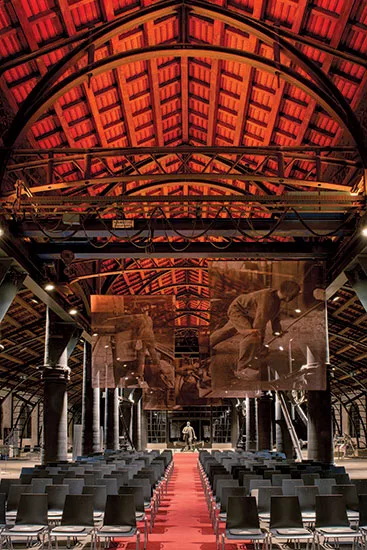
The ceiling in the building’s nave is washed in white or red light supplied by concealed RGB LED strips, while the columns receive a cool white glow from LED spotlights.

Photo © Johannes Roloff
Sayne Foundry

The ceiling in the building’s nave is washed in white or red light supplied by concealed RGB LED strips, while the columns receive a cool white glow from LED spotlights.

Photo © Thomas Naethe
Sayne Foundry

Image courtesy Carl Ludwig Althans

Sayne Foundry

Image courtesy Carl Ludwig Althans

Sayne Foundry

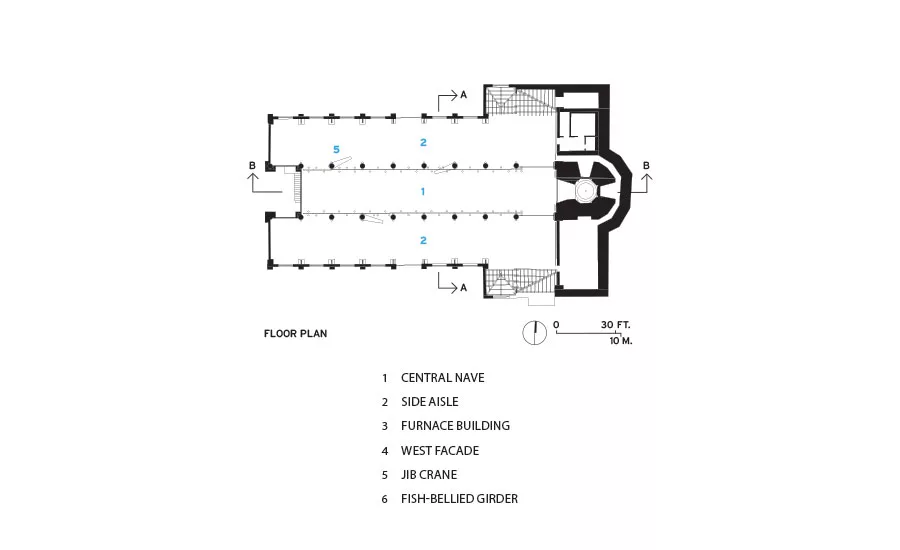
Floor plan

Image courtesy Carl Ludwig Althans

Sayne Foundry
Sayne Foundry
Sayne Foundry
Sayne Foundry
Sayne Foundry
Sayne Foundry
Sayne Foundry
November 1, 2016

Architects & Firms

Carl Ludwig Althans
Licht Kunst Licht

Bendorf, Germany

People/Products

Bendorf, a Rhine River city north of Koblenz, Germany, and a former center of mining and ironwork, acquired the derelict Sayn Iron Works Foundry in 2004 to repurpose it as a cultural attraction and an event space. A cutting-edge industrial building celebrated for its inventive design when it was built in 1830, the intricate structure is now illuminated by sensitively integrated LEDs that allow for contem­porary use and lend an enchanting nocturnal appeal. “We wanted to use modern technology to bring the old foundry back to life,” says Werner Prümm, who oversees the city’s economic development.

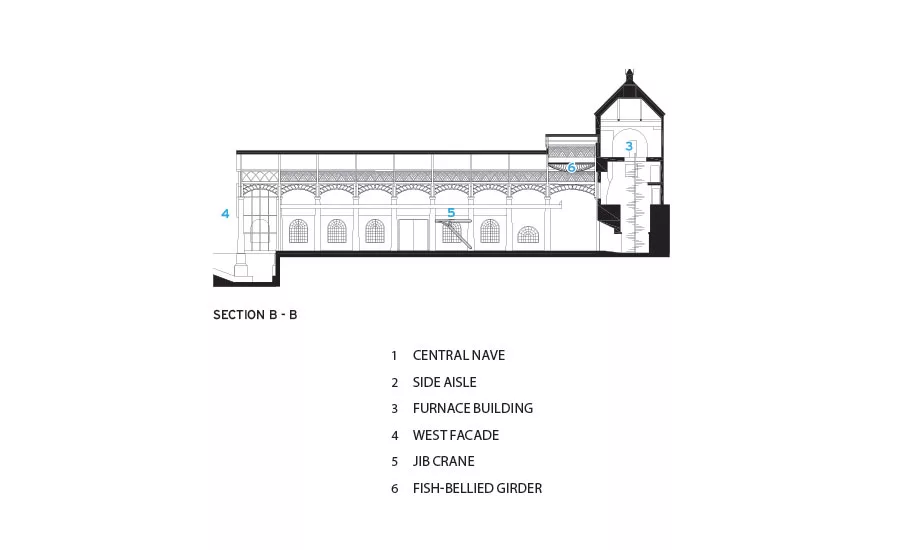
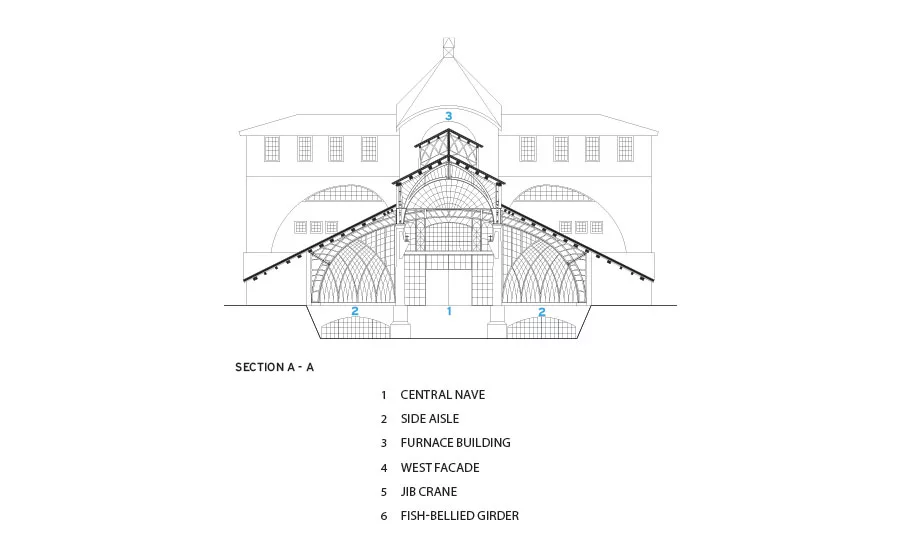
Designed by architect Carl Ludwig Althans, the building, which is situated on a site hugging a wooded slope on the city’s outskirts, is a basilica-like hall with massive masonry walls. In order to flood the capacious interior with daylight, Althans installed clerestories above the central nave, fenestration along the sides, and spectacular glazing with neo-Gothic tracery on the west-facing facade. Details are both eclectic—including 20-foot-high columns topped with Doric capitals and prefabricated cast-iron structural framework devoid of rivets and screws—and functional, like the elevated tracks to transport materials flanking the central nave and the three giant pivoting cranes attached to the columns.

Following an overall renovation in 2014, the city commissioned the Bonn-based lighting-design firm Licht Kunst Licht (LKL) to develop a scheme for the newly restored foundry, now a listed building. The designers were required to preserve the physical substance and devise a no-frills yet versatile design that maintains the landmark’s distinct character and can accommodate diverse functions. “The concept was spare and elegant,” says designer Johannes Roloff.

First, LKL convinced the officials to abandon using exterior illumination to draw attention to the monument at night and to replace it with more evocative interior lighting. “We wanted a building that pours warm light out into the surroundings,” says Roloff, “and seems to glow from within.”

To accomplish this, the design team felt it was necessary to clearly articulate the continuous interior surfaces. Con­cealed adjustable linear RGB LED strips bathe the underside of the roof in the nave in alternating white or brilliant red tones. Washers at the base of the rear wall uplight this surface, and the sidewalls receive indirect illumination from spotlights affixed to two elevated tracks, which transverse the hall above the columns.

Then the designers turned to the industrial artifacts and historic construction within. The cast iron elements had been coated with a special paint containing glimmering metal flakes. To emphasize this effect, LED spotlights with a cool 4000K color temperature and a narrow angle were mounted at the top of the columns and aimed at each member along the side aisles. For those in the nave, spotlights were placed underneath the elevated tracks. Each giant crane received two spotlights, placed at different angles to enliven them and cast shadows on the surrounding floor.

Because the space will house receptions, exhibitions, and performances, adjustable LED spotlights, also positioned on the elevated tracks, are equipped with honeycomb louvers or snoots to reduce glare and direct strong, warm-white 2700K downlight to the base of the building. LED luminaires were employed throughout to minimize cost and energy, as well as to provide the ability to alter color schemes via a digital DALI lighting-control system that is equipped with a DMX interface. Most of the luminaires have casings that blend in with the historic construction to conceal them.

Lead designer Johannes Roloff worked in theatrical lighting for a decade before turning to architecture, and it is not surprising that his schemes for the Sayn Iron Works Foundry have dramatic flair—the white ceiling illumination possesses an ethereal demeanor, while the red tones conjure up visions of the smoldering furnaces and molten iron that once occupied this space. Both hint at the inner life of this restored landmark, but their means do not overwhelm it. “Licht Kunst Licht understood it was important to put the architecture in the foreground,” says Werner Prümm, “and not show off their own special effects.”


People

Lighting Designer:
Licht Kunst Licht AG
Project lead: Johannes Roloff
Jagdweg 16
53115 Bonn
Germany


Photographers:

Johannes Roloff, Thomas Naethe 


Products

Lighting

Guzzini, EWO, GE (fixtures); Jung (control interface)

Interior ambient lighting

Linear profile luminaire, wallwashing light distribution, RGB, LED
LED, 22W/mtr, RGB, Quantity: 78 mtr
- Adjustable spotlight with LED, 34W, 3000K, Quantity: 48
- Adjustable spotlight with LED, 17W, 4000K, Quantity: 32
- Adjustable spotlight with LED, 17W, 3000K, Quantity: 8
- Floor-recessed linear wallwashing profile, LED, 32W/mtr, 4000K, Quantity: 23 mtr

Dimming system or other lighting controls

DALI-DMX interface with touchpanel front-end

 
KEYWORDS: Germany

Share This Story

Looking for a reprint of this article?
From high-res PDFs to custom plaques, order your copy today!
Mary Pepchinski is a writer, curator, and former professor of architectural theory at the Technical University Dresden.

Post a comment to this article

Report Abusive Comment

Subscription Center
  • Create an Account
  • Start a Subscription
  • Manage My Account
  • Sign Up for Newsletters
  • Visit Customer Service
  • Update Preferences

More Videos

Sponsored Content

Sponsored Content is a special paid section where industry companies provide high quality, objective, non-commercial content around topics of interest to the Architectural Record audience. All Sponsored Content is supplied by the advertising company and any opinions expressed in this article are those of the author and not necessarily reflect the views of Architectural Record or its parent company, BNP Media. Interested in participating in our Sponsored Content section? Contact your local rep!

close
  • TAMLYN XtremeTrim Exterior Trim
    Sponsored byTamlyn

    Designing Cleaner Panel Facades: Why Exterior Trim Details Matter

  • Building with Vapor Barriers
    Sponsored byReef Industries, Inc.

    Vapor Barriers Help Control Moisture in Tighter Building Designs

  • Duct Interior with Prodeq System
    Sponsored byHenry, a Carlisle Company

    Designing Resilient Water Containment Systems

DESIGN:ED Podcast
Listen to Architectural Record’s DESIGN:ED Podcast

Events

June 10, 2026

Rethinking Stormwater – The Power of Porous Paving

Credits: 1 AIA LU/HSW; 1 AIBD P-CE; 0.1 ICC CEU

Learn how porous paving systems support stormwater management, reduce heat island effects, and enhance sustainable site design performance.

June 11, 2026

Very Early Warning Fire Detection for Mission-Critical Facilities

Credits: 1 AIA LU/HSW; 1 AIBD P-CE; 0.1 ICC CEU

Examine advanced fire detection strategies that support uptime and enhance safety in data centers and other mission-critical facilities.

View All Submit An Event

Products

2026 Architect's Square Foot Costbook

2026 Architect's Square Foot Costbook

See More Products

Popular Stories

Practice Matters illustration

What’s in a (Firm’s) Name? Thinking About Succession and Legacy

Coronado Bridge

The Architect’s Guide to San Diego

Practice Matters illustration

By the Numbers: Counting America's Architects

Riverdale House by Studio Lau

Riverdale House by Studio Lau

House on a Hill

Design Vanguard 2026: Forma

Broader Sustainability of CMU - Free Webinar - May 21, 2026

Related Articles

  • Wilhelm-Leuschner-Platz

    Wilhelm-Leuschner-Platz

    See More
  • State Museum of Archaeology

    State Museum of Archaeology

    See More
  • Werdendes Ruhrgebiet

    Werdendes Ruhrgebiet

    See More

Related Products

See More Products
  • superlux.jpg

    SuperLux: Smart Light Art, Design & Architecture for Cities

  • 0470114223.gif

    Interior Lighting for Designers, 5th Edition

See More Products
×

The latest news and information

#1 Source for Architectural Design, News and Products

SUBSCRIBE
  • RESOURCES
    • Advertise
    • Contact Us
    • Submit
    • Store
  • ACCOUNT CENTER
    • Create an Account
    • Start a Subscription
    • Manage My Account
    • Sign Up for Newsletters
    • Visit Customer Service
    • Update Preferences
  • PRIVACY
    • PRIVACY POLICY
    • TERMS & CONDITIONS
    • DO NOT SELL MY PERSONAL INFORMATION
    • PRIVACY REQUEST
    • ACCESSIBILITY
  • SERVICES
    • Marketing Services
    • Reprints
    • Market Research
    • List Rental
    • Survey/Respondent Access
  • STAY CONNECTED
    • Linkedin
    • Facebook
    • Instagram
    • YouTube
    • X (Twitter)

Copyright ©2026. All Rights Reserved BNP Media, Inc. and BNP Media II, LLC.

Design, CMS, Hosting & Web Development :: ePublishing