Architectural Record
search
cart
facebook twitter linkedin youtube
  • Sign In
  • Subscribe
  • Sign Out
  • My Account
Architectural Record
  • NEWS
    • Latest News
    • Awards
    • Interviews
    • Obituaries
    • Podcasts
      • Design:Ed Podcast
      • Sponsored Podcasts
  • OPINION
    • Book Reviews / Excerpts
    • Exhibition Reviews
    • Forum
  • EXCLUSIVES
    • Videos
    • Design Vanguard
    • Top 300 Firms
    • Sponsored Content
    • Sponsored eBooks
    • From the Archives
  • CONTINUING ED
    • Editorial Continuing Ed
    • CE Center
    • CE Academies
  • PROJECTS
    • Buildings By Type
    • Reuse & Renovation
    • Museums & Arts Centers
    • Colleges & Universities
    • Multifamily Housing
    • Interiors
    • Lighting
    • Kitchen & Bath
  • HOUSES
    • Record Houses
    • House of the Month
    • Featured Houses
  • PRODUCTS
    • Products by Category
    • Record Products of the Year
    • Latest Products
  • EVENTS
    • Dates & Events
    • Record on the Road
    • Innovation Conference
    • Sustainability in Practice
    • Women In Architecture
    • Webinars
    • Ad Excellence Awards
    • Submit an Event
  • CONNECT
    • Ask RECORD AI
    • Newsletters
    • Contact
    • Advertise
    • Editorial Calendar
    • Store
    • Customer Service
  • SUBMIT
    • Submission Guidelines
    • RECORD Competitions
  • MAGAZINE
    • Subscribe
    • My Account
    • Digital Edition
    • Current Issue
    • Firm Pass
    • Historic Archive
ProjectsInterior DesignRecord Interiors

Werdendes Ruhrgebiet

Mining the past: An exhibition in an old coal-washing plant used modern technology to tell the story of an industrial region's heritage.

By Mary Pepchinski
Werdendes Ruhrgebiet
For a recent exhibition, Bernhard Denkinger designed a 'lattice of light' with perforated platforms underlit by LEDs.
 
Photo © Deimel and Wittmar
Werdendes Ruhrgebiet
OMA with B'll and Krabel converted the old coal-washing plant into a museum in 2006, adding a new escalator that takes visitors to the entry, 80 feet above the ground.
 
Photo © Deimel and Wittmar
Werdendes Ruhrgebiet
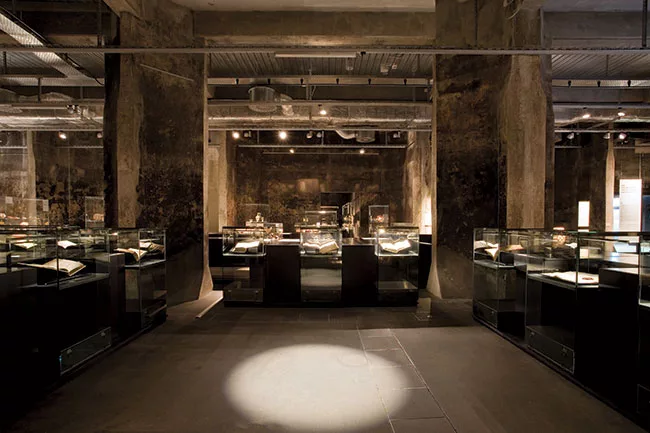
Halogen luminaires, favored for their warm tone, light most artifacts, while LEDs in recessed vitrines are used for objects that require more light.
 
Photo © Deimel and Wittmar
Werdendes Ruhrgebiet
A central arrangement of vitrines displays manuscripts.
 
Photo © Deimel and Wittmar
Werdendes Ruhrgebiet
Powder-coated chain-link curtains'recalling both medieval armor and 20th-century industrial production'separate some thematic sections.
 
Photo © Deimel and Wittmar
Werdendes Ruhrgebiet
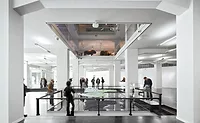
When entering the room visitors were greeted by a wide ramp on which illustrations of three main themes are projected.
 
Image courtesy Bernhard Denkinger
Werdendes Ruhrgebiet
Early medieval objects on the left side of the gallery were presented on elongated parallel plinths. Paths at right angles led to the gallery's center.
 
Image courtesy Bernhard Denkinger
Werdendes Ruhrgebiet
Entrance to the Essen Abbey section
 
Image courtesy Bernhard Denkinger
Werdendes Ruhrgebiet
Entrance to the Werden Abbey section
 
Image courtesy Bernhard Denkinger
Werdendes Ruhrgebiet
An 'Interpretation' section presented more recent paintings and sculptures that depicted the history on display.
 
Image courtesy Bernhard Denkinger
Werdendes Ruhrgebiet
The exhibit was presented at the Ruhr Museum, part of an inactive coal mine'now a UNESCO World Heritage site'adapted by Rem Koolhaas and his firm OMA to house a cultural center. An escalator transports visitors to the entrance, 80 feet above ground, where they then move downward through the plant, following the path coal once travelled.
 
Image courtesy OMA
Werdendes Ruhrgebiet
The exhibit was presented at the Ruhr Museum, part of an inactive coal mine'now a UNESCO World Heritage site'adapted by Rem Koolhaas and his firm OMA to house a cultural center. An escalator transports visitors to the entrance, 80 feet above ground, where they then move downward through the plant, following the path coal once travelled.
 
Image courtesy OMA
Werdendes Ruhrgebiet
The exhibit was presented at the Ruhr Museum, part of an inactive coal mine'now a UNESCO World Heritage site'adapted by Rem Koolhaas and his firm OMA to house a cultural center. An escalator transports visitors to the entrance, 80 feet above ground, where they then move downward through the plant, following the path coal once travelled.
 
Image courtesy OMA
Werdendes Ruhrgebiet
Image courtesy Bernhard Denkinger
Werdendes Ruhrgebiet
September 16, 2015

Architects & Firms

Bernhard Denkinger

Essen, Germany

People/Products

Once vilified for pollution and noise, the mines and factories of the Ruhr district (Ruhrgebiet), Germany’s former coal and steel belt, have become proud symbols of the region’s industrial past. One inactive coal mine, the Zeche Zollverein in Essen, is now a UNESCO World Heritage site and houses a cultural center, following a master plan by Rem Koolhaas and his firm, OMA. With architects Heinrich Böll and Hans Krabel, Koolhaas also repurposed the coal mine’s Kohlenwäsche (coal-washing plant), transforming it into the Stiftung Ruhr Museum in 2006. Leaving the plant’s machinery intact, the architects’ bold interventions—including an escalator that transports visitors to the entrance, 80 feet above ground, where they then move downward through the plant, following the path coal once traveled—marked a new chapter in the building’s history.

Within this museum, Vienna-based architect Bernhard Denkinger designed a recent exhibition entitled Werdendes Ruhrgebiet (Beginnings of the Ruhr Region—which was on view from March 27 to August 23) in a gallery retaining a grid of concrete coal-washing cells. Drawing upon literary associations, Denkinger engaged visitors with an arresting display of 800 rare artifacts—manuscripts, coins, weapons, jewelry, architectural fragments, glass and ceramic vessels—dating from the third to the 11th centuries CE. 

According to Denkinger, the design had to organize the disparate artifacts and the cell structure into a narrative—because “exhibition designs are like short stories”—linking the Ruhr’s distant past with its post-industrial present. At the same time, it had to protect the building’s historic structure with a temporary architecture that could only be placed in position and clamped or hung from existing ceiling tracks.

Denkinger inserted a field of modular display units, measuring about 3 feet high and ranging from 18 to 25 inches wide, between the cells. Made out of MDF panels clad in steel sheets with a charcoal-gray powder coating, these units served as a base for both freestanding artifacts and others protected by vitrines made of safety glass.

Challenged by a floor that slopes from the entry to the rear, the architect inserted adjustable supports under the units to maintain an even datum line. Then he arranged the units to define a path around the gallery, linking the exhibit’s five sections—everyday life, conflict, cultural development, beliefs, and the modern interpretation of this period. Along this path, ceramic vessels and weapons yielded to reliquaries, elaborate gravestones, and finally present-day paintings and sculptures that depict this history. These encircled a  central arrangement of manuscripts—cloister inventories, musical notation, and illustrated prayer books—which occupied 24 vitrines set upon 10-inch-high bases. The path was straight and wide at the start, becoming narrower and more irregular at the end. There  one felt disoriented, as if the past were easier to comprehend than the present.

Such rare and fragile objects necessitated extremely low light levels. To assist in orientation, Denkinger created a “lattice of light,”  a series of perforated platforms underlit by LEDs, that marked the exhibition’s transitional zones—the gallery entrance, the introduction of the path, and the point where it segued to the manuscripts. Halogen luminaires on ceiling tracks accented exhibits. Integrated LEDs within both raised and recessed vitrines illuminated the manuscripts and other sensitive artifacts. Top-lit chain-link curtains glowed softly in front of the rear wall to mute the exit signage and signaled the beginning of the modern section.

As visitors moved through the museum’s dusky interior, forms emerged from the darkness as luminous beams showcased gold-encrusted swords, ivory reliquaries, or pottery shards. Complementing its haptic appeal, the architecture of Werdendes Ruhrgebiet invited interpretation: the placement of the manuscripts at the center of the gallery established written knowledge at the heart of this region’s culture, while elaborate gold crucifixes placed in high vitrines loomed over the section about beliefs, a nod to Christianity’s rise and endurance. And, as it hugged the base of the coal-washing cells, the display proposed that the region’s early development laid the basis for its industrial heyday. “It was difficult to show hierarchies in this exhibition,” reflects Denkinger, because “all stories are equal.”


People

Client: Stiftung Ruhr Museum, Fritz-Schupp-Allee 15, D-45141 Essen; www. ruhrmuseum.de

Owner: Stiftung Ruhr Museum

Architect:
Bernhard Denkinger Architect
Florianigasse 60/5, A-1080 Wien
Tel. 0043-1-5137437
Fax 0043-1-5137437-9
projects@denkinger.at
www.denkinger.at

Interior designer: Bernhard Denkinger (registered architect)

Consultant(s):
Museum Director: Heinrich Theodor Grütter; Curators: Patrick Jung, Reinhild Stephan-Maaser; Construction manager staff Ruhr Museum: Frank Kerner; Graphic design of text elements: Karsten Moll

General contractor:
No general contractor was involved. The works were executed by local firms of small and medium size coordinated by Bernhard Denkinger Architect.

Photographer(s):
Deimel + Wittmar Fotografie
Gemarkenstrasse 19, D-45147 Essen
Tel. 0049-201-721530
info@deimel-wittmar.de
www.deimel-wittmar.de

Size: 10,225 square feet

Project cost: $560,000

Construction cost: $168,000

Completion Date: March 2015


Products

Glazing
Glas Stebani, Econova Allee 18, D- 45356 Essen,
www.glasstebani.at

Interior finishes
Thomas Wellenbeck - Tischlermeister, Germaniastr. 16, D-40223 Düsseldorf,
info@wellenbeck.com, www.wellenbeck.com

Special interior finishes unique to this project:
Laser-cut panels and metal-work: Hiska Metalltechnik Gmbh, Haberstrasse 42, D-42551 Velbert, info@hiska.de, www.hiska-metalltechnik.de

Curtains made of industrial chains: Heinrich Schäfers, Schmiede- und Bauschlosserei GmbH. Bonifaciusring 19, D-45309 Essen, info@schaefers.ruhr

Lighting
Interior ambient lighting:
Custom made, components delivered by internet-seller:
PUR-LED GmbH&Co.KG, D- Bahnhofstr. 18
D-55278 Selzen
info@pur-led.de
www.pur-led.de

Downlights:  Existing Spots of ERCO were used, they can be dimmed individually

 
KEYWORDS: Germany

Share This Story

Looking for a reprint of this article?
From high-res PDFs to custom plaques, order your copy today!
Mary Pepchinski is a writer, curator, and former professor of architectural theory at the Technical University Dresden.

Post a comment to this article

Report Abusive Comment

Subscription Center
  • Create an Account
  • Start a Subscription
  • Manage My Account
  • Sign Up for Newsletters
  • Visit Customer Service
  • Update Preferences

More Videos

Sponsored Content

Sponsored Content is a special paid section where industry companies provide high quality, objective, non-commercial content around topics of interest to the Architectural Record audience. All Sponsored Content is supplied by the advertising company and any opinions expressed in this article are those of the author and not necessarily reflect the views of Architectural Record or its parent company, BNP Media. Interested in participating in our Sponsored Content section? Contact your local rep!

close
  • TAMLYN XtremeTrim Exterior Trim
    Sponsored byTamlyn

    Designing Cleaner Panel Facades: Why Exterior Trim Details Matter

  • Building with Vapor Barriers
    Sponsored byReef Industries, Inc.

    Vapor Barriers Help Control Moisture in Tighter Building Designs

  • Duct Interior with Prodeq System
    Sponsored byHenry, a Carlisle Company

    Designing Resilient Water Containment Systems

DESIGN:ED Podcast
Listen to Architectural Record’s DESIGN:ED Podcast

Events

June 11, 2026

Very Early Warning Fire Detection for Mission-Critical Facilities

Credits: 1 AIA LU/HSW; 1 AIBD P-CE; 0.1 ICC CEU

Examine advanced fire detection strategies that support uptime and enhance safety in data centers and other mission-critical facilities.

June 16, 2026

Focus on the Façade: Exploring Steel, Timber & Fire-Rated Curtain Walls and Channel Glass Systems

Credits: 1 AIA LU/HSW; 1 AIBD P-CE; 0.1 ICC CEU

Explore modern façade and glazing systems that enhance daylighting, fire safety, and thermal performance while expanding architectural design possibilities.

View All Submit An Event

Products

2026 Architect's Square Foot Costbook

2026 Architect's Square Foot Costbook

See More Products

Popular Stories

Practice Matters illustration

What’s in a (Firm’s) Name? Thinking About Succession and Legacy

Coronado Bridge

The Architect’s Guide to San Diego

Practice Matters illustration

By the Numbers: Counting America's Architects

SanDiegoAirport

Top 300 Architecture Firms of 2026

Crane Cove, ONO

Design Vanguard 2026 Winners

Broader Sustainability of CMU - Free Webinar - May 21, 2026

Related Articles

  • State Museum of Archaeology

    State Museum of Archaeology

    See More
  • St. Bartholom'us Church

    See More
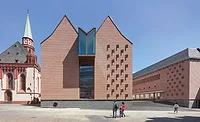
  • Historical Museum by Lederer Ragnarsdottir Oei

    Historical Museum by Lederer Ragnarsdóttir Oei

    See More

Related Products

See More Products
  • 1118978811.gif

    Architectural Design with SketchUp: 3D Modeling, Extensions, BIM, Rendering, Making, and Scripting, 2nd Edition

  • ribbonarch.jpg

    Ribbon Architecture: Light, Shadow, and Reflection in Architecture

  • postmodern design.jpg

    Postmodern Design Complete

See More Products
×

The latest news and information

#1 Source for Architectural Design, News and Products

SUBSCRIBE
  • RESOURCES
    • Advertise
    • Contact Us
    • Submit
    • Store
  • ACCOUNT CENTER
    • Create an Account
    • Start a Subscription
    • Manage My Account
    • Sign Up for Newsletters
    • Visit Customer Service
    • Update Preferences
  • PRIVACY
    • PRIVACY POLICY
    • TERMS & CONDITIONS
    • DO NOT SELL MY PERSONAL INFORMATION
    • PRIVACY REQUEST
    • ACCESSIBILITY
  • SERVICES
    • Marketing Services
    • Reprints
    • Market Research
    • List Rental
    • Survey/Respondent Access
  • STAY CONNECTED
    • Linkedin
    • Facebook
    • Instagram
    • YouTube
    • X (Twitter)

Copyright ©2026. All Rights Reserved BNP Media, Inc. and BNP Media II, LLC.

Design, CMS, Hosting & Web Development :: ePublishing