Innovation: Features
Tall Tales
The stories of a few classic skyscrapers that were never built tell us much about what motivates architects, and their clients too.
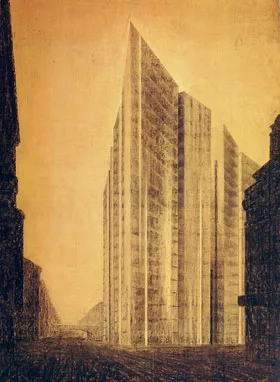
Office Tower at Grand Central, New York, 1956
Developers began seriously exploring the idea of building a skyscraper above Grand Central Terminal in the early 1950s. The idea for a skyscraper on the site, though, had been actually around since the Beaux Arts terminal was completed in 1913. Its architects, Reed & Stem, proposed their own tower which would have elegantly straddled the terminal’s main passenger hall.
Working for developers Webb & Knapp, I.M. Pei proposed an 80-story tower with a circular footprint and, thanks to a taper halfway up the shaft, an hourglass profile. Its facade was crisscrossed by structural supports; overall the building resembled a bundle of sticks. At the base of Pei’s building, and again in its upper levels, the floors were left open and the structure was left exposed. Grand Central Terminal would have been demolished to make room for the tower, just as Penn Station was demolished a few years later to make room for Two Penn Plaza and Madison Square Garden.
Although Pei’s design was passed up, the idea for a Grand Central skyscraper remained. In the late 1960s, the terminal’s owner sold the air rights to developer UGP Properties, which hired architect Marcel Breuer. By this point, however, the terminal had been designated a historic landmark, and with support from the nascent preservation movement, the Landmarks Commission rejected Breuer’s design. However, a skyscraper was built north of Grand Central Terminal: the Pan Am Building (now the Met Life Building), completed in 1963. This high-rise has been said to be the one New Yorkers would most like to see demolished, because it obstructs Park Avenue’s view corridor and dwarfs nearby buildings
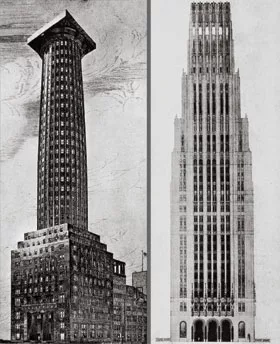
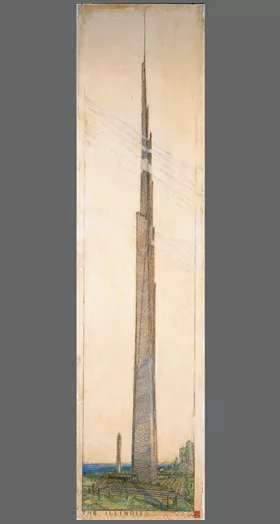
Mile High Illinois, 1956
Frank Lloyd Wright intended his Mile High Illinois skyscraper to be the focal point of Broadacre City, the theoretical city, he began planning in the 1920s. Because the Broadacre project was an exploration of horizontal space, a one-mile-high skyscraper might at first seem out of place—but by the 1950s Wright had decided that some cities were “incorrigible,” and that even Broadacre City could use a tall building as a cultural and social hub. The foundation of Wright’s building was a massive column, shaped like an inverted tripod, sunk deeply into the ground. This supported a slender, tapering tower with cantilevered floors. In keeping with his belief that architecture ought to be organic, Wright likened this system to a tree trunk with branches. He planned to use gold-tinted metal on the facade to highlight angular surfaces along balconies and parapets and specified Plexiglas for window glazing. Inside the building, mechanical systems were to be housed inside hollow cantilevered beams. To reach the building’s upper floors, Wright proposed atomic-powered elevators that could carry 100 people.
Image courtesy The Frank Lloyd Wright Foundation
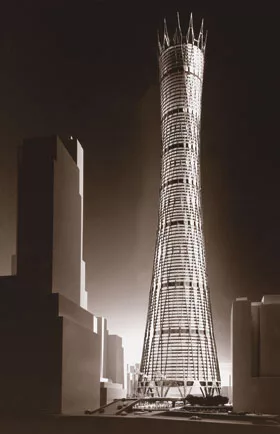
Sino Tower, Hong Kong, 1989
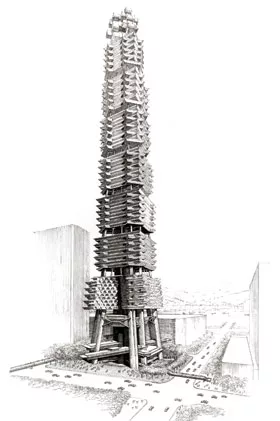
Paul Rudolph’s winning entry for the Sino Land Company’s skyscraper competition has been described as the realization of his search for a formal expression in a tall building. Taking a cue from the Eiffel Tower, the Sino Tower was framed by four massive columns that sloped upward from a splayed base. The first 150 feet of this 90-story structure was mainly open, though crisscrossed by pedestrian sky bridges and retail shops. Above this space was a “sky lobby” for a 200-room hotel, and above that were eight blocks of 10 floors each that contained the hotel as well as office space. These eight blocks were separated by open floors that housed mechanical systems and served as areas of refuge, a fire code requirement. A cluster of forms at the building’s apex that contained mechanical systems was to be sheathed in silver leaf. During the 1960s, when Rudolph was among the leading proponents of Modern architecture, he experimented with the “plug-in” city—an urban system in which residential, commercial and other uses could be contained in moveable units connected to a central service core. His Sino Tower embodied many of these ideas.
Image courtesy Paul Rudolph Foundation
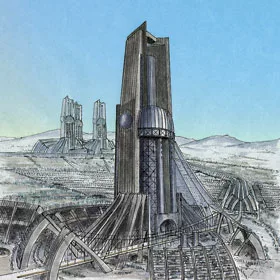
Hyper Building, Mojave Desert, 1996
In 1996 the Japanese Ministry of Construction and Culture sponsored a competition for the design of the “Hyper Building,” a structure capable of housing 100,000 people that was to stand for 1,000 years. Three architects were invited to participate: Rem Koolhaas, Nobuaki Furuya, and Paolo Soleri. The competition’s intent was to produce a building that would rein in urban sprawl, be capable of generating and recycling its resources, and reduce environmental damage. Soleri proposed a 1,000-meter tall structure with a footprint of one square kilometer, flanked by two “exedrae” or semicircular structures.
Soleri’s described his Hyper Building as a vertical “arcology,” a term he invented to describe the merging of architecture and ecology. He sited his Hyper Building in the Mojave Desert between Los Angeles and Las Vegas, cities he believes symbolize contemporary society’s penchant for consumption and hedonism. It played on these cities’ sense of artifice, incorporating a virtual-reality recreation park and using climate controls to simulate seasonal changes.
Image courtesy The Cosanti Foundation
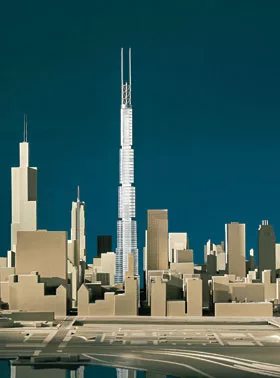
7 South Dearborn, Chicago, 1998
If it had been built, 7 South Dearborn’s 108 stories of communications facilities and antennae would have been the world’s tallest building, a remarkable achievement given that the skyscraper’s footprint occupied only one-quarter of a city block. It was supported by a rigid interior spine: a 67-square-foot hollow mast of reinforced concrete, surrounded by eight mega-columns. The mast allowed column-free floor plates and provided a base from which the building’s upper three sections could be cantilevered.
The tiny footprint meant that 7 South Dearborn contained just 1.9 million square feet of space, less than many shorter buildings. The building’s lower 50 stories contained office space, while residential space and communications facilities occupied the upper floors. SOM’s design called for an outer skin of aluminum and stainless steel, which made it seem as though the entire structure was a communications tower—and indeed the twin 450-foot antennas were intended to be the building’s main revenue source. Although there was supposedly a need for communications towers in Chicago during the telecom boom of the late 1990s, the project fell victim to the tech-market crash and real estate downturn that hit commercial developers in 2001.
Image courtesy Skidmore, Owings & Merrill
New York Times Tower Competition, New York, 2000
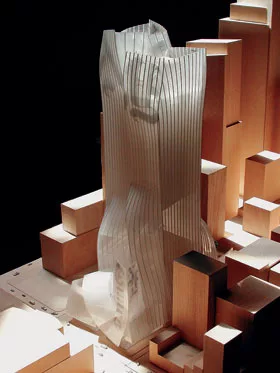
The architects’ entry was a 1.5-million-square-foot, 45-story glass tower that presented a swirl of facades that, at street level, resembled a folded copy of the Times caught in the wind. As the building rose, the form resolves into a more rectilinear shaft, with leasable floor plates. At its apex, the building erupted into peaks inspired by the Times’s calligraphic masthead font. The duality between calm and chaos they created allowed the building to conform to the street grid, while also carving out a unique identity on the skyline. It has been said that the collaboration between Gehry and Childs was strained, but for whatever reason, the team withdrew its design just weeks before the competition concluded. The commission went to Renzo Piano Building Workshop and Fox & Fowle Architects, whose design is under construction.
Image courtesy TR Hamzah & Yeang
EcoTower, London, 2000
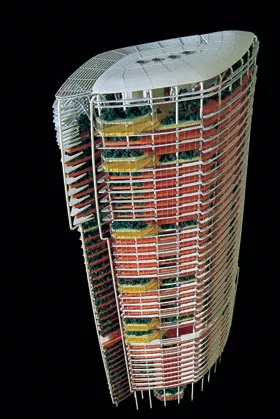
When architect Ken Yeang said his design for the EcoTower was intended to create a “suburb in the sky,” he meant something similar to the garden suburbs that would have been familiar to Beaux-Arts planners a century ago, not the suburban sprawl identified with strip malls and ranch houses.
The EcoTower actually comprised two towers, one rising 459 feet and the other 240 feet. It would have contained 300,000 square feet of residences and gardens. This green space, which was to occupy 20 percent of the building, is more than just an amenity for tenants. In keeping with Yeang’s bio-climatic design principles, the gardens were designed to shade various parts of the building and to allow efficient wind circulation. The EcoTower’s orientation, moreover, would also allow it to maximize passive solar energy gain.
Yeang’s building was intended to be the capstone of a 180-acre redevelopment project in the Elephant and Castle district of south London. Construction was slated to begin in 2002. The project stalled when the developer, Southwark Land Regeneration, failed to win financial support from the local city government.
Image courtesy Gehry Partners/SOM
Architecture critics nearly always cite a handful of unbuilt skyscrapers as the best of the type, neglecting the vast majority of completed ones entirely. That begs the question, what is it about working in the tall building genre that propels architects to produce such interesting work? It could be any number of things, from the most fantastic wish to be free of gravity’s limitations and to soar, to the more down-to-earth wish to build cities that make a rational use of the land. In the following pages, we’ve recounted the stories of nine of these iconic but unbuilt structures. Some were theoretical and never meant to be built. Others ran headlong into conflict, everything from community opposition to world war. Still others were ready for construction but were scuttled because the numbers didn’t work, or worse, because their intended market experienced a catastrophic reversal. Those factors, however, have hardly ever slowed designers down, for in the end you can’t get past the fact that something tall is nearly always something big—and inspired skyscrapers have always been just the thing to flatter vain, money-encumbered clients. They, in turn, have often been just the type to ask that the work be done on the cheap: “You only had to draw the floor plan once, right? So cut your fee.” The opportunity is so magnetic that many an architect has been willing to do just that.
Looking for quick answers on architecture and design topics?
Try Ask RECORD, our new smart AI search tool.
Ask RECORD →
Looking for a reprint of this article?
From high-res PDFs to custom plaques, order your copy today!