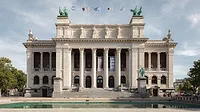
Supreme Court of the Netherlands by KAAN Architecten
The Hague

The delicacy of the buildling’s facade speaks to the tall trees along the street, locally nicknamed “green cathedral."
Photo © Fernando Guerra

Six 19th-century statues of famous Dutch legal scholars are situated outside of the lobby, where a wall proclaims the Supreme Court’s Latin motto in large stainless-steel letters; it warns of war when law breaks down.
Photo © Fernando Guerra

A cantilevered box-frame construction above the double-height lobby enables its long public gallery to be open and column-free.
Photo © Fernando Guerra

The large main courtroom, with its rich oak floor and judges’ bench, is bathed in gentle daylight through a translucent-alabaster rear wall.
Photo © Fernando Guerra

One of the atria is clad in striped Turkish marble.
Photo © Fernando Guerra

The staff restaurant is surfaced in oak.
Photo © Fernando Guerra

Etched marble tile over the Council Chamber entrance depicts a historic map of The Hague.
Photo © Fernando Guerra

The rear facade faces a canal.
Photo © Fernando Guerra

Image courtesy KAAN Architecten

Image courtesy KAAN Architecten

Image courtesy KAAN Architecten

Image courtesy KAAN Architecten
Architects & Firms
The Hague (Den Haag) is the administrative core of the Netherlands—though not the capital, which is Amsterdam. The Dutch government and king are based in The Hague, as is the International Criminal Court of the United Nations. But there is another important court in town, one that is the culmination of the country’s own legal system: the new Supreme Court of the Netherlands designed by KAAN Architects.
Additional Information:
Jump to credits & specifications
The firm was part of a contractor-led consortium—which also maintains the $63 million courthouse—that won the 2012 competition to design and build the judicial building. In a city full of important structures, many historic, this one had to have presence. The court, explains architect Kees Kaan, who runs his firm with partner Vincent Panhuysen, had been housed in a variety of buildings since its founding in 1838, and, more recently, in particularly unsuitable ones, largely invisible to the public. Not anymore. Completed in January 2016, its first purpose-built home in decades is on a broad treelined street close to the historic center, backing onto a canal. It stands on an ancient route between the Nordeinde Palace in town and the Huis Ten Bosch country palace, which is now in an extensive urban park. Due to its location, the size and overall shape of the building was pre-determined by city planners: a long rectangular building where previously there had been three 1960s office blocks.
How did the architects manage to think outside this box—one that measures 341 feet wide by 72 feet deep by 89 feet tall? The solution begins with the beautifully detailed exterior divided into three horizontal bands with full, double-height glazing at the ground level, followed by a single floor of pale limestone with punched windows, then four floors above that of tall, narrow double-glazed units framed in white painted steel. The top floor steps back as an attic story. The elegant fenestration pattern of the upper floors was designed to harmonize with the trees along the verdant street, which is locally nicknamed the “green cathedral.”
The entire length of the front facade is structurally “scooped out” at grade. There are no columns, just the enclosing glass, thick and laminated for security and braced from behind by structural glass fins. This band of reflective, transparent glass is broken by highsecurity steel entrance doors, which are necessary but visually clumsy.
A double-height limestone colonnade runs along the rear facade, which faces the canal. This is not a walkable portico but rather the expression of deep-set windows. The only public access along the back is by canal boat from the waterway. Here the bulk of the building breaks out of the box with what Kaan calls a “backpack”—a rearward projection providing larger floor plates to accommodate a library, restaurant, and administrative offices for 350 employees on the upper floors.
The lobby runs along the length of the front elevation, with public areas and two courtrooms behind. These halls of justice— one large, one small—are largely surfaced in a warm oakwood and enjoy diffused north light transmitted through an alabaster wall that backs the bench in each. Circulation for the judges and lawyers is behind this. What makes all these clear-span spaces possible is revealed on the floor above, a box frame of one-story-high steel girders running transversely. Most are hidden in the crosswalls, but one, a full Vierendeel type with vertical stanchions, marches proudly right across the restaurant from side to side. This floor forms the structural “tabletop” that allows for the deep cantilever above the ground-level lobby and the large column-free spaces of the courts. There are two parking sublevels.
Above the mighty girders, from the third floor to the sixth, the building is divided into what Kaan calls “houses” for the administrative sections of the court. Four skylights illuminate atria in the houses, each daylit space clad with a different patterned or hued marble to create a unique identity. Surrounded by traditional glass-doored offices and conference rooms, which line the window walls and are necessary for privacy, these voluminous atria provide a welcome relief, with casual breakout areas and meeting places for employees and visitors. Kaan sees them as being similar to the Dutch “Golden Age” tradition of grand top-lit staircases.
The institutional importance of the building is signified out front by a row of 19thcentury bronze statues of Dutch legal scholars, which had been preserved from the previous locations. Raised on a low plinth along the edge of the street, the six sculptures align with the main courtroom inside, as well as with a wall in the lobby that contains the Latin motto of the Supreme Court in large stainless-steel letters. It translates as, “Where legal justice falls short, armed struggle begins.”
The extensive use of limestone, marble, and wood, along with other high-quality materials, gives a sense of tradition, gravitas, and longevity to the clean-cut Dutch modernist aesthetic. That, combined with audacious structural engineering, sends a clear message. Never mind the uncertainties of the world—this place is here to stay.
CreditsArchitect: KAAN Architecten — Kees Kaan, Vincent
Engineers: ARUP (structural and mechanical); BAM Bouwen Techniek (electrical and plumbing)
Consultants: DGMR (fire, comfort, security); Level Acoustics (acoustics); CBB (building control)
General contractor: Nagata Acoustics America (acoustics);
Client: Central Government Real Estate Agency
Size: 194,000 square feet
Cost: $63.4 million
Completion date: January 2016
|
SpecificationsStone Bateig (limestone); Kolen Natuursteen (floor and wall tile, and marble) Glazing Scheuten (glass); Oskomera (metal framing) Lighting Philips; Flos; Luceplan; ETAP; Modular Doors Boon (entry); MHB (interior) Hardware FSB; Dorma Interior finishes Baswaphon (acoustic ceilings and stucco); HC KP (climate ceilings); Technoplanning (wood); Interface (carpet tiles); Van Besouw Tapijt (carpet); Vitra, Arper, Arktis (furniture) |
Looking for a reprint of this article?
From high-res PDFs to custom plaques, order your copy today!