Architectural Record
search
cart
facebook twitter linkedin youtube
  • Sign In
  • Subscribe
  • Sign Out
  • My Account
Architectural Record
  • NEWS
    • Latest News
    • Awards
    • Interviews
    • Obituaries
    • Podcasts
      • Design:Ed Podcast
      • Sponsored Podcasts
  • OPINION
    • Book Reviews / Excerpts
    • Exhibition Reviews
    • Forum
  • EXCLUSIVES
    • Videos
    • Design Vanguard
    • Top 300 Firms
    • Sponsored Content
    • Sponsored eBooks
    • From the Archives
  • CONTINUING ED
    • Editorial Continuing Ed
    • CE Center
    • CE Academies
  • PROJECTS
    • Buildings By Type
    • Reuse & Renovation
    • Museums & Arts Centers
    • Colleges & Universities
    • Multifamily Housing
    • Interiors
    • Lighting
    • Kitchen & Bath
  • HOUSES
    • Record Houses
    • House of the Month
    • Featured Houses
  • PRODUCTS
    • Products by Category
    • Record Products of the Year
    • Latest Products
  • EVENTS
    • Dates & Events
    • Record on the Road
    • Innovation Conference
    • Sustainability in Practice
    • Women In Architecture
    • Webinars
    • Ad Excellence Awards
    • Submit an Event
  • CONNECT
    • Ask RECORD AI
    • Newsletters
    • Contact
    • Advertise
    • Editorial Calendar
    • Store
    • Customer Service
  • SUBMIT
    • Submission Guidelines
    • RECORD Competitions
  • MAGAZINE
    • Subscribe
    • My Account
    • Digital Edition
    • Current Issue
    • Firm Pass
    • Historic Archive
Architecture News

San Francisco’s 185 Post Street Gets a Luminous Lift
By John King
185 Post Street

Photo © Mariko Reed

185 Post Street

Photo courtesy Brand + Allen Architects
185 Post Street

Photo © Mariko Reed

185 Post Street

Photo © Mariko Reed

185 Post Street
185 Post Street
185 Post Street
185 Post Street
185 Post Street
185 Post Street
June 1, 2009

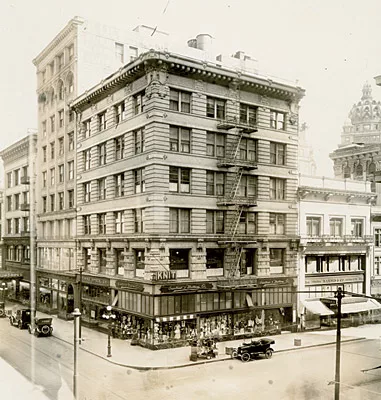
If the national economy had been stronger a few years back, the six-story brick building at 185 Post Street in San Francisco would be long gone, replaced by a Rem Koolhaas–designed Prada boutique with thick walls of bead-blasted steel.

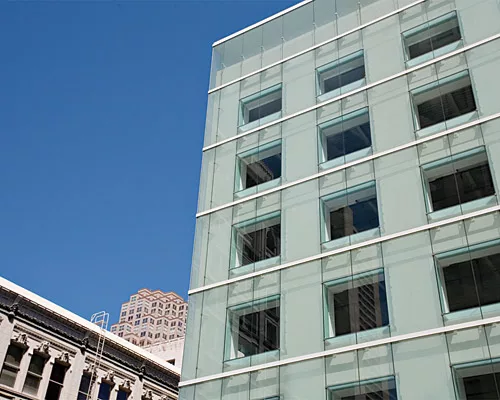
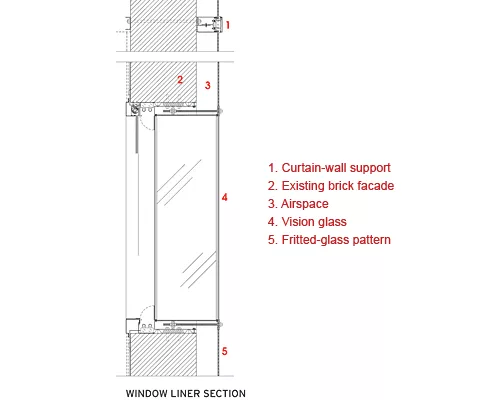
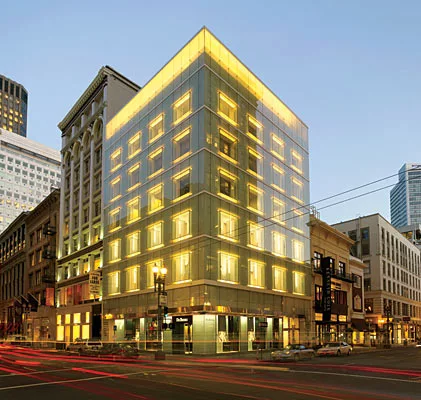
Instead, the masonry structure from 1908 has been restored to house offices above shops. Architecturally, though, the result is anything but a fastidious bow to the past. Quite the opposite: 185 Post Street is wrapped in a shroud of fritted glass set 9 inches out from the brick shell, which is now painted white.

“I go to museums and see glass encasements over beautiful artifacts, and I thought, ‘Why not try that?’ ” says Koonshing Wong, a principal in the San Francisco office of Brand + Allen Architects. “The goal was to touch the existing structure as lightly as possible with a new one.”

Brand + Allen was the architect of record for Koolhaas on his Prada “epicenter” that was to rise 10 stories as a provocative counterpoint to the Beaux-Arts-flavored landmarks of San Francisco’s retail district. That project was approved in 2001 but fell victim to changing times, and Prada finally sold the site to Grosvenor Properties in 2005.

In purchasing a prime commercial corner one block from Union Square, Grosvenor inherited an oft-altered 1908 building scarred finally by a 1950s tile facade. But because of budget, Brand + Allen’s marching orders were to work with what was there rather than start from scratch. That’s what led to Wong’s allegorical curtain wall, a glass case seemingly detached from the display inside.

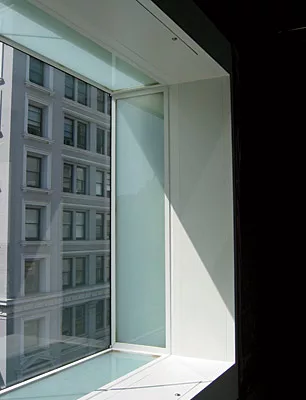
Wong conceived of the glass as a sort of veil, opaque from some angles and transparent from others. After ruling out translucent glass, Wong settled on two patterns of fritted glass—a 60 percent transparency running horizontally beneath the windows and 40 percent in the vertical space between each opening.

The technical challenge was to translate an artistic notion into a physical element discreet and durable at once: “The thing that made us think a lot was how to have the connections dictated by the facade, rather than the structure behind it,” said David Murphy of Murphy Burr Curry, the project’s structural engineer. Tests determined that lightly braced panels could be no larger than 6 by 12 feet if they were to withstand the site’s wind load and a “maximum seismic event”—a euphemism for the tumultuous earthquake forecast to strike the Bay Area at some point in the future. The silver lining was that the need for seismic bracing offered an alternative to tying the new glass directly to the original walls. Instead, horizontal steel brackets are bolted to rods that extend from a new moment frame installed behind the 1908 walls. Except for the drilled holes that the rods pass through, the two systems are distinct.

Looking for quick answers on architecture and design topics?
Try Ask RECORD, our new smart AI search tool.
Ask RECORD →

While most of the glass is fritted, the square directly in front of the original window openings is clear. The openings are emphasized in another way, by glass frames that span the 9-inch gap between the two walls. The perpendicular pieces serve a structural role—subtly helping to tie back the new wall and offer reinforcement.

Because so much of the visual impact rides on the details, the team made alterations throughout the construction process. The design initially called for white caulking, for instance, but what looked subdued in the office drew attention to itself in full-scale mock-ups, catching sunlight with a vengeance. Black caulking is used instead, a steady presence that doesn’t jump out.

The biggest change involved the masonry: Instead of being left bare, it is now covered in a white epoxy paint that seals small fractures and gives the wall a uniform appearance.

“That’s not what we had planned—fritted white against heavy red would have been an interesting contrast,” Wong says with regret. “But the original walls were so beaten up, they had to be stabilized.” It also turned out that while most of the walls were red, the bricks around the windows were yellow.

Inevitably, the question that Wong hears most about 185 Post Street has nothing to do with design. It’s something more basic: How do you clean the space behind the glass?

You don’t.

The cavity isn’t airtight; there’s a vent with particle filters at the bottom of the curtain wall, above the ground floor. On the roof, the glass skin extends above the original brick structure and has fans attached to the back. They circulate air that prevents the cavity from heating up and warping the glass, but also keeps dust and dirt from settling down.

KEYWORDS: historic preservation San Francisco

Share This Story

Looking for a reprint of this article?
From high-res PDFs to custom plaques, order your copy today!

John King is a contributing editor to RECORD and former urban-design critic at the San Francisco Chronicle. He is the author of Portal: San Francisco’s Ferry Building and the Reinvention of American Cities.

Post a comment to this article

Report Abusive Comment

Subscription Center
  • Create an Account
  • Start a Subscription
  • Manage My Account
  • Sign Up for Newsletters
  • Visit Customer Service
  • Update Preferences

More Videos

Sponsored Content

Sponsored Content is a special paid section where industry companies provide high quality, objective, non-commercial content around topics of interest to the Architectural Record audience. All Sponsored Content is supplied by the advertising company and any opinions expressed in this article are those of the author and not necessarily reflect the views of Architectural Record or its parent company, BNP Media. Interested in participating in our Sponsored Content section? Contact your local rep!

close
  • TAMLYN XtremeTrim Exterior Trim
    Sponsored byTamlyn

    Designing Cleaner Panel Facades: Why Exterior Trim Details Matter

  • Building with Vapor Barriers
    Sponsored byReef Industries, Inc.

    Vapor Barriers Help Control Moisture in Tighter Building Designs

  • Duct Interior with Prodeq System
    Sponsored byHenry, a Carlisle Company

    Designing Resilient Water Containment Systems

DESIGN:ED Podcast
Listen to Architectural Record’s DESIGN:ED Podcast

Events

June 10, 2026

Rethinking Stormwater – The Power of Porous Paving

Credits: 1 AIA LU/HSW; 1 AIBD P-CE; 0.1 ICC CEU

Learn how porous paving systems support stormwater management, reduce heat island effects, and enhance sustainable site design performance.

June 11, 2026

Very Early Warning Fire Detection for Mission-Critical Facilities

Credits: 1 AIA LU/HSW; 1 AIBD P-CE; 0.1 ICC CEU

Examine advanced fire detection strategies that support uptime and enhance safety in data centers and other mission-critical facilities.

View All Submit An Event

Products

2026 Architect's Square Foot Costbook

2026 Architect's Square Foot Costbook

See More Products

Popular Stories

Practice Matters illustration

What’s in a (Firm’s) Name? Thinking About Succession and Legacy

Coronado Bridge

The Architect’s Guide to San Diego

Practice Matters illustration

By the Numbers: Counting America's Architects

Riverdale House by Studio Lau

Riverdale House by Studio Lau

House on a Hill

Design Vanguard 2026: Forma

Broader Sustainability of CMU - Free Webinar - May 21, 2026

Related Articles

  • Larkin

    Larkin Street Substation Addition Illuminates an Industrial Corner in San Francisco

    See More
  • Gensler San Francisco Office

    Gensler San Francisco's New Full-Floor Office is a Balancing Act Between Future and Past

    See More
  • India Basin Waterfront Park

    At India Basin, GGN and Jensen Architects Revamp a Once-Industrial Stretch of San Francisco Shoreline

    See More

Related Products

See More Products
  • Architectural Record - July 2025

    Architectural Record July 2025 Issue

See More Products
×

The latest news and information

#1 Source for Architectural Design, News and Products

SUBSCRIBE
  • RESOURCES
    • Advertise
    • Contact Us
    • Submit
    • Store
  • ACCOUNT CENTER
    • Create an Account
    • Start a Subscription
    • Manage My Account
    • Sign Up for Newsletters
    • Visit Customer Service
    • Update Preferences
  • PRIVACY
    • PRIVACY POLICY
    • TERMS & CONDITIONS
    • DO NOT SELL MY PERSONAL INFORMATION
    • PRIVACY REQUEST
    • ACCESSIBILITY
  • SERVICES
    • Marketing Services
    • Reprints
    • Market Research
    • List Rental
    • Survey/Respondent Access
  • STAY CONNECTED
    • Linkedin
    • Facebook
    • Instagram
    • YouTube
    • X (Twitter)

Copyright ©2026. All Rights Reserved BNP Media, Inc. and BNP Media II, LLC.

Design, CMS, Hosting & Web Development :: ePublishing