Architectural Record
search
cart
facebook twitter linkedin youtube
  • Sign In
  • Subscribe
  • Sign Out
  • My Account
Architectural Record
  • NEWS
    • Latest News
    • Awards
    • Interviews
    • Obituaries
    • Podcasts
      • Design:Ed Podcast
      • Sponsored Podcasts
  • OPINION
    • Book Reviews / Excerpts
    • Exhibition Reviews
    • Forum
  • EXCLUSIVES
    • Videos
    • Design Vanguard
    • Top 300 Firms
    • Sponsored Content
    • Sponsored eBooks
    • From the Archives
  • CONTINUING ED
    • Editorial Continuing Ed
    • CE Center
    • CE Academies
  • PROJECTS
    • Buildings By Type
    • Reuse & Renovation
    • Museums & Arts Centers
    • Colleges & Universities
    • Multifamily Housing
    • Interiors
    • Lighting
    • Kitchen & Bath
  • HOUSES
    • Record Houses
    • House of the Month
    • Featured Houses
  • PRODUCTS
    • Products by Category
    • Record Products of the Year
    • Latest Products
  • EVENTS
    • Dates & Events
    • Record on the Road
    • Innovation Conference
    • Sustainability in Practice
    • Women In Architecture
    • Webinars
    • Ad Excellence Awards
    • Submit an Event
  • CONNECT
    • Ask RECORD AI
    • Newsletters
    • Contact
    • Advertise
    • Editorial Calendar
    • Store
    • Customer Service
  • SUBMIT
    • Submission Guidelines
    • RECORD Competitions
  • MAGAZINE
    • Subscribe
    • My Account
    • Digital Edition
    • Current Issue
    • Firm Pass
    • Historic Archive
ProjectsResidential Architecture

Restoring Richard T. Foster's Round House

Wilton, Connecticut
By Anna Fixsen
A Fresh Spin

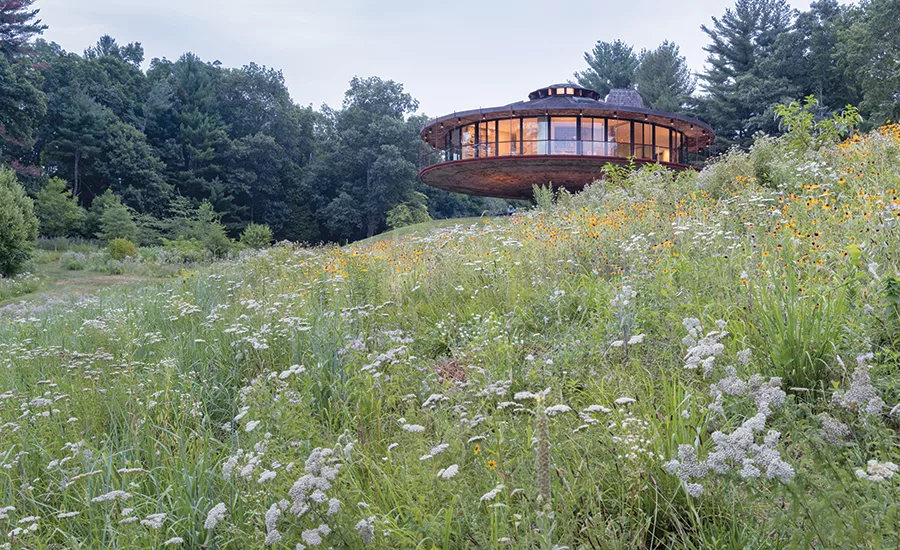
Though Richard Foster’s Round House made its first appearance in RECORD’s April 1969 issue, it still feels utterly ahead of its time, hovering above the verdant landscape like a midcentury UFO.

Photo © Iwan Baan
A Fresh Spin

Photo © Architectural Record

A Fresh Spin

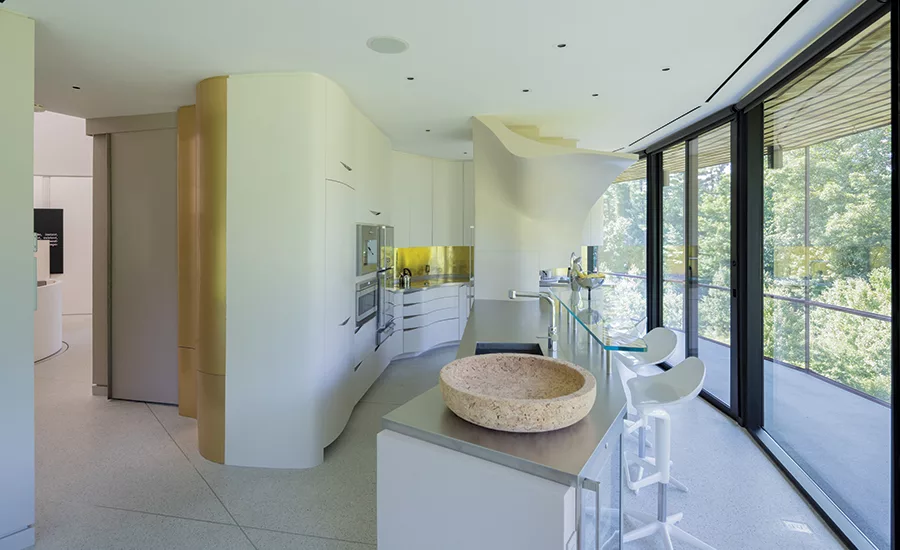
Light from the house’s 360-degree windows is magnified by gleaming surfaces and a crisp palette of white and metallic finishes.

Photo © Iwan Baan
A Fresh Spin

Light from the house’s 360-degree windows is magnified by gleaming surfaces and a crisp palette of white and metallic finishes.

Photo © Iwan Baan
A Fresh Spin

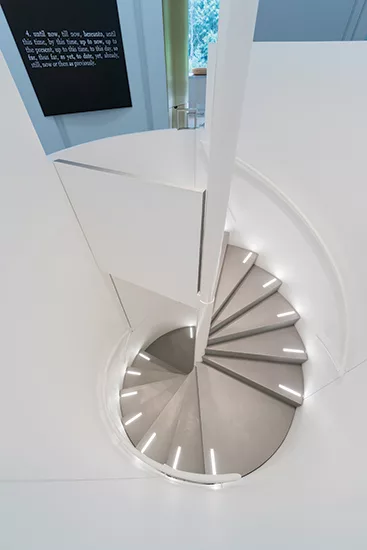
Canvases by artist Joseph Kosuth surround the stair.

Photo © Iwan Baan
A Fresh Spin

Image courtesy Mack Scogin Merrill Elam Architects
A Fresh Spin

Image courtesy Mack Scogin Merrill Elam Architects

A Fresh Spin
A Fresh Spin
A Fresh Spin
A Fresh Spin
A Fresh Spin
A Fresh Spin
A Fresh Spin
June 1, 2017

Video

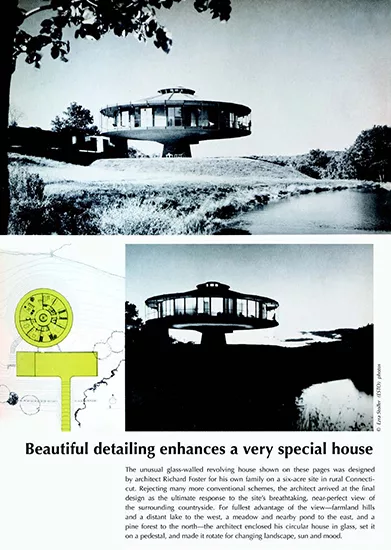
Architect Richard T. Foster caused quite the stir when his mushroom-shaped house sprouted out of the rural Connecticut landscape in the spring of 1968. Not only did the structure resemble something from the Martian Chronicles, it rotated in both directions atop its trunk-like pedestal. When The New York Times asked Foster—a protégé of Philip Johnson—why such residential designs had yet to catch on, he shrugged: “Look how long it took man to get out of the cave.”

Nearly half a century later, Foster’s Round House—floating over the landscape like a marooned spacecraft—still feels thrillingly radical. But when a pair of Manhattanites purchased the house in 2010 as a weekend getaway, it became clear that it required some upgrades. The owners turned to Atlanta-based architects Merrill Elam and Mack Scogin to breathe new life into their unusual home.

“Our initial thought was, whoever buys a round house that moves has to be very interesting,” says Elam.

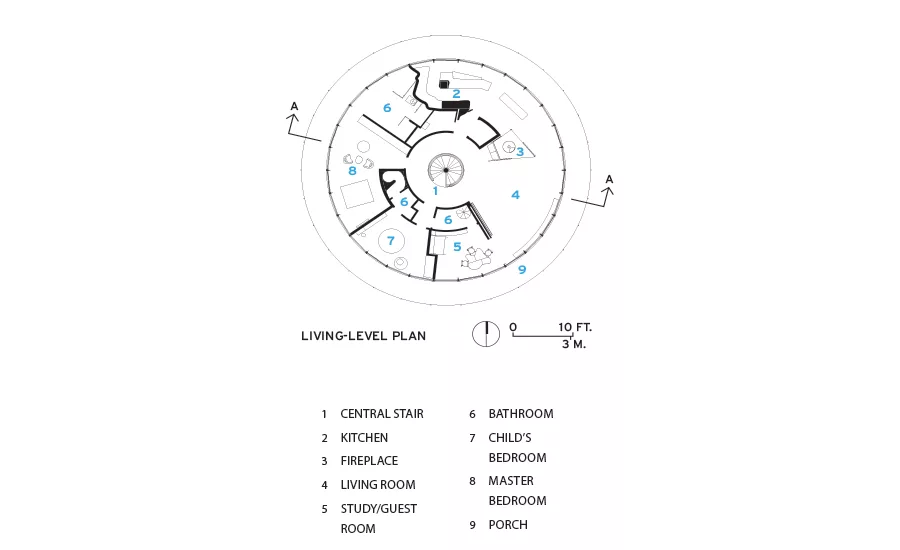
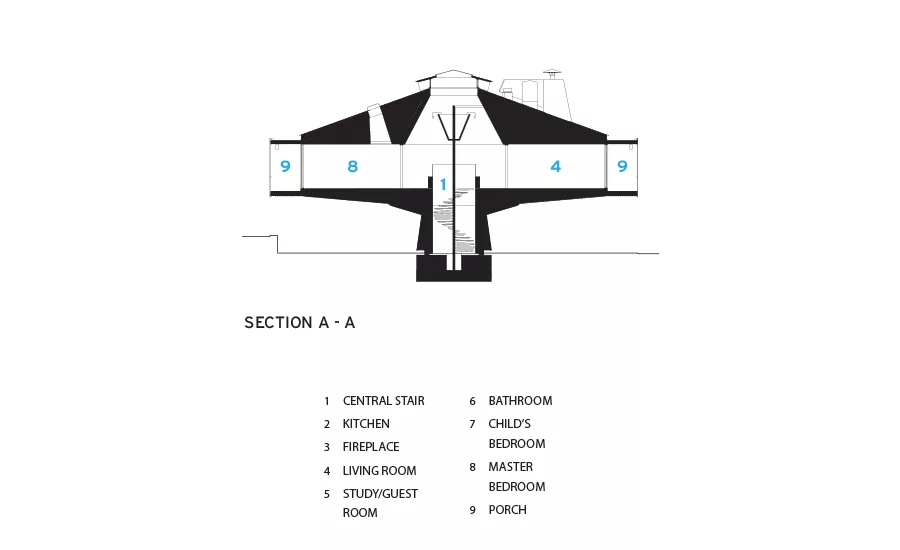
They also may want to stock up on Dramamine. Foster’s 500,000-pound house rotates around a fixed, 9-foot-tall spiral concrete stair using a 3-ton ball bearing assembly. The 72-foot-diameter upper volume relies on an umbrella-shaped steel structural system and—unlike revolving restaurants of the period—an ingenious scheme of concealed trolleys and troughs that allow the plumbing, electric, and water connections to pivot with it.

The machinery may be complex, but the user controls the house with the push of a button on a shoebox-sized control panel. Relying on just a 1.5 horsepower motor, the house can revolve up to 5 feet per minute. For the unaccustomed, it can feel a bit like traversing the deck of a ship.

In spite of the home’s revolutionary nature—both literally and figuratively—little daylight from the 360-degree windows penetrated its center. “It was a little melancholy,” says Scogin, a sense amplified by Foster’s strict adherence to a radial floor plan, so that rooms surrounded the stair core like pie slices.

Scogin and Elam sought to “soften” the house by breaking up the geometries and by bringing nature into the interior. This begins as soon as one ascends the spiral stair in the house’s “trunk.” The architects built a low wall around the floor opening so that—like a stage curtain prepped for a big reveal—a visitor’s first views are out to the undulating landscape, not the terrazzo floor.

Looking for quick answers on architecture and design topics?
Try Ask RECORD, our new smart AI search tool.
Ask RECORD →

From the stair, one can access the living room, the kitchen, the master bedroom suite, or the children’s room— depending on where the house is in its orbit. A previous renovation eliminated a wall to unify the kitchen and living areas, but the architects also opted to remove additional partitions to allow for a more generous master bedroom suite and a larger bedroom for the clients’ 10-year-old daughter.

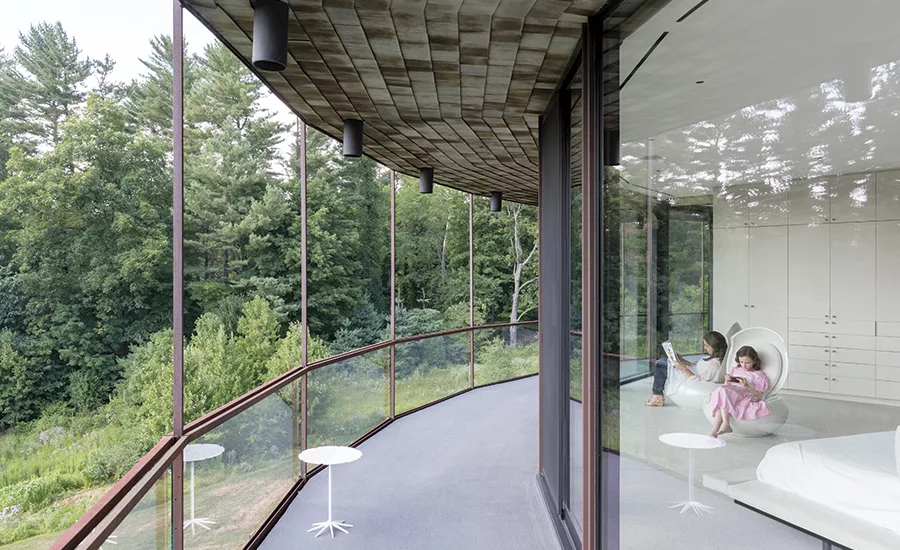
Crucially, the architects incorporated reflective surfaces throughout so that views of the countryside are visible even when looking inward. Just off the kitchen, a clever series of sliding glass partitions diffuse light, but also conceal a fireplace and, in a study, slide shut to become a guest room. Meanwhile, sliding doors along the glazed perimeter open onto a porch. To bring the house up to code and to curb visual obstructions, Scogin and Elam designed a glass railing. Standing there on a misty spring afternoon, the calls of redwing blackbirds and blue jays harmonized with the hum of the house in motion.

Scogin and Elam replaced the single-pane windows with double insulated glazing, restored and replaced the original weathering-steel fascia, and upgraded the cedar shingle cladding where necessary. Working with Foster’s archives, which the clients obtained from the architect’s son, they were able to track down the original cobblestone specialist to redo the outdoor terrace, and the schematics for the ball bearing assembly. Remarkably, the mechanical components required minimal servicing—though the house needs the occasional greasing.

Peculiar maintenance aside, the family has adjusted to life in their futuristic abode. They set it into motion every day—whether to entertain guests, to get a better view of their chicken coop, or to move away from the din of pond frogs at night. The clients have put this part of Foster’s archive online, so that the public can learn about the architect’s extraordinary home.

But the extra exposure might be unnecessary: tourists will often park in the driveway to gawk. Luckily, the owners can simply turn the house away.


KEYWORDS: Connecticut restoration

Share This Story

Looking for a reprint of this article?
From high-res PDFs to custom plaques, order your copy today!


Anna Fixsen was a staff writer and editor for Architectural Record from 2013 to 2017, during which time she covered topics ranging from new projects to human rights, and edited Firms to Watch—a special section devoted to emerging architecture firms.

Post a comment to this article

Report Abusive Comment

Subscription Center
  • Create an Account
  • Start a Subscription
  • Manage My Account
  • Sign Up for Newsletters
  • Visit Customer Service
  • Update Preferences

More Videos

Sponsored Content

Sponsored Content is a special paid section where industry companies provide high quality, objective, non-commercial content around topics of interest to the Architectural Record audience. All Sponsored Content is supplied by the advertising company and any opinions expressed in this article are those of the author and not necessarily reflect the views of Architectural Record or its parent company, BNP Media. Interested in participating in our Sponsored Content section? Contact your local rep!

close
  • cold storage facility
    Sponsored byCarlisle SynTec Systems

    How Architects Can Design More Continuous Cold Storage Envelopes

  • TAMLYN XtremeTrim Exterior Trim
    Sponsored byTamlyn

    Designing Cleaner Panel Facades: Why Exterior Trim Details Matter

  • Building with Vapor Barriers
    Sponsored byReef Industries, Inc.

    Vapor Barriers Help Control Moisture in Tighter Building Designs

DESIGN:ED Podcast
Listen to Architectural Record’s DESIGN:ED Podcast

Events

June 23, 2026

Enhancing Fire Resistance with Advanced PVC Solutions

Credits: 1 AIA LU/HSW; 1 AIBD P-CE; 0.1 ICC CEU; 1 IIBEC CEH

Evaluate advanced PVC solutions that improve fire resistance, support WUI compliance, and enhance resilience in residential and commercial building design.

June 25, 2026

Designing Glass Railing Systems that Enhance Aesthetics and Meet Code

Credits: 1 AIA LU/HSW; 1 AIBD P-CE; 0.1 ICC CEU

Upon course completion, participants will possess a deeper understanding of glass railings to help ensure that safety, aesthetic, and performance objectives are achieved.

View All Submit An Event

Products

2026 Architect's Square Foot Costbook

2026 Architect's Square Foot Costbook

See More Products

Popular Stories

Lorcan O' Herilhy

California Architect Lorcan O’Herlihy Has Died, Age 66

Obama Presidential Center, Chicago

The Obama Presidential Center Opens on Chicago’s South Side

Spoonbill Ranch

Johnsen Schmaling Architects Integrates Spoonbill Ranch into a Pristine Landscape

Image of Bruce Springsteen Center for American Music

The CookFox-designed Bruce Springsteen Center for American Music Opens in New Jersey

Three Courtyards House

Design Vanguard 2026: Balsa Crosetto Piazzi

Enhancing Fire Resistance with Advanced PVC Solutions - Free Webinar - June 23, 2026

Related Articles

  • David Bowie Richard Rogers

    Richard Rogers “Delighted” to Have Been Name-Dropped in David Bowie Song

    See More
  • Norman Foster

    Interview with Norman Foster on Droneports and His New Foundation

    See More
  • Foster's West Kowloon Park Plan Dropped Again

    See More

Related Products

See More Products
  • biogenic.jpg

    Manual of Biogenic House Sections

  • iconic house.jpg

    The Iconic House

See More Products
×

The latest news and information

#1 Source for Architectural Design, News and Products

SUBSCRIBE
  • RESOURCES
    • Advertise
    • Contact Us
    • Submit
    • Store
  • ACCOUNT CENTER
    • Create an Account
    • Start a Subscription
    • Manage My Account
    • Sign Up for Newsletters
    • Visit Customer Service
    • Update Preferences
  • PRIVACY
    • PRIVACY POLICY
    • TERMS & CONDITIONS
    • DO NOT SELL MY PERSONAL INFORMATION
    • PRIVACY REQUEST
    • ACCESSIBILITY
  • SERVICES
    • Marketing Services
    • Reprints
    • Market Research
    • List Rental
    • Survey/Respondent Access
  • STAY CONNECTED
    • Linkedin
    • Facebook
    • Instagram
    • YouTube
    • X (Twitter)

Copyright ©2026. All Rights Reserved BNP Media, Inc. and BNP Media II, LLC.

Design, CMS, Hosting & Web Development :: ePublishing