Case Study: Aspen Middle School, Aspen, Colorado, Studio B
Mountain Do
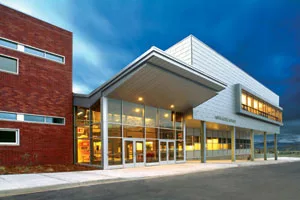
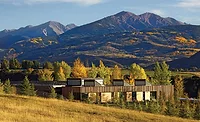
The butterfly-roofed entrance to the school is located in the elbow of an L-shaped plan, dividing classes from aspecial-purpose spaces like the gym.
Photo © Time Frame Photography/Fred Fuhrmeister
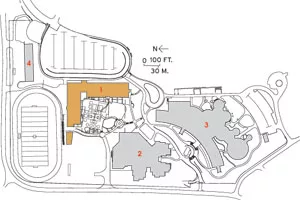
Site Plan:
1) Middle school 2) Elementary school 3) High school 4) Bus barn
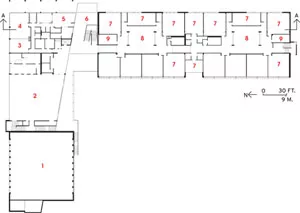
Second Floor Plan:
1) Gym 2) Cafeteria 3) Administration 4) Staff lounge 5) Administration 6) Lobby 7) Classroom 8) Classroom core 9) Office

Section A-A:
1) Classroom core 2) Classroom 3) Lobby 4) Staff lounge 5) Office 6) Conference 7) Industrial arts 8) Future classroom
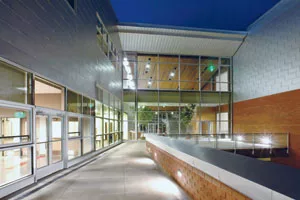
A balcony adjacent to the cafeteria and the lobby offers students a wind-protected spot to eat lunch oudoors. The library, at the northwest corner of the building, commands spectacular views of the surrounding landscape.
Photo © Time Frame Photography/Fred Fuhrmeister
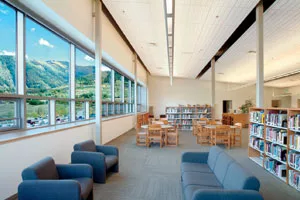
A balcony adjacent to the cafeteria and the lobby offers students a wind-protected spot to eat lunch oudoors. The library, at the northwest corner of the building, commands spectacular views of the surrounding landscape.
Photo © Time Frame Photography/Fred Fuhrmeister
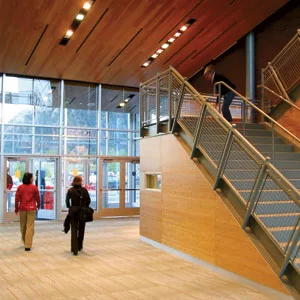
The bamboo-clad lobby ceiling follows the contours of the butterfly roof.
Photo © Studio B Architects
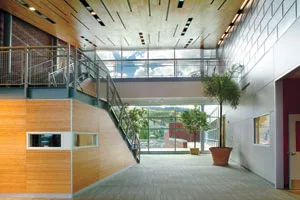
Its form maximizes the view west to Buttermilk Mountain, a spiritual and aesthetic lodestar for the project.
Photo © Time Frame Photography/Fred Fuhrmeister
It should come as no surprise that a school in Colorado’s Rocky Mountains ranks sustainability high on its teaching agenda. The small town of Aspen, an upscale winter ski resort and summer hiker’s paradise, takes civic pride in its ecological awareness. The newest of its three public schools, the year-old, 113,000-square-foot Aspen Middle School by local Studio B Architects and Denver-based Hutton Ford Architects, is designed to support environmental education and to foster a sense of stewardship among students.
As a symbol of the school’s place in the landscape, its exterior materials echo the surrounding mountains. Regionally manufactured brick and metal panels evoke the snowy peaks of the photogenic Maroon Bells. “Our educational concept was to connect the students to the landscape and to the environment,” says Studio B principal Gilbert Sanchez, AIA.
The building’s angular form also reminds users of the spectacular surroundings. Studio B principal Scott Lindenau, AIA, explains, “The L-shaped plan bifurcates the classroom wing from the specialty wing and opens the entry toward the view. And as you walk from parking lot into lobby, the major view is oriented toward Buttermilk Mountain; the lobby roof is butterfly-shaped to open up that view.”
Unlike its nearly windowless predecessor, the new middle school boasts views of the mountains from every classroom. Operable, double-glazed, low-E glazing controls the flow of heat and light so the new building is comfortable, fuel-conserving, and filled with daylight. Aluminum louvers on the exterior of the west-facing windows are fixed at a 25-degree angle off horizontal to maximize their shading effectiveness throughout the year. Fixed aluminum louvers on the interiors of east- and south-facing classroom windows help with daylight distribution. On mild winter days, many students eat lunch on the south-facing, wind-protected balcony outside the second-floor cafeteria. Teaching about the building’s orientation to the sun and other sustainability features is integrated into science coursework.
All subjects are taught in what school superintendent Diana Sirko calls an “educational teaming approach.” Each of the four grades’ classrooms clusters around a common area where students of that grade meet for group activities. For the core areas on the lower level, a raised ceiling differentiates the space from the adjacent corridor; the upper-level cores have roof monitors with north- and south-facing clerestories. The rectilinear cores are further differentiated by their carpet designs.
Small-group classrooms that can be outfitted with movable partitions are adjacent to each core. “We feel it’s important to meet the individual needs of students,” Sirko says. “So these mini-classrooms are for math or reading specialists to work with individual students for enrichment or remediation.”
Another key part of the curriculum is the outdoor educational program. Classes learn recreational skills by taking camping and rafting trips. In addition to the large storage rooms needed for the school-owned equipment, the program called for open spaces, where students learn to set up rafts and tents. The central core areas serve this purpose well.
Looking for quick answers on architecture and design topics?
Try Ask RECORD, our new smart AI search tool.
Ask RECORD →
But environmentalism at Aspen Middle School is more than views and camping trips. The building offers object lessons in sustainability. Bamboo, a rapidly regrown material frequently substituted for wood, clads the ceilings and walls in the lobby. The flooring is natural linoleum and the carpet has recycled content. New cabinets are formaldehyde-free, while some from the previous building are reused.
“Reduce, recycle, reuse” applied to the old school’s deconstruction in general. To provide continuous service, it stayed in session while the new building was being erected just a few feet away on the 25-acre site. Later, in plain view of the students, crews painstakingly dismantled the structure to reclaim reusable materials. Rather than compete for attention, some teachers asked curious students to write about the process.
That recycling helped push the school toward LEED Gold territory, a rating granted by the U.S. Green Building Council in late October. Other contributing aspects include energy-saving features, solar air heating, waterless urinals, and sensors that turn lights down when daylight is sufficient and off in unoccupied rooms. Sirko reports the electric lights in the classrooms are largely unnecessary during the day. “This building is saving us about 50 percent in energy costs over the building it replaced,” she says. Aside from a few features deleted for budgetary reasons, “mostly we achieved what we set out to accomplish.”
Looking for a reprint of this article?
From high-res PDFs to custom plaques, order your copy today!