Architectural Record
search
cart
facebook twitter linkedin youtube
  • Sign In
  • Subscribe
  • Sign Out
  • My Account
Architectural Record
  • NEWS
    • Latest News
    • Awards
    • Interviews
    • Obituaries
    • Podcasts
      • Design:Ed Podcast
      • Sponsored Podcasts
  • OPINION
    • Book Reviews / Excerpts
    • Exhibition Reviews
    • Forum
  • EXCLUSIVES
    • Videos
    • Design Vanguard
    • Top 300 Firms
    • Sponsored Content
    • Sponsored eBooks
    • From the Archives
  • CONTINUING ED
    • Editorial Continuing Ed
    • CE Center
    • CE Academies
  • PROJECTS
    • Buildings By Type
    • Reuse & Renovation
    • Museums & Arts Centers
    • Colleges & Universities
    • Multifamily Housing
    • Interiors
    • Lighting
    • Kitchen & Bath
  • HOUSES
    • Record Houses
    • House of the Month
    • Featured Houses
  • PRODUCTS
    • Products by Category
    • Record Products of the Year
    • Latest Products
  • EVENTS
    • Dates & Events
    • Record on the Road
    • Innovation Conference
    • Sustainability in Practice
    • Women In Architecture
    • Webinars
    • Ad Excellence Awards
    • AIA 2026 Videos
    • Submit an Event
  • CONNECT
    • Ask RECORD AI
    • Newsletters
    • Contact
    • Advertise
    • Editorial Calendar
    • Store
    • Customer Service
  • SUBMIT
    • Submission Guidelines
    • RECORD Competitions
  • MAGAZINE
    • Subscribe
    • My Account
    • Digital Edition
    • Current Issue
    • Firm Pass
    • Historic Archive
SNAP

Virginia Firm Builds Largest Net-Zero-Energy School in Country
By Pilar Viladas
Teaching Tools

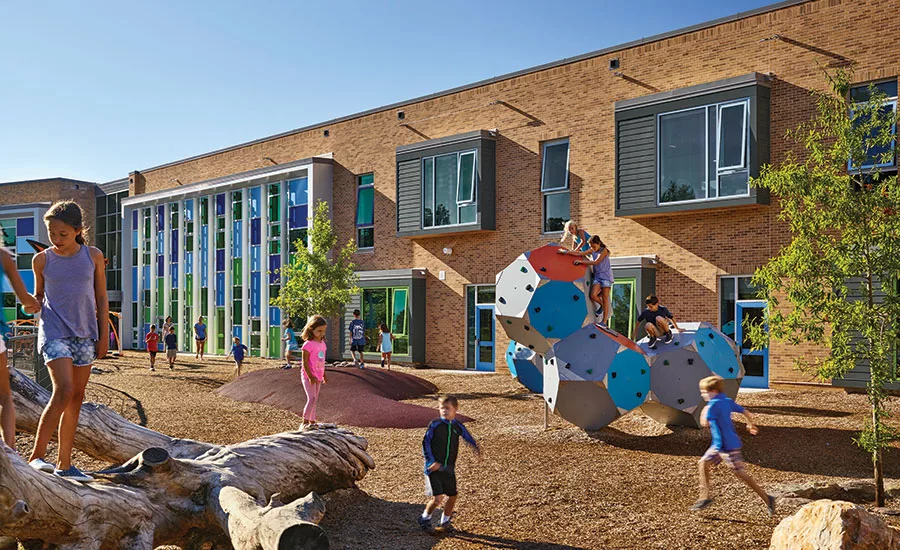
Colorful insulated panels punctuate the brick cladding and define windows and doors.

Photo © Alan Karchmer
Teaching Tools

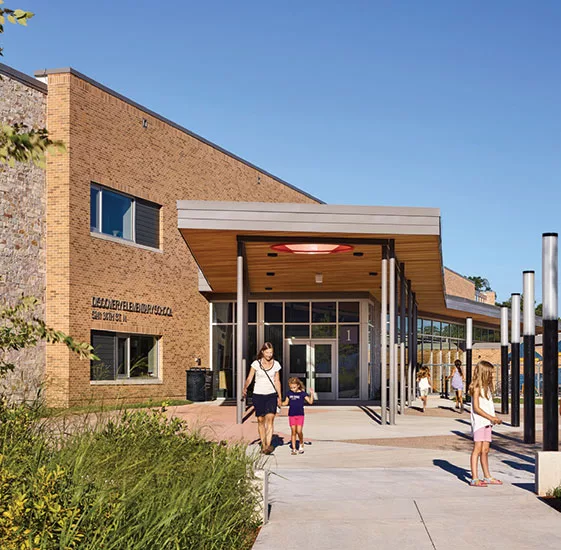
An oculus built into the main entry’s roof awning channels sunlight onto the ground creating a solar calendar.

Photo © Alan Karchmer
Teaching Tools

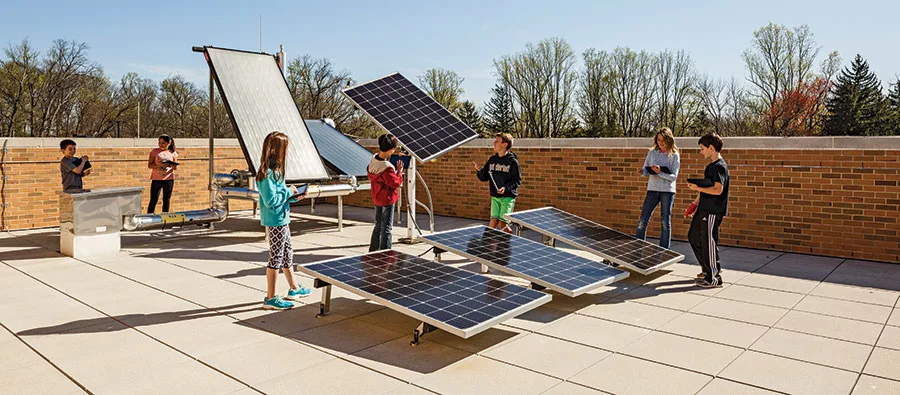
The rooftops’ lab uses functioning panels to integrate sustainable practices into lessons on energy use.

Photo © Alan Karchmer
Teaching Tools

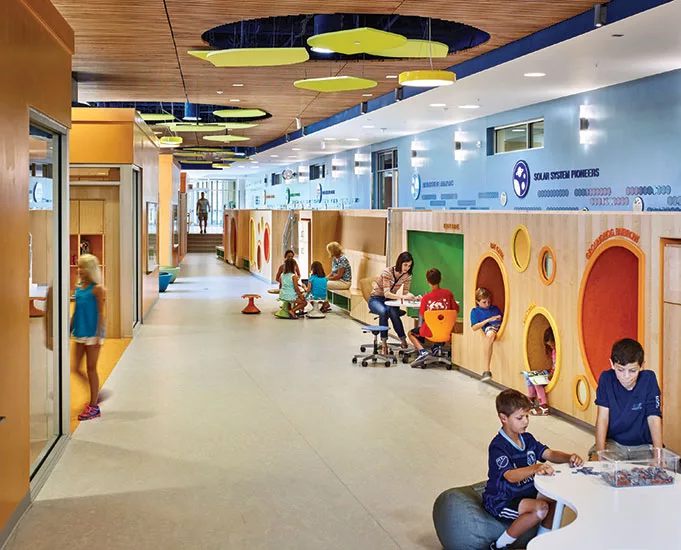
Flexible furnishings such as height-adjustable tables and chairs allow students to migrate between informal learning stations.

Photo © Alan Karchmer
Teaching Tools

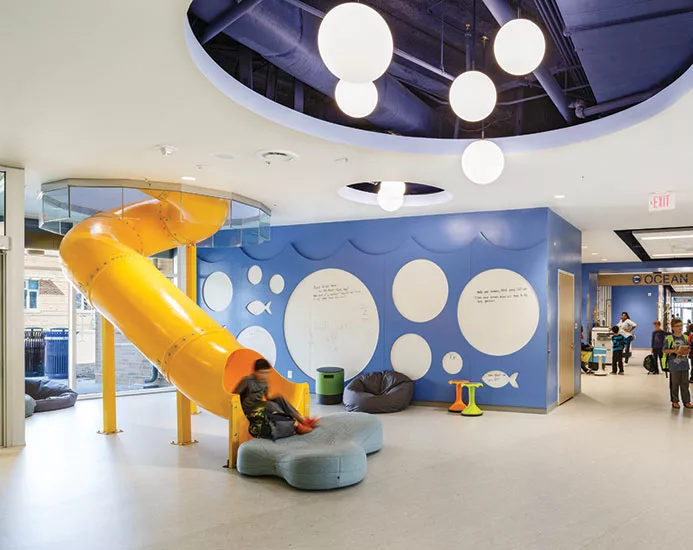
A slide instead of stairs and bean bags keep the environment fun.

Photo © Alan Karchmer

Teaching Tools
Teaching Tools
Teaching Tools
Teaching Tools
Teaching Tools
December 1, 2017

Architects & Firms

VMDO Architects

When Arlington Public Schools (APS) in Virginia approached Charlottesville firm VMDO Architects to build a new elementary school for its expanding student population, the goal was a place “that integrated learning with sustainability,” recalls John C. Chadwick, the district’s assistant superintendent of facilities and operations.

VMDO’s design produced an innovative teaching environment, which not only integrates sustainability into the curriculum but also offers the school’s 650 pre-K through 5th-grade students lively, interactive learning and play spaces. The Discovery Elementary School, which opened in 2015, is the largest net-zero-energy school in the country. This year it was the recipient of the AIA Committee on the Environment’s Top Ten award, and designated a Green Ribbon School by the U.S. Department of Education.

The approximately 98,000-square-foot building features a tiered design that is set into a hillside to minimize its scale. Despite its considerable size, exterior building materials (brick, stone, and colored insulated panels and sun shades) appear to harmonize with the surrounding residential neighborhood, and the building’s energy-saving features (among them 1,710 roof-mounted solar panels, a geothermal well field, 100-percent LED lighting, solar orientation and high-thermal-mass exterior walls) all contribute to its low Energy Use Intensity (EUI).

Discovery was designed for an EUI of 23kBtu per square foot, per year—one-third of the energy use of a typical elementary school in the area—but it actually performs at 18, Chadwick says. And while other elementary schools in Arlington each spend about $110,000 a year in energy costs, this one spends about $12,000 annually.

Sunlight is an integral part of the learning experience. A roof canopy with a cedar soffit runs the length of the school’s southern (street) side, serving as its “front porch.” A rooftop solar lab enables students to conduct real-time experiments, the data from which can be tracked via the building’s dashboard, which is accessible to anyone with a wireless device. Meanwhile, a part of the roof that extends out over the main entrance with an oculus turns the entry plaza into a solar calendar. A video made by the school on September 22nd of last year shows the oculus tracing the autumnal equinox.

The result of such interactive architecture is that it encourages behavior on the part of students and teachers that fosters sustainability. (Another of the school’s videos offers a time-lapse look at the dashboard during the August 21st solar eclipse.)

The school’s interiors encourage flexibility and informality, with foldable partitions, retractable garage doors, and furnishings that include bean bags, height-adjustable tables and chairs, reading steps, and a two-story slide. The “Hedge,” which encloses and defines the kindergarten’s indoor common space, or “Backyard,” is punctuated with inset semicircular and round nooks for reading, discussion, and hanging out. But perhaps the most intriguing aspect of the school’s design is the way that its ingenious organization and wayfinding reflect the expanding curriculum of each successive grade level.

Looking for quick answers on architecture and design topics?
Try Ask RECORD, our new smart AI search tool.
Ask RECORD →

Wyck Knox, a VMDO principal and the project architect, explains that astronaut John Glenn figured prominently in the concept. Glenn lived next door to the school’s site when he was the first American to orbit the earth in 1962; he became the oldest person to fly in space when he was on the crew of the space shuttle Discover in 1998. Chosen by the students, the school’s name is a partial tribute to the space pioneer and U.S. senator. But just as important, Knox adds, is that Glenn was an inspiration for the school’s “expanding world” concept: Students start out in the first-floor kindergarten rooms as Backyard Adventurers, with graphics that refer to trees and animals (nooks are named “Groundhog Burrow” or “Eagle Aerie”). Then, in the first and second grades (also located on the first floor), learners progress through the themes of forest and ocean to the atmosphere, solar system- and galaxy-themed areas for third, fourth, and fifth graders—the last are called Galaxy Voyagers—on the second floor. Knox refers to the concept as “zooming out,” a reference to Charles and Ray Eames’s film Powers of Ten. The result, Knox says, is that “sustainability and learning feed off each other in a really nice way.”

Chadwick is equally enthusiastic. “We’ve achieved more integration of teaching, learning, design and sustainability than I had ever imagined,” he says. “In the best hands, every student, teacher and parent understands how their actions contribute—you’re creating a culture change, and the kids, especially, understand.”

KEYWORDS: net zero energy Virginia

Share This Story

Looking for a reprint of this article?
From high-res PDFs to custom plaques, order your copy today!

Pilar Viladas wrote about design and architecture for a variety of publications.

Post a comment to this article

Report Abusive Comment

Subscription Center
  • Create an Account
  • Start a Subscription
  • Manage My Account
  • Sign Up for Newsletters
  • Visit Customer Service
  • Update Preferences

More Videos

Sponsored Content

Sponsored Content is a special paid section where industry companies provide high quality, objective, non-commercial content around topics of interest to the Architectural Record audience. All Sponsored Content is supplied by the advertising company and any opinions expressed in this article are those of the author and not necessarily reflect the views of Architectural Record or its parent company, BNP Media. Interested in participating in our Sponsored Content section? Contact your local rep!

close
  • 3D configurator
    Sponsored byDoorBird

    How DoorBird’s 3D Configurator Is Redefining Customization Across Residential and Commercial Design

  • interior of modern office
    Sponsored byCurrent

    The Downlight's Second Life: Why Below-Ceiling Serviceability Is the Specification Detail That Matters Most

  • cold storage facility
    Sponsored byCarlisle SynTec Systems

    How Architects Can Design More Continuous Cold Storage Envelopes

DESIGN:ED Podcast
Listen to Architectural Record’s DESIGN:ED Podcast

Events

July 29, 2026

Adaptive Reuse Reimagined: Designing Multifamily Housing from Existing Buildings

Credits: 1 AIA LU/HSW; 1 AIBD P-CE; 0.1 ICC CEU; 1 IIBEC CEH

Examine adaptive reuse envelope strategies that improve energy performance, preserve architectural character, and transform existing buildings into high-performing multifamily housing.

July 30, 2026

Constructing Exterior Walls to Avoid Moisture Issues

Credits: 1 AIA LU/HSW; 1 AIBD P-CE; 0.1 ICC CEU

Examine exterior wall and air barrier system strategies that improve moisture control, energy efficiency, durability, and indoor environmental quality.

View All Submit An Event

Products

Architectural Detailing: Function, Constructibility, Aesthetics, 4th Edition

Architectural Detailing: Function, Constructibility, Aesthetics, 4th Edition

See More Products

Popular Stories

Goldring Woldenberg Park

Continuing Education: Postindustrial Waterfronts

House of the Month - Casa BL

In Chile, Alejandro Beals and Loreto Lyon Revive a 1960s House Designed by a Le Corbusier Disciple

Nieuw Bergen, Eindhoven

MVRDV’s Nieuw Bergen Brings ‘Mountainous’ Housing to a Low-Rise District in the Dutch City of Eindhoven

Temple-Emanu-El, San Francisco

AIA California Announces 2026 Design Award Recipients

University of Victoria Indigenous Law Wing

Indigenous Law Shapes a Different Kind of Academic Building at the University of Victoria in British Columbia

Adaptive Reuse Reimagined: Designing Multifamily Housing from Existing Buildings - Free Webinar - July 29, 2026

Related Articles

  • Congress Moving on Aid for Haiti, But Little Rebuilding in Country

    See More
  • NREL Opens Largest Net-Zero Building in U.S.

    See More
  • Living the High Life in the Low-Country Residence Residential Quarterly

    See More

Related Products

See More Products
  • AR July 2026 Issue Cover

    Architectural Record July 2026 Issue

See More Products
×

The latest news and information

#1 Source for Architectural Design, News and Products

SUBSCRIBE
  • RESOURCES
    • Advertise
    • Contact Us
    • Submit
    • Store
  • ACCOUNT CENTER
    • Create an Account
    • Start a Subscription
    • Manage My Account
    • Sign Up for Newsletters
    • Visit Customer Service
    • Update Preferences
  • PRIVACY
    • PRIVACY POLICY
    • TERMS & CONDITIONS
    • DO NOT SELL MY PERSONAL INFORMATION
    • PRIVACY REQUEST
    • ACCESSIBILITY
  • SERVICES
    • Marketing Services
    • Reprints
    • Market Research
    • List Rental
    • Survey/Respondent Access
  • STAY CONNECTED
    • Linkedin
    • Facebook
    • Instagram
    • YouTube
    • X (Twitter)

Copyright ©2026. All Rights Reserved BNP Media, Inc. and BNP Media II, LLC.

Design, CMS, Hosting & Web Development :: ePublishing