'Gordon Matta-Clark: Anarchitect' at the Bronx Museum of Art
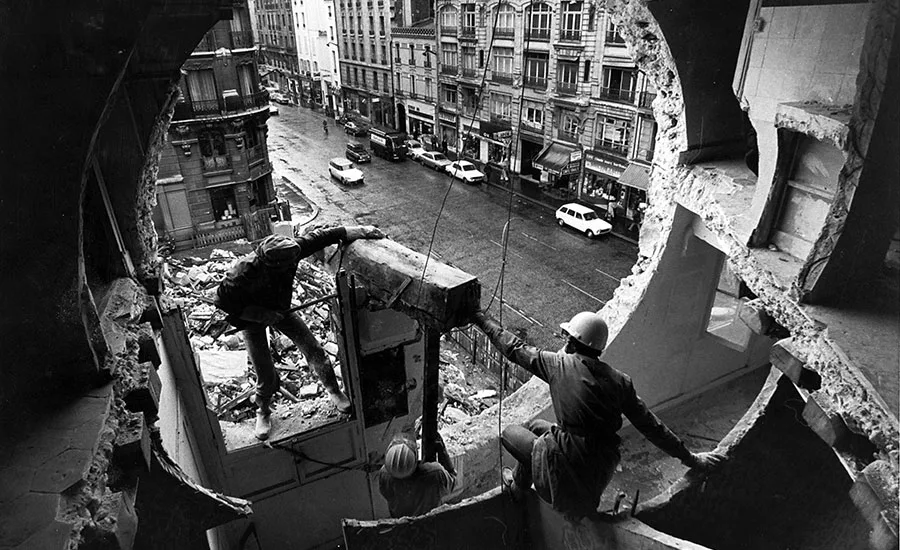
Gordon Matta-Clark working on Conical Intersect, his installation at the Paris Biennale in 1975, for which he drilled a telescope-like hole so people could peer inside two derelict 17th-century houses.
Photo © Harry Gruyaert 2017 Estate of Gordon Matta-Clark/Artists Rights Society, New York, and David Zwirner, New York
In 1971, I came to New York to have my first solo art exhibition at the Reese Palley Gallery in SoHo. The neighborhood seemed to me—an L.A. boy—a war zone, its gritty streets only recently colonized by a few galleries and artists, many of whom were living on the edge. I was fascinated by a communal artists’ restaurant called Food that was about to open near the gallery, though I knew nothing then of the subversive proprietor behind it, Gordon Matta-Clark.
That was only a year after Matta-Clark had made his first Garbage Wall—trash embedded in concrete as a cheap and handy guerilla building material, and just a year before he’d begin working— as an “anarchitect”—in the desolate borough of the Bronx, rife with condemned buildings.
The son of the Chilean surrealist painter Roberto Matta and an American artist, Anne Clark, Matta-Clark earned an architecture degree from Cornell in 1968 (and studied Deconstructionist literary theory in Paris) before turning to art. His canvas was always the city and its detritus of abandoned buildings—from a mundane frame house in New Jersey, which he sliced in two, to a pair of 17th-century houses in Paris, into which he cut a huge conical void before they were razed, near the site of the controversial new Pompidou Center. A new exhibition at the Bronx Museum of Art, Gordon Matta-Clark: Anarchitect, documents that period of the artist’s work (on view through April 8, the show will travel to the Rose Art Museum in Waltham, Massachusetts; the Jeu de Paume in Paris; and the Kumu Art Museum in Talinn, Estonia). It makes a wonderful case for Matta-Clark’s artistic and social importance.
The anchors of the exhibition are the first chainsaw-and-chisel “cuts” Matta-Clark made in the Bronx. At first, he excised chunks of floor (e.g., Bronx Floor: Threshole, 1972) and, as with his later Conical Intersect in Paris (1975), his genius was to see that openings sawed and chopped in the walls and floors of derelict buildings could be a two-way signaling system saying, in effect, “Here’s what the powers that be have done to your neighborhood, and here’s what we can do back.”
Selected by Antonio Sergio Bessa, curator at the Bronx Museum, and Jessamyn Fiore, co-director of Matta-Clark’s estate, and daughter of the artist’s widow, the works now on view range from a few actual three-dimensional art objects (including a chunk of that Bronx flooring and a brick made from melted beer bottles) through a plethora of photographs, short films, offset prints, and documents demonstrating Matta-Clark’s pioneering work in what are now called architectural “interventions.” It’s a brave story of an outside-the-box artist working in the face of a nearly bankrupt New York City and, through his art, casting a light on disastrous social policies that led to the marginalization and displacement of thousands of people.
Matta-Clark’s working parameters, Bessa says, were “we make places” versus “places make us.” Day’s End (1975)—involving five Ellsworth Kelly–type shapes cut into the empty Pier 52 building on the Hudson River in Manhattan, through which the play of sunlight shifted—was perhaps his best manifestation of that working philosophy. He made the work without permission, left the building open as a kind of people’s park, and absconded with a rowboat from Central Park to photograph the results from the water. The building is long gone, but the Whitney Museum has recently commissioned a work of public art by MacArthur recipient David Hammons (born the same year as Matta-Clark) that will be a steel outline-in-the-air duplicating the pier building’s dimensions.
The Bronx Museum’s iteration of Garbage Wall, originally made for the first Earth Day, in 1970, is the most elegant object in the exhibition, with its lovely bits of Lego-block walls and a vintage portable cassette player poking through the concrete. Matta-Clark’s ever-present wit—a necessary leavening of his social earnestness— comes through most in a small graffitied metal panel from his van. When his art was rejected from a Washington Square show, he parked his vehicle as a “protest van” nearby, allowed all comers to graffiti it, then blowtorched segments of the body and gave them away.
Looking for quick answers on architecture and design topics?
Try Ask RECORD, our new smart AI search tool.
Ask RECORD →
New York has transformed itself mightily since Matta-Clark’s guerilla art of nearly a half-century ago. Galleries have been priced out of SoHo, and gentrification is the villain that desolation once was; even in the once-burning South Bronx, rents are rising, faster than anywhere else in the city. Yet the precedent of Day’s End laid the way for the recycling sensibility that gave us New York’s High Line and many recent public artworks. It makes one wistful to ponder what Matta-Clark might have gone on to do had he not died so young—of pancreatic cancer, in 1978, at age 35.
Still, he remains a powerful and provocative figure. Although, nominally, he deconstructed neglected architecture, his most salient contribution to our sense of the built environment is a heightened consciousness of who and what gets bulldozed by the endless tide of new building—and of the aesthetic possibilities hidden in what we are about to destroy.
Looking for a reprint of this article?
From high-res PDFs to custom plaques, order your copy today!