National Gallery of Ireland by Heneghan Peng Architects
Dublin

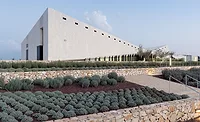
A new Wicklow granite ramp leads up to the main entrance of the historic museum; the team buried a mechanical space beneath the front lawn.
Photo © Marie-Louise Photography

Light bounces off original white-glazed bricks, illuminating the new minimalist courtyard around which visitors to the Dargan and Milltown wings now orient themselves.
Photo © Marie-Louise Photography

The gallery is part of Dublin’s main governmental and museum complex.
Photo © Archimation and Heneghan Peng Architects

Bricked-over windows have been reopened, bringing daylight back into the Dargan wing’s Shaw Room after an absence of several decades.
Photo © Marie-Louise Photography

The architect’s hand in the historic galleries is almost invisible, bringing the rooms up to 21st-century mechanical and lighting standards while maintaining their original spirit.
Photo © Marie-Louise Photography

Photo © Marie-Louise Photography

Image courtesy Heneghan Peng Architects

Image courtesy Heneghan Peng Architects
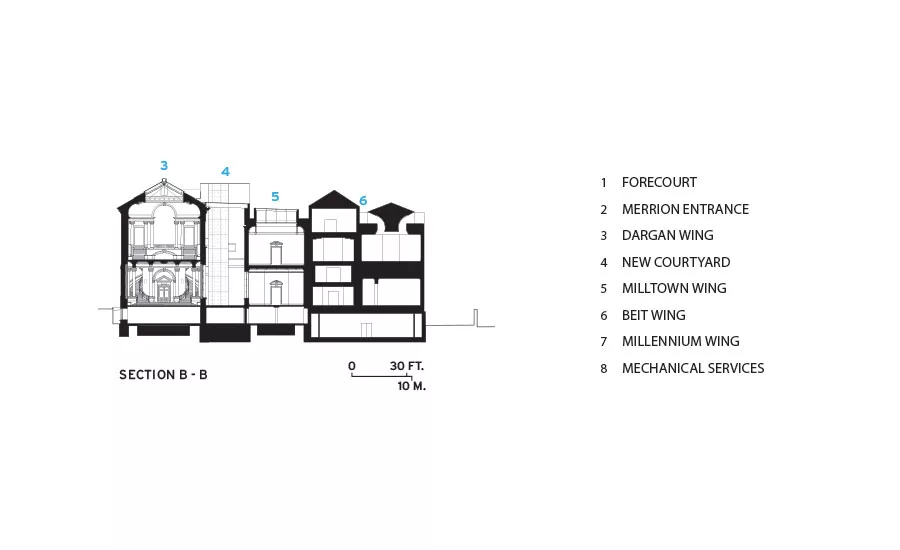
Image courtesy Heneghan Peng Architects
Architects & Firms
Even regular visitors to Ireland’s National Gallery would admit the much-loved Dublin institution—on the corner of an elegant Georgian square and home to the country’s preeminent collection of Irish and European art—was a challenging place to navigate. Negotiating the ad hoc assemblage of four distinct wings, constructed between the 19th and 21st centuries, and wending through the building’s windowless galleries often left people feeling disoriented.
Additional Content:
Jump to credits & specifications
Tackling this circulation problem was one of the main challenges facing local practice Heneghan Peng, the husband-and-wife team behind the Grand Egyptian Museum and the Palestinian Museum in Ramallah. But it also became the genesis for an inventive solution that drove a six-year refurbishment and has redefined the visitor experience. Central to the transformation was turning a gloomy, unused slot-like space between the museum’s two oldest wings, the Dargan and the Milltown, into a soaring new, lightfilled courtyard where visitors now enter, pause, and orient themselves as they travel through the galleries.
The architects took a delicate approach to the space, leaving in place the original white-glazed bricks cladding the 1903 south-facing Milltown wing to reflect the sunlight that passes through the new glass ceiling, bouncing it into the adjacent 1864 Dargan Wing. This minimalist strategy makes the courtyard a place of respite that does not compete with the Victorian and Edwardian splendor of the two wings that enclose it. The utilitarian bricks are harmoniously complemented by new white terrazzo flooring and benches. Clearer orientation for visitors was in part achieved by reopening two rows of large windows on either side of the courtyard that had been bricked up decades ago to provide more wall space for art. While reestablishing a visual connection between the wings, this move also floods the lower galleries, once again, with daylight. To deliver the universal access now required, the team added an elevator at either end of the new courtyard. The poured-in-place concrete shafts subtly contrast with the Dargan wing’s gray, rusticated stone masonry. And the larger of these functional—though sculptural—elements also sits in dialogue with the space’s sole artwork, a sinuous, ribbon-like contemporary sculpture in olive ashwood by Irish artist Joseph Walsh.
The courtyard is unquestionably the most striking component of Heneghan Peng’s intervention, but the architects’ numerous other efforts are, while far more subtle, just as transformational. Despite the 2,600 cubic yards of concrete that has been poured to replace the crumbling floors, the new roofing, updated mechanical systems, and fresh color schemes chosen by curators to rejuvenate the galleries, many patrons are probably unaware of the extensive construction beyond now being able to appreciate the museum’s famous Vermeer, Woman Writing a Letter with her Maid, or Caravaggio’s The Taking of Christ in far superior lighting conditions. Achieving this was a challenge. “It is much more difficult to work with the restrictions of the existing buildings than to design a new building, where everything is under your control,” says project architect Katarzyna Turza-Rachwal. “But it is also much more exciting. There are discoveries made on-site that you could never have anticipated.”
The architects turned to the museum’s archive to help them identify and strip away some of the interventions of previous decades, to bring the building back in line with the original design intent. Preserving historic elements when possible was paramount. For example, the Milltown wing’s iconic walnut architraves from the Siena workshop of Carlo Cambi have been carefully restored, but in other areas new solutions faithful to the original feel of the building were implemented. For the Dargan’s upper-gallery skylights, the team used cathedral glazing that approximates the original, highly transparent cast glass rather than employing the opaque glass common in contemporary galleries. (The units are double glazed, with micro aluminum louvers sandwiched between that deflect damaging light.) For the Milltown’s ceiling-light fixtures, the team specified textured glass to maintain light uniformity with the Dargan. Combined with new LED lamping, the museum has become an uplifting, luminous destination.
Of course, another major challenge was to discreetly install the updated fire, temperature, and humidity controls expected of a 21st-century gallery. The team buried a new mechanical space under the garden in front of the original entrance on historic Merrion Square. Ducts run beneath the building, feeding each floor through risers hidden behind the stainless-steel mesh that forms the back wall of the new courtyard. The front lawn has been replanted and is now bordered by a gently sloping ramp, paved with Wicklow granite, sourced from a quarry just south of the city, to provide universal access from the front gate to the entrance portico.
A second phase of the architects’ museum renaissance will include renovating the 1968 Beit Wing. The plan will also create a full-height, indoor public passageway to link the Merrion Square entrance with the rear entrance on Clare Street, which was part of the 2002 Millennium Wing addition. The light touch and innovative use of space the architects have employed for the project’s first phase have not only revitalized the most venerable wings to make an institution for the 21st century, but the team’s masterful touch has increased enthusiasm for what lies ahead as Heneghan Peng’s vision is completed.
CreditsArchitect: Heneghan Peng Architects — Róisín Heneghan, Shih-Fu Peng, directors; Katarzyna Turza-Rachwal, associate director and project architect
Conservation architect: Blackwood Associate Architects
Consultants: BDP (building services); PUNCH Consulting Engineers (structural/civil); Davis Langdon/AECOM (quantity surveyor); FLN Consulting Engineers (fire); T/E/S/S Atelier d’ingénierie (facades); Bartenbach (concept lighting)
General contractor: John Paul Construction
Client: Irish Office of Public Works |
SpecificationsRainscreen VMZINC
Green roof system Alumasc Exterior Building Products
Glass Pilkington
Daylight control system Siteco
Skylights Octatube
Elevators KONE |
Looking for a reprint of this article?
From high-res PDFs to custom plaques, order your copy today!