The Housing Crisis in Orlando
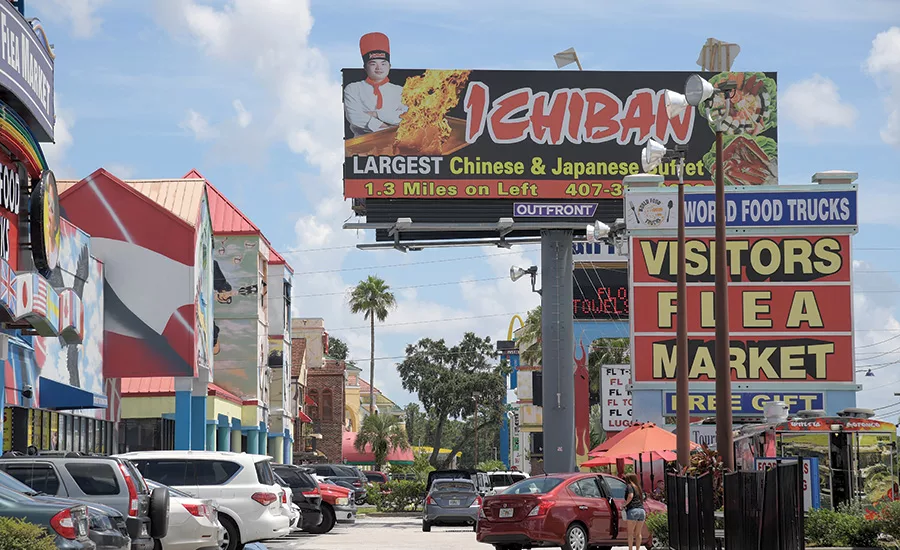
A cacophany of billboards and other signage along central Florida’s U.S. Highway 192 reflects the region’s vibe.
Photo © Phelan Ebenhack
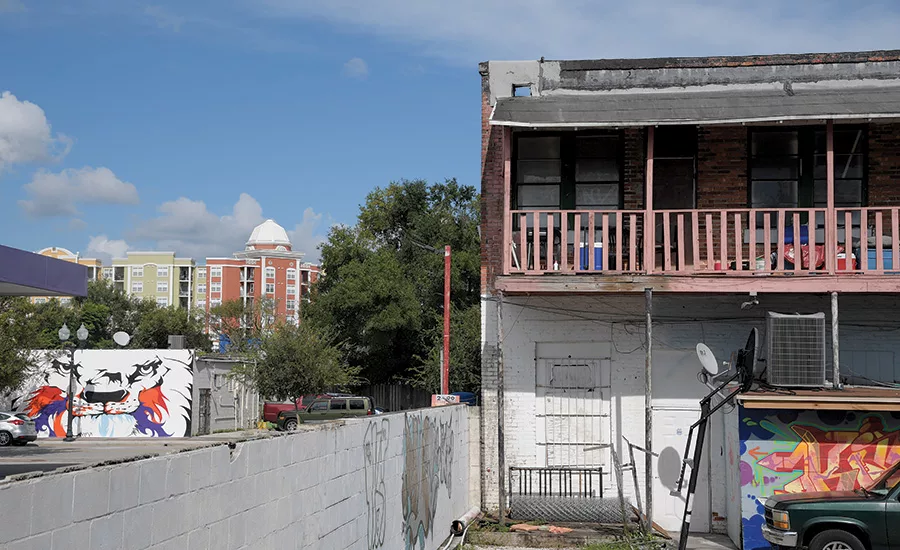
Aging structures continue to provide shelter to families as mid-rise residential buildings sprout up around the city.
Photo © Phelan Ebenhack
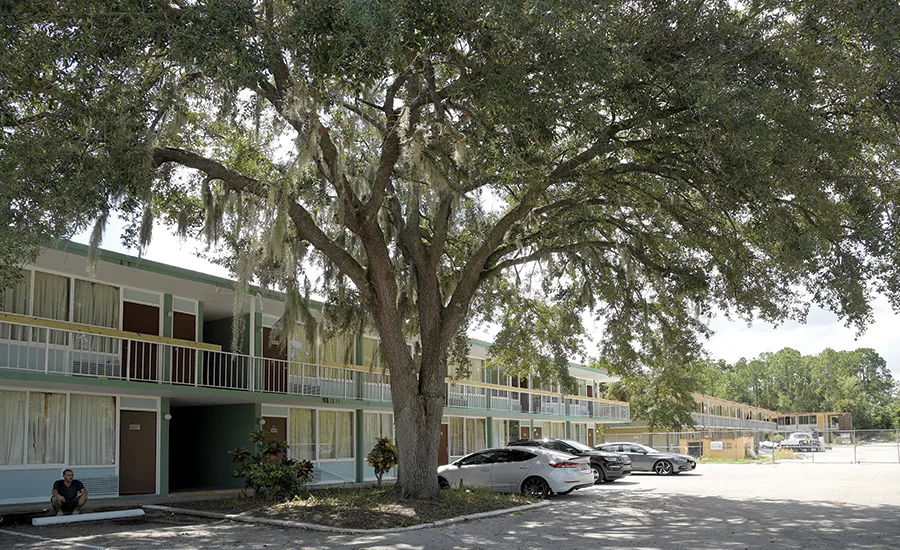
A Travelodge motel on U.S. Highway 192 is being converted into the Backlot Apartments, to provide efficiency housing for working-class renters.
Photo © Phelan Ebenhack
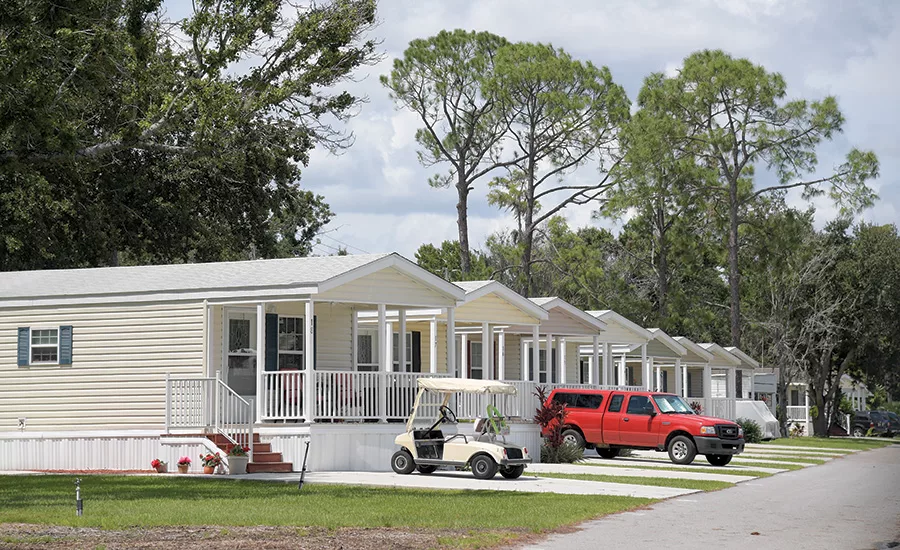
Skyrocketing costs have led residents to consider alternative housing options like RVs and “park model” mobile homes like these at the Sherwood Forest RV Resort.
Photo © Phelan Ebenhack
Orlando, the world’s top tourism mecca, was so ripe with the American Dream nine years ago that first-time buyers could purchase a house for less than $100,000. Today, the superheated residential market has become unaffordable for many buyers. Rent hikes have made Orlando a darling of the multifamily investment crowd but have further strapped residents in a wage-challenged economy. As the population swells, bulldozers are demolishing old orange groves and cheap housing to make way for market-rate and luxury communities. “They are basically building new towns with no affordable housing,” said Jaimie Ross, president of the Florida Housing Coalition.
Adequate affordable housing eludes most major U.S. metro areas, but Orlando’s conditions are among the worst. Earlier this year, the National Low Income Housing Coalition reported that only Las Vegas had a more severe shortage of rentals for the lowest-income families and individuals. Cities such as Boston, Pittsburgh, and Minneapolis have twice the rate of affordable housing—at least 40 affordable and available residences for every 100 renter households—while Orlando had just 17.
Orlando’s housing plight has captured Hollywood’s imagination and has figured in a number of recent movies and television programs. Last year’s award-winning film The Florida Project depicts raw motel life for poor families living in the shadow of the city’s theme parks. The movie 99 Homes shows Orlando’s foreclosure frontlines of evictions, squatters, and real estate flippers. And an A+E Networks affiliate filmed the series Zombie House Flipping about purchasing, renovating, and selling abandoned houses there.
How a region known for affordability less than a decade ago could so quickly price out many residents is a story that centers on a booming population, a housing-market collapse, and wages that have stagnated while prices spiked.
Housing pressures have escalated in the last five years; last year, on average, more than 1,000 new residents arrived each week in the country’s eighth-fastest-growing metro region, census numbers show. About 40 percent of that growth came from other states, plus a similar share from Puerto Rico (following Hurricane Maria) and foreign countries. With Orlando’s unemployment rate dropping from 10 percent in 2010 to just 3 percent in mid-2018, jobs have been the primary draw, but there are other factors as well. Central Florida Congressman Darren Soto, who has long represented working-class neighborhoods, says Orlando has simply become increasingly popular, while wages have lagged far behind housing costs. “It’s buyers competing with folks from the Northeast, Canada, Brazil, Russia, and international markets that aren’t tied to the local wages,” he says.
Orlando’s housing crunch hits everyone from the poor to the middle class throughout the 4,000-square-mile metro area. The onetime agricultural hub is bifurcated by 77.5 million annual theme park visitors to the south and 2.5 million metro-area residents largely to the north. This divide has most shortchanged blue-collar neighborhoods near the theme parks in the region’s southern stretches. In Osceola County, for instance, rents rose 11 percent from a year ago to a midpoint of $1,317, according to ALN Apartment Data.
Metro Orlando is home to six of the world’s 10 most-attended theme parks. Walt Disney World’s Central Florida operations alone employed 73,000 workers last year. But theme parks pay as little as $10 an hour. The National Low Income Housing Coalition recently found that the average wage for renters in the Orlando region was $16.80 an hour, which would cover $818 monthly in rent, if following national guidelines that recommend spending no more than one-third of income on housing. But Orlando-area workers earning about $15 per hour are paying about half their income for the median market-rate apartments. Vacancies are increasingly rare and tenants typically need about $3,000 for deposits and initial rent.
| Population: | Median Price of Home in 2012: | Median Price of Home in 2017: | Average Rent for 1-BR Apartment in 2012: | Average Rent for 1-BR Apartment in 2017: |
| 2.5 Million (metro area) | $229,829 | $265,000 | $827 | $1,189 |
Source: *Metrostudy **Rainmaker Insights
Chances to build financial stability by purchasing a house have also diminished. In 2009, three of every four houses had owners living in them—far above the national rate of 69 percent at the time, according to the census. Recessionary job losses and foreclosures drove the rate of owners down to 57 percent by last year. Orlando’s home-price collapse—from a median of $264,000 in 2007 down to $95,000 in 2011—meant many ordinary people could, in theory, suddenly afford two median-priced houses, according to data from the Orlando Regional Realtor Association. But cash investors and equity groups quickly controlled the market at its depths (with a new wave of landlords buying foreclosed-on houses to rent to newly arriving families and those who lost their homes and ruined their credit on defaulted mortgages). Since then, the metro area has regained a share of homeowners but still lags behind the national rate of 64 percent, so fewer residents are building equity, and more face a future of rent increases that outstrip wage increases.
The housing gap became most evident this year with the opening of Pendana at West Lakes, a two-story complex of siding-clad apartment buildings. More than half its 201 units had subsidized rents, charging just 30 percent of tenants’ income for a handful of apartments. For other government-backed units, one-bedrooms rent for an average of $593, and rent is $850 for market rate in this blighted urban pocket. Months before it opened in May, demand swelled, with inquiries from more than 8,000 prospective tenants—or about 40 families vying for each apartment. In comparison, median regional rents of about $1,300 rose 7.5 percent during the last year as wages grew just 1 percent. The public/private development group that launched Pendana recently halted applications while it works on plans to expand with additional phases.
Just down the street from Disney’s Animal Kingdom and the site for a new Margaritaville Resort, a young mother stands on the balcony of Backlot Apartments. The former Travelodge motel was built during Walt Disney World’s infancy in 1973, and the 300-unit, six-building complex sold last year for $5.3 million. The property is currently being converted into efficiency apartments, some already renting at $750 per month. Faded billboards clutter the nearby stretch of U.S. Highway 192. “It’s better than being homeless,” says Eliza Santos, 29, a Puerto Rican hurricane refugee who works at the front desk of an adjacent hotel. “I have found a lot of help for my kids. Really, to be here, it’s so amazing.” She says she may have to return to her ravaged island but would prefer to stay here because she finds her children’s public school teachers so supportive—a recurring sentiment among those who fled after Hurricane Maria and now hunt for permanent housing in the Orlando area. Four dozen families are currently living in the repurposed motel, and another 96 are on a waiting list for units set for completion in the fall.
Backlot’s small apartments may not be ideal for families, but Santos has tried to make the most of it. Inside her clutter-free studio is a bunk bed for her two children and a queen bed she shares with her longtime boyfriend. They have a one-wall kitchenette and a bathroom Santos decorated with a plume-filled vase to match the shower curtain. Renovations include fresh paint, kitchen counters, sinks, refrigerators, and microwaves. A security gate and improved outdoor lighting help safeguard this neglected corner of the region.
“We require first and last month’s rent, and the tenant needs to be working,” says Mark Vengroff, whose family business buys and redevelops motels throughout Florida and beyond. “There are people we take a chance on.” Backlot is home to a wide variety of tenants—nurses, other hospital employees, and theme park workers, says Vengroff. In addition, the local school board directs homeless families to find housing there, and FEMA sent Hurricane Maria evacuees, before ending the subsidies in September.
Throughout the region, even young professionals increasingly lack the resources to become owners and look to nontraditional housing solutions. Two years ago, Caitlin Dineen purchased a 1,500-square-foot suburban house for $175,000. After a divorce, she sold it last year for $190,000 but then found limited options for a place to call home. “The market has only gotten more expensive here in Central Florida, and I would have had to compromise a lot,” says Dineen, 32, an administrator at the Orange County Convention Center. “I thought about an apartment but, honestly, I couldn’t afford it even with my pay raise.” Instead, she purchased a new, 450-square-foot “park model” mobile home in the Sherwood Forest RV Resort. Most residents are twice her age and many come for just the winter. Dineen said she paid about $50,000 for the light-filled unit, which has a loft bed, bathroom, and small kitchen. “It feels like a tiny house,” said Dineen, who tossed most of her belongings. “I don’t feel like I’m missing anything.” Even though monthly costs are manageable, she’s unlikely to achieve savings that would help with a down payment or rent deposit elsewhere.
Orlando’s spiraling lack of affordable-housing options has politicians, nonprofits, and businesses looking for answers. Regional leaders recently completed a series of housing summits and proposed modifying land-use for more density. They seek to increase the number of unrelated people who may reside together and reduce parking requirements so developers can pass along reduced rents that reflect lower land-acquisition costs.
The Central Florida Foundation, a local philanthropic organization, plans to create a land trust, which would shave costs because residents would pay only for the structure on sites held by the trust. In Orlando’s pricey Winter Park area, the Hannibal Square Land Trust reclaimed a gentrifying neighborhood by building small, cottage-style Florida-vernacular homes so that longtime residents could afford to stay. Near the tourist corridor, Osceola County planners point to a “missing middle” of housing types that falls between traditional homes and apartment complexes. They want to change the zoning rules to accommodate granny flats and garage apartments.
And one Osceola nonprofit is exploring construction of a four-story rental community with as many as 256 units, using shipping containers on 5.5 acres of donated land. Plans are in early stages as Bumpus and Associates, an architecture firm in nearby Celebration, develops the design, says Mary Downey, executive director of the nonprofit Community Hope Center. “I like the idea of being a good steward of the environment and upcycling,” she says of the scheme for containers as building blocks.
West of Orlando, ENB Architects of Jacksonville is working with a partnership of nonprofits and the government on the Villages at Mercy Drive apartment complex, for low-income tenants. The four-building development will draw on the Urban Land Institute’s healthy standards to provide space for a food pantry, community garden, fitness path, computer use, and jobs fairs. “It’s very much about supporting the whole person,” says Tom Norman, principal of ENB.
Orlando-area governments also are eyeing inclusionary zoning, which calls on large-scale residential projects to include a percentage of units to be designated as affordable. While sometimes unpopular with developers, the model has added below-market-rate housing in Sarasota and other parts of Florida.
Despite the ideas and efforts, though, Orlando’s affordable housing shortage is likely to become more severe. Work has started on just 15 percent of the 70,000 houses and apartments needed by 2021. And long-term solutions have been further stymied as the state has redirected much of its affordable-housing trust fund over the last decade to pay for general state operations. Last year, for example, part of it went to school safety after the mass shooting at Parkland.
Near downtown Orlando, Pendana was funded with tax credits. The next phase, which includes 120 low-income units, is set to start in the fall. But credits are limited geographically and cover only about 110 units annually in each designated county, notes Robert Ansley, president of the Orlando Neighborhood Improvement Corporation. “Good Lord,” he says, “We have that many people move here every day."
Looking for quick answers on architecture and design topics?
Try Ask RECORD, our new smart AI search tool.
Ask RECORD →
Looking for a reprint of this article?
From high-res PDFs to custom plaques, order your copy today!