Interview with Rosanne Haggerty

Rosanne Haggerty
Photo © Josh Wool
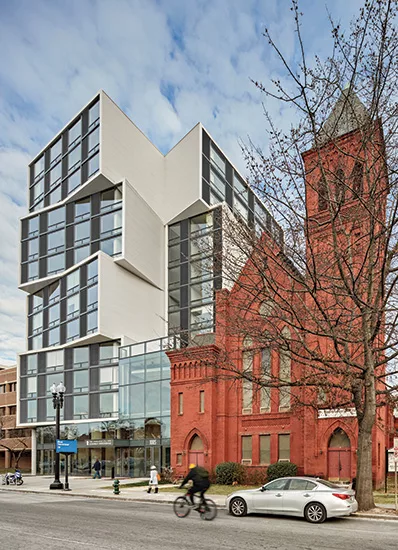
Community Solutions spearheaded the John and Jill Ker Conway Residence in Washington, D.C., designed by architects DLRGroup/Sorg, with supportive/affordable units.
Photo © Robert Benson Photography
An important leader addressing our nation’s homeless problem, Rosanne Haggerty founded Common Ground Community in New York in 1990. The nonprofit housing-development organization built thousands of affordable and supportive apartments through an approach that brought together architects, health and mental health providers, community groups, and public and private investors. Owing to her accomplishments, Haggerty was named a MacArthur Foundation Fellow in 2001. In 2011, she left Common Ground to start Community Solutions and address the larger problem of fragmented local housing and social-support systems. Through large-scale initiatives including the 100,000 Homes Campaign and, now, Built for Zero, Community Solutions assists cities or counties in coordinating resources and efforts of multiple stakeholders to make homelessness rare, brief, and nonrecurring. The organization’s innovative approach creates accountable housing systems and has already eliminated chronic or veteran homelessness in 11 places. More than three dozen other communities are seeing steady improvement.
RECORD's Cathleen McGuigan and Suzanne Stephens talked with Haggerty about the thinking behind her strategies for reducing homelessness in America.
In such a booming economy, why is homelessness spiking and affordable housing reaching a crisis in many U.S. cities?
Homelessness is not spiking everywhere, but I would say it’s the failure of housing policy and practice to adapt quickly to changing demographics and dynamics. Our work is focused on shifting mindsets about the nature of the problem, and building skills in communities that enable them to solve a problem that is not static or uniform in the way it is experienced by individuals and families, and requires disciplined coordination of effort and resources. That coordination calls for accurate and timely information on what is actually happening does our community have fewer people experiencing homelessness this month than last month? We now have the evidence that homelessness is a solvable problem. But communities need to think about housing as a system: how all the parts—zoning, land tenure, allocation of benefits, regulation of dwelling-unit types and use, plus code enforcement—can better fit together. Much of our work concentrates on helping communities learn how to organize themselves and use practices from other industries to encourage collaborative problem-solving. Most of all, an accountable group in each community needs to know who is homeless and who is on the verge of homelessness. They could bring the numbers down by aligning policies and practices to support connectivity between local agencies and various stakeholders.
What are some places where such connectivity is working?
We could look at Bergen County in New Jersey and Montgomery County in Maryland. Both have very high-cost housing markets, yet both have achieved zero chronic and/or veteran homelessness. In the case of Bergen County, they’ve understood how to align all their related housing policies: they learned who was really trapped in homelessness (the chronic) and were able to house everyone. They learned who had a less severe housing need, and had a system in place that could respond quickly. They know who has a disability that needs to be addressed with supportive services along with housing assistance. They know what units are available, where the vacancies are. Both these counties are very disciplined about tying these pieces of demand and supply together, and they are addressing the housing crisis in a transparent, accountable, comprehensive, and connected way.
What are the housing options in those communities for somebody moving from homelessness to a dwelling?
Looking for quick answers on architecture and design topics?
Try Ask RECORD, our new smart AI search tool.
Ask RECORD →
Homelessness is a term we might want to think about retiring. It’s like saying “sickness.” It does not tell you enough about what is going on, and there are many different manifestations. Various communities figured out that a significant percentage of homeless individuals and families have something else going on in their lives—maybe a health-care crisis or some legal issue. People need well-informed assistance about their options in addressing those problems. Then they might solve their housing situation largely on their own. Other households experiencing homelessness can be helped with essentially a one-time financial reset, perhaps a rent subsidy for a few years.
What do you do about providing housing to the homeless in a high-cost market?
I’ll share one example of the local problem-solving required. We just opened an affordable 66-unit apartment building this year outside Denver, a city with high housing costs. The metro Denver area has just over 300 homeless veterans remaining to be housed, with a less than 1 percent vacancy rate in rental housing. We couldn’t find landlords willing to rent to these veterans, all of whom had rental subsidies and vouchers. So we bought an existing building, by putting together a group of socially minded investors. For a 3 percent return, they’ll get their capital back in seven years—which enabled us to move very quickly to purchase the building before speculators arrived.
You have suggested that corporations should act as private investors in housing.
In Seattle and San Francisco, there is a desire to tax the tech employers for having altered the housing market. Many big companies are sitting on a lot of cash– instead of taxing them, why not convince them to invest in either preserving or building affordable housing? If you can cap returns at a workable level, it would be possible. These employers are stakeholders in cities and towns that are overwhelmed by homelessness and the stress of high housing costs on those with places to live. Their creativity and resources can be tapped in new ways, once communities take collective responsibility for this situation.
We’re accustomed to affordable housing projects financed through low-income housing tax credits that take years to develop and require multiple funding sources. We have used these programs ourselves, to build projects like the John and Jill Ker Conway Residence in Washington, D.C. The architects DLR Group/Sorg designed the 124-unit complex, which includes 60 apartments for formerly homeless veterans as well as low-income residents. It’s a fantastic building, located near the U.S. Capitol and the Washington Monument. But investments from new sources could fast-track the production of new affordable housing, and remove the friction and inefficiency of the tools we’ve been using.
You have said hospitals and other institutions are becoming stakeholders. For example?
Kaiser Permanente announced a $200 million housing-investment fund earlier this year. United Healthcare is investing in housing for high-cost patients who are homeless in their markets. Trinity Healthcare has an initiative to support affordable housing in targeted areas. These systems are seeing that stable housing is crucial to health.
Another interesting thing we’re seeing is that as health care shifts to outpatient services, and there are more consolidations of hospital systems, old hospital real estate becomes available. A concerted practice of looking to these sites for affordable housing makes sense. This is also true of religious properties. As parishes consolidate, churches close or require less space due to changing demographics, they can continue serving their communities by making their properties available for affordable housing.
How does Community Solutions differ from Common Ground?
During my 20 years at Common Ground, we built lots of affordable and supportive housing, but homelessness in New York City continued to rise. It was clear that new housing alone, or being one organization running good programs, was not having much of an impact on the overall problem. We no longer believed the rhetoric that it was just a matter of resources. We thought a new way of understanding the situation was needed. We were fortunate to be introduced to an organization called the Institute for Healthcare Improvement, and through them to grasp systems thinking: homelessness is a symptom of broken housing and support systems. Community Solutions establishes teams of organizations with critical housing and support resources; it works with communities that are willing to hold themselves accountable for results in reducing and ending homelessness, and analyzes and changes policies and practices they have in place that contribute to homelessness.
I can’t say enough about the communities that have moved past hand-wringing and blame and are working as teams, not competing organizations, to bring about reductions. Our Built for Zero team helps these communities create the data infrastructure to support collaboration. It provides training and coaching in data analytics, human-centered design, and in developing new housing models. It also enables learning from peers across communities by regularly bringing them all together and by documenting and sharing practices that are working. This is a team sport at every level. Each community needs at the very least the mayor’s office, the Veterans Administration, the housing authority, and the consortia of not-for-profit service providers working toward the same goal and holding each other accountable. Once Built for Zero communities have a clear grasp of the type of housing units needed to reach “zero,” Community Solutions can develop new affordable housing, plus finance models.
What is the process by which Community Solutions helps put these projects in place?
There are three phases to Built for Zero: The first phase is all about getting person-specific, real-time data together on homelessness in a community. It’s a process of building a clear, comprehensive picture of what this crisis looks like, and helping organizations work as a team. The second phase is using that data to start bringing about reductions, by bringing in successful ideas from other communities and experimenting with new strategies in short cycles to see what works. There is no one solution for every community or every person. You need disciplined, constant testing of strategies targeted at specific problems in the local housing system for measurable progress. The last phase is sustaining the elimination of chronic and veteran homelessness while expanding this system to encompass all those experiencing homelessness in the community.
What about shelters and temporary housing. Do they work?
Every study of this question supports what we are seeing across the 70-plus communities that have been part of Built for Zero: that the key to ending homelessness is helping people keep their housing or get back into stable housing quickly. That’s probably what you most need to know about homelessness. Shelters and temporary housing should never be a community’s primary investment: it becomes an expensive industry while not solving homelessness. It’s a roughly $2 billion-plus annual industry in New York City, for example– and homelessness is at an all-time high there.
Homelessness mirrors income inequality and racial inequity, and demands attention for those reasons alone. Proof of what works is now emerging. It clearly is a leadership issue at every level of government—one that needs to challenge conventional approaches, require a team-based system, make targeted investments in housing, and provide rental subsidies rather than shelters. Citizens should expect no less.
Looking for a reprint of this article?
From high-res PDFs to custom plaques, order your copy today!