Dujardin Mews by Karakusevic Carson and MaccreanorLavington
London
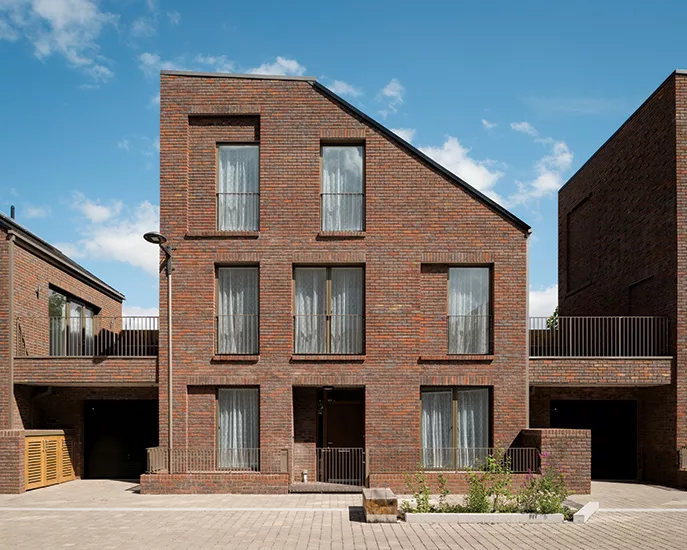
Window frames are timber faced with powder-coated aluminum on the outside for low maintenance.
Photo © Jim Stephenson

The pedestrian-friendly street features shared surfaces, landscaped areas, and on-street parking.
Photo © Mark Hadden

Some units include a terrace over the garage.
Photo © Emmanuelis Staasaitis

South-facing roof pitches feature PV panels.
Photo © Tim Crocker
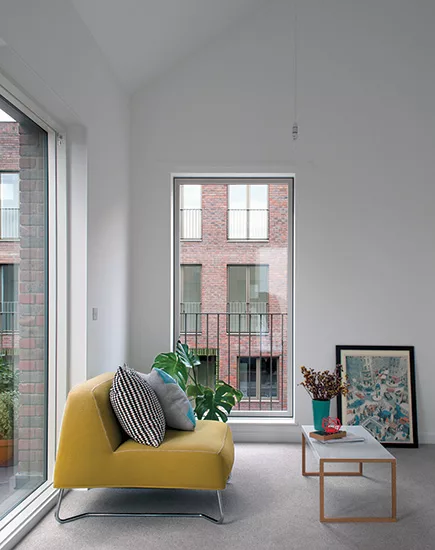
Living rooms rise to the roof soffit.
Photo © Emanuelis Stasaitis

Image courtesy Karakusevic Carson Architects & MaccreanorLavington

Image courtesy Karakusevic Carson Architects & MaccreanorLavington
There can be few clearer examples than this project of how housing architects revisit and reinvent old ideas. This new street of row houses in outer London goes back to 18th- and 19th-century precedents in the shadow of the 1960s towers that they are partly replacing.
British architects have been designing alternatives to high-rise social housing since the late 1960s (see my review of Cook’s Camden), in recent years often adopting the form of the high-density courtyard-based development or mid-rise block. Dujardin Mews is different. Designed by architects Karakusevic Carson with MaccreanorLavington, it is a full-blooded return to the idea of the traditional street of attached houses. But unlike some other developments in the UK—especially in rural areas—it is not traditionalist in style.
Additional Content:
Jump to credits & specifications
The north–south street was built on part of a former gasworks next to a railway line in Ponders End, a poor industrial and postindustrial district in the outer North London borough of Enfield. Immediately to the north of Dujardin Mews is the Alma Estate, a large blue-collar social housing project from the 1960s that originally featured a mix of four tall towers and lower buildings. The borough deemed this estate ripe for a 10-year, $400 million regeneration project. Although much of this has been put in the hands of private developers, the borough decided it would also directly build its first social housing in 40 years and that this should be an exemplar project, to rehouse residents displaced by demolitions on the Alma Estate.
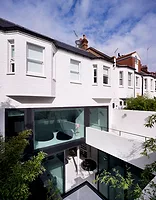
A large new school was built on most of the old gasworks site, leaving only a narrow strip at its western edge for housing. The brief to competing architects envisaged a single row of houses facing the school. But the school made it clear that it was not keen to be observed. In a joint submission, the winning architects proposed instead a double-sided street, achieving this by rotating the house plans on the eastern side 90 degrees, resulting in shallow three-story houses with wide frontages. In place of full-sized rear gardens, a second-floor terrace is provided over a garage in each house on this side, along with a tiny, enclosed ground-floor backyard.
This simple move made a proper double-sided street possible. Measuring 41 feet across, there is just enough space for a roadway, sidewalks, planted landscape areas, and on-street parking as well as the garages—all in a Dutch-style pedestrian-friendly “Home zone” arrangement of shared surfaces, where cars naturally move slowly and it’s normal to stroll down the middle of the street. A “mews” was traditionally a narrow secondary street with small servants’ dwellings over coach houses and stables. Here, however, internal room dimensions are impressive: when you walk in, these houses feel spacious and full of daylight despite the limited fenestration on the school side. Living rooms are double-height, rising to the roof soffits.
Although there are only 38 units in total, the development contains a number of different types, from one-bedroom apartments to four bedroom houses. The mix is 50 percent social-rented and 50 percent subsidized-sale. (UK “right to buy” legislation allows social-rent tenants to purchase their homes at a discount from market rates after three years of residence, so increasing private ownership is expected.) All are occupied by previous residents of the Alma Estate, who, along with the school, took part in consultation sessions with the architects as the design progressed. Three-story flat-roofed apartment blocks at each end act as visual stops, the one at the south end also turning the corner so as to screen existing industrial sheds. The variety of unit sizes could have made for a fussy aesthetic, but it is carefully controlled, with just enough visual variation.
A more conventional row house type with gardens occupies the west side of the street, while what appears at first glance to be a single block at the northern end is in fact divided, with each of the two architects designing half. The southern part, by MaccreanorLavington, is houses; the northern, by Karakusevic Carson, consists of courtyard apartments at ground level with duplexes above. At the rear, they are very different. But on the street-facing side, only subtle detail variations give this away. Similarly, MaccreanorLavington designed the houses on the western side of the street and the southern end-block, while Karakusevic Carson also designed the eastern row and acted as executive architect for the whole development. Says Paul Karakusevic, “We like to collaborate with other practices on housing projects, to create distinctive neighborhoods with real character. For Dujardin Mews, the collaboration yielded a street with a variety of frontages and dwelling types that respond to the surrounding context.”
The various designs share a common language of materials—red brick with gray concrete roof tiles and a mix of planted green and zinc flat roofs. Detailing is of a high order, especially the texturing and modeling of brick on end gables, deep window reveals, and, on the western side, green-glazed brick lintels. Construction quality is impressive for a low-energy project that cost approximately $255 per square foot to build.
Ideally, Dujardin Mews would be just the start of a grid or ladder of such streets, but at present it feels slightly marooned in the midst of all the redevelopment taking place around it. Perhaps anticipating this, the architects designed the street to feel very self-contained and neighborly. This is a totally convincing revisit of a very London human-scale domestic typology: to heal the scars of industry and of failed earlier housing experiments, it deserves to be studied and replicated widely.
CreditsArchitect: Karakusevic Carson Architects
Associate architect: MaccreanorLavington
Engineers: Peter Brett Associates (structural and civil); Designbrook (m/e/p)
General contractor: Durkan |
SpecificationsBrick Freshfield Lane
Tile Johnson Tiles, Waxman Ceramics
Resilient flooring Forbo
Acoustical ceilings British Gypsum
Doors Premdor, Pendle Doors |
Looking for a reprint of this article?
From high-res PDFs to custom plaques, order your copy today!