High Street Residence Hall by Deborah Berke Partners
Carlisle, Pennsylvania

The south facade, clad in zinc, looks out onto a patio and lawn.
Photo © Chris Cooper

The south facade, clad in zinc, looks out onto a patio and lawn.
Photo © Chris Cooper

Facing the street, the building is clad in limestone, reflecting the campus’s historical design language. Mahogany accents indicate common spaces while adding warmth.
Photo © Chris Cooper
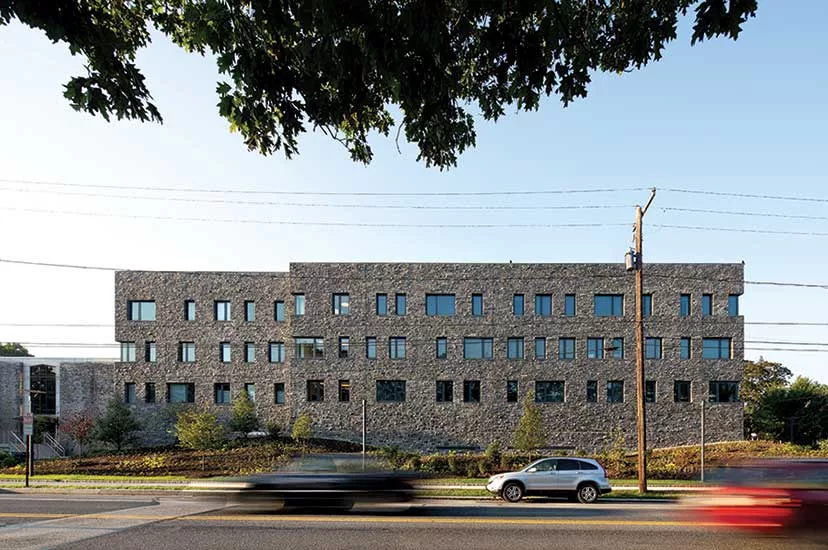
From the main campus road, the residence hall formally expresses itself as part of the Dickinson campus with its limestone cladding.
Photo © Chris Cooper

Mahogony cladding visually links the two facades; a high-performance landscape wraps around the building’s perimeter.
Photo © Chris Cooper

Floor-to-ceiling windows are placed at the end of corridors for maximum daylight.
Photo © Chris Cooper

The building’s E-shape plan was driven by a program that emphasizes casual socializing. A large kitchen and lounge area serves as a flexible living and working space.
Photo © Chris Cooper
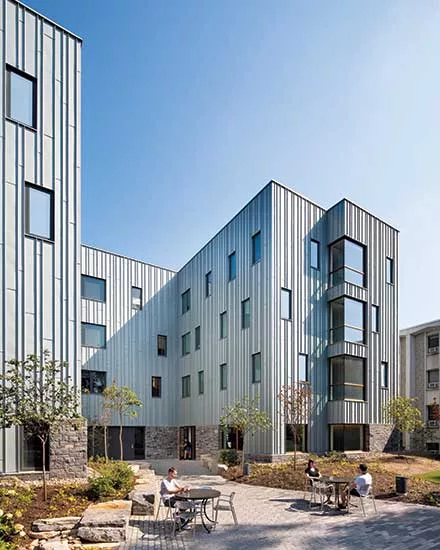
A patio encourages residents to get outside.
Photo © Chris Cooper

Image courtesy Deborah Berke Partners

Image courtesy Deborah Berke Partners
Architects & Firms
Chartered in the rural town of Carlisle, Pennsylvania just days after the American Revolution ended in 1783, Dickinson College claims to be the first school established in the newly independent United States. Now considered among the state’s top liberal arts institutions, Dickinson has maintained a small, quaint campus defined by three leafy quadrangles, its beating heart a limestone Federal-style building designed in 1803 by Benjamin Henry Latrobe, architect of the U.S. Capitol.
Additional Content:
Jump to credits & specifications
With many quarries nearby, limestone is the campus’s unifying architectural element—nearly all its buildings, from Georgian-inspired to Midcentury Modern, have stone facades. The school’s newest addition, a 130-bed dormitory designed by New York–based Deborah Berke Partners, keeps this tradition, but with a modern twist. Viewed from the main campus road on which it sits, the High Street Residence Hall appears as an elongated masonry monolith, handsome yet staid, and candid about its utilitarian function. As you walk around the building’s perimeter, however, stone pivots to a satiny zinc that cloaks the south facade in a silvery blue sheen.
The new, 42,000-square-foot residence hall is the last phase of a six-year campus enhancement effort that included the construction and renovation of several academic buildings, plus a new athletic field. Now all 2,400 enrolled students can be accommodated in college-owned or -leased residences. Although the architects had no previous dormitory experience, the project was a “logical melding,” says Berke, of the firm’s portfolio, which includes hotels, private residences, and other higher-education projects. The High Street dorm, she says, was an opportunity to set a new bar for 21st-century residential life on the Dickinson campus while riffing off its historical design language.
The building’s split material expression emerged from its siting on the south side of High Street—a stretch of highway that runs through Carlisle and cuts across campus, separating the academic quad to the north from the residential quads to the south. As a buffer between this transient public zone and the halcyon grounds where students and faculty reside, it made sense for the building, which uses a hybrid structural system of concrete block and plank with steel framing, to have two different faces: a formal articulation of Dickinson’s legacy to the north, and, to the south, something friendlier, expressed in a “more forward-thinking language,” as project lead Rhoda Kennedy puts it. The architects chose zinc after considering its use as cladding in the local agricultural vernacular, as well as in other campus buildings; they arranged standing-seam panels in alternating vertical layers for a contemporary interpretation of the material.
Although the contrast of smooth and uniform metal with rugged and imperfect stone could result in a discordant whole, the design achieves a peculiar harmony. It is also dynamic. On both facades, windows are punched out at irregular intervals—some are skinny and short, some are tall and wide, others wrap the corners—adding variation to both the interior and exterior, plus the apertures are more deeply set on the stone side than on the metal one, emphasizing the different weights of the two materials. And, over time, the limestone will lighten and the zinc will weather. “The idea of making the building’s skin something that is active and evolving is exciting,” says Kennedy. “We thought it really matched the way that Dickinson was conceiving of this project.”
Typically, given the need for durable, easy-to-maintain surfaces—and with limited budgets—dorms tend to have bland interiors. And, unsurprisingly, the interiors here are not as exciting as what’s on the outside. But they are thoughtful. According to Kennedy, the key considerations were high ceilings and lots of light. An E-shape plan maximizes the number of bedrooms and daylight. The design team organized rooms along the three “fingers” and created “pockets” with café tables off the north side of the main east–west hallway. Suites of bathrooms and single and double rooms surround the alcoves. Often in suite layouts, such lounge spaces are behind closed doors, but the intention here was to “democratize these areas,” says design partner Maitland Jones, by making it clear that they don’t belong solely to those living adjacent to them. By opening the lounges to the main corridor, “students are allowed to cruise by and negotiate a decision about where they will hang out,” says Jones.
On the second-through-fourth levels, floor-to-ceiling windows cap the ends of the “finger” corridors, bringing daylight into the core as well as each of the ends of the main circulation passage, where movable lounge chairs signal a quiet place to study or reflect. Here, the architects exposed the building’s concrete planks, to give the ceiling more height. From outside, these lookout nooks are identified by a sliver of mahagony cladding that visually links the two facades and, at the east end, announces the main entry.
In lieu of game rooms, quiet study and conference rooms with fully glazed walls are located on each of the building’s top floors—a preference that students emphasized during the programming phase. “The idea that everyone prefers a ping-pong table is less and less true,” says Berke. “I don’t think students these days want their activities to be prescribed to them—they want flexibility and places to shape ideas.” The residence hall’s main amenity is a large daylit kitchen and lounge on the ground level; this area opens out to a patio and courtyards formed by the building’s E-shape, which also breaks down the scale of the south facade.
Since September, the new residence has been housing its inaugural group of occupants—a mix of sophomores, juniors, and seniors. During the design process, the students who weighed in were adamant about having high sustainability standards for the building. In line with Dickinson’s goal to be carbon-neutral by 2020, the project is on target to be the campus’s first LEED Platinum building, and, says Kennedy, it is currently meeting Passive House standards for airtightness, even though it is not seeking certification.
On a recent early fall day, shortly after move-in, tables and chairs were already being shuffled, and whiteboards were covered in scrawls, showing signs that occupants were getting comfortable; individuals and quiet study groups had formed on the patio and inside the first-floor lounge. “Students gravitate toward a coffee shop mindset,” says Berke. “This building reflects that.” As the first dormitory to be built on campus in over four decades, High Street Residence Hall’s unique form succeeds in encouraging new ways for students to be engaged with each other and with their living environment; the two-toned exterior looks toward the future while acknowledging the past. “As a whole, it exemplifies what we think this project is all about,” says Kennedy: “the transformation from old to new.”
CreditsArchitect: Deborah Berke Partners—Maitland Jones, design partner; Rhoda Kennedy, project lead; Aaron Plewke, project manager; Kiki Dennis, interiors lead; Virginia Gray, Jason Hill, Andrew Ledbetter, Emily Martyn, Thao Nguyen, Scott Price, Tal Schori, Alex Stinchcomb, project team
Engineering: Kohler Ronan (m/e/p); Providence Engineering (structural); Nutec Group (civil)
Consultants: PHT Lighting (lighting); Steven Winter Associates (sustainability); Andropogon Associates (landscape)
General contractor: Benchmark Construction |
SpecificationsMasonry Alverson Limestone
Metal panels Rheinzink
Wood Duratherm
Glazing Vitro Architectural Glass, Wasco Skylights |
Looking for a reprint of this article?
From high-res PDFs to custom plaques, order your copy today!