Vessel Has Landed: Heatherwick's Sculptural Structure Opens at Hudson Yards
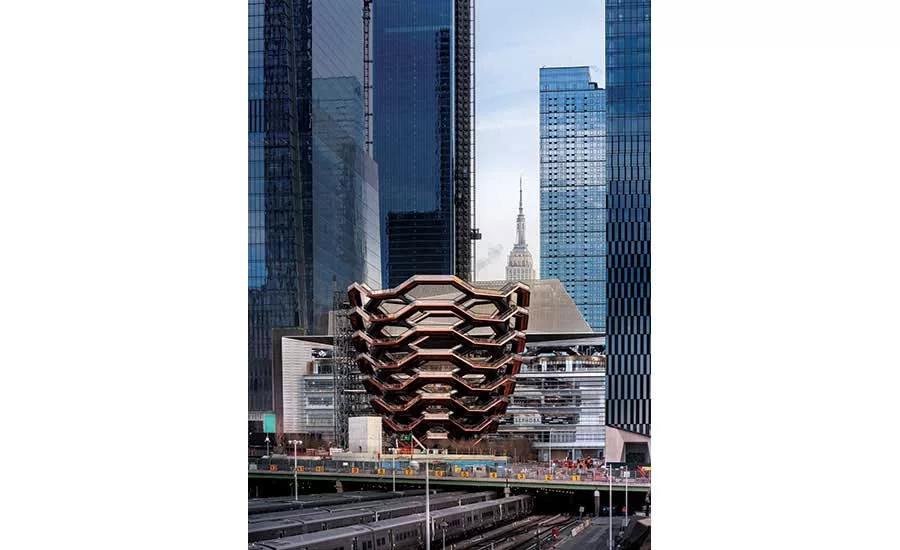
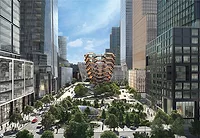
Heatherwick’s Vessel mushrooms from a base of 50 feet.
Photo courtesy Michael Moran for Related-Oxford
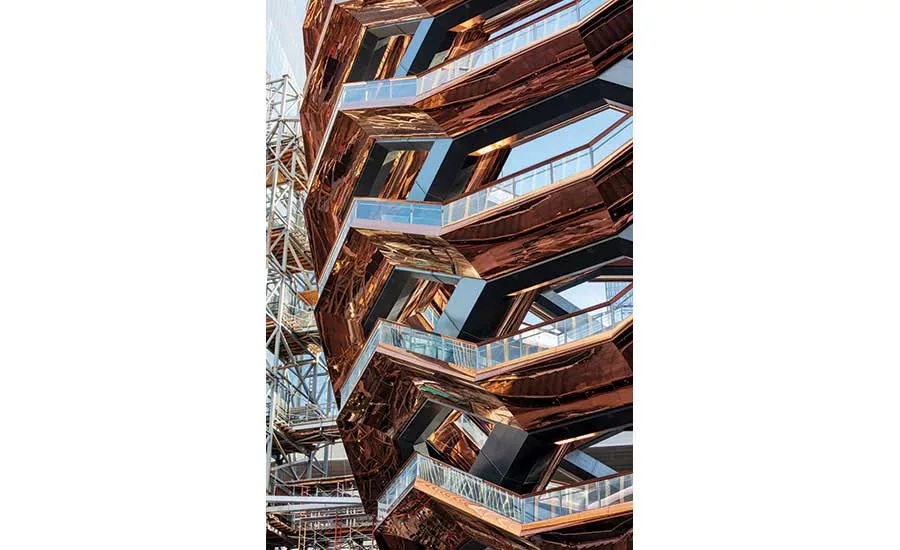
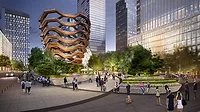
Its stairs and landings are clad with a copper-colored stainless steel.
Photo courtesy Michael Moran for Related-Oxford
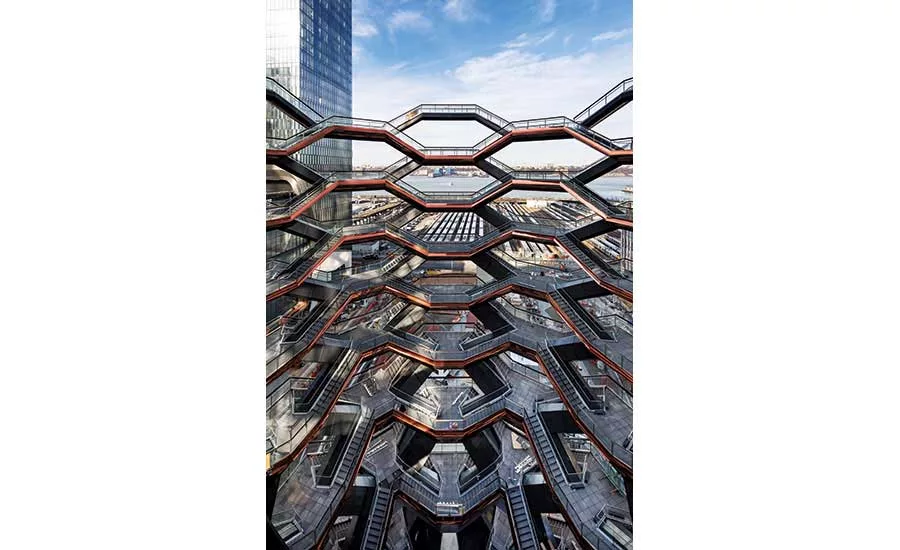
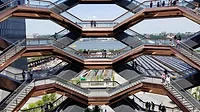
The 150-foot-high structure consists of 154 staircases and 80 landings that run in straight lines and intersect at oblique angles.
Photo courtesy Michael Moran for Related-Oxford
Architects & Firms
On the far west side of Manhattan—where Hudson Yards, the monumental city-within-a-city that will someday encompass 18 million square feet, is rising on a platform held aloft above a sea of railroad tracks—stands one of the most original structures in New York. Viewed head-on at a sufficient distance—looking east from the spur of the High Line, say, across acres of parked commuter trains—Vessel, the climbable sculpture designed by Thomas Heatherwick, has the calming aspect of a pagoda, its eight levels of upturned wings glowing a soft copper color in the sun. But up close, at ground level, its rigid symmetry dissolves into a jumble of stairs and platforms, mushrooming from a base of 50 feet across to 150 feet across at the top. London-based Heatherwick Studios managed to come up with a shape that defies geometric description. The elaborate website devoted to it, which features a promotional video staged by the Alvin Ailey dance company, calls it a “spiral staircase,” which it most definitely is not. The interior of the Guggenheim Museum is a spiral, one continuous ramp circling a central axis, but Vessel is a nest of steps, landings, and walkways that run in straight lines and intersect at oblique angles.
Nor is it “soaring,” as the website calls it—a curious description for a 150-foot-high object just yards from a 900-foot-tall tower, 10 Hudson Yards, and its even more gigantic neighbor, 30 Hudson Yards, both by Kohn Pedersen Fox. For that matter, it’s not a “vessel” either, a name that pretentiously eschews a definite article—just “Vessel,” like “London Bridge” or “Jupiter”—but which has nothing to do with the object itself, either in the sense of a ship or a container. Heatherwick drew inspiration from the 1,000-year-old stepwells of Rajasthan, deep cisterns reached by steep stairs chiseled into the walls. They are vessels that hold water, but Vessel encloses nothing but air.
Stephen Ross, the chairman of Related Companies, which, along with Oxford Properties, developed Hudson Yards, wanted to make a bold statement with Vessel, and he spared no expense. The structure’s 154 staircases and 80 landings, mostly fabricated in Monfalcone, Italy, are clad with stainless steel, copper-colored by a process called physical vapor deposition. This creates a shiny surface that will not weather or corrode into verdigris. In certain lights, it reflects a sallow sheen onto the movable ETFE “shell” of the adjacent performing and visual-arts space, the Shed, which will open in early April. There is no obvious reason why the copper-like cladding was necessary, except as a statement of how much money the developers had and were willing to spend.
“Our brief was that Hudson Yards needed a galvanizing moment,” said Stuart Wood, the project manager for Heatherwick who led a tour of the site, a week before it opened to the public. “New York is an intense, bold, very compressed environment, one of the few places in the world that can take this.” Apart from that generalization, Vessel makes no obvious gestures toward the surrounding cityscape—it is only a couple of hundred feet from busy 10th Avenue but walled off from it by the two big towers and the new shopping mall between them—or to the site itself, either the once-bustling waterfront nearby or the enormously complex infrastructure below. It is meant to complement the nearby High Line and attract at least a fraction of the 7 million or so who visit there each year, but it has none of the High Line’s DNA, the sense of discovery imparted by its origins as a hidden, indeed forbidden, remnant of New York’s industrial history.
Once completed, almost the entire Hudson Yards project will sit on two platforms totaling 28 acres and spanning the trainyards and the rail tunnels to New Jersey under the Hudson River. (Construction is scheduled to start next year on the western half of the site, which is expected to include towers designed by Heatherwick, Frank Gehry, Robert A.M. Stern, and Santiago Calatrava.) This marvel of engineering was designed not just to support the buildings but also the landscaping, which required a stormwater storage tank and a ventilation and air-conditioning system to exhaust the heat of the idling trains below and cool the soil enough for plants to survive. “Considering what it takes to hang 225 trees over the rail yards,” said landscape architect Thomas Woltz of Nelson Byrd Woltz, “these must be the most expensive trees in the world."
By the same token, Vessel must rank among the most expensive pieces of public sculpture in the world; for the same $200 million price, Ross could have bought, just a week earlier, the entire Chrysler Building, with $50 million to spare. And expectations are high; admission will be by timed ticket, although there are no plans to charge for it. The optimum number of visitors at one time is calculated to be around 700, although it remains to be seen whether that will allow for Heatherwick’s vision of New Yorkers’ ditching their gym memberships to get their exercise running up and down Vessel’s 2,500 steps. The truth is, there isn’t much else to do on it; there are no places to sit, no food for sale or allowed, and you can take a selfie but the rules prohibit selfie sticks. Vessel conveys, in Wood’s words, a “hyper-acceleration of arousal from the outside but, on it, a calm materiality.” The best views, he adds, “are inwards, because they focus on intimate spaces, on human beings.”
It’s good that he thinks that, because, once the entire project is built out, the current sight lines to the Hudson River and the New Jersey shore will be mostly cut off, and the views will be of the looming towers and the expensive shops inside the retail atrium, the experience less like walking across the Brooklyn Bridge than being a mouse trapped in a wastebasket. The success or failure of the project won’t be known until people begin to use it, of course, and New Yorkers, starved for open space, have been habituated to less likely places. It’s a safe bet it will fulfill its destiny to provide them—or, certainly, tourists—with Instagrammable moments.
Looking for quick answers on architecture and design topics?
Try Ask RECORD, our new smart AI search tool.
Ask RECORD →
Looking for a reprint of this article?
From high-res PDFs to custom plaques, order your copy today!