Architectural Record
search
cart
facebook twitter linkedin youtube
  • Sign In
  • Subscribe
  • Sign Out
  • My Account
Architectural Record
  • NEWS
    • Latest News
    • Awards
    • Interviews
    • Obituaries
    • Podcasts
      • Design:Ed Podcast
      • Sponsored Podcasts
  • OPINION
    • Book Reviews / Excerpts
    • Exhibition Reviews
    • Forum
  • EXCLUSIVES
    • Videos
    • Design Vanguard
    • Top 300 Firms
    • Sponsored Content
    • Sponsored eBooks
    • From the Archives
  • CONTINUING ED
    • Editorial Continuing Ed
    • CE Center
    • CE Academies
  • PROJECTS
    • Buildings By Type
    • Reuse & Renovation
    • Museums & Arts Centers
    • Colleges & Universities
    • Multifamily Housing
    • Interiors
    • Lighting
    • Kitchen & Bath
  • HOUSES
    • Record Houses
    • House of the Month
    • Featured Houses
  • PRODUCTS
    • Products by Category
    • Record Products of the Year
    • Latest Products
  • EVENTS
    • Dates & Events
    • Record on the Road
    • Innovation Conference
    • Sustainability in Practice
    • Women In Architecture
    • Webinars
    • Ad Excellence Awards
    • Submit an Event
  • CONNECT
    • Ask RECORD AI
    • Newsletters
    • Contact
    • Advertise
    • Editorial Calendar
    • Store
    • Customer Service
  • SUBMIT
    • Submission Guidelines
    • RECORD Competitions
  • MAGAZINE
    • Subscribe
    • My Account
    • Digital Edition
    • Current Issue
    • Firm Pass
    • Historic Archive
Editorial

Crossing the Line

Many migrant-detention centers were not designed for their current use—and architects should stand up and say stop.
By Cathleen McGuigan
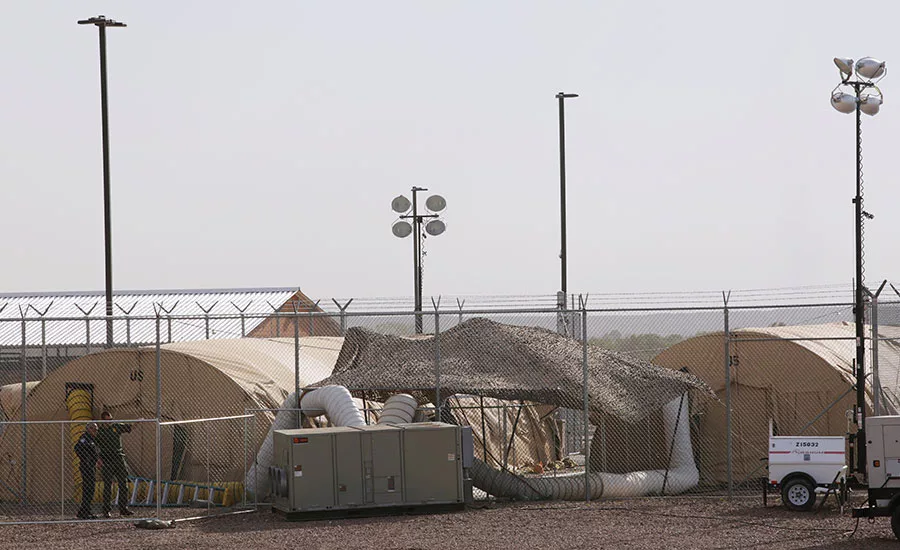
U.S. Customs and Border Protection's Border Patrol

U.S. Customs and Border Protection's Border Patrol station facilities in Clint, Texas, on June 25, 2019

Photo © Jose Luis Gonzalez/REUTERS/Newscom

July 22, 2019

Editor's Note: On the afternoon of Monday, July 22, the AIA issued a statement denouncing conditions at detention centers. Read the full statement.


Beginning in late June, a series of news reports detailed once again the horrendous conditions in certain migrant-detention centers along the southern border. Immigration lawyers, doctors, Congressional representatives, journalists, and the Department of Homeland Security’s own Office of Inspector General described what they saw or heard inside some of these facilities: deplorable overcrowding; lack of good nutrition and sometimes even clean drinking water; poor access to basic sanitation and medical care. While the government seeks to enforce new rules for asylum seekers, the state of these centers remains a testament to an intense humanitarian crisis.

What does this have to do with architecture? Architects are charged with ensuring the health, welfare, and safety of those who inhabit the structures they design. If local building codes were applied to the worst of these centers, they would be closed down today. But local officials seem to have no jurisdiction over federal facilities. Take the now-notorious Border Patrol center outside El Paso, in Clint, Texas, designed largely to house vehicles and equipment, albeit with space to briefly hold 104 adult detainees. But when a team of lawyers and doctors visited in June, they found instead 350 children, most of whom were likely separated from the adult who brought them over the border. The team also learned of an adjacent windowless warehouse that allegedly held hundreds more, according to an article in The New Yorker. Though the law mandates that children be moved out of detention within 72 hours, some children told lawyers they had been there for three weeks. They were “filthy,” said one lawyer; they had not had access to showers, and some slept on concrete floors. Overwhelmed guards charged older kids with looking after babies and toddlers, including changing their diapers.

But none of these facts can begin to convey the emotional misery and fear these children suffer.

A joint investigation, by the El Paso Times and The New York Times, of the Clint facility in early July said, “Architects designed the Clint station as a type of forward base . . . from which agents could go on forays along the border . . . [and] migrants would be detained for only a few hours of processing before being transferred to other locations.” The architects are uncredited, but shouldn’t all architects protest when a structure designed as a giant garage becomes a squalid prison for hundreds of children?

Last year, the Architecture Lobby and Architects/Designers/Planners for Social Responsibility (ADPSR) called for professionals to refuse work on immigrant-detention centers. Several AIA chapters, including Boston and Austin, similarly called for rejecting work that violates basic human rights.

Now Rosa Sheng, FAIA, well-known for her activism on behalf of women and diversity in the field, has reached out to the College of Fellows and the Board of the AIA to ask architects “not to look away or remain complicit” in the face of the inhumane conditions at detention centers. She believes the AIA should denounce “injustices and misuse of building types not meant for human habitation” and should “call for building inspections to have these facilities shut down.” As Sheng points out, “The AIA Code of Ethics clearly states that we shall uphold human rights.” So far, she has received a positive reaction from many Fellows endorsing a public statement.

Looking for quick answers on architecture and design topics?
Try Ask RECORD, our new smart AI search tool.
Ask RECORD →

Two years ago, the American Medical Association (AMA) voted to adopt policies to protect the health of immigrants and refugees. The AMA opposed all family immigration detention, the separation of children from parents, and any plans to expand detention centers, “given the negative health consequences that detention has on both children and their parents.”

This June, the American Bar Association (ABA) declared that the organization was “appalled by credible reports of hundreds of children being held in unsafe and unhealthy conditions in violation of federal and state law, court settlements, and common decency.”

It is time for the AIA to join doctors and lawyers in taking a stand. According to Robert A. Ivy, the organization’s EVP/CEO, the board is “actively discussing its position on this issue.” Ivy told RECORD just before the magazine went to press that the AIA is distressed “at the living conditions in overcrowded detention facilities, and stands by its ethical standards.” We look forward to the AIA taking action.

Share This Story

Looking for a reprint of this article?
From high-res PDFs to custom plaques, order your copy today!


Mcguigan

Cathleen McGuigan served as editor in chief of Architectural Record from 2011 to 2022.

Post a comment to this article

Report Abusive Comment

Subscription Center
  • Create an Account
  • Start a Subscription
  • Manage My Account
  • Sign Up for Newsletters
  • Visit Customer Service
  • Update Preferences

More Videos

Sponsored Content

Sponsored Content is a special paid section where industry companies provide high quality, objective, non-commercial content around topics of interest to the Architectural Record audience. All Sponsored Content is supplied by the advertising company and any opinions expressed in this article are those of the author and not necessarily reflect the views of Architectural Record or its parent company, BNP Media. Interested in participating in our Sponsored Content section? Contact your local rep!

close
  • TAMLYN XtremeTrim Exterior Trim
    Sponsored byTamlyn

    Designing Cleaner Panel Facades: Why Exterior Trim Details Matter

  • Building with Vapor Barriers
    Sponsored byReef Industries, Inc.

    Vapor Barriers Help Control Moisture in Tighter Building Designs

  • Duct Interior with Prodeq System
    Sponsored byHenry, a Carlisle Company

    Designing Resilient Water Containment Systems

DESIGN:ED Podcast
Listen to Architectural Record’s DESIGN:ED Podcast

Events

June 10, 2026

Rethinking Stormwater – The Power of Porous Paving

Credits: 1 AIA LU/HSW; 1 AIBD P-CE; 0.1 ICC CEU

Learn how porous paving systems support stormwater management, reduce heat island effects, and enhance sustainable site design performance.

June 11, 2026

Very Early Warning Fire Detection for Mission-Critical Facilities

Credits: 1 AIA LU/HSW; 1 AIBD P-CE; 0.1 ICC CEU

Examine advanced fire detection strategies that support uptime and enhance safety in data centers and other mission-critical facilities.

View All Submit An Event

Products

2026 Architect's Square Foot Costbook

2026 Architect's Square Foot Costbook

See More Products

Popular Stories

Coronado Bridge

The Architect’s Guide to San Diego

Practice Matters illustration

What’s in a (Firm’s) Name? Thinking About Succession and Legacy

Practice Matters illustration

By the Numbers: Counting America's Architects

Inward House

Inward House by VeeV Design Studio

Riverdale House by Studio Lau

Riverdale House by Studio Lau

Broader Sustainability of CMU - Free Webinar - May 21, 2026

Related Articles

  • The Line NEOM.jpg

    Saudi Arabia’s The Line Drastically Scales Back Its Ambitions

    See More
  • "Disney World on the Hudson" Op-Ed Comes Down on the High Line

    See More
  • If You Go to the High Line, Visit the Bathrooms

    See More

Related Products

See More Products
  • 0470130628.gif

    Sustainable Design: The Science of Sustainability and Green Engineering

See More Products
×

The latest news and information

#1 Source for Architectural Design, News and Products

SUBSCRIBE
  • RESOURCES
    • Advertise
    • Contact Us
    • Submit
    • Store
  • ACCOUNT CENTER
    • Create an Account
    • Start a Subscription
    • Manage My Account
    • Sign Up for Newsletters
    • Visit Customer Service
    • Update Preferences
  • PRIVACY
    • PRIVACY POLICY
    • TERMS & CONDITIONS
    • DO NOT SELL MY PERSONAL INFORMATION
    • PRIVACY REQUEST
    • ACCESSIBILITY
  • SERVICES
    • Marketing Services
    • Reprints
    • Market Research
    • List Rental
    • Survey/Respondent Access
  • STAY CONNECTED
    • Linkedin
    • Facebook
    • Instagram
    • YouTube
    • X (Twitter)

Copyright ©2026. All Rights Reserved BNP Media, Inc. and BNP Media II, LLC.

Design, CMS, Hosting & Web Development :: ePublishing