Scuola Colognola Ai Colli by Claudio Lucchin & Architetti Associati
Colognola ai Colli, Italy
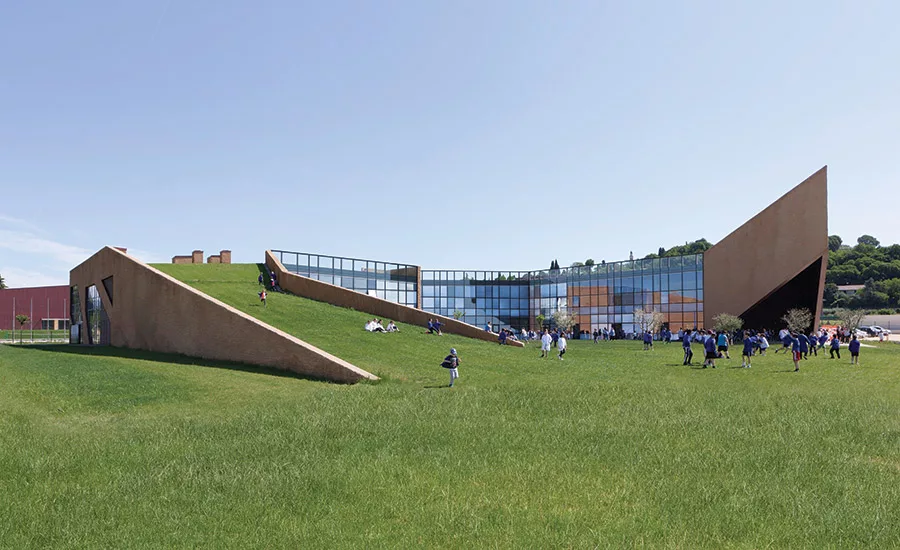
The school’s coiling form originates from a grassy ramp that leads to a green roof and terminates with a prowlike volume that functions as a canopy. The building embraces a large courtyard at its center, to which ground-floor classrooms have direct access.
Photo © Paolo Riolzi
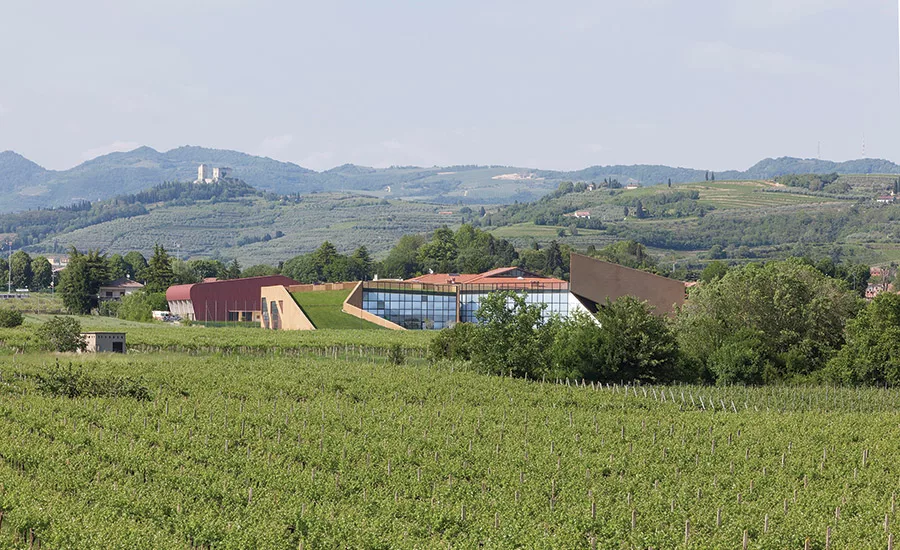
The building emerges from the rolling topography and surrounding vineyards.
Photo © Paolo Riolzi

The green roof and ramp is a favorite play space.
Photo © Paolo Riolzi
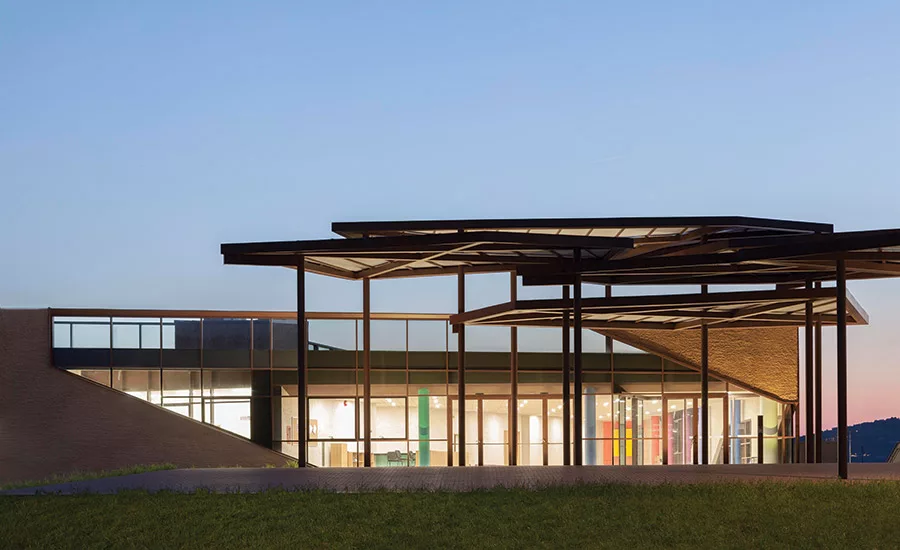
A steel and polycarbonate canopy leads to the main entry.
Photo © Paolo Riolzi
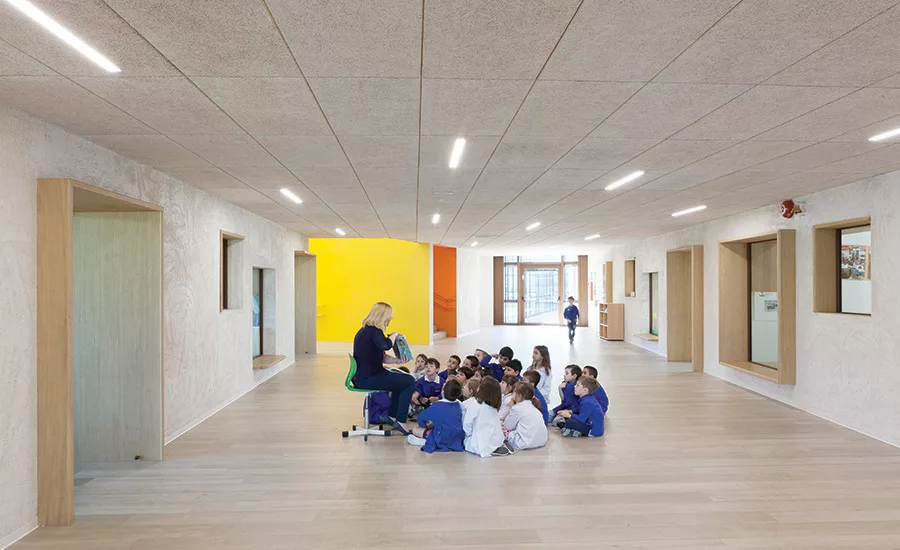
Generous corridors serve as flexible learning spaces.
Photo © Paolo Riolzi
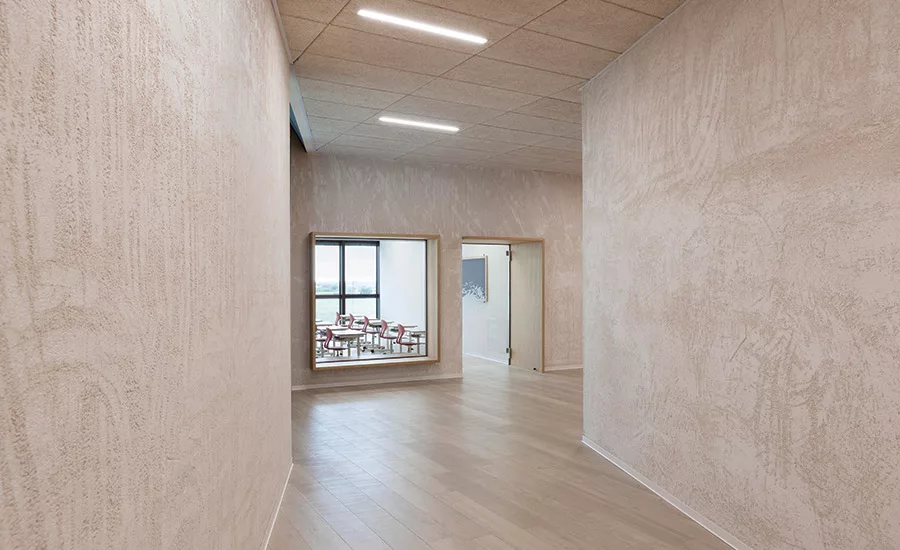
Hallways narrow and widen, leading to daylit classrooms.
Photo © Paolo Riolzi
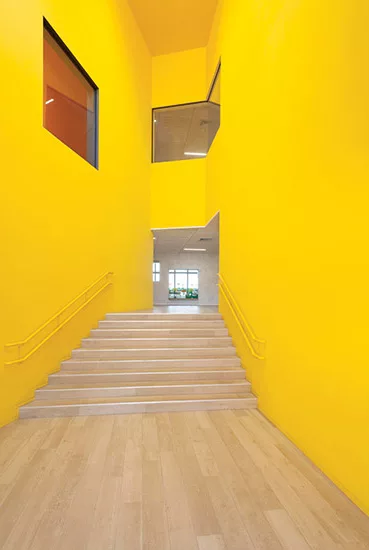
Vibrant colors mark vertical circulation.
Photo © Paolo Riolzi
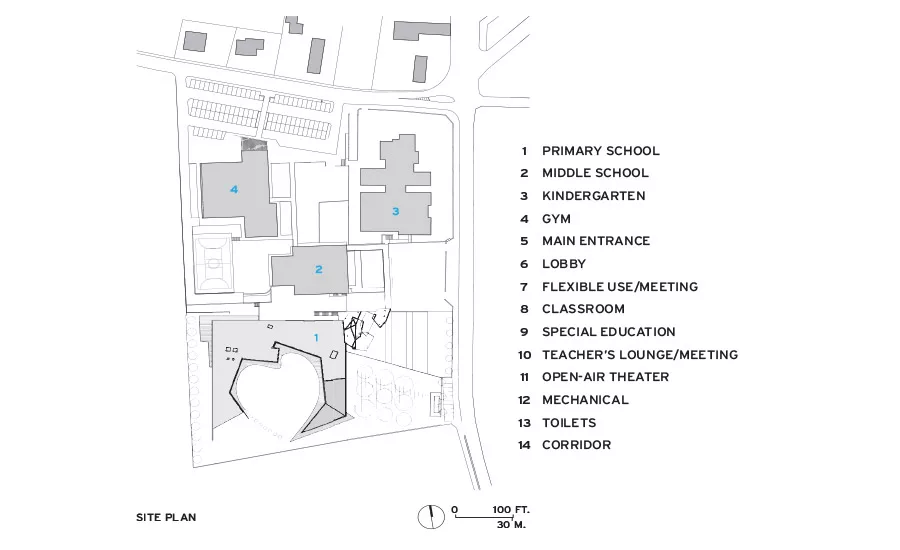
Image courtesy Claudio Lucchin & Architetti Associati
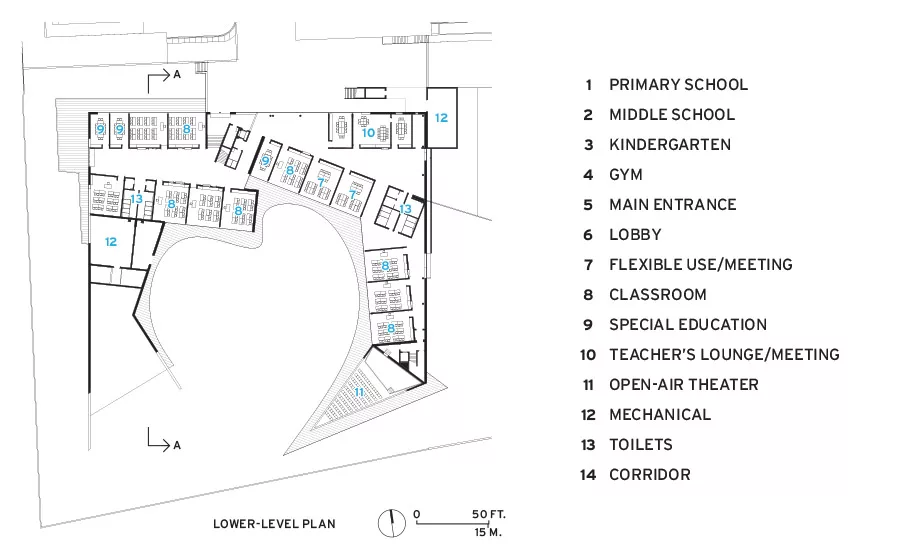
Image courtesy Claudio Lucchin & Architetti Associati
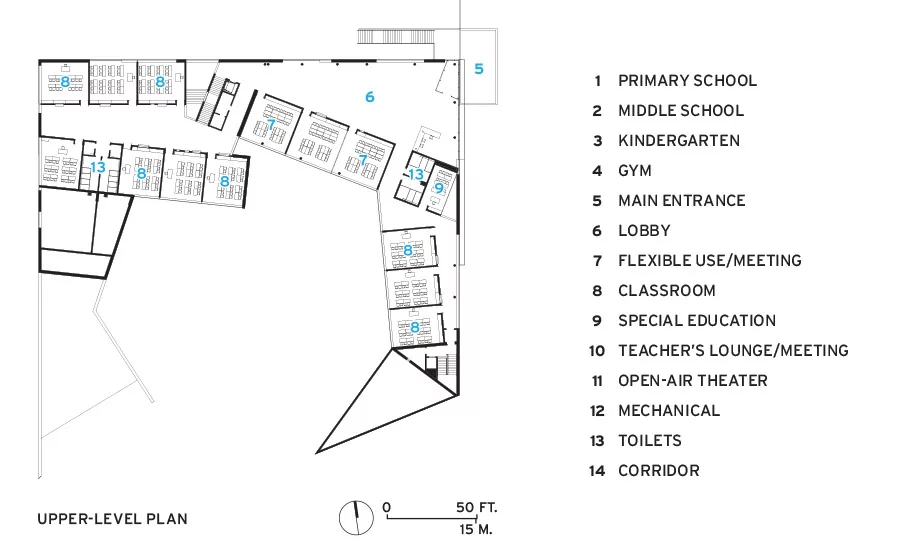
Image courtesy Claudio Lucchin & Architetti Associati
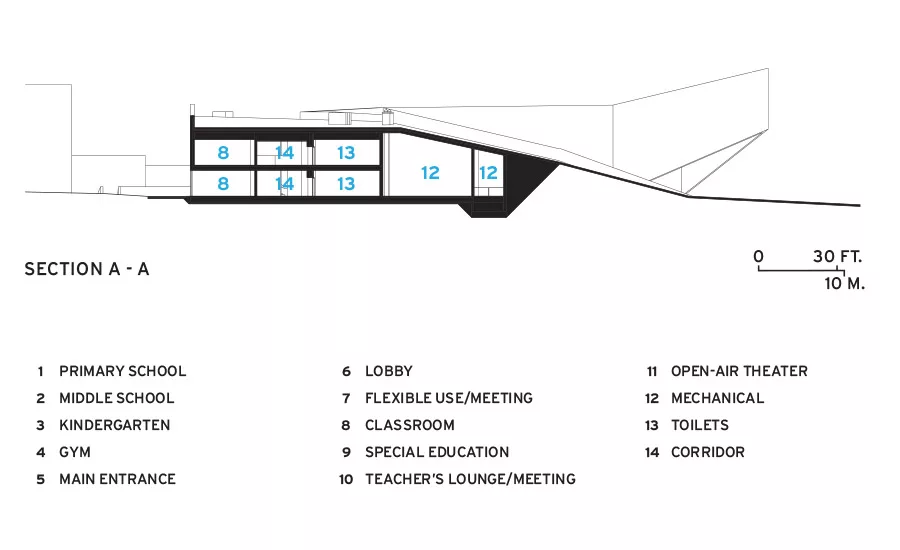
Image courtesy Claudio Lucchin & Architetti Associati
Architects & Firms
Colognola ai Colli, half an hour east of Verona, Italy, is a quiet, conservative-minded industrial and farming village of 8,700. So, when architect Claudio Lucchin presented his design for a new primary school here that bucked tradition, it raised some eyebrows. “Please, can you build me a normal school?” the architect recalls the then-mayor imploring upon seeing his scheme and its unorthodox form and fenestration. “This one is too weird.” But Lucchin is not interested in bowing to conformity, especially where education is involved. “When you do banal, it kills any form of curiosity or creativity,” he says. “For me, it is important to make spaces with possibility.”
Additional Content:
Jump to credits & specifications
Since founding his firm in 2004 in his native Bolzano, the capital of the country’s South Tyrol province, Lucchin has designed a wide array of public buildings, including numerous schools, such as the subterranean Hannah Arendt academy in his hometown. In that context, Lucchin dug down to sink the school into its dense urban lot; the Scuola Colognola ai Colli (“of the hills”), on the other hand, which sits amid expansive vineyards with the foothills of the Alps beyond, rises from the earth. In its differentness, the building announces an evolving pedagogy. “Rather than the pupils’ having to fit what a school offers,” says Lucchin, “schools now have to accommodate the children and the diverse experiences they bring.”
The new primary school replaces an outdated one from the ’80s, which did not meet seismic standards, and which was part of a dowdy campus that also includes a kindergarten, middle school, and sports facility, all built over the last few decades. Against its rolling backdrop (and next to the old school, which was later demolished), Lucchin conceived the 26,000-square-foot building as a hill peeking up through the Garganega vines and fruit trees. The architect says that, whenever he gets a commission, he visits the local school and cemetery, to better understand the community. Colognola’s graveyard sits above the village, a squared-C-shaped mausoleum embracing rows of tombstones between its arms. Taking cues from this structure, Lucchin envisioned a similar form—one that both protects and connects—with one arm of the C as a grassy ramp that travels from the ground up to a green roof. The gentle slope and roof serve as a play area and a lookout to the pastoral landscape, historic village, and the courtyard below. Such expansive open spaces are, not surprisingly, a highlight for the children. “Our favorite parts are the garden, the roof, and the large corridors where we can play, especially in winter when we go out less,” says third-grader Asia. The reinforced-concrete-frame building continues its circular path on an upward trajectory that terminates in a somewhat awkward prow pointing to the sky—a formal folly with no program inside but which creates a sheltered stage area below for outdoor performances or events.
Though in the Veneto, the building was designed according to South Tyrol’s stringent CasaClima energy-efficiency program. This made it possible to attain an A4 classification—the highest designation—under the national APE energy-certification rating system, for its high performance in terms of thermal insulation and energy efficiency. Beneath the green roof (which also supports a PV display), a super-tight envelope is composed of 8 inches of concrete with 8 inches of mineral-wool insulation. A deliberately chunky top layer of spray stucco—tinted to give the impression of the soil lifting from the ground—resembles thick cake frosting. The building’s irregularly shaped windows are intended to recall the sky—“As you have a hill, you have clouds,” says Lucchin. They are triple paned, with one of the two inner chambers containing automated louvers, especially important since the floor-to-ceiling glass on the elevations fronting the courtyard is south-facing, to take advantage of the views as well as of the thermal heat gain that warms the building in the damp cold of winter. Overall, the exterior has a rough-and-ready finish, fitting for its rural context.
It is the interiors here that really sing. Entering the school, a broad triangular lobby—which doubles as an auditorium—draws you in. The building’s internal proportions—the compression and expansion from low, wide hallways into higher-ceilinged classrooms—have a calming, swaddling effect, as do the materials. The architects used oatmeal-colored cementitious wood-fiber acoustical panels on the ceilings and locally sourced ceramic tile with a wood-grain pattern on the floor (they had initially specified wood, but ceramic was more efficient for the radiant heating and cooling system). The walls are of a similar muted hue, left rough with just a scratch coat of plaster. The texture is a pleasing one against those of the surfaces below and above.
As you move through the building, the corridors crank and fluctuate in width, creating an element of surprise. Modestly proportioned classrooms and specialty rooms, flooded with abundant daylight, connect to the corridors via 4-foot-wide glass doors and large windows with deep oak frames. The sills serve as reading nooks or benches, expanding the classrooms out into the halls. Answering the demand to accommodate a variety of teaching approaches beyond row-and-column-style seating, the circulation spaces allow for flexible learning spaces. “I enjoy the large corridors,” says religion teacher Chiara Bonamini. “They are great for working in different ways—circles, small groups, for example—without the obstacle of tables.” On a recent visit, children spread out in a hallway for a yoga lesson. Outside a classroom, an instructor talked to a fidgety boy on a window bench while keeping an eye on the rest of the children inside. “Teachers like it that windows help when working in small gatherings,” notes school director Lorenza Dalla Tezza. Bonamini adds that at first she was concerned all the transparency would be distracting, but has come around. “Walking through the school, the teachers see what others are doing, and we get inspired,” she says.
Approval of this odd, though sensitively crafted building seems, finally, to have taken hold even among the top brass of this tradition- bound enclave. “Having something completely different makes people curious,” admits Claudio Carcereri De Prati, the new mayor. “And, through curiosity, they are enlightened.”
CreditsArchitect: Claudio Lucchin & Architetti Associati — Claudio Lucchin, project manager; Angelo Rinaldo, Daniela Varnier, Marco Mozzarelli, Roberto Gionta,
Engineering: Fabio Giannici (structural); BRN Engineering (m/e)
General contractor: MAK Costruzioni
Size: 26,000 square feet
Cost: $5.5 million
Completion date: May 2019
|
SpecificationsCurtain wall MA-COS
Moisture barrier Isolchini
Green roof Climagrün
Entrance canopy Caccaro Gastone
Elevators Schindler
Furnishings DMG Solution di Gebelin Manuel, Mobil Ferro di Rovigo |
Looking for a reprint of this article?
From high-res PDFs to custom plaques, order your copy today!