Two New Books on Architectural Theory
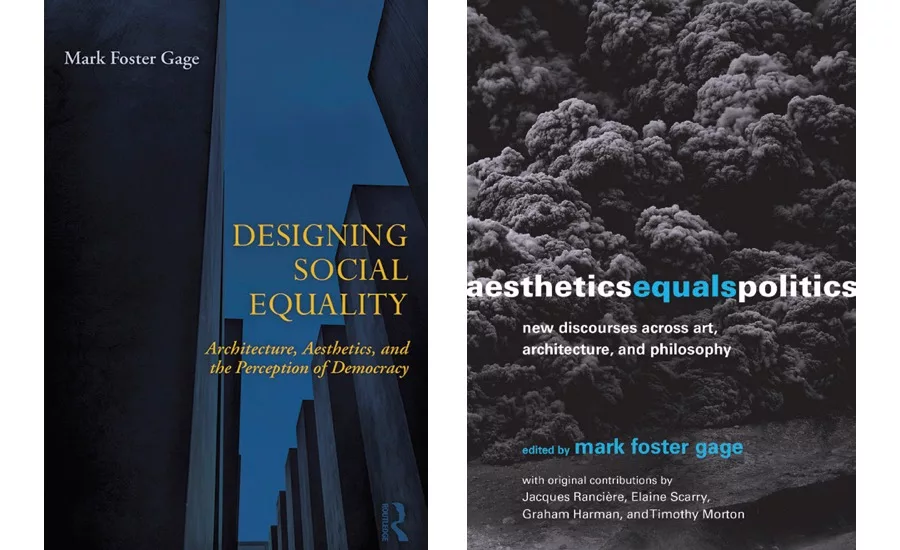
Designing Social Equality: Architecture, Aesthetics, and the Perception of Democracy, by Mark Foster Gage. Routledge, 131 pages, $44.95 (paper).
Aesthetics Equals Politics: New Discourses Across Art, Architecture, and Philosophy, edited by Mark Foster Gage. MIT Press, 317 pages, $34.95.
In the early 2000s, there was much questioning of the importance of theory and criticism for architectural practice—including Michael Speaks’s “Design Intelligence and the New Economy” in RECORD (January 2002). I wrote about this situation in 2004 (“Criticality and its Discontents” in Harvard Design Magazine) and argued that any new architectural approach would need a supporting body of theory to help develop design or it would “devolve into merely pragmatic and merely decorative work.”
Over the subsequent years, theoretical issues were discussed in academic conferences and publications, but things seemed generally quiet on the philosophical front. Now, with two books by Mark Foster Gage, a New York architect and associate professor at the Yale School of Architecture, both of which investigate aesthetics and politics in relation to social equality, the time might be right to bring this discussion to a professional audience.
The book Gage has written is a slender but ambitious treatise; the other is a companion volume of influential texts by notable contemporary thinkers such as the French philosopher Jacques Rancière, the American philosopher Graham Harman, and Elaine Scarry, a professor at Harvard who has written much on aesthetics and ethics. This compilation also includes shorter commentaries by Gage’s colleagues in the design field, including architect and Yale professor emerita Peggy Deamer and Cooper Union architecture professor Michael Young.
In Designing Social Equality, Gage seeks to erase the distinction between the social and the so-called “aesthetic” dimensions of architecture. He argues that aesthetics need not be understood as a question of beauty but can be defined as that which “encompasses all that surrounds us and our political relations with those surroundings.”
This broad definition of aesthetics is a claim that Rancière has made in his reference to the “distribution of the sensible.” Although he accepts aesthetics as a sensory experience, his emphasis is on the set of relations between that experience and its interpretation. According to Gage, Rancière’s “distribution of the sensible largely describes a condition of access or . . . a measure of distance between what a person can see, say, touch, hear, smell, and feel and to whom they may come in contact with.” Rancière’s notion of “aesthetic distances,” Gage notes, are those that occur between the observer and the object: in the foreground is that which is sensed; in the background is that which can be potentially sensed; and, finally, the third is that which is unknown and unknowable.
This reference to the unknowable or inaccessible opens the door to another major philosophical construct that has been garnering attention in academic architectural circles and that Gage has adopted—that of “object-oriented ontology,” (usually referred to as OOO), as conceived by Harman. His idea of the object is not a simple one, since it combines both what he calls “sensual” objects—ones that can readily be apprehended or “sensed” by a subject, and “real” ones that exist beyond the sensual, and are always withdrawn from human apprehension. In other words, there are architectural objects that indeed appear in the world as sensuous entities, as well as those that embody more mysterious features—and belong to this less accessible state that Harman calls the “real.” Harman teaches philosophy at SCI-Arc, where early initiates of his theories are David Ruy, chair of postgraduate programs at SCI-Arc (whose architecture office, Ruy Klein, is in New York), and Tom Wiscombe, SCI-Arc undergraduate program chair (who has a firm in Los Angeles).
In the early stages of Harman’s influence, the objects designed by his architectural followers of OOO indeed evoked considerable perceptual mystery. When they didn’t, as sometimes happened, they just looked self-consciously weird. (While Gage doesn’t include illustrations in his book, the reader can find an example by Wiscombe in Log 33.)
Looking for quick answers on architecture and design topics?
Try Ask RECORD, our new smart AI search tool.
Ask RECORD →
Nevertheless, it is through an appeal to this inaccessible real that Gage and those influenced by Harman want to reinvigorate architecture. To this reader, it is as though they are using Harman’s thinking as a sort of analog of Freud’s ideas about the human unconscious. Furthermore, OOO’s influence in certain architectural circles raises a number of questions. First of all, it has been an axiom of phenomenological philosophy from Edmund Husserl to Maurice Merleau-Ponty that an individual subject’s perception does not guarantee access to reality in itself. So Harman’s construct, within this philosophical tradition, is not as radical as it might seem. It is true that he polarizes the opposition between “sensual” objects—those readily accessible to immediate perception—and “real” ones, or the inaccessible, to a greater extent than traditional phenomenology would do. In the end, however, I am not sure that OOO offers much more to architecture than a traditional appeal to phenomenology from Husserl, Martin Heidegger, Merleau-Ponty, or Hannah Arendt would be able to do.
Harman’s approach links to Rancière’s in his conviction that the estrangement of the unknown makes all perceiving subjects equal because of that inaccessibility. Gage wants architects to “allude to the existence of deeper realities lurking below the surface” in their designs, rather than “distilling big singular ideas into reductively simplistic diagrams or metaphors” such as the current focus on “program” and “sustainability.” For this reason, he deplores the current professional and academic focus on program and sustainability as just such “big singular ideas.”
In addition to these issues is the one raised by Gage’s Yale colleague Deamer in her valuable, wary commentary in Aesthetics Equals Politics. Deamer gives short accounts there of a number of current intellectual and cultural tendencies that have flowed, one way or another, from OOO. And she does not fail to note that two of the more obviously political ones have diverged drastically from one another—one to a quite radical, more-or-less Marxist left, and the other to an extreme right-wing libertarianism. This problematic divergence among some in the band of followers of OOO, it seems to me, does not augur well for its future influence in the world.
Looking for a reprint of this article?
From high-res PDFs to custom plaques, order your copy today!