Architectural Record
search
cart
facebook twitter linkedin youtube
  • Sign In
  • Subscribe
  • Sign Out
  • My Account
Architectural Record
  • NEWS
    • Latest News
    • Awards
    • Interviews
    • Obituaries
    • Podcasts
      • Design:Ed Podcast
      • Sponsored Podcasts
  • OPINION
    • Book Reviews / Excerpts
    • Exhibition Reviews
    • Forum
  • EXCLUSIVES
    • Videos
    • Design Vanguard
    • Top 300 Firms
    • Sponsored Content
    • Sponsored eBooks
    • From the Archives
  • CONTINUING ED
    • Editorial Continuing Ed
    • CE Center
    • CE Academies
  • PROJECTS
    • Buildings By Type
    • Reuse & Renovation
    • Museums & Arts Centers
    • Colleges & Universities
    • Multifamily Housing
    • Interiors
    • Lighting
    • Kitchen & Bath
  • HOUSES
    • Record Houses
    • House of the Month
    • Featured Houses
  • PRODUCTS
    • Products by Category
    • Record Products of the Year
    • Latest Products
  • EVENTS
    • Dates & Events
    • Record on the Road
    • Innovation Conference
    • Sustainability in Practice
    • Women In Architecture
    • Webinars
    • Ad Excellence Awards
    • Submit an Event
  • CONNECT
    • Ask RECORD AI
    • Newsletters
    • Contact
    • Advertise
    • Editorial Calendar
    • Store
    • Customer Service
  • SUBMIT
    • Submission Guidelines
    • RECORD Competitions
  • MAGAZINE
    • Subscribe
    • My Account
    • Digital Edition
    • Current Issue
    • Firm Pass
    • Historic Archive
Architecture NewsOpinion

A New Volume Provides Food for Thought on Metabolist Architecture in Japan

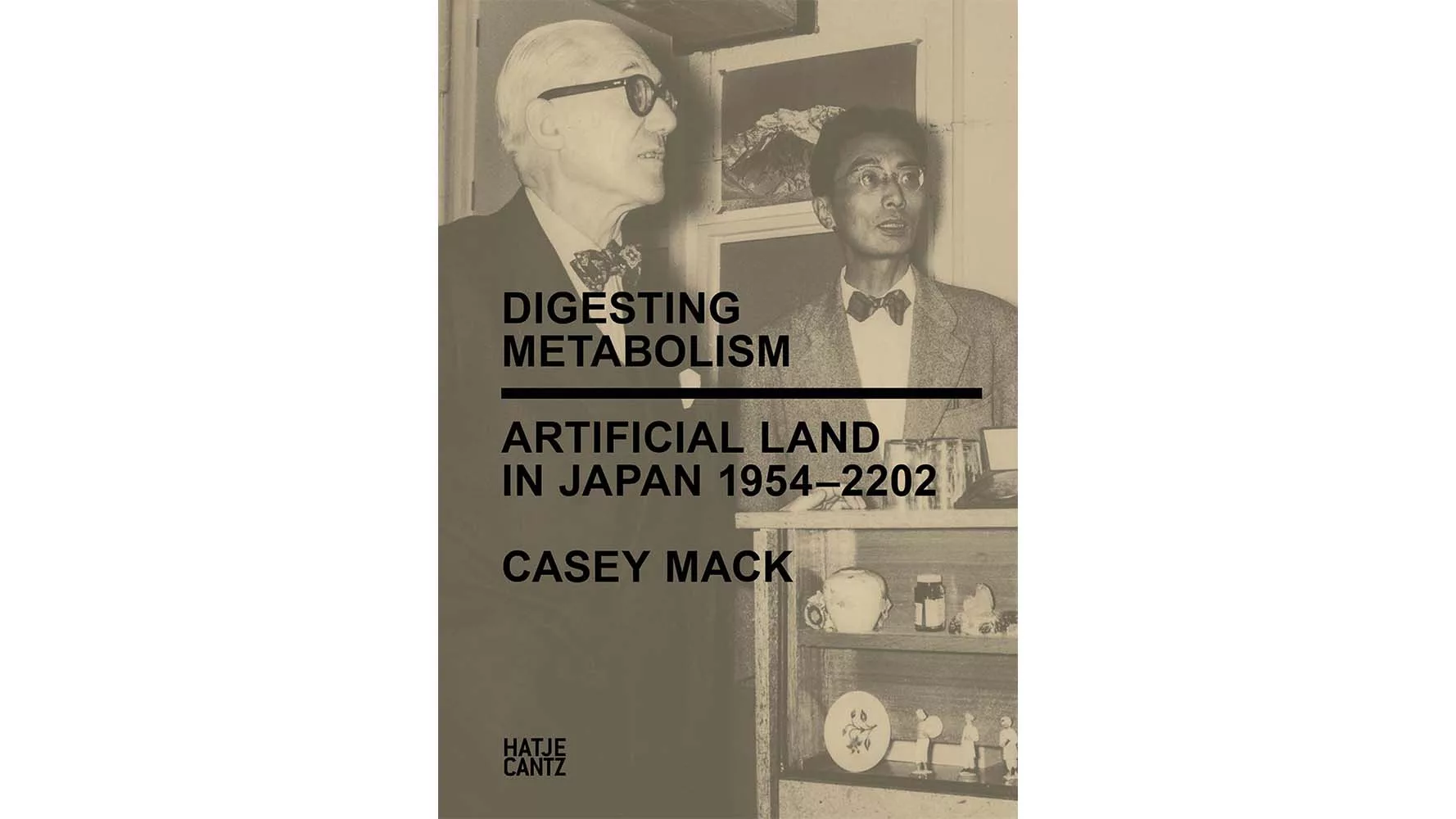
Review: Digesting Metabolism: Artificial Land in Japan 1954–2202 by Casey Mack
By Naomi Pollock, FAIA
Digesting Metabolism

Digesting Metabolism: Artificial Land in Japan 1954–2202, by Casey Mack. Hatje Cantz, 368 pages, $50.

January 30, 2023

Digesting Metabolism: Artificial Land in Japan 1954–2202 is one of the better books about works of Japanese architecture that you have probably never heard of. But that’s exactly why you should read it. This cogent and well-illustrated volume was inspired by author-architect Casey Mack’s experience of Hong Kong, whose vernacular facades he describes as “self-organized into patterns of air conditioners, hanging laundry, and DIY balconies.” That observation led to this book, which features housing projects in Japan that grew directly, or indirectly, from the concept of artificial land promoted by the Metabolism architectural movement.

In contrast to Western Modernism’s goal of swapping the old for the new, Metabolism, launched in postwar Japan, promoted “replacement as an ongoing process.” Though it was “a movement largely famous for what it failed to build,” the author posits that a fundamental Metabolist concept—the creation of artificial land —lived on and has value today. Unlike landfill, artificial land was a way to expand the country’s limited landmass by stacking layers of buildable space supported by a mega-framework. Individual homes or shops could be built within that and, later on, replaced.

The author traces the pre-Metabolist origins of artificial land back to the Arcade des Anglais in Algiers, built in the 1860s, where local fishermen constructed makeshift homes within its soaring waterfront arches. This blend of engineering and human resourcefulness made an impression on Le Corbusier, who, in his seminal book, The Radiant City, included his sketches of the structure. From there, the ideas reached the Japanese designers who apprenticed with Le Corbusier, including Takamasa Yoshizaka, who had joined the Swiss architect’s Paris studio in 1950 for two years.

In part, Yoshizaka’s French sojourn stemmed from Japan’s decimation during World War II. Returning to Japan in 1945 after overseas army service, he found an acute housing shortage—an estimated 4.2 million new homes were needed. Many of the homeless quickly built ad hoc shelters, including Yoshizaka, on the site of his parents’ destroyed house. For the Japanese government, large-scale rebuilding was a chance to establish standards for the “minimum dwelling.” But in Le Corbusier’s representation of artificial land in The Radiant City, Yoshizaka saw a model for blending the government’s standardization with the population’s innate proclivity for individualization. Though predating Metabolism, Yoshizaka’s vision was an architecture that could grow and evolve alongside its occupants—an idea he first tested out in the home he built for himself in 1954.

Mack chronicles a series of housing projects built on the artificial-land premise. These “long tail” works were mainly designed after the decline of Metabolism but build on the movement’s concept of artificial land, culminating with the author’s speculation for housing in 2202. Some are the products of designers, others of zenicon, Japan’s large construction companies. One notable example is the Stratiform Structure Module devised by the Metabolist Kiyonori Kikutake, who began working with the Japanese government in 1973 on an infrastructure system that would enable “a suburban lifestyle without the painful commuting.” Incorporating unused airspace, the project called for an enormous A-frame that straddled train tracks or highways while providing the scaffolding for layers of artificial land suitable for home development. Though thought-provoking, the Stratiform model was never realized except for a full-scale prototype visited and discussed by Mack.

One of the most impressive of the 11 works profiled in the book is the Sawada Mansion. The six-story complex, an ongoing project begun in 1971 in the city of Kochi, consists of a concrete skeleton holding apartments and small businesses built by “a self-taught builder couple.” Tailored to individual preferences, the units are all connected to street level by a ramp sufficient for cars and people, which yields “a ground-floor experience” for everyone.

In their improvisational homeliness, many of the projects profiled pale in comparison to the elegant Japanese buildings gracing the pages of architectural magazines and monographs today. But where social engagement, ecology, and technical ingenuity are concerned, this book offers a wealth of information. Its promotion of “housing that stimulates rather than dictates” can be an inspiration everywhere.

Looking for quick answers on architecture and design topics?
Try Ask RECORD, our new smart AI search tool.
Ask RECORD →

KEYWORDS: Book Reviews / Excerpts Japan modernism

Share This Story

Looking for a reprint of this article?
From high-res PDFs to custom plaques, order your copy today!

Contributing Editor Naomi Pollock, FAIA, is the author of Japanese Design Since 1945: A Complete Sourcebook and the forthcoming Vanishing Japan: Modern Architecture Gone But Not Forgotten,

Post a comment to this article

Report Abusive Comment

Subscription Center
  • Create an Account
  • Start a Subscription
  • Manage My Account
  • Sign Up for Newsletters
  • Visit Customer Service
  • Update Preferences

More Videos

Sponsored Content

Sponsored Content is a special paid section where industry companies provide high quality, objective, non-commercial content around topics of interest to the Architectural Record audience. All Sponsored Content is supplied by the advertising company and any opinions expressed in this article are those of the author and not necessarily reflect the views of Architectural Record or its parent company, BNP Media. Interested in participating in our Sponsored Content section? Contact your local rep!

close
  • cold storage facility
    Sponsored byCarlisle SynTec Systems

    How Architects Can Design More Continuous Cold Storage Envelopes

  • TAMLYN XtremeTrim Exterior Trim
    Sponsored byTamlyn

    Designing Cleaner Panel Facades: Why Exterior Trim Details Matter

  • Building with Vapor Barriers
    Sponsored byReef Industries, Inc.

    Vapor Barriers Help Control Moisture in Tighter Building Designs

DESIGN:ED Podcast
Listen to Architectural Record’s DESIGN:ED Podcast

Events

June 23, 2026

Enhancing Fire Resistance with Advanced PVC Solutions

Credits: 1 AIA LU/HSW; 1 AIBD P-CE; 0.1 ICC CEU; 1 IIBEC CEH

Evaluate advanced PVC solutions that improve fire resistance, support WUI compliance, and enhance resilience in residential and commercial building design.

June 25, 2026

Designing Glass Railing Systems that Enhance Aesthetics and Meet Code

Credits: 1 AIA LU/HSW; 1 AIBD P-CE; 0.1 ICC CEU

Upon course completion, participants will possess a deeper understanding of glass railings to help ensure that safety, aesthetic, and performance objectives are achieved.

View All Submit An Event

Products

2026 Architect's Square Foot Costbook

2026 Architect's Square Foot Costbook

See More Products

Popular Stories

Lorcan O' Herilhy

California Architect Lorcan O’Herlihy Has Died, Age 66

Obama Presidential Center, Chicago

The Obama Presidential Center Opens on Chicago’s South Side

Spoonbill Ranch

Johnsen Schmaling Architects Integrates Spoonbill Ranch into a Pristine Landscape

Image of Bruce Springsteen Center for American Music

The CookFox-designed Bruce Springsteen Center for American Music Opens in New Jersey

Three Courtyards House

Design Vanguard 2026: Balsa Crosetto Piazzi

Enhancing Fire Resistance with Advanced PVC Solutions - Free Webinar - June 23, 2026

Related Articles

  • Food for Thought

    See More
  • Made in Japan: 100 New Products

    See More

Related Products

See More Products
  • image7.jpg

    Contemporary Architecture in China Towards A Critical Pragmatism

See More Products
×

The latest news and information

#1 Source for Architectural Design, News and Products

SUBSCRIBE
  • RESOURCES
    • Advertise
    • Contact Us
    • Submit
    • Store
  • ACCOUNT CENTER
    • Create an Account
    • Start a Subscription
    • Manage My Account
    • Sign Up for Newsletters
    • Visit Customer Service
    • Update Preferences
  • PRIVACY
    • PRIVACY POLICY
    • TERMS & CONDITIONS
    • DO NOT SELL MY PERSONAL INFORMATION
    • PRIVACY REQUEST
    • ACCESSIBILITY
  • SERVICES
    • Marketing Services
    • Reprints
    • Market Research
    • List Rental
    • Survey/Respondent Access
  • STAY CONNECTED
    • Linkedin
    • Facebook
    • Instagram
    • YouTube
    • X (Twitter)

Copyright ©2026. All Rights Reserved BNP Media, Inc. and BNP Media II, LLC.

Design, CMS, Hosting & Web Development :: ePublishing