RECORD Forum
The Destructive Rebirth of the Pyramid of Tirana

The transformed Pyramid of Tirana by MVRDV. Photo © Ossip van Duivenbode
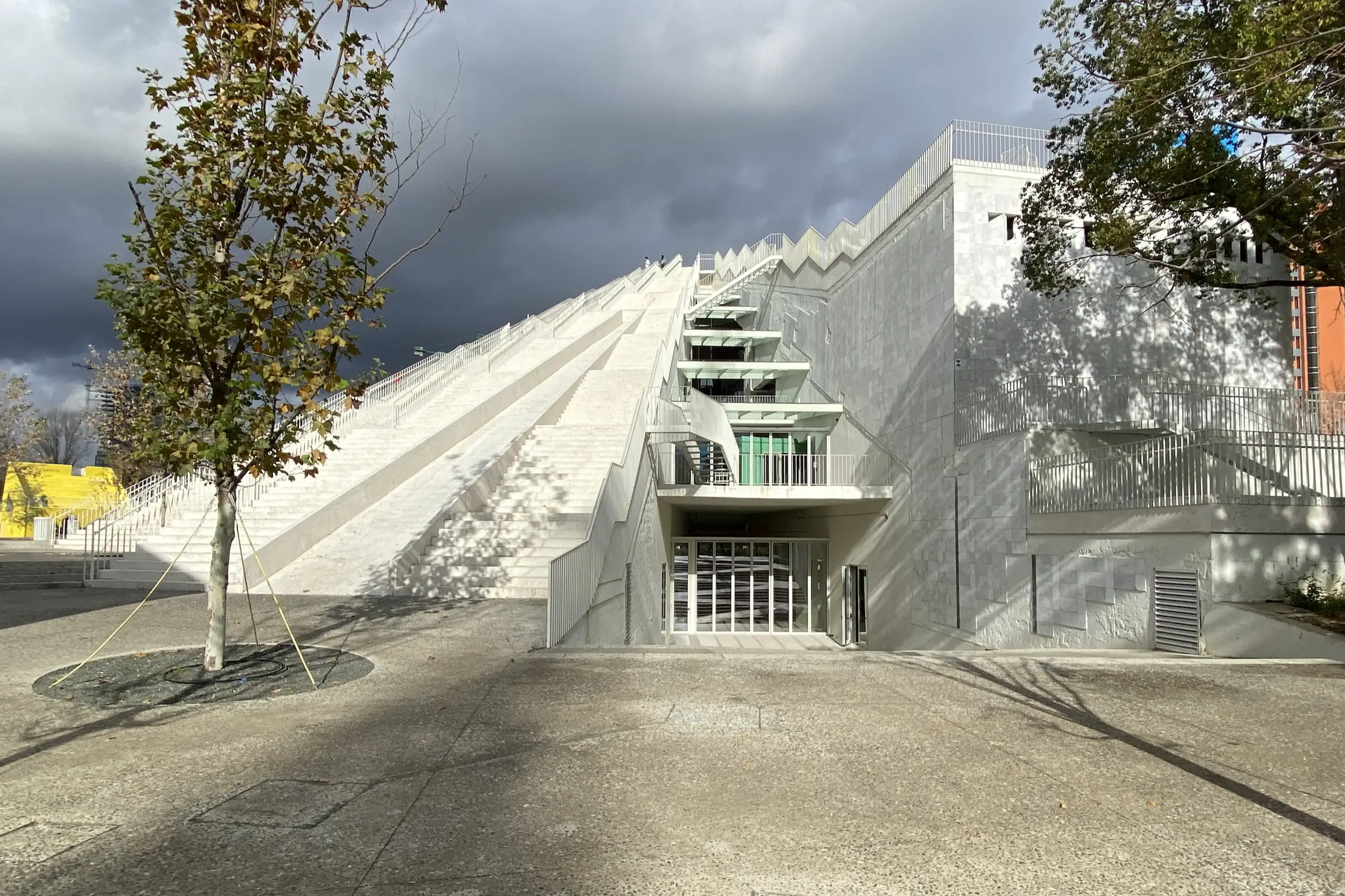
MVRDV’s transformation of the Pyramid of Tirana into a digital hub was inaugurated on the occasion of the Western Balkan Summit on October 16—not coincidentally, the birthday of longtime Albanian dictator Enver Hoxha, for whom the Pyramid was built as a museum in 1988. The symbolism is clear: the renovated Pyramid becomes a pivot through which Albania irreversibly leaves its past and orients itself toward a progressive European future. Such a message has also been highlighted in the press: “The revamped Pyramid demonstrates that structures can be maintained, but their significance transformed. In between the rhetorical symbolism of the old regime and the new one, the re-inhabited memorial acknowledges other histories, other meanings,” wrote Tim Abrahams in RECORD in December. The main features of the project are the new colored boxes, scattered throughout the building, stairs added to the existing sloped piers, and the horizontal elements between them. As MVRDV partner Winy Maas put it to Dezeen, “the structure is completely open as a ruin in the park, and all these boxes are ‘squatting’ in and around the structure.”
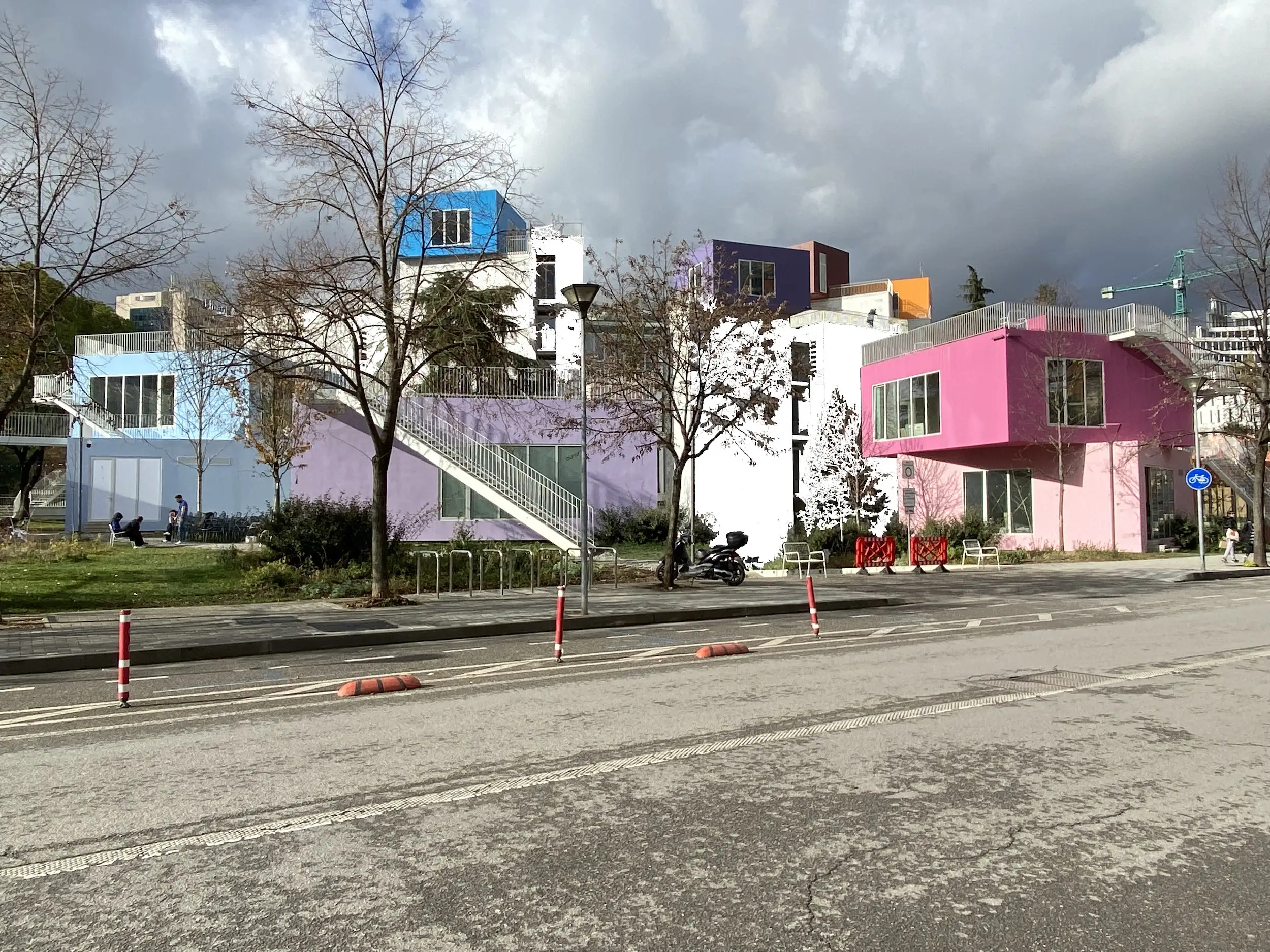
Such “revamping” of the Pyramid, however, overshoots the threshold of renovation to the point of erasure, as the Pyramid becomes neither an integral whole nor a ruin, but rather a prop for the new elements that are understood to signify progress, like the colored boxes. Of course, the Pyramid is still extant insofar as its structure was not demolished. But while the structure is maintained, the structure of its form is not. This can be quickly demonstrated in Photoshop by erasing the visible vestiges of the existing building: so little remains of the original as to incapacitate it almost entirely. More than a decade has passed since a debate erupted over a proposal to demolish the Pyramid of Tirana and replace it with a new Albanian Parliament to be designed by Coop Himmelb(l)au. That proposal ultimately did not go forward, yet, it was not until its very “rebirth” into a digital hub that the Pyramid was finally destroyed.

1
2
The east side of the renovated Pyramid, December 2023 (1); altered image with the remaining existing surfaces erased in Photoshop (2). Photos by Skender Luarasi
It is not a matter of whether the former Pyramid was “better” or “worse” than what MVRDV has designed, but rather of the conceptual dilemma of interventions in existing buildings—namely, where to draw the line between transformation and erasure in adaptive reuse. The practice of adaptive reuse too often becomes a mere alibi for interventions that, in the name of “rehabilitation,” fundamentally alter existing buildings. What is the point in keeping a building if its form is defrauded? An intervention is not preservation or adaptive reuse simply by virtue of not demolishing the whole building or by keeping some part of it—unless, that is, the form of the existing building remains in the game, as it were, as an integral part of the transformed whole.
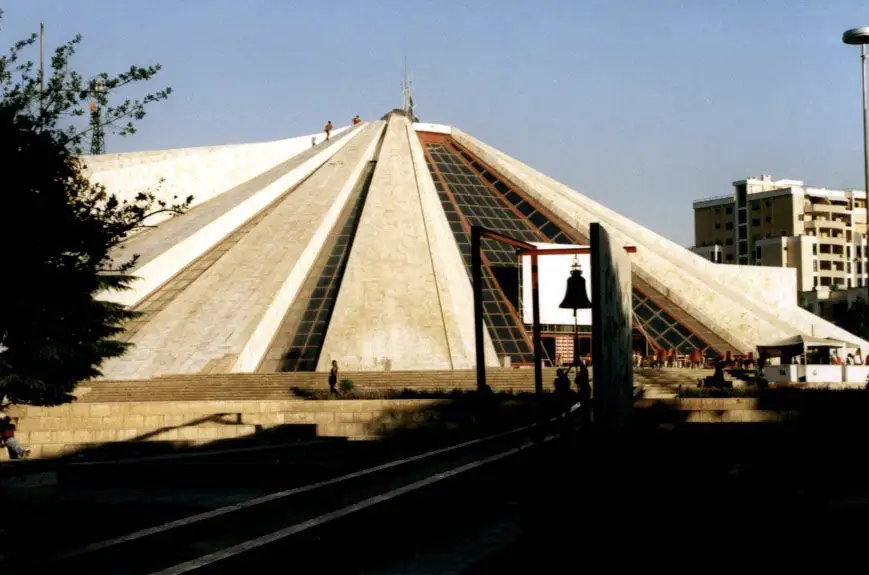
View of the former Pyramid. Photo by Stefan Kühn, Creative Commons
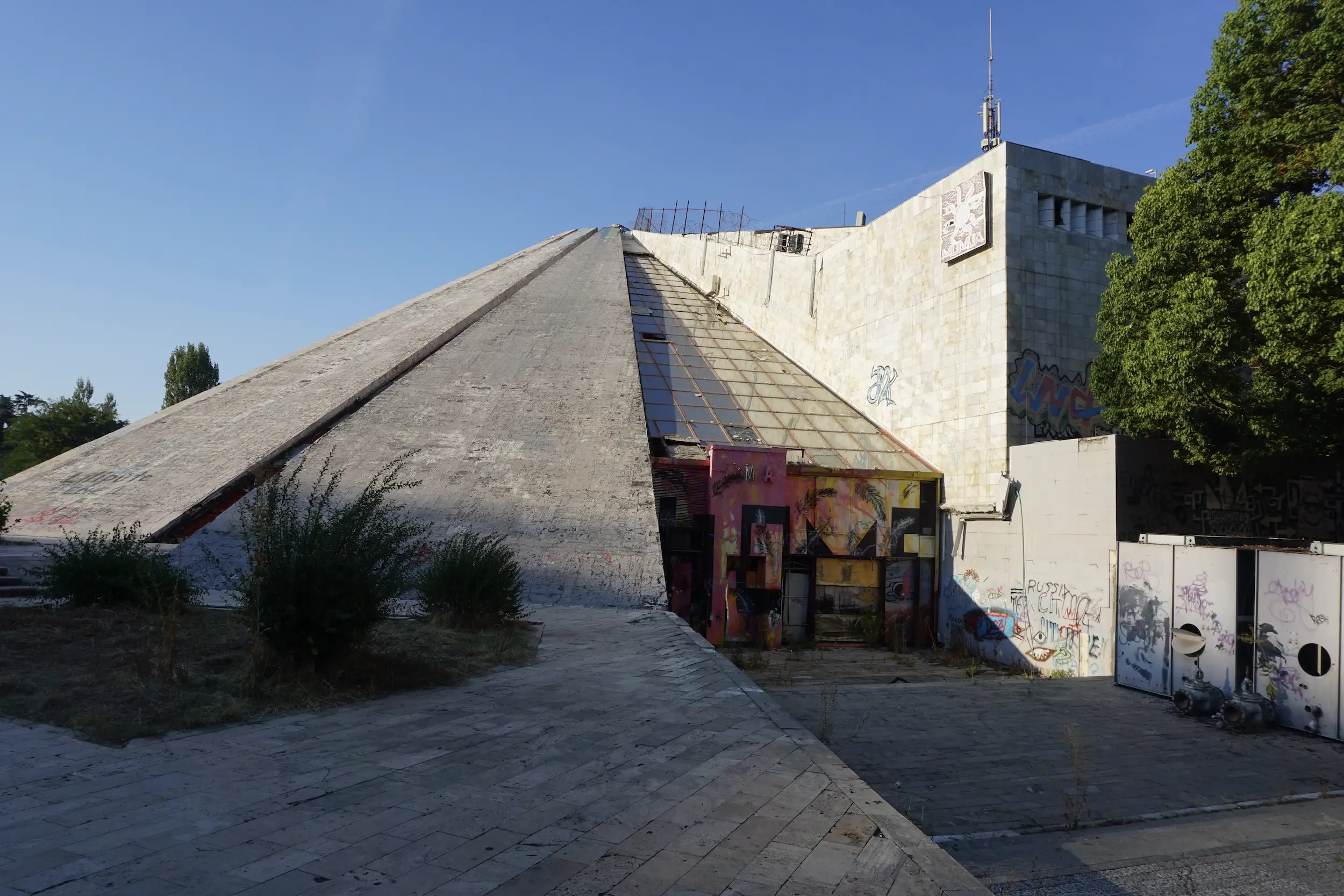
The Pyramid-Museum, as it was formerly known, was designed by Klement Kolaneci, Pranvera Hoxha, Pirro Vaso and Vladimir Bregu, and was finished in 1988, just three years before the communist system fell. When it was built, it radiated an aura of eternal stability that contrasted not only with the country’s economic poverty but also with an unconscious sense of uncertainty over the imminent dissolution of the regime. Not long afterward, the winds of change blew away the light plexiglass star at its top together with the heavy statue of Hoxha in the lobby. The building changed many programs while it began to physically deteriorate. But as its marble tiles started to fall and its glass roofs started to leak, the Pyramid acquired a special status in the cognitive map of post-communist Tirana: it became the Pyramid, a place where people passed through, met, or sat on the steps outside, a non-directional void in a frenzied, ever-changing urban landscape. Such serendipitous referentiality emerged as the Pyramid, stripped of its intended meaning and poorly maintained, retained just one original aspect: its form.

View of the interior of the renovated Pyramid. Photo by Skender Luarasi
The form of the Pyramid was thus separated from its functioning as a sign. As the art historian Henri Focillon put it in his 1942 book The Life of Forms in Art, unlike a sign that “signifies an object, form signifies only itself.” In Focillon’s terms, a sign is only the conceptual content of a form, the “graph of an activity,” just as a “seismograph” is the “graph of an earthquake.” Form, on the other hand, has an irreducible density that creates new meaning beyond simply referring to an object outside itself. Indeed, the Pyramid itself possessed a formal complexity that belied the simple geometrical sign implied by its name. Rather, it consisted of a eurhythmic composition of solids and voids around an interior void, with only the piers on the front appearing pyramid-like; the others gradually turning into cubic volumes on the side and back. As a result, the building, unlike a true pyramid, had just a single axis of symmetry.
MVRDV’s rash of colored boxes effectively anesthetizes the compositional density of the Pyramid by ignoring its eurhythmic enclosure and by squatting in the interior void. If there ever were a spatial symbol of democracy, it would be the empty center, or rather the conscious act of not occupying it, of letting it be a void. It is almost as if the design were driven by a phobia of the existing form, cloaked in a false deference to what MVRDV architects and others see as its Brutalist style.
3
4
The former Pyramid of Tirana (3); the south side of the renovated Pyramid, December 2023 (4). Photos by Andrew Milligan sumo, Creative Commons (3); Skender Luarasi (4).
There were two better alternatives: first, to demolish the Pyramid entirely with the intention of doing away with its original intended symbolism and replacing it with another building, or, better, with no building at all—a violent but more honest choice than covering it with a colony of colored boxes. The second and better option would have been to preserve the Pyramid to accommodate different programs—perhaps including the digital hub it now houses—but renovating it in such a way as to reveal and engage its formal specificity. Such a choice would trigger a wide spectrum of preservation and adaptive reuse methodologies. A conservative preservation would have meant preserving what the art critic and historian Cesare Brandi calls the “first” or “author’s time”—here involving the piers and interior void, and the “second time”—the very process of their being emptied of the original iconography. The Pyramid could have also been transformed through non-conservative interventions à la the artist Gordon Matta Clark. What makes Matta Clark’s work a valuable precedent is that in it, existing structures are neither hidden nor transformed but literally cut into in such a way that their interiority erupts outward.
Looking for quick answers on architecture and design topics?
Try Ask RECORD, our new smart AI search tool.
Ask RECORD →
If the colored boxes commit artistic and historic erasure by incapacitating the eurhythmic form of the building, the stairs on the sloped piers commit what Brandi calls “artistic and historical forgery” by coinciding exactly with the form of the piers to the point of appearing as if they have always been there. There is nothing wrong with providing access to the top, of course, but this could have been accomplished by other means. Even adding stairs on select piers while leaving others untouched would have enabled visitors to distinguish between the original piers and the transformed ones.
By critically and sensitively engaging the existing form, the renovation of the Pyramid could have enabled a mnemonic function that would recall the shedding of the building’s original symbolism and thus signify the Albanian people’s post-communist journey toward a better life. Instead, the Pyramid became just another decorated real estate shed of the new urban “archipelagos” of Tirana, thrown onto the no man’s land of a city determined to erase its past and its cultural heritage in the name of “progress,” to the point of no return.
Looking for a reprint of this article?
From high-res PDFs to custom plaques, order your copy today!