Continuing Education: High-Performance Landscapes
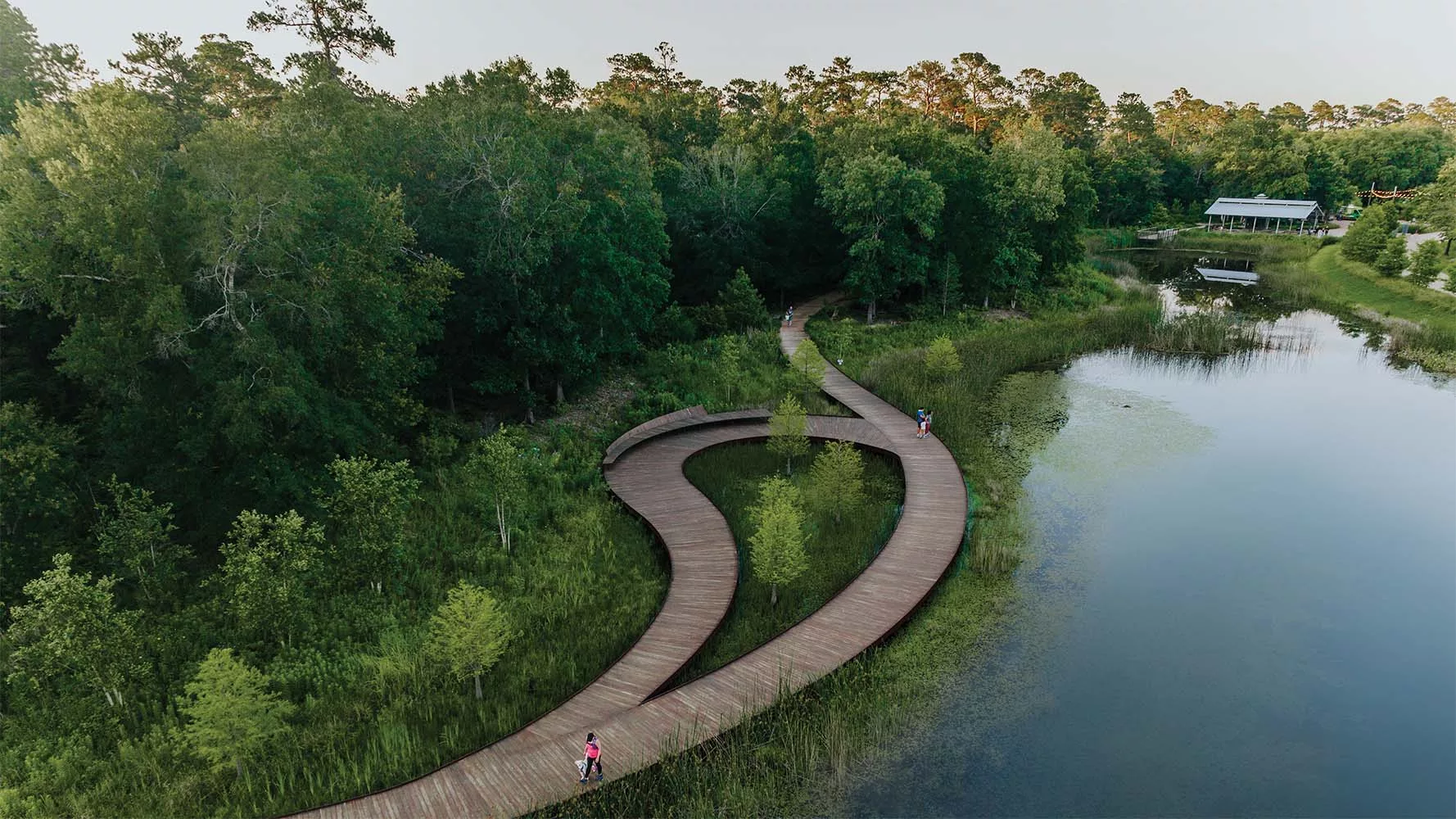
By now, most architects are aware that buildings are responsible for a huge chunk of humanity’s contribution to global warming. They have probably heard that the built environment contributes more than 40 percent of CO2 emitted into the atmosphere every year. However, they may not have considered the role of that part of the built environment outside buildings. Landscapes, like buildings, can generate emissions: operational ones, including those from maintenance equipment and use of chemical fertilizers, as well as embodied emissions, from the extraction, transport, and manufacture of materials.
Landscapes, however, also represent an immense opportunity, since their trees, plantings, and soils extract carbon from the atmosphere, sinking it into their biomass. And those who design these landscapes are uniquely positioned to capitalize on this capability. “We are the only design profession that works with living systems,” says Sarah Fitzgerald, climate and sustainability lead at landscape architecture firm SWA. She is one of the coauthors of the Climate Action Plan put forward by the American Society of Landscape Architects. The plan is a multipronged set of goals and initiatives, with the first on the list being to attain zero emissions and double carbon sequestration by 2040.
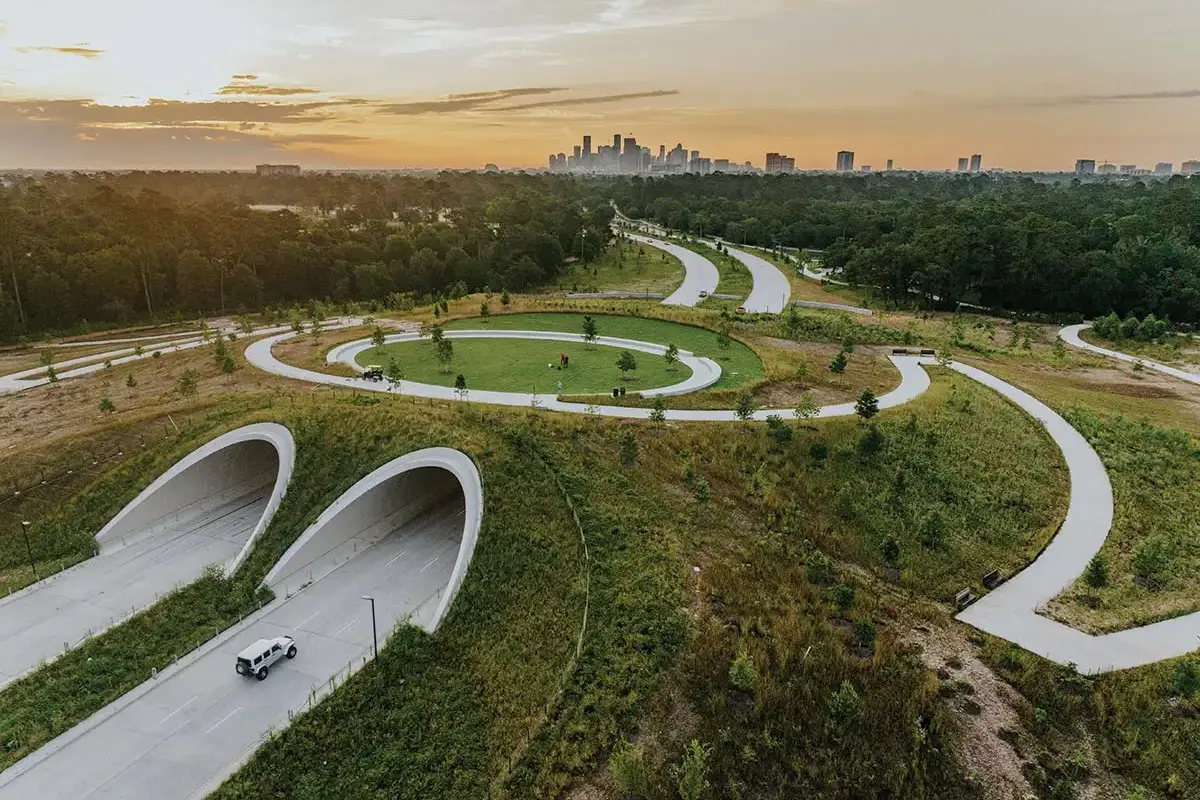
What does it mean to look at landscape design through the lens of carbon? For landscape architect Thomas Woltz, senior principal and owner of Nelson Byrd Woltz, it means starting projects with deep research into the biological health of the site and intense analysis. He points to his firm’s long-range master plan for Houston’s Memorial Park, whose ecosystems had suffered the effects of drought and hurricanes. Among the plan’s recent phases is a “land bridge,” completed last year, that spans Memorial Drive, a busy traffic artery that had long bisected the 1,500-acre urban park that encompasses wooded areas, trails, picnic areas, and sports and cultural facilities.
1
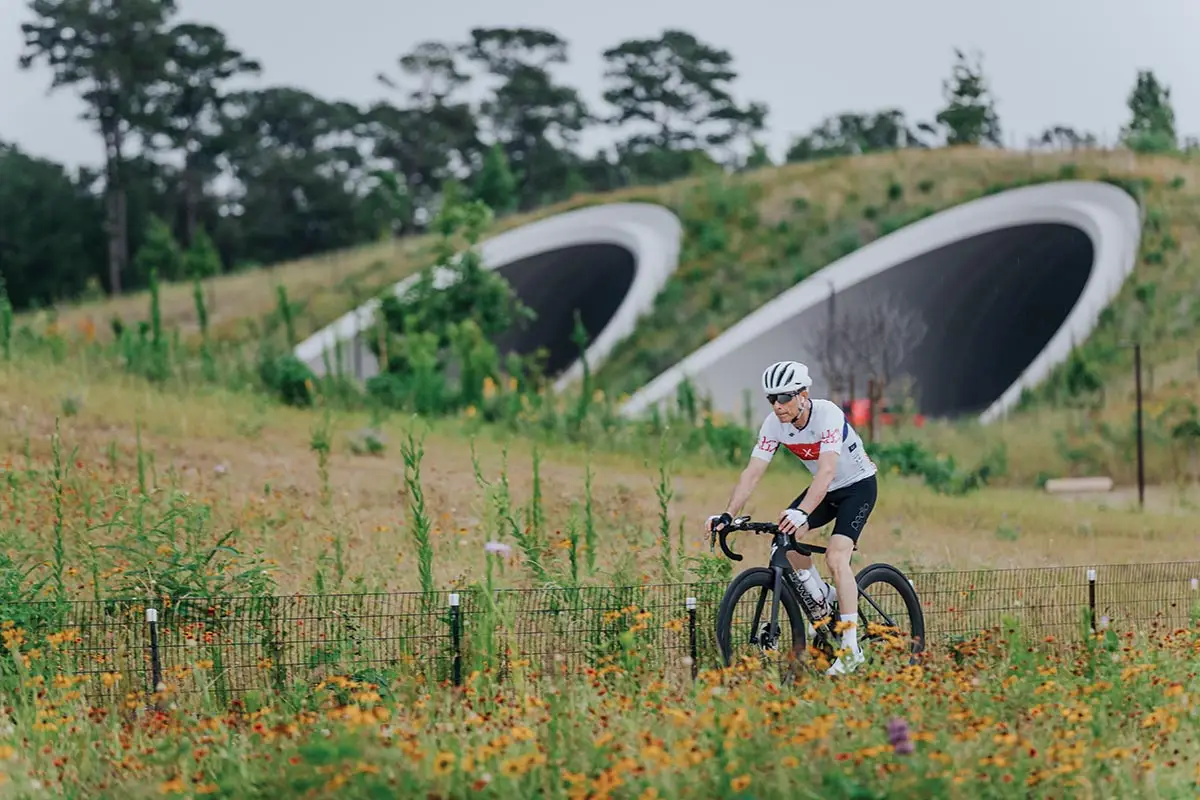
The new land bridge at Memorial Park in Houston (1 & 2) allows for safe crossing of a busy road by people and wildlife and reintroduces native prairie grasses. Photos © Nick Hubbard, click to enlarge.
2
In addition to providing a safe crossing for people—as well as wildlife—the land bridge restores 45 acres of native prairie, reintroducing Gulf Coast grasses and flowering forbs. Along with the earlier completed Eastern Glades, the project helps manage stormwater, promotes biodiversity, and creates habitat for nesting birds, other small animals, reptiles, and insects. But this new landscape also serves to sequester carbon, especially within the roots of the native grasses, which can grow up to 18 inches deep.
Preparing the soil, which was moved from other locations within the park, and creating just the right medium for the grasses, was a multiyear effort, notes Woltz. It included inoculating the soil with fungi to increase its carbon-storage capacity, he says. Another step entailed planting agricultural crops, such as legumes, and tilling them into the soil before planting the grass seedlings, explains Jaime González, a Houston-based environmental educator involved in the master-planning process in various capacities for more than a decade. The result is an artful natural landscape tied to an ecological story, says Woltz. “It is the authentic landscape of Texas.”
The desire of landscape architects to better understand the carbon impacts of their work has prompted the development of new tools. One of the first is Pathfinder, launched in September 2019 by landscape architect Pamela Conrad, founder and executive director of Climate Positive Design, an advocacy non-governmental organization. The free web-based calculator estimates a project’s embodied carbon, its operational carbon, sequestration capacity, and how long it will take to reach carbon neutrality.
Conrad realized there was a need for such an application while working for a West Coast landscape firm on a sea level–rise adaptation project. The design team considered many aspects of the project’s ecological performance. “But there was little to no discussion of carbon,” she says. “The tools just didn’t exist. Especially beyond buildings.”
Looking for quick answers on architecture and design topics?
Try Ask RECORD, our new smart AI search tool.
Ask RECORD →
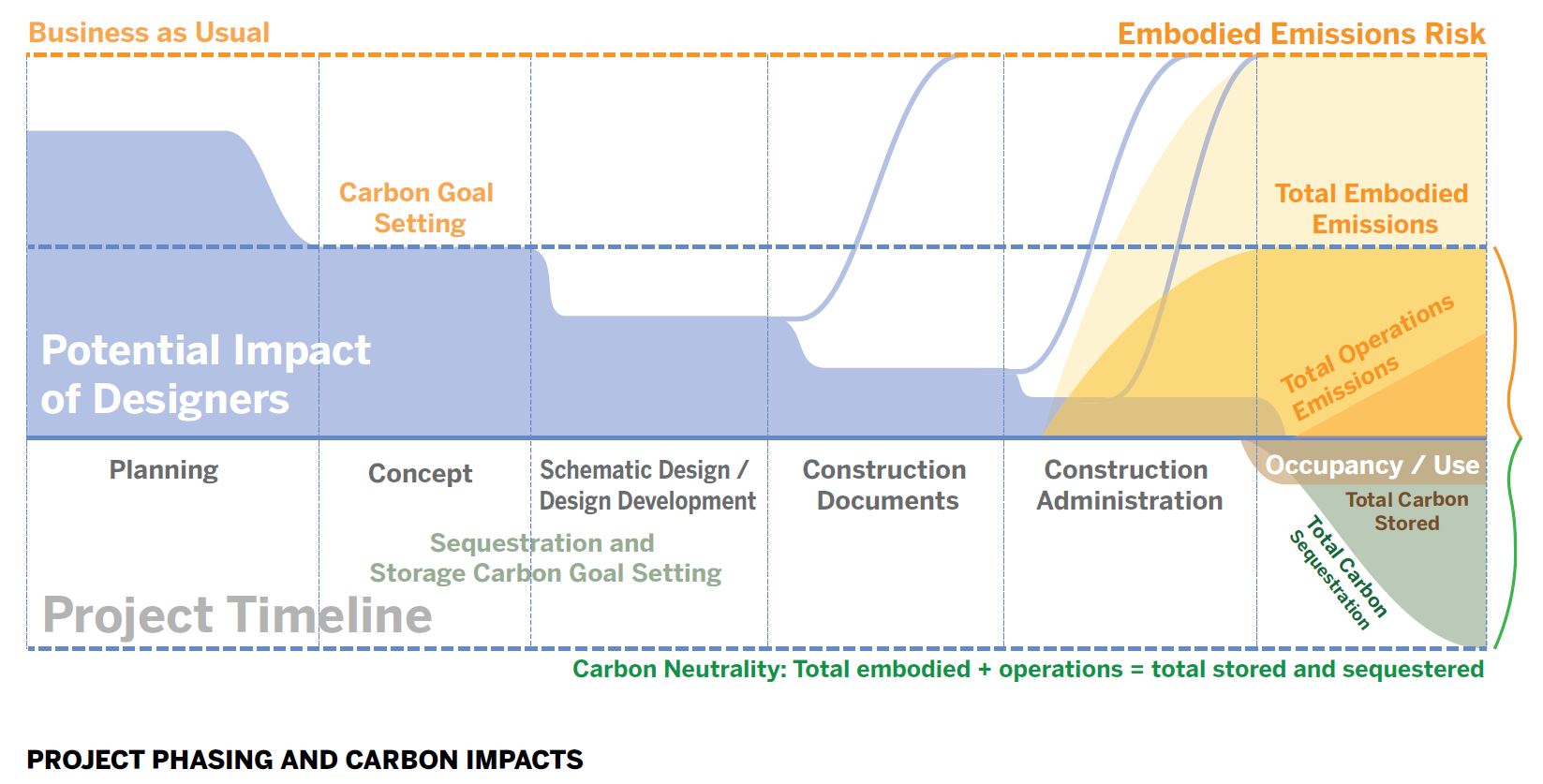
Landscape and architecture firm Sasaki has also developed a tool called Carbon Conscience, which is free and open-source. It is an outgrowth of research by senior associate Chris Hardy and builds on Pathfinder. But unlike that app, it is intended for the earliest phases of a project—before there is a detailed bill of quantities or materials. “If we start considering the carbon impacts during planning stages, we can make those order-of-magnitude decisions,” says Hardy. As the project advances, he points out, it becomes more difficult to consider such questions as: “Do we prioritize reuse? Does the plaza need to be a full block of hardscape? Do we work harder to preserve an existing forest stand?”
Hardy points out that Pathfinder, Carbon Conscience, and those more focused on buildings, including Tally, EC3, and EPIC, among others, rely on different methodologies, metrics, and assumptions. But now there is an industry initiative, facilitated by the Seattle-based Carbon Leadership Forum, to align these efforts. “If everybody is reporting data out in the same way, we can start being more effective,” he says.
Landscape architecture studio Stimson used Pathfinder to develop a Sustainable Landscape Implementation Plan for Pennsylvania State University. Published earlier this year and prepared in collaboration with horticulture consultant Phyto Studio and Conrad’s Climate Positive Design, the study concentrates on the core of the school’s main campus, University Park, encompassing nearly 430 acres. It examined strategies for a transition from mostly manicured lawns (making up more than one-third of the study area) to landscaping that is ecologically healthier, with lower maintenance requirements.
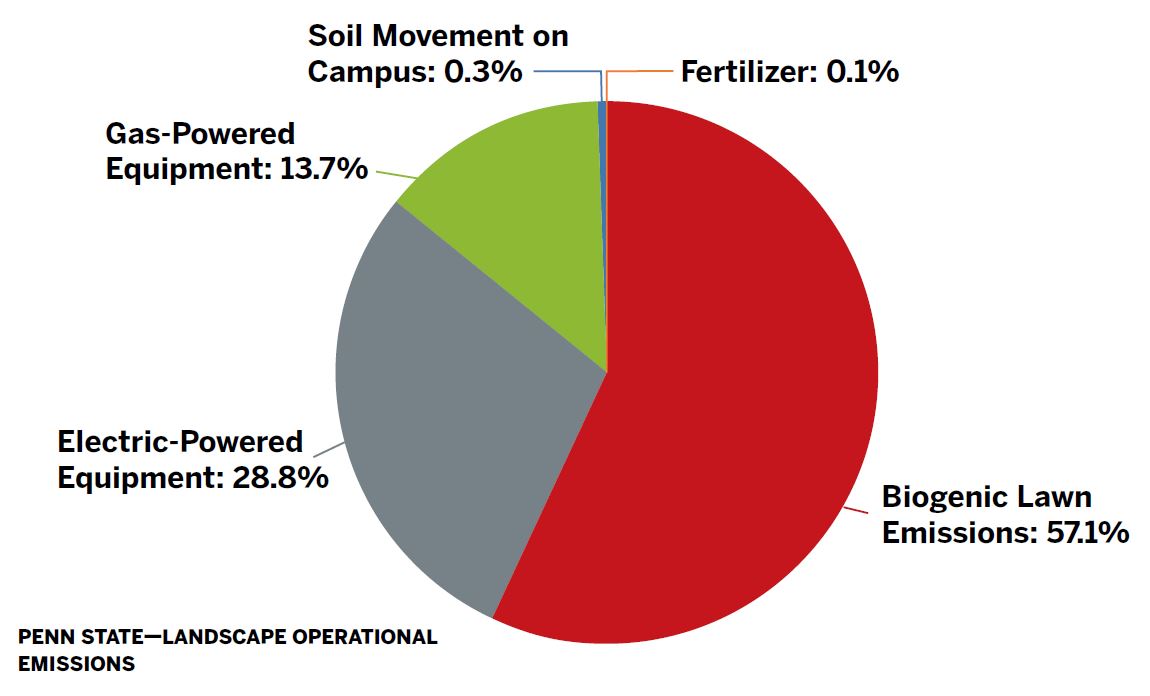
Penn State’s groundskeeping staff has already incorporated many ecological practices into its maintenance regimen. For instance, crews use very little chemical fertilizer, and they do not irrigate. Even so, Stimson and its collaborator found that the study area is responsible for 72,750 kilograms of CO2 emissions per year. The lion’s share (57.1 percent) are generated by the decomposition of lawn clippings, with almost all the rest stemming from equipment use, both gas- and electric-powered, such as mowers, clippers, and leaf blowers.
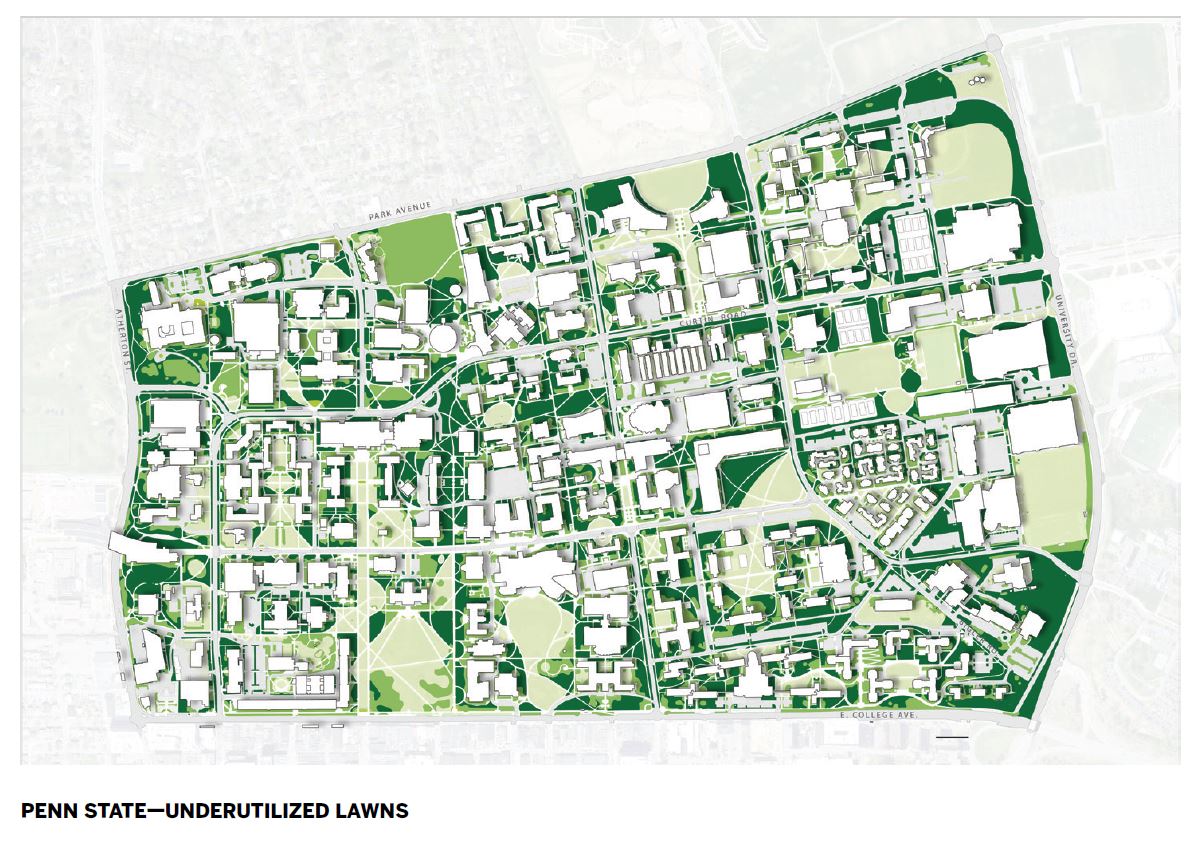
The report determined that the university could cut biogenic emissions by 60 percent and increase carbon-sequestration potential by 40 percent if it expanded campus tree cover, reduced mulched areas, and converted underutilized lawns to higher-performing, lower-maintenance ground flora, among other practices. And it identified locations distributed throughout the core campus, nearly 85 acres in total, as prime candidates for the transition, including those that are not used for recreation, are not in front of an historic campus building, or are often shrouded in shade, explains Matt Langan, Stimson technical director.
3
A study of Penn State’s grounds revealed that lawn clippings are responsible for the majority of the landscape’s operational footprint (3) and proposed converting underutilized lawns (in dark green, 4) to less carbon-intensive plantings. Images © Climate Positive Design (3); Stimson (4)
4
To jump-start the transformation, the report includes designs for two pilot projects—a 15,000-square-foot “sun meadow” and a 20,000-square-foot “shade meadow”—each with a unique combination of flora that will thrive in the select setting and particular solar exposure and include flowering varieties to provide what Langan calls “pops of color or sparkle” throughout the growing season. Planned for highly visible locations on campus in order garner support from the university community, pilot-project implementation is slated for next spring, pending funding.
If such landscape conversions were adopted at Penn State at scale, along with a move to an all-electric equipment fleet and a university-wide switch to renewable energy, management of the school’s grounds could achieve net zero operational emissions by 2035 (its emissions would be less than the amount that the landscape could sequester). This equation does not take into account the embodied carbon associated with any future landscape construction projects, however. To help keep these emissions in check, the report includes recommended changes to the school’s landscape-construction standards, including prioritizing salvage and reuse, minimizing new paving, and eliminating or reducing PVC piping.
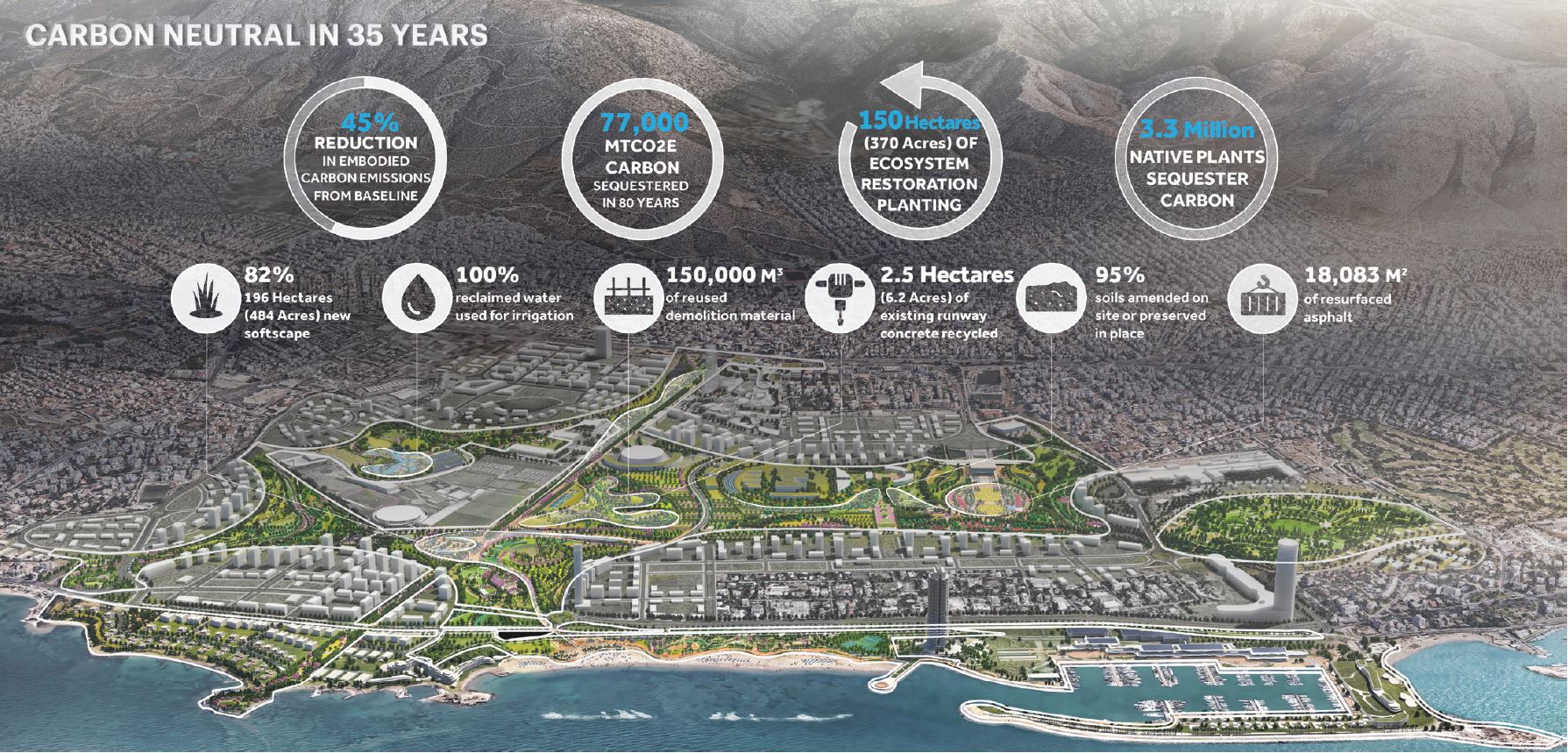
Sasaki, meanwhile, is using Carbon Conscience on its own projects, including Ellinikon, a park under construction on the former Kalamaki Airfield in Athens. It is projected to reach carbon neutrality within 35 years, meaning it will store at least as much carbon as is emitted, and continue to function as a carbon sink into the future. On the surface, the time frame might not sound impressive, but the scale is vast for a new park in such an ancient and densely populated city. Encompassing more than 650 acres, Ellinikon is larger than the city-state of Monaco; when complete at the end of the decade, it will single-handedly increase the amount of open space, per Athenian, by 44 percent.
The park is part of a larger redevelopment project master-planned by Foster + Partners on the land of the old airport, which was decommissioned in 2001 and subsequently used for sports venues during the 2004 Summer Olympic Games. The new development, organized into mixed-use neighborhoods, includes apartment buildings, hotels, and shopping malls, with buildings by Foster, Kengo Kuma, and BIG.
Sasaki came onto the project as landscape architect after the master-planning phase was complete, but by using Carbon Conscience and other tools the firm was able to convince the client to examine the character and scale of certain elements, moving the project toward what Michael Grove, Sasaki principal, calls a “true restoration ecology,” with reestablished grasslands, riparian corridors, and freshwater wetlands.
Relying on Carbon Conscience as well as Pathfinder, and with carbon-analysis assistance from environmental-design consulting firm Atelier Ten, Sasaki and local landscape architect Doxiadis+ created a scheme that prioritizes maximizing sequestered and stored carbon and focuses on reducing embodied carbon. The team says that their design cuts embodied emissions by 45 percent, compared to a more traditional approach.
5
At Ellinikon (5), Sasaki evaluated the carbon implications of land use, programming, and design decisions, starting with early project phases (6). Images © Sasaki
6
The park’s plants, more than 3.3 million of them—including trees, shrubs, geophytes, and herbaceous material—are being procured within Greece and were selected for their ecological benefits and adaptability to the site’s highly alkaline soil and its climate. They will be almost entirely irrigated with reclaimed water from a system comprising a stormwater-collection lake—repurposed from the former Olympic canoe and kayak venue—and a network of constructed wetlands, rain gardens, and bioswales. “We daylit as much of this infrastructure as possible, to avoid piping and channelization,” says Hardy, thereby conserving embodied carbon.

Image © Sasaki
The project’s biggest carbon savings come from material reuse, including amending the existing soil rather than replacing it, and minimizing the employment of new concrete by salvaging the site’s considerable pavement. The former runways and tarmac, for instance, will be used as hefty monolithic slabs for new surfacing or broken up for aggregate in road base. The salvaged concrete will also to be incorporated into gabion walls and dry-stacked retaining walls. “It is gorgeous material, without rebar, and containing quartzite and marble,” says Grove. “It looks like terrazzo when polished.”
The design team’s considerations went beyond plants and materials. They also included energy modeling, which helped size an on-site solar array. With vehicles and equipment planned to be all-electric, the park should be operationally carbon neutral on day one. The multifaceted nature of the Ellinikon, as well as that of the proposed revamp of Penn State’s campus, and the ongoing renewal of Houston’s Memorial Park, illustrate the level of analysis and thoughtful design needed to create low-carbon landscapes. When based in data and backed by science, the built environment beyond buildings can play a significant role in helping mitigate the climate crisis.
Continuing Education

To earn one AIA learning unit (LU), including one hour of health, safety, and welfare (HSW) credit, read the article above and Designing with a Carbon Conscience V2: a web-based application to inform planning and urban design projects on potential carbon impacts, Sasaki Associates, Chris Hardy, Michael Frechette, June 2023. (Through page 13). Then complete the quiz.
Upon passing the quiz, you will receive a certificate of completion, and your credit will be automatically reported to the AIA. Additional information regarding credit-reporting and continuing-education requirements can be found at continuingeducation.bnpmedia.com.
Learning Objectives
- Outline the types of carbon emissions that landscapes can create.
- Discuss strategies for reducing these emissions.
- Discuss strategies for maximizing the carbonsequestration capacity of landscapes.
- Describe tools for calculating the carbon impacts of landscape projects.
AIA/CES Course #K2409A
Looking for a reprint of this article?
From high-res PDFs to custom plaques, order your copy today!