Books
‘Assembly by Design’ Challenges the Accepted Story behind the Design of UN Headquarters in New York
Review: ‘Assembly by Design: The United Nations and Its Global Interior’ by Olga Touloumi

The typical tale of the design of the United Nations Headquarters in New York as a World Cup match between Le Corbusier and Oscar Niemeyer—refereed by Wallace Harrison—is one that leaves both key players and details out of the story. This is the case convincingly made by Olga Touloumi in her new book, Assembly By Design, which challenges the “artificial” nature of the accepted history surrounding the construction of the UN. Who is on her expanded credit list? Not the other architects on the so-called Board of Design, who, as it turns out, didn’t do all that much. Instead, there were numerous bureaucrats and technical advisors whose fingerprints are all over the complex.
The core of Touloumi’s account is the United Nations’ fretful fixation on carefully managing its physical debut to the world. There was no precedent—there had never been a UN headquarters—and the organization was intent on presenting as carefully curated a public image as possible. How the complex might appear from the FDR Drive was not the UN’s primary interest. Rather, the organization focused obsessively on how its interiors would look through a camera’s lens—the only view into the building that most of the world would ever have. Major television networks were consulted to plot out what were effectively televisual stages long before a single pier was ever poured.
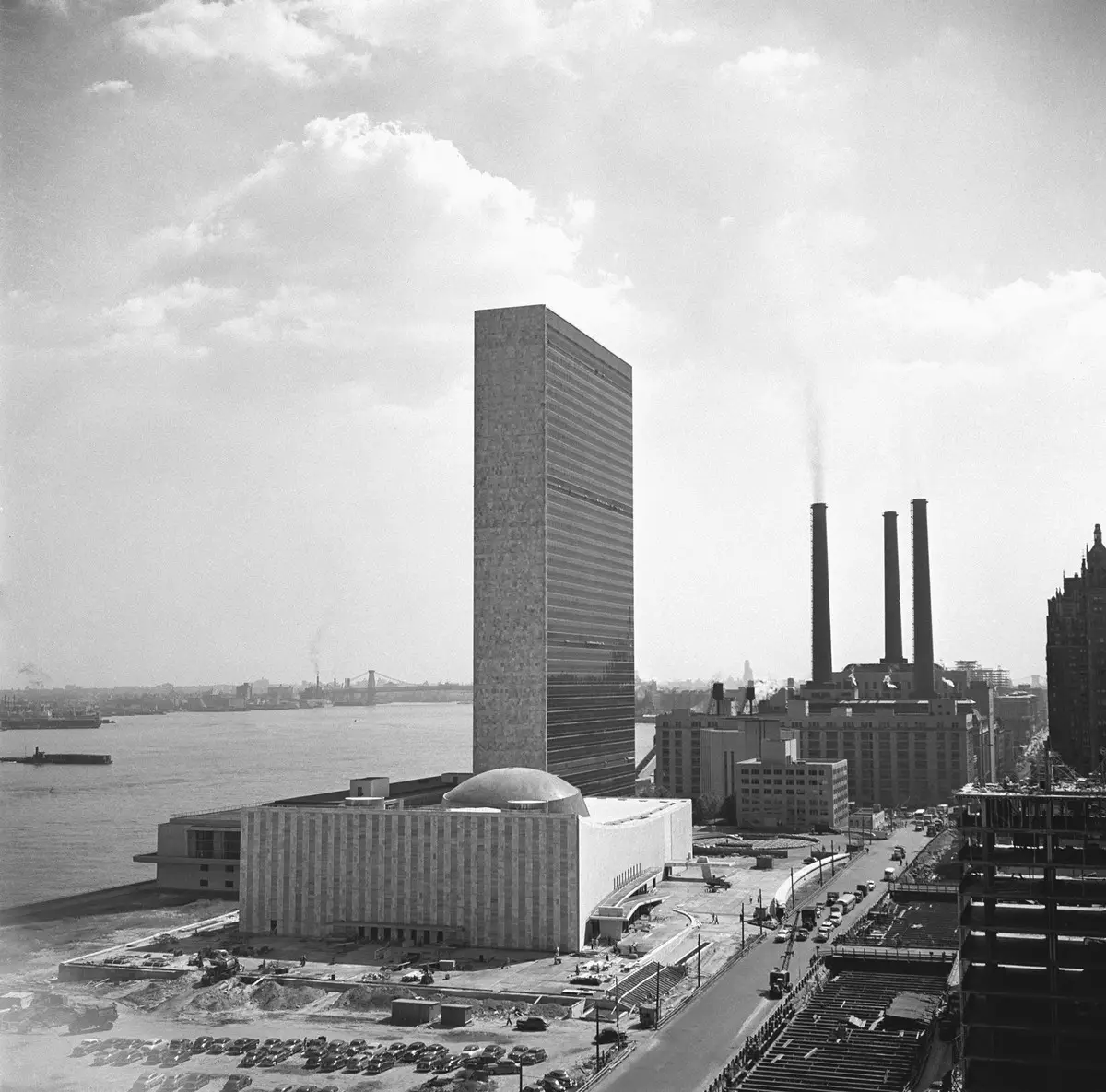
An exterior view, taken in 1952, of the United Nations Secretariat and General Assembly Building in Manhattan. Photo courtesy the United Nations Photo Library, click to enlarge.
Conceived in the aftermath of the Second World War, the UN had specific ideas about the kinds of spaces they did not want to build: no domineering rostrums for despotic reverberations. The complex would feature round tables fostering calm, diplomatic conversations. This might seem like a simple brief, but it certainly wasn’t. Round tables, although a perfect symbol for egalitarian discourse, collided instantly with the UN’s impulse to present all that they might on camera (filming one inherently captures someone’s back).
Touloumi’s research reaches a level of impressive granularity in demonstrating the UN’s preoccupation with this dilemma. The UN Headquarters’ three principal council chambers were largely the work of Finn Juhl, Sven Markelius, and Arnstein Arneberg—but they were not entrusted with the design of furniture. This work was allotted to Danish architect Abel Sorenson, who produced three different camera-friendly table designs, from a horseshoe for the Economic and Social Council to a parabola for the Trusteeship Council.
The selection of Scandinavian architects for the council chambers naturally resulted in a general mood of hygge (the Secretary-General at the time, Trygve Halvdan Lie, was Norwegian), but institutional acoustical and visual imperatives played a considerable role in further exaggerating such tendencies. As Touloumi writes, “architects would translate this desire for intimacy into lower ceilings, shorter corridors, a preference for carpets and wood, as well as curved walls.”
Touloumi, in dedicating great attention to acoustical planning of the complex, notes the prime irony that strenuous efforts were taken to shape spaces where many attendees couldn’t hear any given speaker. A conversation between the nations of the world is only possible with the scaffolding of translators, whose all-but-concealed roles manifested in IBM headphones at each seat. The setting was unitary, but comprehension was atomized—“collectivized isolation,” as Touloumi puts it.
The UN’s meticulous stage design, she also points out, extended to a rather deliberate effort to conceal the most consequential branch in the organization. Most government complexes trumpet the placement of their most powerful bodies; the United Nations deliberately hides its own. The General Assembly is foregrounded as the icon of the complex while the Knights of the Round table—the Security Council—hide amid the otherwise fairly toothless council chambers. Le Corbusier, with a certain ineradicable tendency toward programmatic honesty, wanted to express the Security Council more clearly, structurally. The organization did not. The process, Touloumi explains, was “the tactical use of global interiors that created an idealized fiction of egalitarian and collaborative diplomatic practices at the United Nations.”
Looking for quick answers on architecture and design topics?
Try Ask RECORD, our new smart AI search tool.
Ask RECORD →
The Board of Design’s intrinsically advisory role was dramatized by its dismissal after four months; the UN did not keep architects around for any actual building. This note of semi-superfluity continues in Touloumi’s accounts of subsequent UN structures—including the UNESCO headquarters in Paris. Each enlisted different combinations of architects; all ended up much the same in plan.
If there’s any criticism to be leveled against Assembly by Design, it’s that, for all the invaluable technical and institutional context the book brings to light, it leaves a certain void. There simply isn’t a comprehensive general history of the design of the UN complex, an accomplishment this book might have quite easily achieved. Touloumi leaves little doubt that Le Corbusier and Niemeyer receive more credit than they deserve, but greater detail on just what they were up to—as well as Harrison’s patient mediations—would have been welcome.
The sheer depth of Touloumi’s archival wrangling and her synthesis of content across fields and languages in explaining the 20th century’s (still standing) Tower of Babel is impressive. In simply explaining the UN’s image-management through the architectural tool of the plan, she hopes the overlooked stories in her book might provide inspiration to “move together toward more just and open structures of assembly.”
Looking for a reprint of this article?
From high-res PDFs to custom plaques, order your copy today!