Architectural Record
search
cart
facebook twitter linkedin youtube
  • Sign In
  • Subscribe
  • Sign Out
  • My Account
Architectural Record
  • NEWS
    • Latest News
    • Awards
    • Interviews
    • Obituaries
    • Podcasts
      • Design:Ed Podcast
      • Sponsored Podcasts
  • OPINION
    • Book Reviews / Excerpts
    • Exhibition Reviews
    • Forum
  • EXCLUSIVES
    • Videos
    • Design Vanguard
    • Top 300 Firms
    • Sponsored Content
    • Sponsored eBooks
    • From the Archives
  • CONTINUING ED
    • Editorial Continuing Ed
    • CE Center
    • CE Academies
  • PROJECTS
    • Buildings By Type
    • Reuse & Renovation
    • Museums & Arts Centers
    • Colleges & Universities
    • Multifamily Housing
    • Interiors
    • Lighting
    • Kitchen & Bath
  • HOUSES
    • Record Houses
    • House of the Month
    • Featured Houses
  • PRODUCTS
    • Products by Category
    • Record Products of the Year
    • Latest Products
  • EVENTS
    • Dates & Events
    • Record on the Road
    • Innovation Conference
    • Sustainability in Practice
    • Women In Architecture
    • Webinars
    • Ad Excellence Awards
    • Submit an Event
  • CONNECT
    • Ask RECORD AI
    • Newsletters
    • Contact
    • Advertise
    • Editorial Calendar
    • Store
    • Customer Service
  • SUBMIT
    • Submission Guidelines
    • RECORD Competitions
  • MAGAZINE
    • Subscribe
    • My Account
    • Digital Edition
    • Current Issue
    • Firm Pass
    • Historic Archive
ProjectsBuildings by TypeMuseums & Art Centers

The Greenhill Building at London’s Harrow Arts Centre Shines Bright with Red Cladding and a Sawtooth Roofline
By Matthew Marani
Greenhill Building at Harrow Arts Center
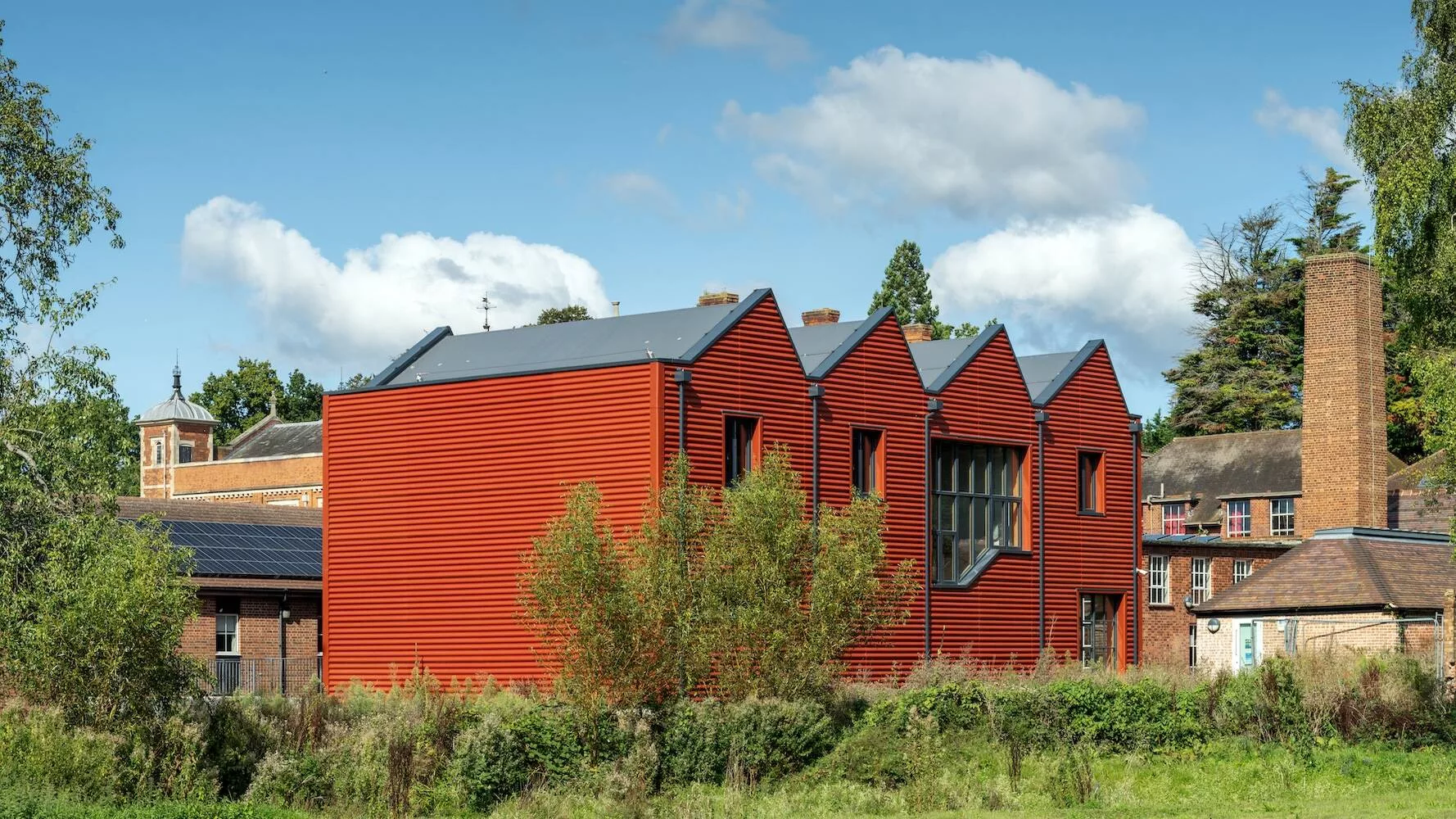
The Greenhill Building at London’s Harrow Arts Centre provides additional space for events and programming. Photo © David Churchill
January 20, 2025

Architects & Firms

Chris Dyson Architects
✕
Image in modal.

The Harrow Arts Centre (HAC), located in the northwest outskirts of London, has served as a multidisciplinary arts institution since its founding in 1988 on the site of the former Royal Commercial Travellers School, which operated on the grounds from 1855 to 1967. The HAC grounds includes the listed Neo-Tudor Elliot Hall (1904) and several converted single-story agricultural buildings, along with farmland. And in November 2024, the organization opened a notable addition to its campus: the 5,500 square-foot Greenhill Building, designed by London-based Chris Dyson Architects.
Greenhill Building at Harrow Arts Centre.

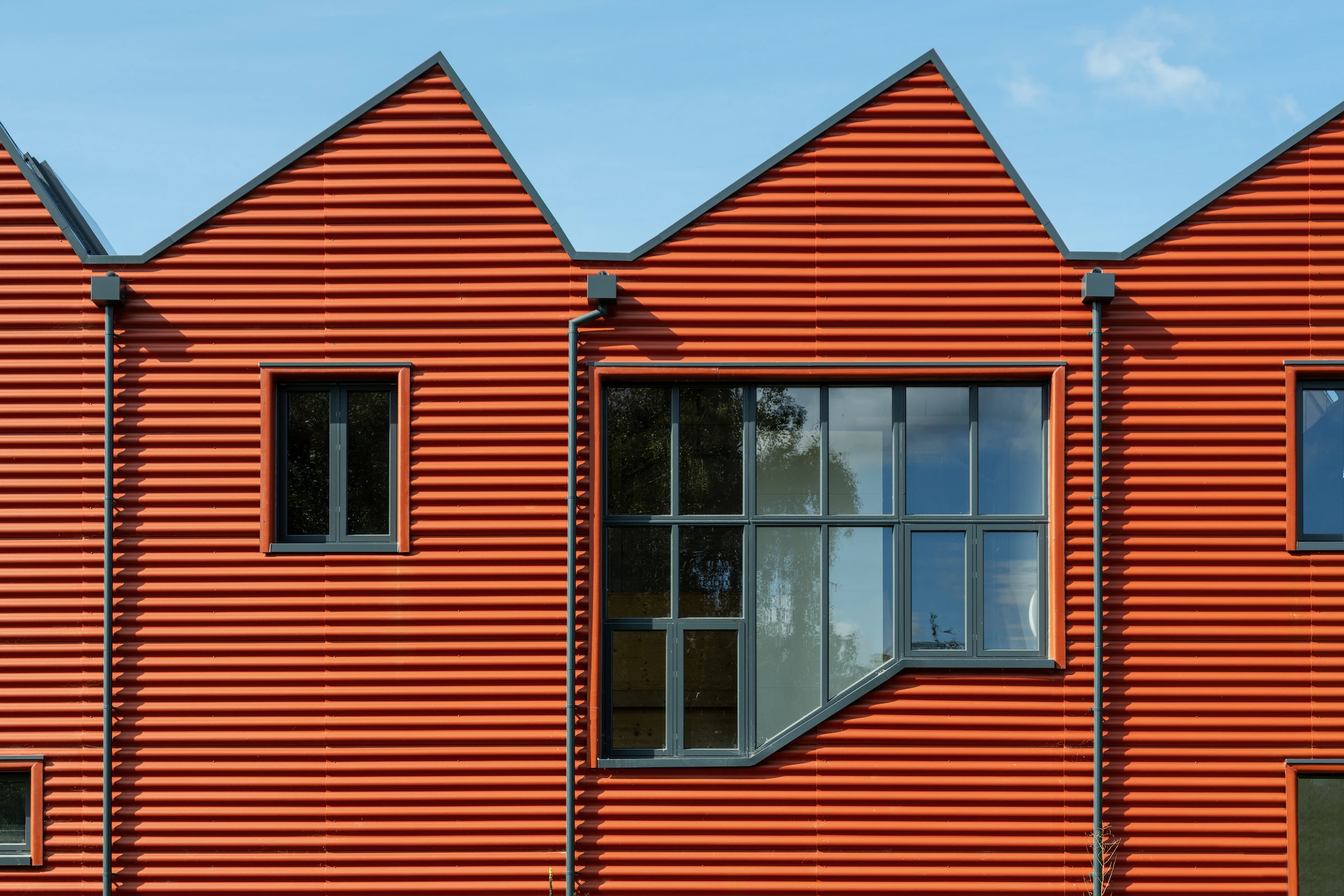
The brig corrugated fiber cement cladding is intended to resemble a barnhouse. Photo © David Churchill

Like other peer institutions in the United Kingdom, HAC faces diminished government support. Greenhill was commissioned to provide a steady stream of rental income to support the public art center. The structure replaces an ancillary temporary building, which had reached the end of its lifespan. For the design team, which included structural engineer Webb Yates and the client, it was imperative that the project conform to the existing context and that the budget to be kept tight—the final cost was approximately $2.2 million. 

To that end, the Greenhill Building’s massing and materials are kept simple. Oriented around a courtyard, the two-story, L-shaped structure rises with a relatively conventional mass timber structural system, consisting of cross-laminated floor plates and glulam post-and-beams, with a sawtooth roofline. It is clad in corrugated, bright-red fiber cement panels, though the design team initially hoped to use weathering steel—a choice forced by pandemic-related price increases. That simplicity paid dividends in terms of the construction schedule. It took just six months to prepare the site and raise the structural frame, and another three months to make it watertight and insulated.
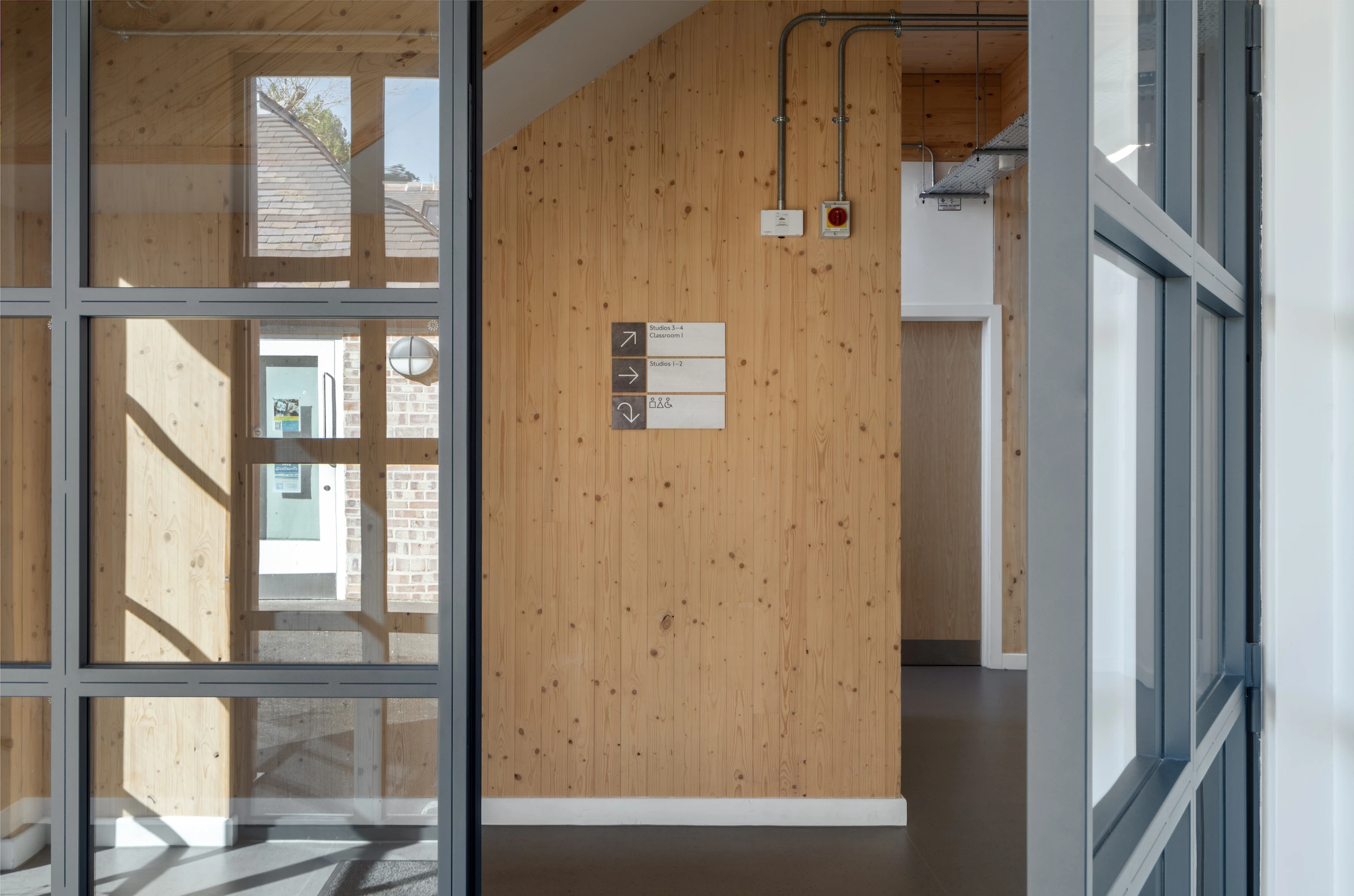
Greenhill Building at Harrow Arts Centre.

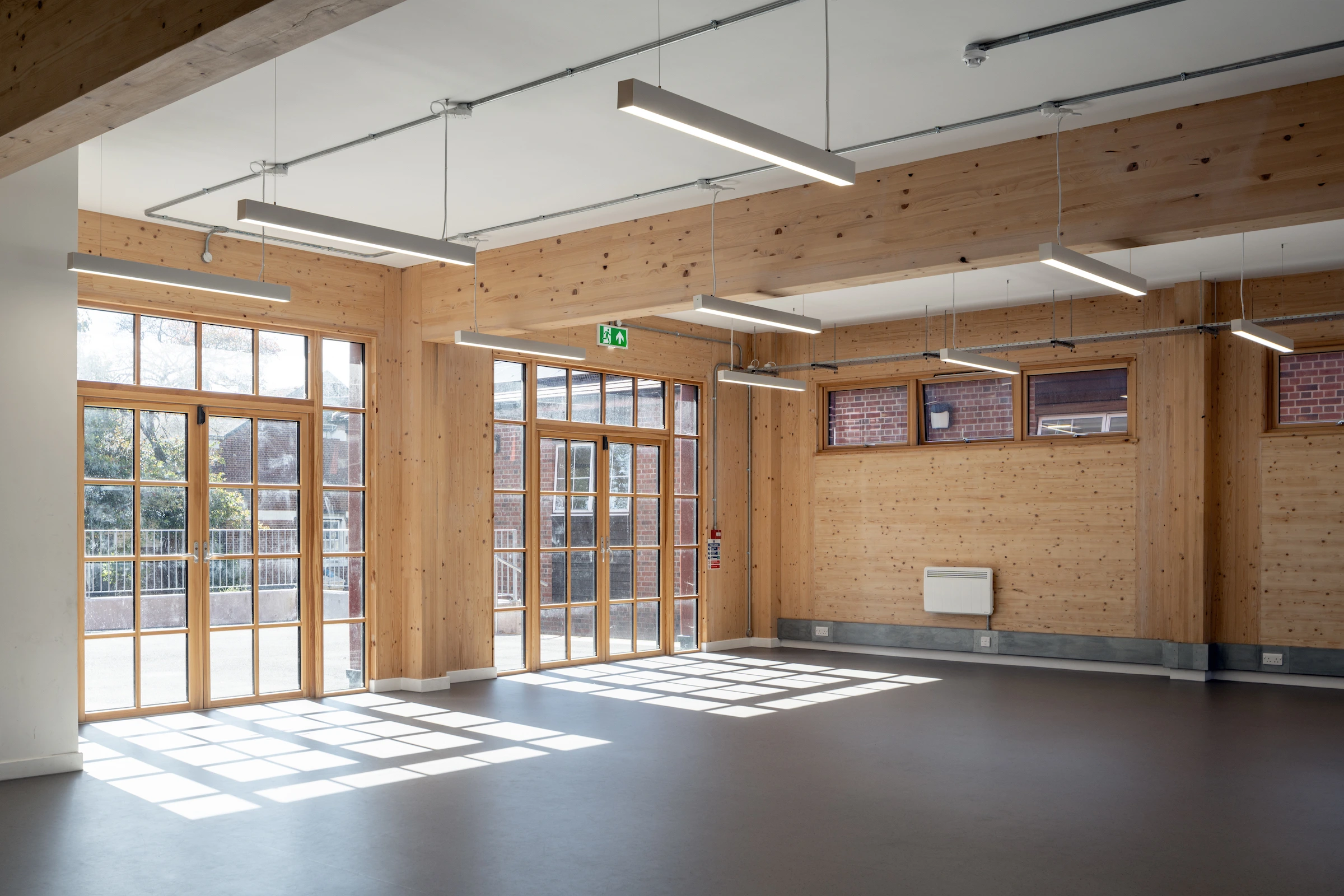
The interior is minimally detailed, and the ground floor opens onto a courtyard. A stairwell is located at the center of the L-shaped plan. Photo © David Churchill
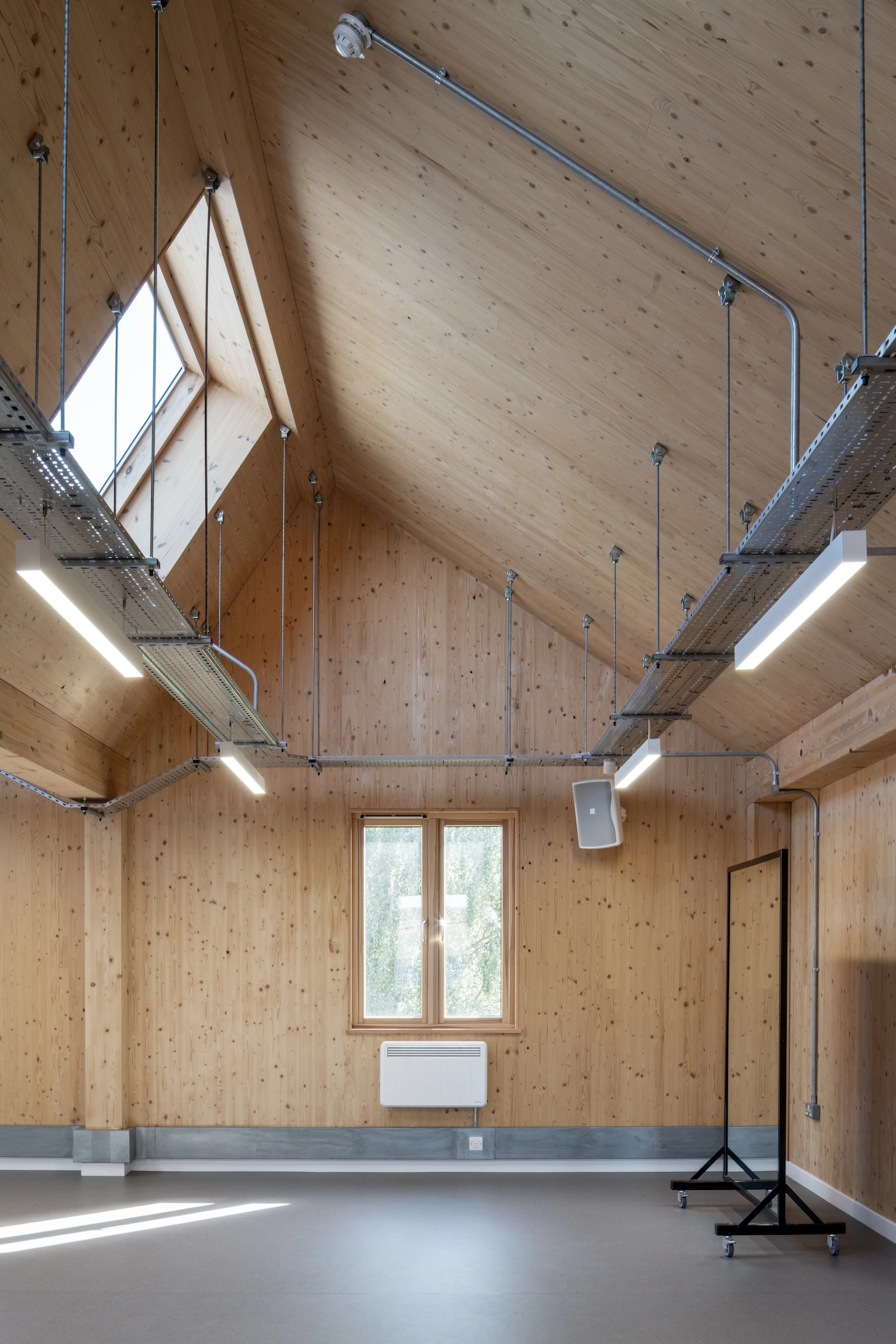
ALT TEXT.

Skylights are placed on the southern face of the sawtooth roofline, which provides abundant daylight to the second-floor studio spaces. Photo © David Churchill

The simple structural grid facilitates an open and flexible program within the building footprint. The ground floor is divided into two primary rooms, which open onto the courtyard, and can provide extra room for classes and events in summer months. The second floor, which is flooded with daylight by north-facing skylights, is primarily used for dance-related programming. The material palette is minimal throughout, with exposed wood grain serving as the prevailing interior finish.

“We called upon the earlier occupation of the site and decided that we could build a rudimentary farmyard aesthetic of a building," explains firm principal Chris Dyson. "That could go much further cost wise than a conventional masonry or brick building, and we successfully convinced the local conservation authorities that this approach was appropriate and respectful to the listed building next door.”

The Greenhill Building’s primary goal is to guide HAC towards greater financial sustainability, and in its first six months of operation has netted more than $60,000 in rental income. But it has also achieved impressive environmental sustainability feats through several simple sleights of hand. The sawtooth roof’s skylights are operable, which provides a chimney effect across the building, and expansive glazing facilitates cross ventilation through the ground floor. The window openings are inset to offer passive shading throughout the day, and the fiber-cement cladding offers considerable thermal performance. And roof-mounted solar panels are positioned southward to power the building’s electric heating. Altogether, the design team estimates that their thermally efficient detailing and m/e/p design can reduce annual CO2 emissions by more than 90 percent when compared to BREEAM’s Part L building regulations baseline.
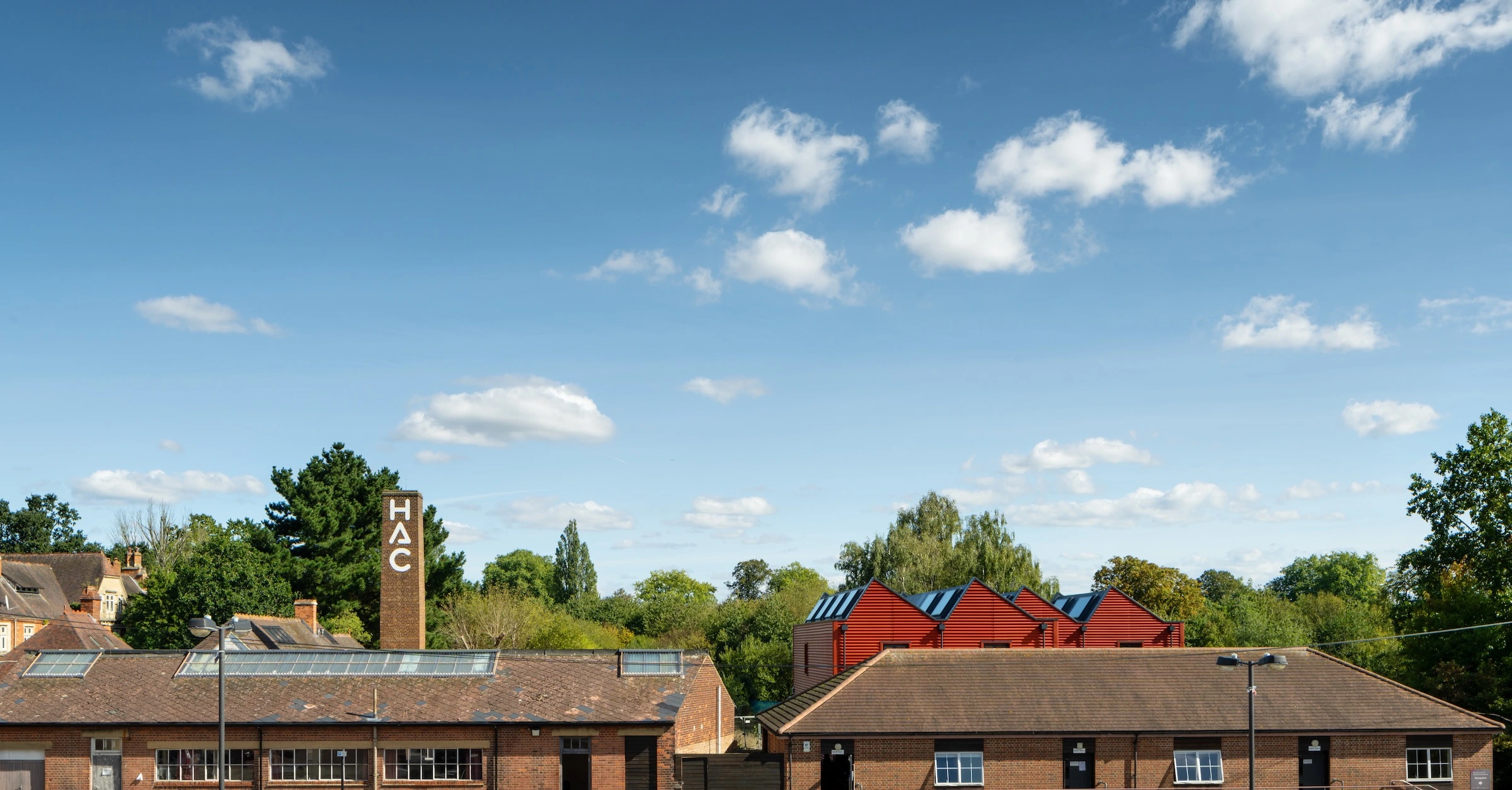
Greenhill Building at Harrow Arts Centre.

The Greenhill Building is located on the periphery of the HAC grounds. Photo © David Churchill

“We set out with the idea that architecture can respond to the realities of a budget in a responsible and sustainable way,” says Dyson. “I think that we’ve achieved what we set out to do, and firms should enjoy that challenge as architects, it is not something we should shy away from.”

Looking for quick answers on architecture and design topics?
Try Ask RECORD, our new smart AI search tool.
Ask RECORD →

KEYWORDS: London prefabrication timber construction United Kingdom

Share This Story

Looking for a reprint of this article?
From high-res PDFs to custom plaques, order your copy today!

Matthew marani

Matthew Marani is a senior editor at Architectural Record. Previously, he served as program manager at The Architect’s Newspaper and has several years of experience as a freelance writer specializing in urban planning, historic preservation, and architectural technology. Matthew is a born and raised New Yorker and holds an MSc in Architectural Conservation from the University of Edinburgh.

Post a comment to this article

Report Abusive Comment

Subscription Center
  • Create an Account
  • Start a Subscription
  • Manage My Account
  • Sign Up for Newsletters
  • Visit Customer Service
  • Update Preferences

More Videos

Sponsored Content

Sponsored Content is a special paid section where industry companies provide high quality, objective, non-commercial content around topics of interest to the Architectural Record audience. All Sponsored Content is supplied by the advertising company and any opinions expressed in this article are those of the author and not necessarily reflect the views of Architectural Record or its parent company, BNP Media. Interested in participating in our Sponsored Content section? Contact your local rep!

close
  • TAMLYN XtremeTrim Exterior Trim
    Sponsored byTamlyn

    Designing Cleaner Panel Facades: Why Exterior Trim Details Matter

  • Building with Vapor Barriers
    Sponsored byReef Industries, Inc.

    Vapor Barriers Help Control Moisture in Tighter Building Designs

  • Duct Interior with Prodeq System
    Sponsored byHenry, a Carlisle Company

    Designing Resilient Water Containment Systems

DESIGN:ED Podcast
Listen to Architectural Record’s DESIGN:ED Podcast

Events

June 16, 2026

Focus on the Façade: Exploring Steel, Timber & Fire-Rated Curtain Walls and Channel Glass Systems

Credits: 1 AIA LU/HSW; 1 AIBD P-CE; 0.1 ICC CEU

Explore modern façade and glazing systems that enhance daylighting, fire safety, and thermal performance while expanding architectural design possibilities.

June 18, 2026

Rebooting the Aging Office Building

Credits: 1 AIA LU/HSW; 1 AIBD P-CE; 0.1 ICC CEU; 1 PDH

Explore façade retrofit strategies and award-winning design concepts that can transform aging office buildings into healthier, higher-performing workplaces for today’s hybrid workforce.

View All Submit An Event

Products

2026 Architect's Square Foot Costbook

2026 Architect's Square Foot Costbook

See More Products

Popular Stories

SanDiegoAirport

Top 300 Architecture Firms of 2026

Coronado Bridge

The Architect’s Guide to San Diego

Dusk House

Design Vanguard 2026: ONO

West Village Penthouse

Design Vanguard 2026: Brent Buck Architects

Hikma Community Complex

Design Vanguard 2026: Mariam Issoufou Architects

Focus on the Facade - Free Webinar - June 16, 2026

Related Articles

  • Exterior image of UWM Chemistry Building

    A New Chemistry Building at the University of Wisconsin-Milwaukee Champions Transparency

    See More
  • 2024AV16-097.jpg

    The New Davis Center at Williams College Features Charred-Wood Cladding and a Folded Roofline

    See More
  • Helene_Binet_archrecord_1170_ss_3.jpg

    Hélène Binet Retrospective Opens at London’s Royal Academy of Arts

    See More

Related Products

See More Products
  • book3.jpg

    If Architecture is a Language, Then a Building is a Story

See More Products

Events

View AllSubmit An Event
  • October 30, 2025

    The Bright Side and Benefits of Designing with Integrated Lighting

    NOW ON DEMANDCredits: 1 AIA LU/HSW; 1 AIBD P-CE; 0.1 ICC CEU; 0.1 IACET CEUThis course is all about light designs and the small details that can make or break the space you’re designing.
View AllSubmit An Event
×

The latest news and information

#1 Source for Architectural Design, News and Products

SUBSCRIBE
  • RESOURCES
    • Advertise
    • Contact Us
    • Submit
    • Store
  • ACCOUNT CENTER
    • Create an Account
    • Start a Subscription
    • Manage My Account
    • Sign Up for Newsletters
    • Visit Customer Service
    • Update Preferences
  • PRIVACY
    • PRIVACY POLICY
    • TERMS & CONDITIONS
    • DO NOT SELL MY PERSONAL INFORMATION
    • PRIVACY REQUEST
    • ACCESSIBILITY
  • SERVICES
    • Marketing Services
    • Reprints
    • Market Research
    • List Rental
    • Survey/Respondent Access
  • STAY CONNECTED
    • Linkedin
    • Facebook
    • Instagram
    • YouTube
    • X (Twitter)

Copyright ©2026. All Rights Reserved BNP Media, Inc. and BNP Media II, LLC.

Design, CMS, Hosting & Web Development :: ePublishing