Sustainability in Practice
Schmidt Hammer Lassen’s Shenzhen Energy Ring Redefines Industrial Architecture in China
Shenzhen, China
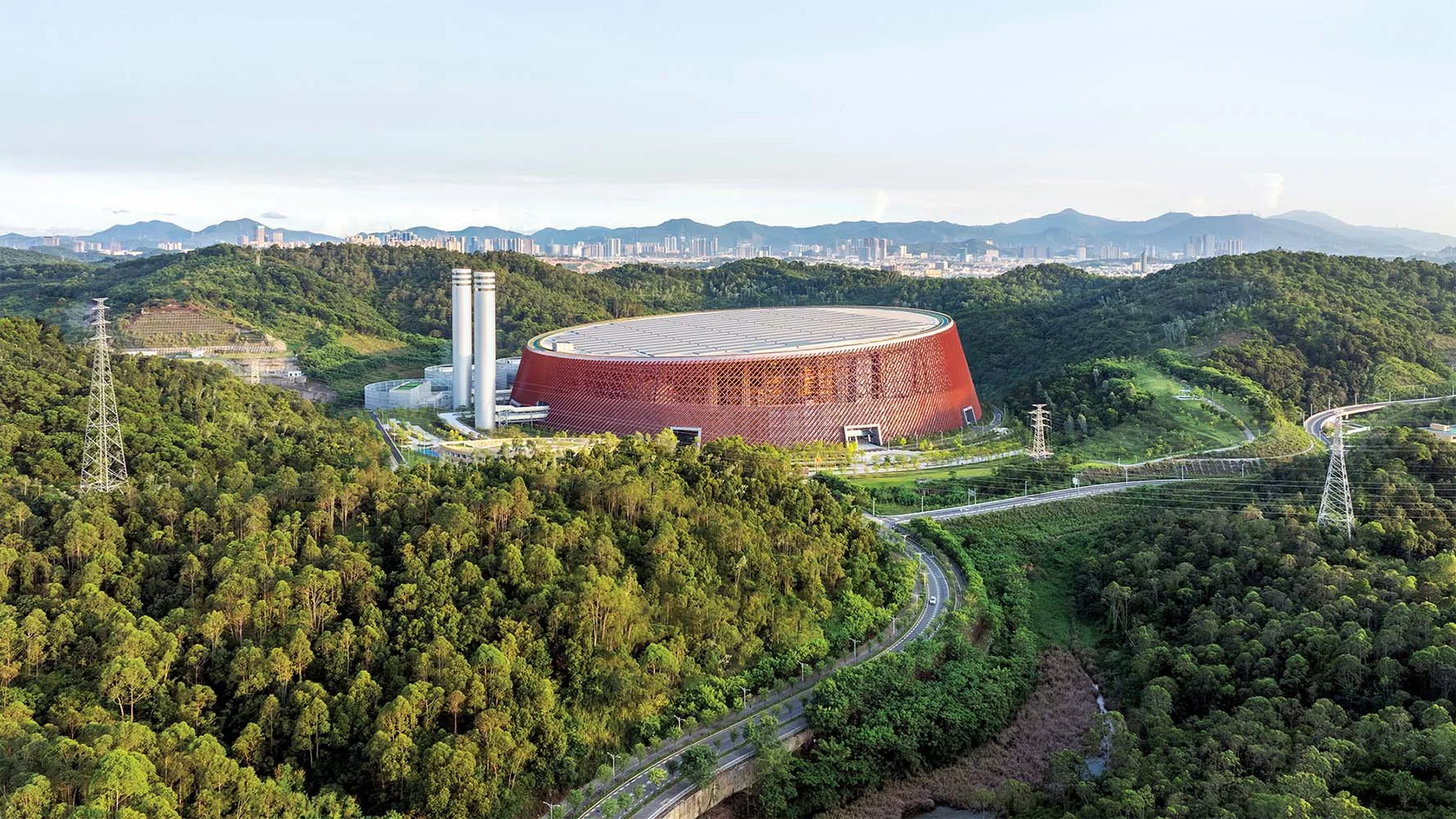
Like the United States, China holds an unenviable position as a leading producer of trash, a fact that has not gone unnoticed by the Shenzhen Energy Environmental Company (SEE). The waste-management company has commissioned dozens of waste-to-energy (WtE) plants across China to put garbage to productive use.
The Energy Ring, in northeastern Shenzhen, takes a noticeable design departure from the boxy and stolid form typical of SEE’s WtE plants. Schmidt Hammer Lassen (SHL), a part of Perkins&Will, collaborating architect Gottlieb Paludan, and architect of record East China Electrical Power Design Institute consolidated the project’s industrial, administrative, and educational program into a tight, circular footprint on its verdant site 22 miles outside the city’s center. “Why would we spread everything out, when we could make it small and reinstate the landscape around it?” says Chris Hardie, design director of SHL’s Shanghai studio.

The drumlike waste-to-energy plant is 1,150 feet in diameter. Photo © Tian Fangfang, click to enlarge.
“Small” is relative here. The Energy Ring is one of the world’s largest WtE plants, enclosing 2 million square feet within a tapering drumlike form approximately 1,150 feet in diameter and ranging from 150 to 215 feet tall. Since it began operations in late 2019, prior to its full completion of construction in 2023, the Energy Ring has converted a quarter of Shenzhen’s domestic waste into 1.2 billion kilowatt hours (kWh) of energy each year.
Though the architects sought to minimize site disturbance, they did not diminish the plant’s presence. “You want it to stand out,” Hardie says. “You want people to know their taxes are paying for tackling waste, a problem that they’re creating.” As such, the facility’s permeable skin of steel lamellas is burnt orange, a vivid human-made mark amid rolling green hills.
Two 100-meter-tall (328-feet-tall) smokestacks flank an elevated visitor entrance into a multi-floor education and exhibition space. While workers monitor plant operations in a 48,200-square-foot office area, visitors can view key statistics, such as the plant’s waste input and power output, on a dashboard.

An education space affords a view of the facility’s operations. Photo © Tian Fangfang
The remaining floor area is largely dedicated to its raison d’etre. The plant’s WtE combustion system and boiler by Babcock & Wilcox come from Denmark, home to another distinctive WtE plant, Amager Bakke, in Copenhagen, by Bjarke Ingels Group.
A fleet of trucks collects waste from residents, who have already separated out recyclables, compostable waste, and oversize items. “In China, you can get fined if you don’t do it right,” Hardie says.
Looking for quick answers on architecture and design topics?
Try Ask RECORD, our new smart AI search tool.
Ask RECORD →
At the plant, the trash is deposited into hoppers and conveyed to a furnace with cranes. The heat of incinerating trash converts circulating water into high-pressure steam, which turns the blades of an enormous turbine generator. Ash from the combustion process and fly ash in the flue gas are captured, filtered for heavy metals and toxins, and taken off-site for processing; the inert slag can be upcycled into building materials, and the recovered metal recycled. Toxic gases—including nitrogen oxides and sulfur oxides—are also filtered, leaving only carbon dioxide and water vapor to exhaust from the twin smokestacks.
Every metric ton of waste incinerated produces about 1 metric ton of carbon dioxide, Hardie says. The Energy Ring processes about 5,000 metric tons of waste per day, producing the equivalent carbon emissions of 10 to 12 transatlantic one-way flights.
Converting waste to energy is not a solution, Hardie acknowledges, “but it’s the best solution we have at the moment.” Short of having a fully circular economy, Shenzhen would send its domestic trash to landfills, producing about 0.5 metric tons of methane for every ton of organic waste. Methane has a global-warming potential more than 80 times higher than carbon dioxide over a 20-year time frame.
The Energy Ring could be outfitted with carbon-capture technology in the future, Hardie says, but such an integration remains nascent.
The Energy Ring is one of the first industrial buildings in China to earn LEED Gold certification, according to SHL. Its compact footprint and ample landscaping promote China’s “sponge city” initiative to make developed areas more flood-resistant through green infrastructure, says SHL project director Chao Chen. Its vast roof plane is covered with 193,750 square feet of photovoltaic panels, adding another 3.6 million kWh to the plant’s annual energy output. A 1.1-kilometer running track ringing the roof perimeter offers recreational opportunities for workers and visitors.

The vast roof is encircled by a running track and includes photovoltaics that add 3.6 million kWh to the plant’s annual energy output. Photo © Tian Fangfang
The absence of a solid envelope means tremendous savings in cladding material. WtE plants make far more energy than they consume as buildings, but many divert a portion to mechanically ventilate their industrial operations, Hardie says. The design team wondered, “Can we leave the facade open and let everything naturally vent?”
Like louver fins fixed ajar, the wraparound skin of 8,215 steel lamellas, each 10 to 13 feet long and triangular in section, is indeed breathable. A self-cleaning coating reduces maintenance needs, while an integral channel directs precipitation out. Expanded metal mesh wraps the lower 100 feet of the building, inboard of the lamellas, to keep out unwanted visitors and debris.

The plant is is enclosed in a breathable skin of 8,215 steel lamellas. Photo © Tian Fangfang
The bare-bones envelope supports the architects’ second design intent, aside from education: avoiding obsolescence. Society is a long way from zero waste, but, when that day comes, Hardie imagines that the Energy Ring shell, emptied of its industrial plant equipment, could find new life as a stadium or entertainment district, akin to London’s Millennium Dome.
Until then, the plant is educating students, researchers, and government leaders. Its efficient land use has enabled the addition of on-site visitor dormitories and a cafeteria for workers. Perhaps the strongest signal of public approval: the city of Shenzhen has recognized the Energy Ring as a top destination for industrial tourism.
Click plan to enlarge

Click section to enlarge

Click graphic to enlarge

Credits
Architect:
Schmidt Hammer Lassen (Perkins&Will) — Chris Hardie, principal in charge; Chao Chen, project director; Steven Chen, Weijie Fu, Rasmus Duong-Grunnet, Tade Godbersen, Yu Jing, Tim Kunkel, Claudius Lange, Dong Liang, Rong Lu, Simon Persson, Xiao Sun, Michelle Tang, Gu Xiao, Ella Xu, Mo Yang, Tasha Ye-Feng, project team
Collaborating Architect:
Gottlieb Paludan Architects
Architect of Record:
East China Electrical Power Design Institute
Consultants:
Schlaich Bergermann Partner (structure); EAST Design, Shenzhen Landscape (landscape)
Contractors:
China Energy Engineering Group Northeast No.1 Electric Construction Company, Power China Shanghai Power Construction No.2 Company
Client:
Shenzhen Energy Environmental Company
Size:
2 million square feet
Cost:
$0.6 billion
Completion Date:
July 2023
Sources
Facade Lamellas:
Bluescope
Looking for a reprint of this article?
From high-res PDFs to custom plaques, order your copy today!

.webp?height=200&t=1713468361&width=200 "8thSt-MedRes-©Mike Kelley-34 (1).jpg")
