Architectural Record
search
cart
facebook twitter linkedin youtube
  • Sign In
  • Subscribe
  • Sign Out
  • My Account
Architectural Record
  • NEWS
    • Latest News
    • Awards
    • Interviews
    • Obituaries
    • Podcasts
      • Design:Ed Podcast
      • Sponsored Podcasts
  • OPINION
    • Book Reviews / Excerpts
    • Exhibition Reviews
    • Forum
  • EXCLUSIVES
    • Videos
    • Design Vanguard
    • Top 300 Firms
    • Sponsored Content
    • Sponsored eBooks
    • From the Archives
  • CONTINUING ED
    • Editorial Continuing Ed
    • CE Center
    • CE Academies
  • PROJECTS
    • Buildings By Type
    • Reuse & Renovation
    • Museums & Arts Centers
    • Colleges & Universities
    • Multifamily Housing
    • Interiors
    • Lighting
    • Kitchen & Bath
  • HOUSES
    • Record Houses
    • House of the Month
    • Featured Houses
  • PRODUCTS
    • Products by Category
    • Record Products of the Year
    • Latest Products
  • EVENTS
    • Dates & Events
    • Record on the Road
    • Innovation Conference
    • Sustainability in Practice
    • Women In Architecture
    • Webinars
    • Ad Excellence Awards
    • Submit an Event
  • CONNECT
    • Ask RECORD AI
    • Newsletters
    • Contact
    • Advertise
    • Editorial Calendar
    • Store
    • Customer Service
  • SUBMIT
    • Submission Guidelines
    • RECORD Competitions
  • MAGAZINE
    • Subscribe
    • My Account
    • Digital Edition
    • Current Issue
    • Firm Pass
    • Historic Archive
ProjectsBuildings by TypeResidential Architecture

Residential Architecture 2025

Mid-Century Modernism Meets Connecticut Woodlands in a House by Tom Lontine Architect

Deep River, Connecticut
By Dante A. Ciampaglia
House in the Woods
House in the Woods. Photo © Nicholas Venezia
March 19, 2025

Architects & Firms

Tom Lontine Architect
✕
Image in modal.

Head east on the winding, bucolic River Road in Deep River, Connecticut, and on your left is a hodgepodge of stone-wall-fronted residences and, behind them, the Connecticut River. To the right, hilly woodland dotted with newly built houses—most large, multi-story, and forgettable. But there’s one that quietly commands your attention.

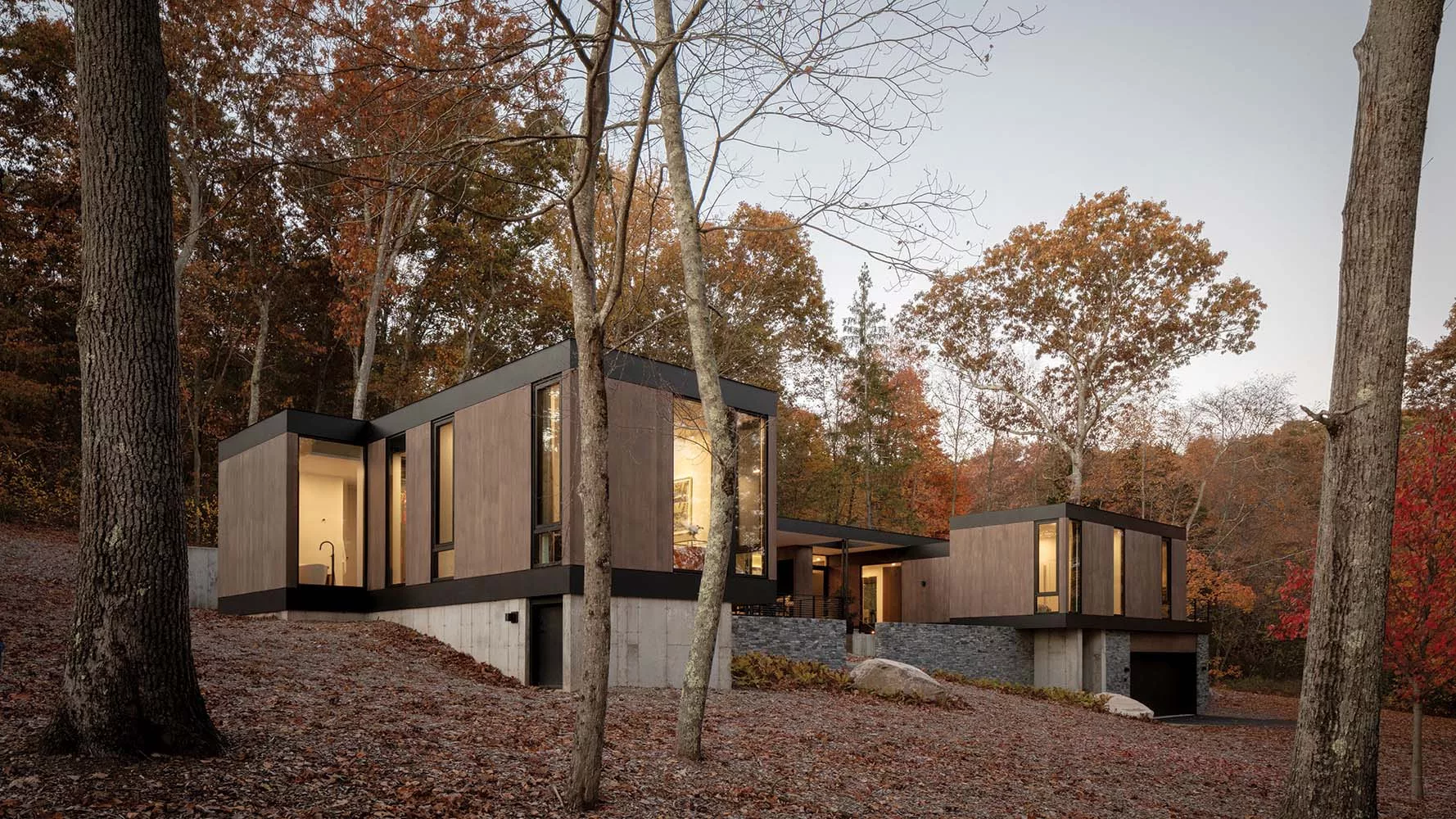
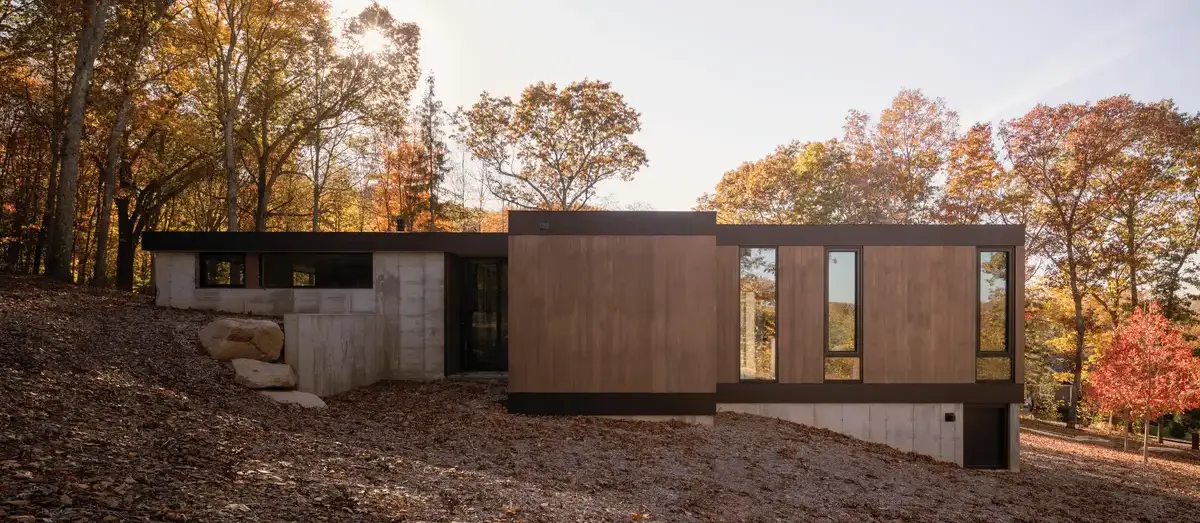
Tucked into the trees at an elevation of 56 feet above the street is Tom Lontine Architect’s Midcentury Modern–inspired House in the Woods, Lontine’s first project since starting his own firm. Low-slung, clad almost entirely in dark cedar, and embedded in the hillside, the 4,400-square-foot home all but disappears into its surroundings—just as its owners intended. The married doctors, who moved to Connecticut from Salt Lake City, wanted a house where they could age in place, which led to a design adaptable to their changing needs. But they also wanted to minimize their impact on the site. “That’s why the house is really quiet and positioned exactly where it is, and why the materials blend in with the surrounding trees,” says Lontine.
House in the Woods.
1
House in the Woods.
2

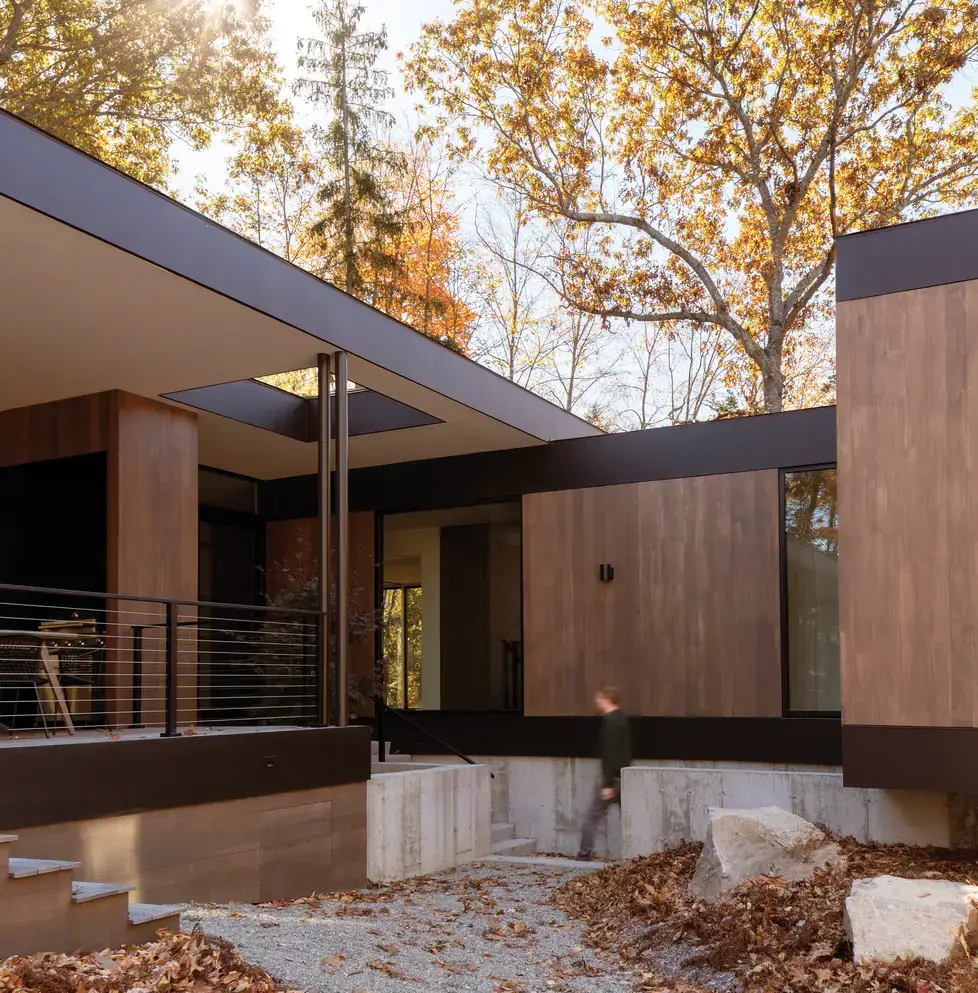
Embedded in a hill (1), the house engages with nature from its entry sequence (2) to its domestic spaces (3). Photos © Nicholas Venezia, click to enlarge.


House in the Woods.
3

Concrete was used for the foundation and walls embedded in the hillside, while almost everything else was built with standard two-by-six stud framing. It was constructed with an eye toward maximizing engagement with the 2.65-acre site, which was once part of cosmetics magnate Elizabeth Arden’s estate. Visitors approach from the driveway up a long stair that passes under the guest bedroom, and emerge to a planted courtyard on the left and, ahead—through the front glass door and a window beyond—a picturesque view into the woods. After entering and turning to the central living space, a series of stepped rectilinear windows at the rear of the house—narrow and horizontal at higher points, larger and wider where the hill dips—mimic the shift in grade of the hillside and allow for glimpses to the trees. The north-facing wall of windows at the front of the house, meanwhile, offers an expansive vista of the property down to the river and, on the opposite shore, the densely forested Selden Neck State Park. The guest wing and laundry room, to the east, and the primary suite to the west extend out to form what Lontine describes as horse blinders to conceal the neighboring residences and frame the view. (The fourth volume of the residence is an office and home gym, behind the guest quarters, with the central living area’s pavilion-like roof covering and unifying the connections.)

Except for totally enclosed areas on the lower level—a mechanical room and an unfinished space that will eventually house a golf simulator—windows are strategically placed to allow for near constant engagement with the surroundings. One in the primary bedroom perfectly frames a majestic maple; another at the top of a dark stairwell leading up from the garage gives the owners their own version of the guest-entry experience. The spectacular view from the central living area is accessible from nearly all spots in that volume: the informal kitchen and dining area, the laid-back entertaining space with low-to-the-floor furniture, and the more intimate den. (The latter two spaces are created by a welded-in-place metal partition with a double-sided fireplace.) This contributes to the overall sense of blurring between indoors and out. Slim black columns—some structural, the others downspouts—mimic the verticality of the property’s trees, while the walls of the corridors connecting the living space with its two wings use the same wood that is found on the exterior.
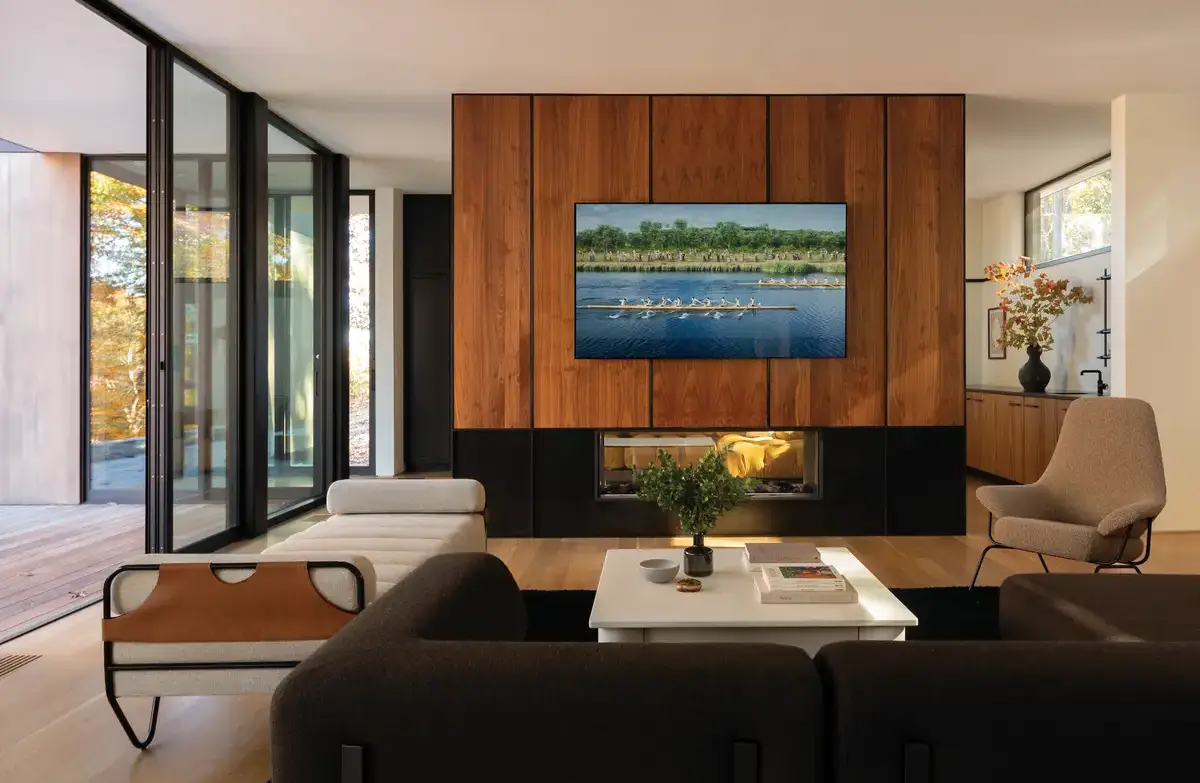
House in the Woods.
4

Open spaces (4 & 5) and intimate areas (5) alike are made calm and inviting by blurring the line between indoors and outside. Photos © Nicholas Venezia
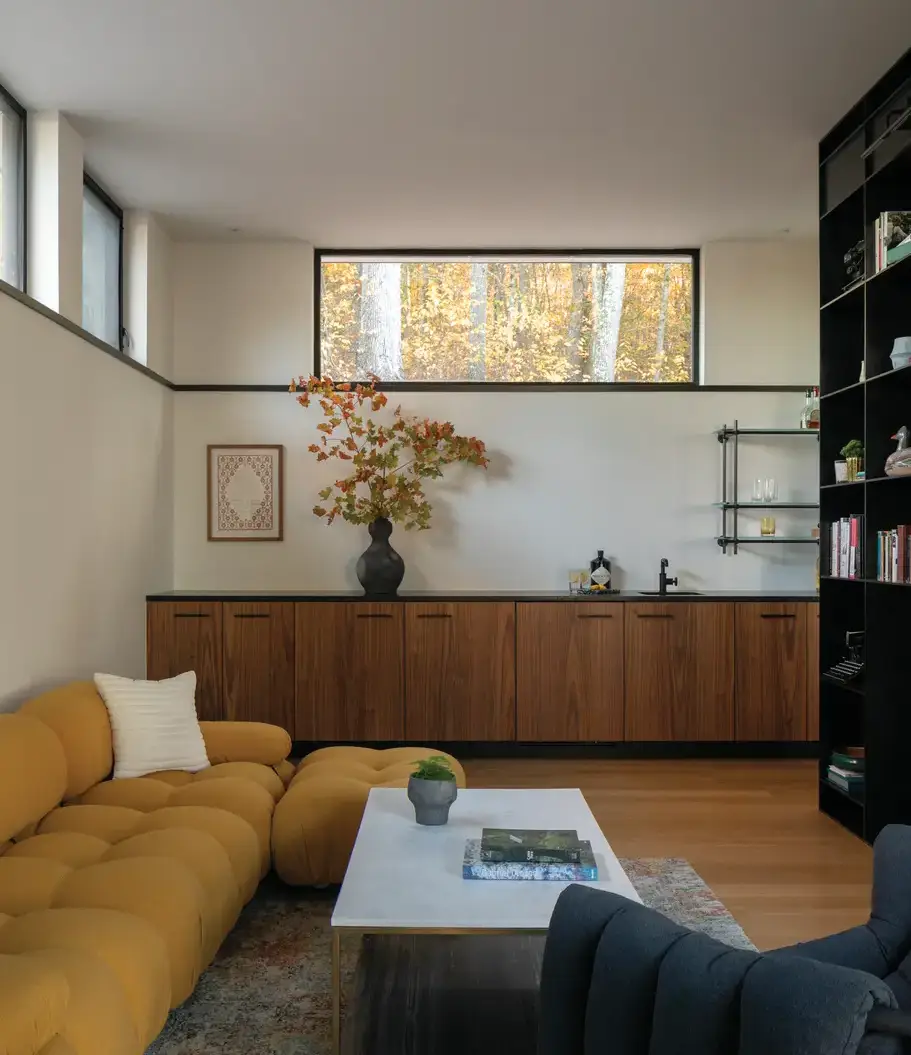
House in the Woods.
5

There’s a palpable tranquility in this mediation between the domestic and the natural. At the house, it’s easy to slow down and get lost in conversation—or in the landscape. Achieving this, though, was tough. Lontine had to negotiate a site that included challenges, from the preservation of as many of the large specimen trees as possible, per the clients’ wishes, to dealing with a ledge that required blasting and earthwork, which the architect had hoped to avoid. A backlog with a local concrete contractor delayed the start of construction, and pandemic-related supply chain issues held up delivery of windows and cabinetry. In the end, it took a year and a half to build House in the Woods.

“The more constraints I have, the better, because that really helps give me a starting point,” Lontine says. Still, he admits that “it got tough at the end,” not only for the architect trying to get his firm’s first project completed but for the owners eager to move into their new home. “But then, once their furniture was delivered and we were sitting at the dining table, right around peak fall, it was, OK—yeah, this is worth it.”

Click plan to enlarge
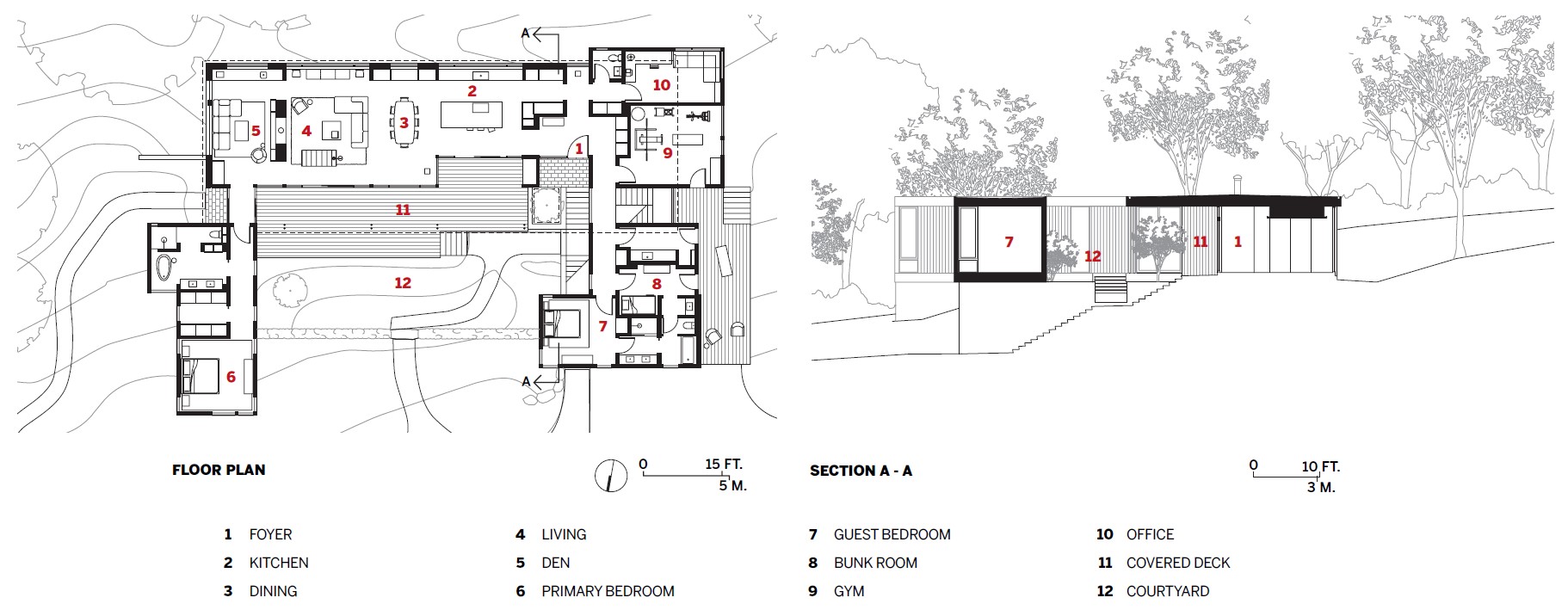
House in the Woods.
Back to Residential Architecture 2025

Credits

Architect:
Tom Lontine Architect

Engineer:
E2 Engineers

General Contractor:
Sapia Builders

Client:
Withheld

Size:
4,400 square feet

Cost:
Withheld

Completion Date:
December 2023


Sources

Rainscreen:
Exitera

Doors:
Arcadia

Chairs:
Hem

Kitchen System:
Space Theory

Plumbing:
Rohl, Kohler (bath fittings); Clarke Products, Duravit (tubs)

Lighting:
WAC (downlights and exterior); Bocci, RBW (decorative); Leviton (control)

Interior Finishing:
Nemo Tile (floor and wall tile); Emtek (lockset and pulls)

Security Devices:
Google Nest


Looking for quick answers on architecture and design topics?
Try Ask RECORD, our new smart AI search tool.
Ask RECORD →

KEYWORDS: Connecticut modern residential architecture modernism

Share This Story

Looking for a reprint of this article?
From high-res PDFs to custom plaques, order your copy today!

Dante ciampaglia

Dante A. Ciampaglia has two decades experience editing print and digital magazines, including at Newsweek, Sports Illustrated, and Time. He has been a contributor to Architectural Record for more than 10 years, writing about the intersection of architecture, film, and the visual arts. His work has also been published by the Washington Post, Paris Review, Wired, Los Angeles Review of Books, Metropolis, and the Brooklyn Rail, among others.

Post a comment to this article

Report Abusive Comment

Subscription Center
  • Create an Account
  • Start a Subscription
  • Manage My Account
  • Sign Up for Newsletters
  • Visit Customer Service
  • Update Preferences

More Videos

Sponsored Content

Sponsored Content is a special paid section where industry companies provide high quality, objective, non-commercial content around topics of interest to the Architectural Record audience. All Sponsored Content is supplied by the advertising company and any opinions expressed in this article are those of the author and not necessarily reflect the views of Architectural Record or its parent company, BNP Media. Interested in participating in our Sponsored Content section? Contact your local rep!

close
  • cold storage facility
    Sponsored byCarlisle SynTec Systems

    How Architects Can Design More Continuous Cold Storage Envelopes

  • TAMLYN XtremeTrim Exterior Trim
    Sponsored byTamlyn

    Designing Cleaner Panel Facades: Why Exterior Trim Details Matter

  • Building with Vapor Barriers
    Sponsored byReef Industries, Inc.

    Vapor Barriers Help Control Moisture in Tighter Building Designs

DESIGN:ED Podcast
Listen to Architectural Record’s DESIGN:ED Podcast

Events

June 23, 2026

Enhancing Fire Resistance with Advanced PVC Solutions

Credits: 1 AIA LU/HSW; 1 AIBD P-CE; 0.1 ICC CEU; 1 IIBEC CEH

Evaluate advanced PVC solutions that improve fire resistance, support WUI compliance, and enhance resilience in residential and commercial building design.

June 25, 2026

Designing Glass Railing Systems that Enhance Aesthetics and Meet Code

Credits: 1 AIA LU/HSW; 1 AIBD P-CE; 0.1 ICC CEU

Upon course completion, participants will possess a deeper understanding of glass railings to help ensure that safety, aesthetic, and performance objectives are achieved.

View All Submit An Event

Products

2026 Architect's Square Foot Costbook

2026 Architect's Square Foot Costbook

See More Products

Popular Stories

Lorcan O' Herilhy

California Architect Lorcan O’Herlihy Has Died, Age 66

Obama Presidential Center, Chicago

The Obama Presidential Center Opens on Chicago’s South Side

Spoonbill Ranch

Johnsen Schmaling Architects Integrates Spoonbill Ranch into a Pristine Landscape

West Village Penthouse

Design Vanguard 2026: Brent Buck Architects

Trinity University Business & Humanities District

AIA Announces 2026 COTE Top Ten Awardees

Enhancing Fire Resistance with Advanced PVC Solutions - Free Webinar - June 23, 2026

Related Articles

  • More (Mostly) Mid-Century Modernism in New Canaan

    See More
  • House of Monitors

    In Toronto, a House by Williamson Williamson Harnesses Light Monitors to Illuminate its Interiors

    See More
  • Thorne Residence

    Pittsburgh's Legacy of Heavy Industry Endures in a Rugged House by studio d'ARC

    See More

Related Products

See More Products
  • image7.jpg

    Contemporary Architecture in China Towards A Critical Pragmatism

See More Products
×

The latest news and information

#1 Source for Architectural Design, News and Products

SUBSCRIBE
  • RESOURCES
    • Advertise
    • Contact Us
    • Submit
    • Store
  • ACCOUNT CENTER
    • Create an Account
    • Start a Subscription
    • Manage My Account
    • Sign Up for Newsletters
    • Visit Customer Service
    • Update Preferences
  • PRIVACY
    • PRIVACY POLICY
    • TERMS & CONDITIONS
    • DO NOT SELL MY PERSONAL INFORMATION
    • PRIVACY REQUEST
    • ACCESSIBILITY
  • SERVICES
    • Marketing Services
    • Reprints
    • Market Research
    • List Rental
    • Survey/Respondent Access
  • STAY CONNECTED
    • Linkedin
    • Facebook
    • Instagram
    • YouTube
    • X (Twitter)

Copyright ©2026. All Rights Reserved BNP Media, Inc. and BNP Media II, LLC.

Design, CMS, Hosting & Web Development :: ePublishing