Multifamily Housing 2025
NOARQ’s HS Building in Portugal Embraces Architectural Honesty with Steel and Glass
Trofa, Portugal
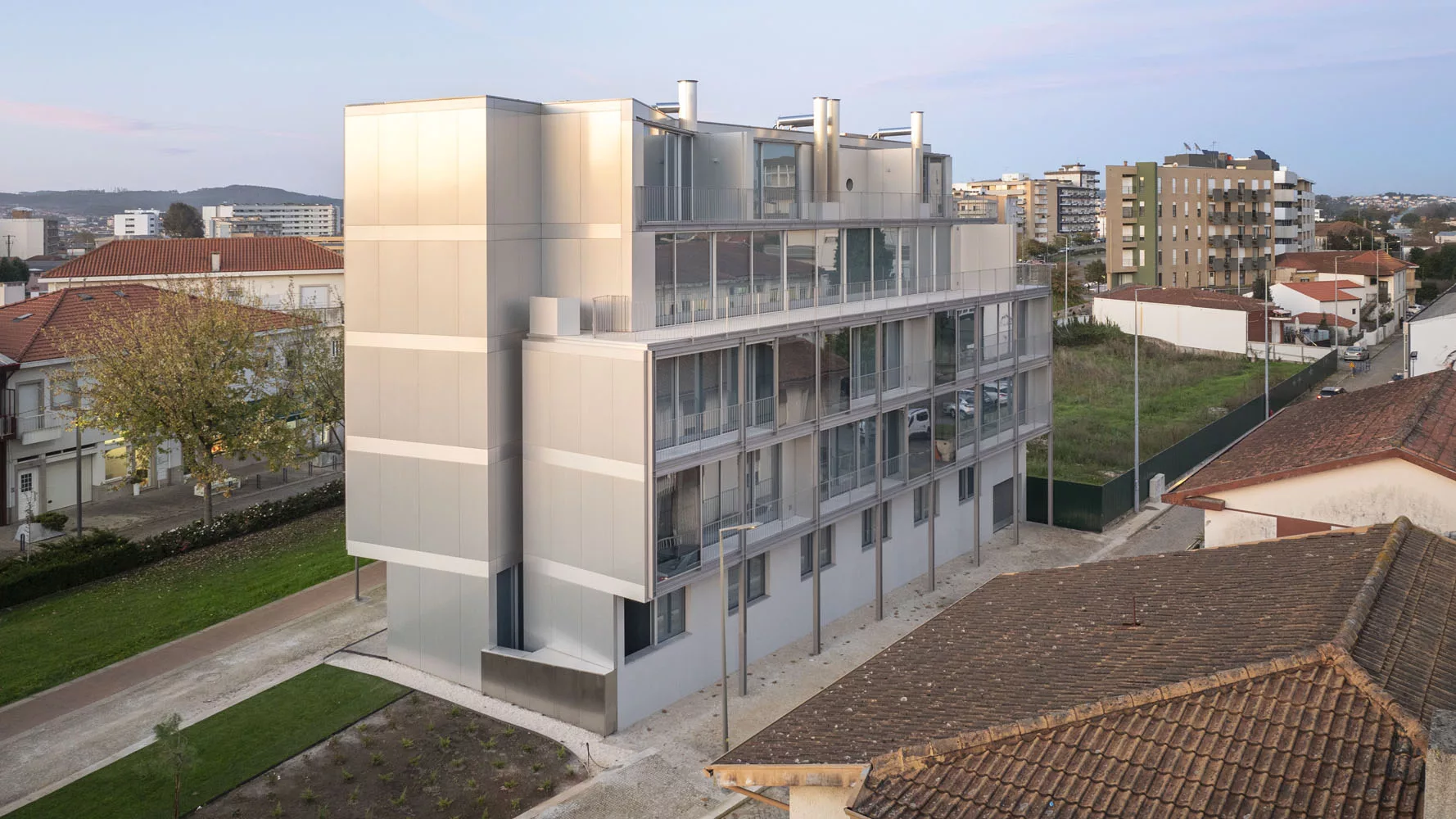
HS Building. Photo © Attilio Fiumarella
Architects & Firms
In an architectural era that embraces softened forms and subtle timber interventions, the HS Building apartment complex in Trofa, Portugal, is an anomaly. Designed by NOARQ, a Portuguese firm that relocated to Trofa from neighboring Porto in 2012, the striking edifice of steel and glass is both an eye-catching landmark and a symbol of the small industrial city’s aspirations for renewal and density. Rising five stories at the tip of an urban block along Alameda da Estação, now Trofa’s premier public boulevard, the 15-unit apartment building stands out amid a heterogeneous landscape of abandoned plots, single-family homes, and industrial facilities. The commission follows NOARQ's 2022 completion of a monumental black-brick-clad town hall for the municipality, further advancing the firm’s commitment to transforming Trofa into a cohesive urban environment with a distinct architectural identity.

Photo © Attilio Fiumarella
Located 15 miles northeast of Porto, Trofa began as a rural settlement in the 1700s but saw dramatic expansion following the arrival of railways in the late 19th century. It quickly became a manufacturing center for larger cities in its radius. “The city was not planned,” says NOARQ founder José Carlos Nunes de Oliveira. “Its urban structure is fragile and undefined.” By the end of the 20th century, however, the railway and road infrastructure that incited the city’s growth began suffocating its development. In 2010, the railway line was officially removed from the city center with the opening of a new station at the town’s periphery, creating the valuable vacant space that would become Alameda da Estação, and in 2017 the city christened an extensive urban park along the boulevard. The trapezoidal plot on which HS Building rests is part of this renewed urban landscape, where vertical growth and increased population density are actively encouraged.
The HS Building responds to its unique corner position with two distinct facades. The eastern elevation, facing Alameda da Estação, presents a taller, more regular composition that establishes a new visual benchmark for future development. Meanwhile, the western side, along Rua Serafim Lima, features a lower, more fragmented profile that adapts to the narrower street while also exposing the building’s mechanical systems—imagined not as a formal homage to high-tech aesthetics but as a straightforward acknowledgment of the project’s technical components. “This is an architectural response based on the truth of design,” de Oliveira says. He explains that the eastern elevation conforms to an urban planning regulation that requires a 45-degree setback relative to the buildings on the opposite side of the street, while the western elevation was a straightforward solution to the impossibility of integrating the vertical ventilation ducts within the building’s structure.

1

2
The eastern elevation (1) presents a taller, more regular composition, while the western side (2) exposes the building's mechanicals. Photos © Attilio Fiumarella
The choice of steel for the facade is particularly uncommon (and expensive) in Portugal, where concrete remains the dominant building material. The unusual request came from the project’s client, an industrial bakery owner accustomed to steel construction in his manufacturing facilities. “We rarely have the opportunity to build with steel due to the cost associated with the raw material and the need for more specialized labor,” says de Oliveira. “However, this was not just a financial operation for the client—he wanted to leave a mark on the city.” For the architect, who previously worked with Álvaro Siza, steel construction embodies qualities he associates with a return to the founding principles and unrealized potential of Modernism, namely freedom from ornamental excess and architecture that is “essential and self-sufficient.”


Steel is a particularly uncommon building material in Portugal. Photo © Attilio Fiumarella
Trofa’s population is mostly working class, and the HS development is aimed at lower-middle-class families. The 21,000-square-foot building houses a total of 15 apartments: two on the ground floor along with commercial space, five each on the second and third, with the three largest units taking up the fourth and fifth floors, which are successively receded to reduce the height of the street front—and allows for the creation of extensive terraces that capitalize on Trofa’s mild climate and views. The minimal interiors incorporate carefully selected materials: exposed concrete for outdoor pavements, microcement coating for bathrooms and kitchens, and solid eucalyptus wood flooring—"the cheapest wood in Portugal,” de Oliveira says—for social areas.


The top two floors are recessed, allowing for expansive terraces. Photos © Attilio Fiumarella
The technical sophistication of the HS Building goes beyond its use of structural steel. High-performance glass with low emissivity properties works in concert with solar protection systems to manage indoor thermal comfort, while aluminum and high-pressure laminate panels provide durable exterior cladding on blind elevations and installation shafts. These material choices reflect Oliveira’s belief that contemporary buildings should “embody intelligence and environmental maturity” and present themselves as products “committed to the major demands of their time.”


The minimal interiors incorporate carefully selected materials: exposed concrete for outdoor pavements, microcement coating for bathrooms and kitchens, and solid eucalyptus wood flooring for social areas. Photos © Attilio Fiumarella
Through the HS Building, NOARQ establishes a site-specific architectural ethos and material language that honors Trofa’s industrial heritage and contemporary aspirations. The project demonstrates that architectural truth—expressed through materials, structure, and form—can both respond to specific spatial challenges and spur broader urban renewal.
Click floor plan to enlarge

Looking for quick answers on architecture and design topics?
Try Ask RECORD, our new smart AI search tool.
Ask RECORD →
Looking for a reprint of this article?
From high-res PDFs to custom plaques, order your copy today!